
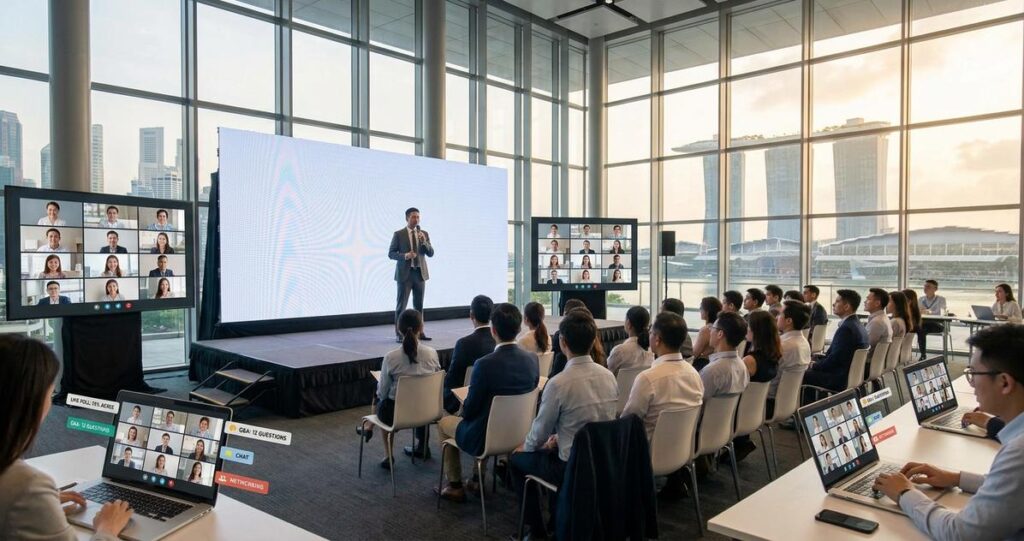
Hybrid events are now a practical reality for many organisations in Singapore, from trade associations and universities to multinational companies and government-linked entities. For delegates, the experience is no longer limited to sitting in a ballroom or watching a livestream. They may be in Marina Bay, Jurong, or logging in from home after work, yet they are expected to listen, contribute, network, and remember key messages. That makes engagement design one of the most important parts of hybrid event planning. When interactive tools are chosen well, they help bridge the gap between physical and virtual attendees. When they are chosen poorly, they can create confusion, delay, and a sense that one audience is always secondary to the other.
For Singapore audiences, the expectation for professionalism is high. Many attendees are accustomed to efficient digital services, clear instructions, and smooth mobile experiences. In a hybrid setting, this means organisers must think carefully about how delegates will ask questions, participate in polls, exchange contact details, and navigate the event without friction. Engagement is not just about adding technology for its own sake. It is about designing a participant journey that feels inclusive, accessible, and purposeful from start to finish.
Interactive tools can support this goal, but only when they are selected with a clear understanding of audience behaviour, event objectives, and technical constraints. Good design also respects attention span. In a hybrid event, people are easily distracted by notifications, work messages, or family responsibilities at home. Engagement tools should therefore make participation simple, intuitive, and meaningful, rather than adding another layer of complexity.
Why engagement design matters in hybrid events
Hybrid events combine two different attendance modes, and each mode has distinct needs. In-person delegates benefit from immediacy, social cues, and spontaneous conversation. Virtual delegates need visibility, interaction, and structured opportunities to contribute. If an organiser treats the online audience as passive viewers, engagement drops quickly. If the event forces both audiences into the same interaction pattern without considering context, neither group gets a good experience.
In Singapore, this challenge is especially relevant because hybrid formats are often used for regional leadership meetings, professional continuing education, industry briefings, and cross-border conferences. These events commonly include people joining from different time zones, different device types, and different levels of digital comfort. A younger delegate may expect mobile-first engagement, while an older executive may prefer simpler navigation and fewer platform changes. A successful format has to accommodate both without making the event feel fragmented.
Engagement also affects learning and retention. In professional events, delegates often attend to understand policy updates, technical developments, market trends, or best practices. Research in learning and communication consistently shows that active participation supports attention and recall better than passive listening alone. In practical terms, a well-designed poll, moderated Q and A, or collaborative exercise can help delegates process information more effectively than a long one-way presentation.
What hybrid delegates usually need
Hybrid delegates generally need three things, clear access, meaningful participation, and a sense of connection. Clear access means the event platform should be easy to join, use, and revisit. Meaningful participation means attendees should be able to do more than watch, they should be able to vote, comment, submit questions, or join breakouts. Connection means both audiences should feel that their presence matters and that the event has been designed for them, not merely streamed at them.
These needs are not limited to technology. They also involve timing, moderation, visual design, and communication. For example, a question submitted by a virtual attendee should not disappear into a separate queue that nobody monitors. A polling result should be visible to both audiences at the same time. A networking feature should be introduced with enough guidance that delegates know how to use it quickly. Engagement design is a service process, not just a software choice.
Interactive tools that work well for hybrid delegates
The best interactive tools are those that support the event objective without distracting from the content. A leadership announcement, technical symposium, product showcase, or medical education programme may all need different interaction patterns. The key is to match the tool to the purpose. Overloading the agenda with too many features can make the event feel disjointed.
Live polling and instant feedback
Live polling is one of the most reliable tools for hybrid engagement. It works well when organisers want to test understanding, gather opinions, or guide discussion. Polls can be used at the start of a session to warm up the audience, in the middle to reset attention, or at the end to reinforce key points. For hybrid audiences, polls should appear on both the in-room screens and the virtual platform so that everyone contributes at the same moment.
Good poll design matters. Questions should be short, specific, and relevant to the session. Avoid asking too many questions in a row, because response fatigue reduces participation. In Singapore, where many delegates are familiar with digital work tools, clear interface design and quick response flow are especially important. A poll that takes too long to load or requires multiple steps will lose attention fast.
Moderated Q and A
Q and A is often the most valued engagement feature, but it needs strong moderation to work well in hybrid settings. A good moderator filters repetitive questions, balances input from the room and the online audience, and helps speakers answer concisely. Without moderation, the loudest participants can dominate, while remote attendees may feel ignored.
For events with a Singapore audience, moderation should also account for communication style. Some participants prefer to type questions privately rather than speak publicly. Others may feel more comfortable submitting a question through an event app than using a microphone in the room. Giving multiple pathways for questions usually improves participation. The moderation team should also watch for timing. If a session is tightly packed, the speaker should be briefed in advance on whether questions will be taken live, at the end, or through a post-session follow-up process.
Chat, reactions, and facilitator prompts
Chat functions can create a sense of shared presence, especially for virtual delegates. Simple prompts such as “type your city,” “share one takeaway,” or “post one question” can make an online audience feel visible. Reaction tools, such as thumbs up or applause, are useful for quick feedback, but they should not replace substantive participation. They work best when paired with a moderator who acknowledges comments and keeps the discussion moving.
Chat should be actively managed. If it is left unattended, it becomes either chaotic or silent, both of which reduce value. A facilitator can highlight good comments, steer participants back to the topic, and collect themes for the speaker. For Singapore-based events with multinational audiences, chat can also help bridge accents, presentation styles, and technical jargon by allowing written clarification in real time.
Breakout rooms and small-group interaction
Breakout rooms are useful when the goal is discussion, brainstorming, training, or relationship building. They work best in workshops or strategy sessions rather than in large keynote programmes. In a hybrid format, breakouts require more planning because physical and virtual participants need an equitable experience. If the in-room table group can discuss freely while the online group sits quietly, the design is unbalanced.
Organisers should assign clear tasks, provide a time limit, and give each group a way to report back. A digital worksheet or shared note board can help keep hybrid breakout discussions focused. In Singapore’s corporate environment, where meetings often have tight schedules, breakout tasks should be concise and directly linked to the event outcome. Participants are more engaged when they can see that the activity has a real purpose.
Networking and matchmaking tools
Networking remains one of the strongest reasons people attend events. Hybrid formats can support networking through appointment scheduling, interest-based matchmaking, and contact exchange features. For delegates, this may mean meeting a speaker after a session, connecting with peers in the same industry, or finding potential partners based on shared interests.
These tools are especially useful in Singapore, where events often bring together local decision-makers and regional visitors. A digital networking tool can reduce the awkwardness of open networking and make it easier for people to connect with relevant contacts. To be effective, the profile fields should be concise and privacy settings should be clear. Too much data entry discourages use, while unclear consent settings can create trust issues.
Design principles that improve participation
Technology alone does not create engagement. The experience depends on how the tools are integrated into the overall event design. Delegates are more likely to participate when the process feels simple, predictable, and relevant to their goals. This is why planning should begin with audience behaviour, not software features.
Keep the interface simple
Hybrid delegates should not have to guess where to click, when to speak, or how to join an interaction. Use a platform with a clean layout and minimal steps. If an event app is required, explain how to use it before the programme starts. For live events in Singapore, a short pre-event email with screenshots or a simple one-page guide can reduce friction significantly. The same principle applies onsite, where QR codes, signage, and staff support should be easy to find.
Simplicity also helps older attendees and those less familiar with event platforms. Clear labels, large enough text, and straightforward navigation support accessibility. If delegates can participate within seconds, they are far more likely to stay engaged throughout the session.
Design for both audiences at once
A common mistake is to design the event primarily for the room and then stream it online as an afterthought. Hybrid engagement works better when both audiences are planned for from the start. This means cameras should capture more than just the speaker, audio should be clear for remote listeners, and interaction windows should include both groups. A moderator should watch both channels and ensure no one is excluded from the conversation.
Visual design matters here too. Poll results, question prompts, and key instructions should be readable on stage screens and on mobile devices. If a feature is only visible to one audience, it creates a split experience. The strongest hybrid events make both audiences feel like part of the same room.
Use pacing to sustain attention
Attention in hybrid settings rises and falls quickly. Sessions that run too long without interaction usually lose both in-room and remote participants. A practical rule is to vary the format regularly, for example, presentation, poll, discussion, then Q and A. Short content blocks with clear transitions help the audience stay mentally engaged.
This is particularly important for Singapore professionals who may attend events between work commitments. Delegates often value efficiency. They appreciate sessions that are well-paced, tightly moderated, and respectful of time. When organisers build in opportunities to respond, reflect, or ask a question, the audience is more likely to remain attentive.
Singapore considerations for hybrid engagement design
Singapore’s event environment places a premium on reliability, clarity, and privacy. Many venues offer strong connectivity, but technical success still depends on proper testing, backup planning, and on-site support. If a delegate cannot hear a speaker clearly or cannot access the interactive tool, the engagement strategy fails regardless of how well it was designed.
Data protection is another important consideration. When using event apps, registration systems, or networking tools, organisers should collect only the data they need and explain how it will be used. This aligns with the expectations created by Singapore’s Personal Data Protection Act, which requires organisations to handle personal data responsibly. Delegates are more likely to engage when they trust that their information is being managed properly.
Accessibility should also be part of the planning process. Use readable fonts, strong colour contrast, and captions where possible for virtual content. Clear language helps multilingual audiences, even when English is the working language of the event. For many Singapore delegates, a polished experience signals respect for their time and attention.
Finally, timing matters. Singapore events often involve regional and international participants, so organisers should think about whether the interaction format works across different time zones and energy levels. A live poll that is open for a short window may work for a local audience, but a longer response period may be better for regional delegates joining from different locations. The right design depends on the audience mix.
Hybrid delegate engagement is most effective when it is intentional, inclusive, and easy to use. The strongest events use interactive tools to support real participation, not as decorative add-ons. Live polling, moderated Q and A, chat prompts, breakout discussions, and networking features each have a role, but they need thoughtful moderation and careful timing. Organisers in Singapore should focus on clarity, accessibility, and trust, because those are the qualities that make delegates feel respected and willing to participate.
For event planners, the practical takeaway is simple. Start by defining the outcome you want, then choose the interaction tools that genuinely support that outcome. Test the platform well in advance, brief speakers and moderators thoroughly, and make sure both in-room and virtual participants have equal opportunities to engage. When these elements come together, the hybrid event becomes more than a broadcast. It becomes a shared experience that is structured, responsive, and professionally delivered.
General information only, not a substitute for legal, technical, or professional event advice tailored to a specific programme or organisation.

Jeremy Lee is a seasoned digital marketing director and strategist with over two decades of experience in the industry. As the founder of Sotavento Medios, I manage a diverse portfolio of over 50 businesses, helping brands grow through advanced search strategies and digital innovation. My work focuses on bridging the gap between traditional search engine optimisation and the evolving world of AI-driven answer engines.
get in touch