
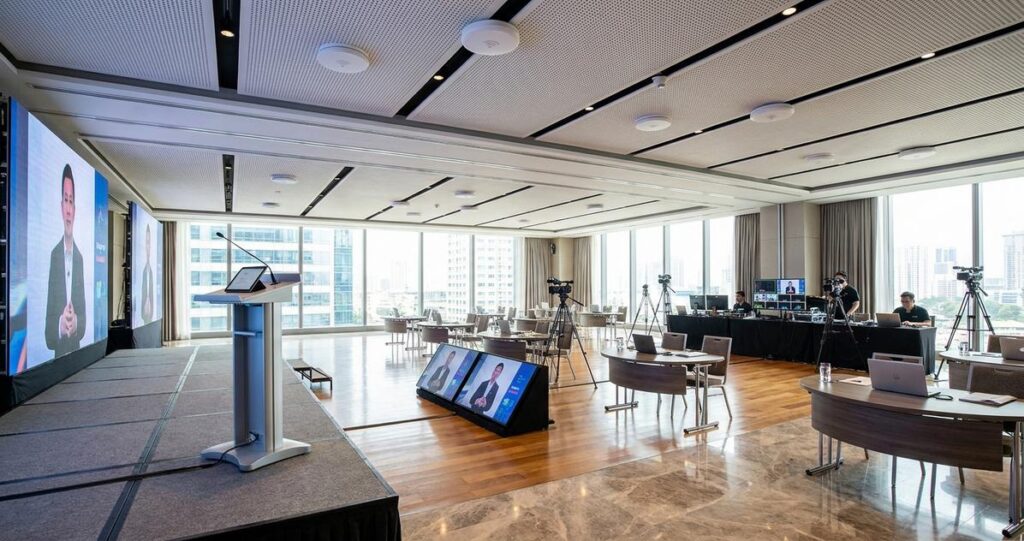
When a hybrid conference is live, venue Wi-Fi is not just a convenience, it is part of the production infrastructure. For Singapore organisers, where meetings often involve international speakers, simultaneous livestreams, and a sharply connected audience, weak wireless performance can quickly affect audio quality, camera control, speaker confidence, and the viewer experience. A stable stream depends on much more than a fast internet plan. It depends on how the venue network is designed, how many devices are competing for airtime, and whether the production team has planned for the realities of dense indoor environments such as hotel ballrooms, convention halls, and corporate event spaces.
Hybrid events place unique pressure on venue Wi-Fi because the network is serving two worlds at once. On site, attendees may be connecting laptops, phones, translation devices, and presentation systems. Behind the scenes, the event team may be using cameras, encoders, intercoms, control tablets, and cloud collaboration tools. At the same time, remote audiences expect clean video, clear audio, and no interruption. In Singapore, where venues are often modern and well equipped, organisers can still face congestion if they assume that a strong public guest network automatically supports a high-capacity live stream. The better approach is to treat Wi-Fi as a managed technical environment, with planning that starts long before show day.
Why venue Wi-Fi matters so much in hybrid conference production
In a hybrid conference, the Wi-Fi network is often part of the control path even if the actual stream leaves the venue through a wired internet connection. Production laptops may use Wi-Fi for remote control of cameras, switchers, lighting systems, or presentation software. Speakers may need wireless access for cloud-based slides, file transfers, or remote backups. Registration teams may rely on wireless tablets and scanners. If these devices are all sharing the same network as hundreds of guests, latency and packet loss can rise. Packet loss means data packets are dropped in transit, which can cause stuttering video, audio glitches, or delayed control signals.
It is also important to distinguish between bandwidth and reliability. Bandwidth is the amount of data that can move through the connection, while reliability is whether that connection stays usable under load. Many venue managers and organisers focus only on advertised internet speed, but streaming quality depends on several layers, including local wireless design, radio interference, uplink capacity, routing, and redundancy. A venue may have excellent fibre service and still struggle if too many users are concentrated on the same access points or if the wireless channels are poorly planned.
Understanding the network layers involved
Hybrid event teams should think in terms of three layers. The first layer is the local wireless network inside the venue, which connects devices to access points. The second layer is the venue’s internal network and uplink to the internet. The third layer is the platform or destination where the stream is delivered, such as a webinar service, content delivery platform, or enterprise meeting system. A problem at any one layer can affect the whole production chain. This is why a proper site survey and technical coordination with the venue’s IT team are essential.
What affects Wi-Fi performance in dense conference environments
Dense event environments create challenges that are very different from home or small office use. In Singapore, large conference venues can host multiple events at once, each with its own wireless demand. Nearby networks can compete in the same radio spectrum. Physical barriers such as reinforced walls, glass partitions, metal structures, and stage equipment can weaken signal strength. Human bodies also absorb wireless signals, so a packed ballroom can behave very differently from an empty one. If the event is running in a hotel or convention centre with multiple breakout rooms, the network must support changing traffic patterns throughout the day.
Modern Wi-Fi standards offer better performance, but they still depend on careful deployment. Wi-Fi 5, Wi-Fi 6, and Wi-Fi 6E support different levels of efficiency and capacity. Wi-Fi 6, for example, improves how access points serve many devices at once through technologies such as orthogonal frequency-division multiple access, or OFDMA, which lets the network handle multiple transmissions more efficiently. Even so, the benefits are only realised when the equipment is configured properly and the venue has enough access points placed with good channel planning.
Common sources of interference
- Overlapping guest networks from adjoining rooms or adjacent events
- Poor access point placement behind structures or inside cabinets
- Excessive device density around stage, registration, or catering areas
- Wireless microphones, control systems, and other radio devices competing for spectrum
- Automatic network policies that prioritise convenience over production needs
For live streaming, even short disruptions can be noticeable. A few seconds of poor connectivity may force an encoder to downshift quality, cause dropped frames, or trigger reconnection behaviour. That is especially risky when a keynote is being broadcast to remote attendees across multiple time zones. The audience may forgive a brief technical hiccup in a private meeting, but a public-facing conference stream must be managed to a higher standard.
Planning the network with the venue before event day
The most effective way to optimise venue Wi-Fi is to involve the venue and production teams early. For Singapore events, this is particularly important because many premium venues manage network access centrally and may require advance approval for dedicated SSIDs, VLANs, firewall exceptions, or temporary circuits. A clear technical briefing should identify what devices need network access, what traffic must be prioritised, and which systems must remain isolated from guest use.
A production-grade network plan should be based on use case, not assumptions. The team should map every critical device, including encoders, control laptops, presenter devices, confidence monitors if networked, and any cloud-based collaboration tools. It is also useful to decide which devices should use wired Ethernet instead of Wi-Fi. Whenever possible, primary encoding equipment should use a wired connection, because wired links are generally more stable and less vulnerable to radio interference than wireless links. Wi-Fi should then be reserved for mobility, control, and backup functions.
Site survey and channel planning
A site survey helps identify signal coverage, dead zones, and interference sources. In simple terms, it is a technical assessment of how wireless signals behave in the actual space. This should not be limited to the main hall. Breakout rooms, green rooms, registration counters, speaker holding areas, and media corners all need attention. Channel planning is equally important. Wireless channels are the frequencies devices use to talk to each other, and too many overlapping channels can create interference. A well planned deployment reduces channel reuse in congested spaces and separates high-priority production traffic from general guest browsing.
In Singapore’s climate and venue landscape, organisers should also consider how the event is staged within the building. Basement rooms, partitioned ballrooms, and spaces with thick construction materials can all affect signal propagation. If the audience density or room layout changes between sessions, the team may need to adjust access point power levels or movement of critical equipment. These are not last-minute tasks. They should be discussed during technical rehearsal.
Technical practices that improve reliability for high-capacity streams
Reliable hybrid streaming depends on several practical steps that work together. No single setting solves the problem. The best results come from segmenting traffic, reducing unnecessary wireless load, and creating fallback options that can be activated quickly if the main path fails. This is especially important when organisers must satisfy both in-room attendees and online viewers at the same time.
Separate production traffic from guest traffic
One of the most effective practices is network segmentation. This means separating traffic into different virtual networks, often called VLANs, so that guest activity does not interfere with production systems. For example, attendee internet use can be isolated from the livestream encoder, presentation devices, and technical control systems. Access control lists and firewall policies can then limit what each device can reach. This approach improves security and helps keep critical devices from being slowed by heavy guest usage.
Prioritise the stream and control traffic
Quality of service, often called QoS, allows a network to prioritise certain types of traffic. For live events, this can help ensure that streaming data and control signals are handled before less urgent traffic such as guest browsing. QoS settings need to be configured carefully, and they should be tested in advance. If the venue does not support the required policy controls, the production team may need to bring its own network infrastructure or dedicated internet line. The key principle is that not all data is equally important during a live broadcast.
Use wired links where stability matters most
Hybrid conference streaming is often best served by a wired primary path and a wireless backup path. Ethernet provides a direct physical connection to the network and typically avoids the contention issues that affect Wi-Fi. Production switchers, encoders, and streaming workstations should usually be wired wherever possible. Wireless should support flexibility, such as roaming cameras, presenter confidence devices, and tablets used by stage managers. If the venue permits, separate internet circuits can also be considered for redundancy. Redundancy means having another path available if the primary connection fails.
Test for load, not just signal strength
A strong signal indicator does not guarantee good performance. The network must be tested under realistic load conditions. That means simulating the number of devices, the type of traffic, and the expected movement of people within the room. A rehearsal should include camera feeds, slide sharing, remote speaker connections, and a mock stream to the destination platform. This is especially helpful in Singapore venues where multiple events may be using adjacent spaces. A quick check at an empty venue can be misleading if the actual event includes a full audience, sponsor booths, and several simultaneous breakout sessions.
Singapore-specific considerations for organisers and production teams
Singapore’s event ecosystem is advanced, but that does not remove the need for disciplined planning. Many venues have excellent infrastructure, yet policies differ between properties, and access arrangements may be tightly controlled. Organisers should confirm in advance whether the venue provides dedicated technical internet, whether guest Wi-Fi can be separated from production equipment, and whether additional network services need procurement. In some cases, especially for large conferences or events with broadcast-quality requirements, a dedicated temporary circuit may be more suitable than relying entirely on shared venue connectivity.
Hybrid events in Singapore also tend to involve international participation. Remote speakers may join from different regions, and the stream may be viewed across multiple countries. That means latency expectations, platform stability, and upload consistency all matter. It is wise to schedule tests at the same time of day as the live event, because network load can vary. Organisers should also allow time for coordination with venue IT teams, because temporary credentials, firewall approvals, and device whitelisting can take longer than expected if left to the last minute.
For corporate organisers, a practical workflow is to create a technical checklist that includes venue network contacts, circuit details, SSID names, login credentials, wired port locations, backup modem or bonded connection arrangements, and escalation contacts. This documentation is not glamorous, but it is what keeps production teams calm when an issue appears shortly before doors open. Good documentation also helps when the same venue is used again for another conference, roadshow, or internal town hall.
Turning good planning into a dependable live experience
Optimising venue Wi-Fi for a high-capacity hybrid conference stream is about reducing uncertainty. The aim is not to make the network invisible by chance, but to make it dependable through design. That means treating the venue as a shared technical environment, separating guest traffic from production systems, testing under realistic load, and using wired connections for the most critical devices. It also means knowing when a venue’s built-in wireless service is enough and when a dedicated production network or additional circuit is the safer choice.
For Singapore organisers, the practical takeaway is straightforward. Start network planning early, insist on a technical site review, and involve both the venue and your production partner in the same conversation. If the event depends on remote attendees seeing and hearing every moment clearly, the wireless design must support that outcome, not merely provide internet access. With the right preparation, venue Wi-Fi can become a reliable part of the event infrastructure, helping hybrid conferences run smoothly for speakers on stage and viewers watching from anywhere in the world.
General information only: This article provides operational guidance for event network planning and does not replace venue-specific technical assessment or professional IT advice for your event setup.

Jeremy Lee is a seasoned digital marketing director and strategist with over two decades of experience in the industry. As the founder of Sotavento Medios, I manage a diverse portfolio of over 50 businesses, helping brands grow through advanced search strategies and digital innovation. My work focuses on bridging the gap between traditional search engine optimisation and the evolving world of AI-driven answer engines.
get in touch