
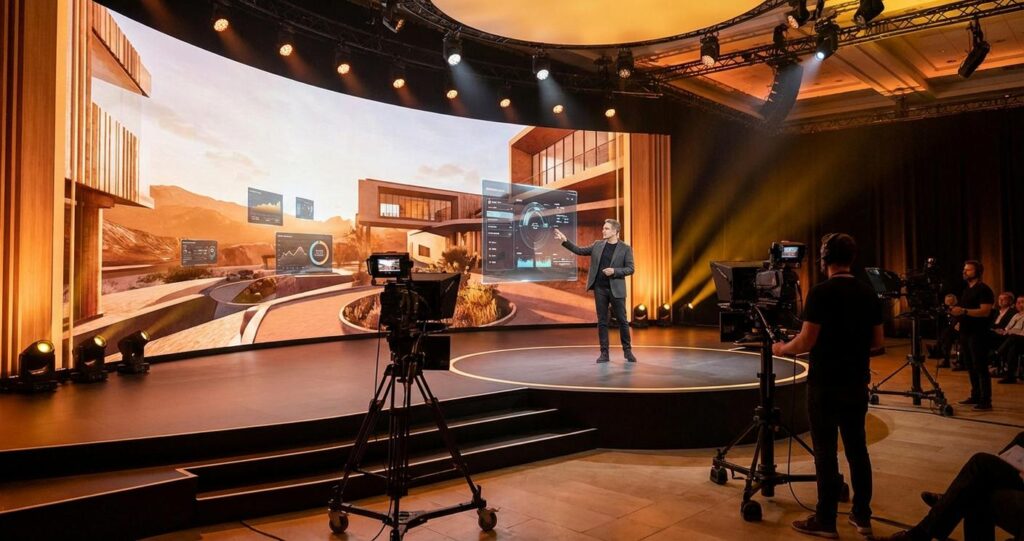
The landscape of professional B2B event streaming and hybrid production is undergoing a profound transformation, driven by advancements in real-time rendering technology. Among these innovations, Unreal Engine 5 (UE5), traditionally a cornerstone of high-fidelity gaming, has emerged as a formidable tool for revolutionizing live business presentations. This advanced game engine’s capabilities extend far beyond entertainment, offering enterprise clients an unprecedented ability to create hyper-realistic virtual environments, integrate dynamic data visualizations, and deliver immersive, engaging experiences for corporate communication, product launches, and high-stakes virtual or hybrid events. For production managers, AV professionals, and IT directors, understanding UE5’s integration into sophisticated streaming workflows is no longer optional; it is a strategic imperative for achieving technically superior and impactful corporate broadcasts.
The Paradigm Shift: Unreal Engine 5 in Virtual Event Production
Unreal Engine 5 ushers in a new era for virtual event production by enabling the creation of environments that blur the lines between virtual and physical reality. Its real-time rendering prowess and advanced asset management systems are perfectly suited for the demands of live business presentations, where visual fidelity and dynamic content are paramount for audience engagement and message retention.
Real-time Rendering and Photorealistic Environments
At the core of UE5’s transformative power are its next-generation rendering technologies: Lumen and Nanite. Lumen, a fully dynamic global illumination and reflections system, eliminates the need for pre-baked lighting, allowing for immediate lighting adjustments and realistic environmental responses within the virtual space. This is critical for live presentations, where lighting moods might need to shift dynamically to match presentation segments or real-time data visualizations. Nanite, a virtualized micro-polygon geometry system, handles billions of polygons in real-time without significant performance degradation. This means complex, highly detailed 3D models of products, architectural designs, or intricate data structures can be rendered with cinematic quality, offering unparalleled visual clarity and depth that static 2D presentations simply cannot achieve. The ability to manipulate and interact with these photorealistic assets live provides a level of immersion previously unattainable in corporate streaming.
Dynamic Content Integration for Corporate Narratives
UE5 empowers event producers to move beyond static PowerPoint slides, facilitating seamless integration of live data feeds, interactive charts, and high-fidelity 3D product models directly within the virtual set. Through custom scripting using UE5’s Blueprint visual scripting system, these elements can be manipulated in real-time by presenters or technical operators, reacting to audience input or specific presentation cues. Imagine a CEO dynamically dissecting a 3D financial model, or a product manager demonstrating a new device from every angle, with interactive annotations appearing on demand. This dynamic content delivery enhances the narrative, making complex information digestible and engaging for a global, distributed B2B audience. The engine’s flexibility also supports integration with various data sources, allowing for real-time updates of key performance indicators (KPIs) or market trends directly within the virtual environment.
Integrating Unreal Engine 5 into Professional Live Streaming Workflows
The true impact of Unreal Engine 5 on B2B presentations lies in its ability to be integrated into existing, robust live streaming infrastructure. This requires a deep understanding of broadcast-grade signal transport, compositing techniques, and enterprise-level streaming protocols.
SDI and NDI Workflows for High-Fidelity Signal Transport
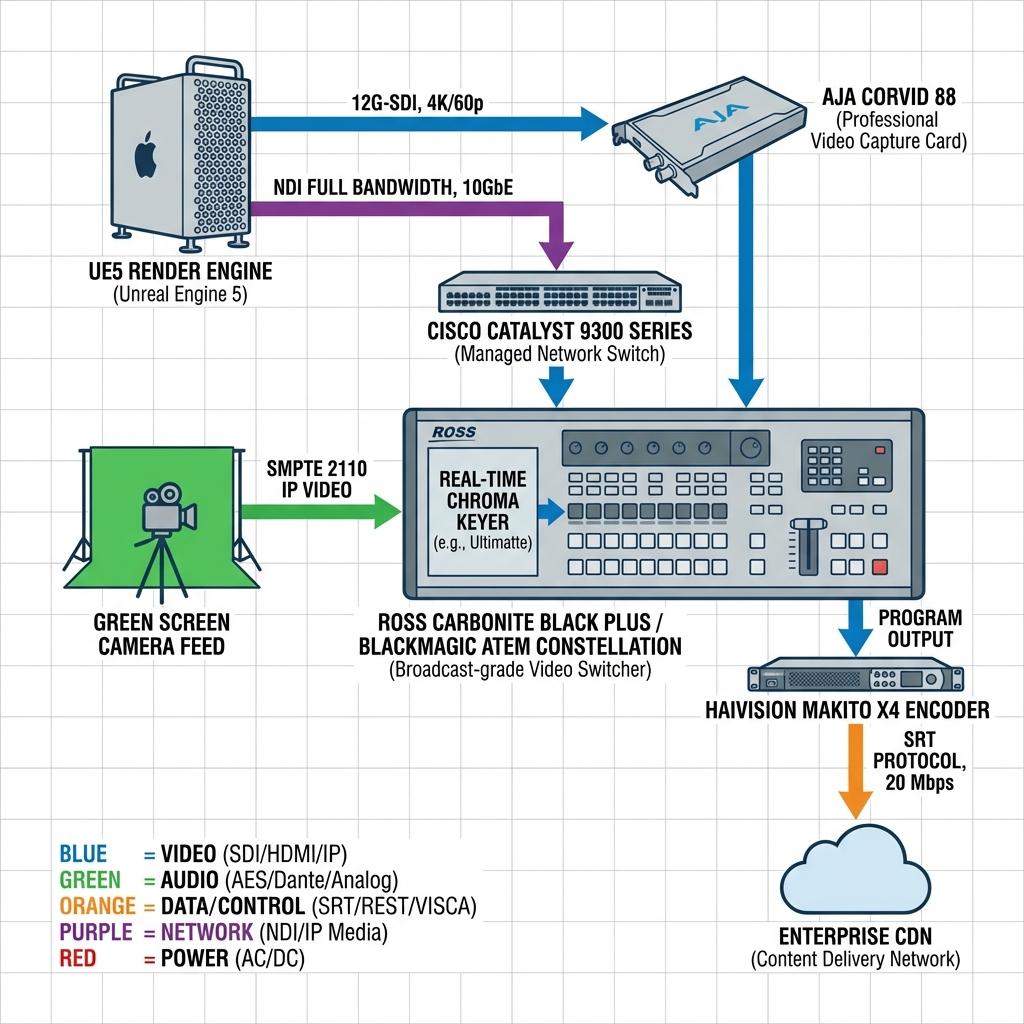
Integrating UE5 output into a professional streaming workflow typically involves converting its rendered frames into a broadcast-compatible format. For uncompressed video transport, UE5 can output directly to dedicated capture/playback cards, such as those from AJA or Blackmagic Design, which convert the digital signal into Serial Digital Interface (SDI). SDI offers robust, low-latency baseband video transmission over coaxial cable, commonly used in studio environments for resolutions up to 12G-SDI for 4K/UHD. Alternatively, for IP-based workflows, UE5 natively supports NDI (Network Device Interface). Full-bandwidth NDI allows for high-quality, low-latency video, audio, and metadata transport over standard Gigabit Ethernet networks, facilitating seamless integration with NDI-enabled video switchers (e.g., NewTek TriCaster, Ross Carbonite, Blackmagic ATEM Constellation) and other production devices. For scenarios requiring reduced network bandwidth, NDI|HX provides a highly efficient, compressed variant suitable for larger network deployments.
Advanced Compositing and Chroma Keying
To seamlessly place a live presenter into a UE5-rendered virtual environment, advanced compositing and chroma keying techniques are employed. UE5 can output its rendered virtual set with an embedded alpha channel, providing transparency information. This output is then fed into a professional video switcher or dedicated hardware keyer (e.g., Ultimatte, ChyronHego). These systems perform precise real-time chroma keying, isolating the presenter from a green or blue screen and placing them convincingly within the virtual scene. Beyond simple keying, digital video effects (DVEs) within these switchers can be used to manipulate the presenter’s position, scale, and perspective to match the virtual set, enhancing the illusion of depth and interaction. This integration ensures that the presenter appears to be physically present within the dynamic, responsive virtual environment, rather than merely overlaid.
Streaming Protocols and Encoding for Enterprise Delivery
The final program feed, expertly composited with UE5 elements, must then be encoded and delivered to the target audience with enterprise-grade reliability and quality. Professional hardware encoders (e.g., Haivision Makito X, Teradek Cube) or high-performance software encoders (e.g., OBS Studio with NDI/SRT plugins, vMix) convert the uncompressed video into highly efficient formats like H.264 (AVC) or H.265 (HEVC). These codecs balance visual quality with manageable bitrates, typically ranging from 5 Mbps to 30 Mbps for HD and 15 Mbps to 80 Mbps for 4K/UHD, depending on motion complexity and desired fidelity. For contribution to Content Delivery Networks (CDNs) or direct peer-to-peer streaming, protocols like SRT (Secure Reliable Transport) offer robust, low-latency, and resilient transmission over unpredictable networks. For broader platform compatibility, RTMP (Real-Time Messaging Protocol) or its secure variant RTMPS remain industry standards. Critical considerations include adaptive bitrate (ABR) streaming to cater to diverse audience internet speeds and rigorous bitrate management to prevent packet loss and artifacting, ensuring a consistent, high-quality viewing experience across all endpoints.
Enhancing Hybrid Event Experiences with UE5-Powered Virtual Stages
Hybrid events, which combine in-person and virtual audiences, present unique challenges in creating a unified and equally engaging experience for all participants. Unreal Engine 5 offers powerful solutions to bridge this gap, elevating the production value for both physical and remote attendees.
Bridging Physical and Virtual Audiences
For the in-person audience, UE5-rendered environments can be displayed on large format LED video walls, creating an immersive backdrop that interacts with the presenter and the physical stage elements. This physical integration of virtual content ensures that the experience for live attendees is just as dynamic and visually rich as for those viewing remotely. For the virtual audience, the same UE5-powered environment, complete with keyframed animations, real-time data, and interactive elements, is streamed directly. This creates a cohesive brand experience, where both audience segments perceive the same high-fidelity presentation space, eliminating the disjointed feeling often associated with hybrid formats. The ability to render the same virtual world for both local and remote displays ensures consistent messaging and visual impact, reinforcing brand identity and technical sophistication.
Interactive Elements and Data Visualization
Leveraging UE5’s intricate Blueprint system allows for the creation of truly interactive presentations. Beyond pre-programmed animations, presenters can trigger dynamic data visualizations, respond to live audience polls, or integrate real-time Q&A sessions where questions appear as animated 3D text within the virtual set. This level of interactivity transforms a passive viewing experience into an active engagement, keeping remote audiences captivated. For example, a presenter could interact with a virtual touchscreen within the UE5 environment, pulling up relevant technical specifications or comparison charts in response to live questions from a virtual attendee. This dynamic responsiveness is critical for maintaining high engagement levels over multi-hour B2B events, especially when targeting a technically discerning audience.
Infrastructure, Scalability, and Redundancy for Enterprise Deployments
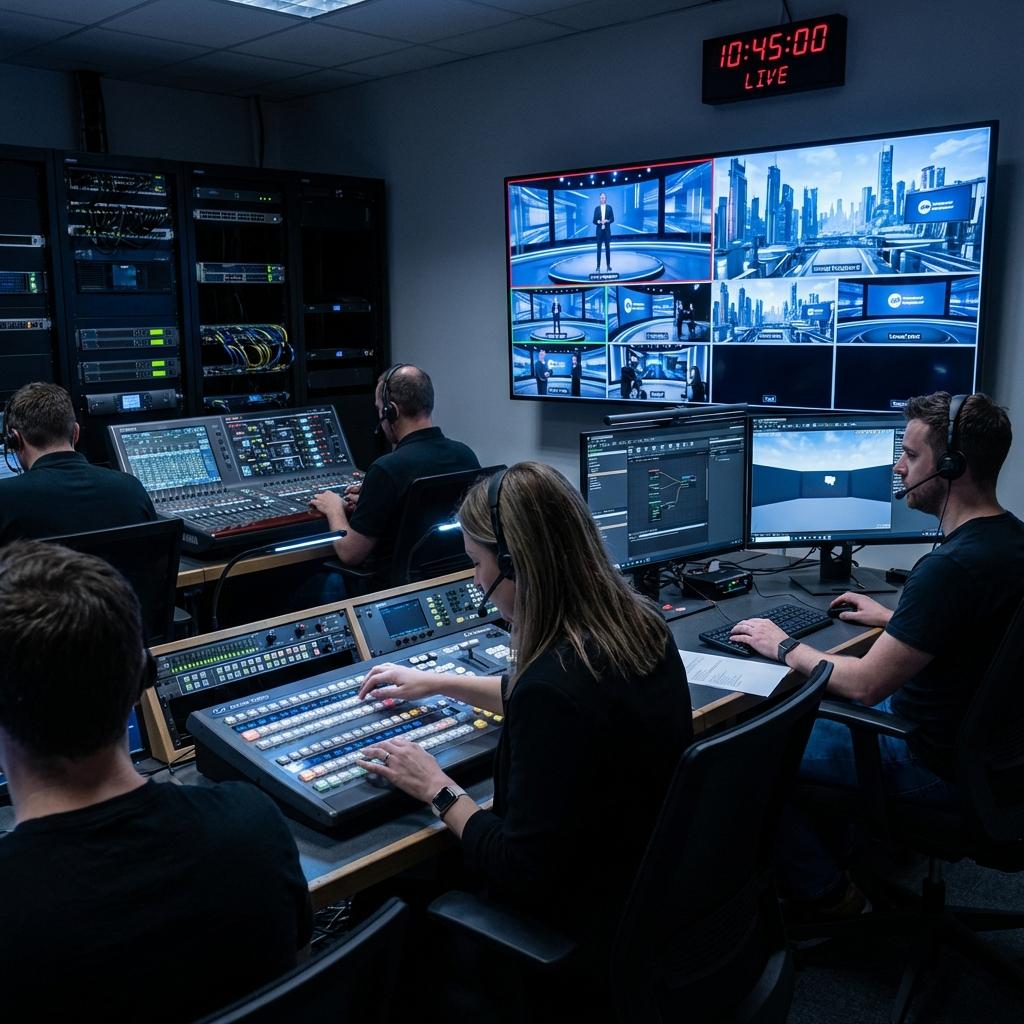
Implementing Unreal Engine 5 for live B2B presentations demands robust infrastructure planning, meticulous network architecture, and comprehensive redundancy strategies to meet enterprise-grade expectations for reliability and performance.
High-Performance Hardware Requirements
The real-time rendering capabilities of Unreal Engine 5 necessitate extremely powerful computing hardware. A typical production workstation for live UE5 integration will feature multi-core, high-frequency CPUs (e.g., AMD Threadripper Pro 5995WX or Intel Xeon W-3300 series) coupled with professional-grade GPUs (e.g., NVIDIA RTX A6000 or RTX 4090 series with at least 24 GB of VRAM). For complex scenes and high resolutions (4K/UHD at 60 frames per second), multiple GPUs in an SLI or NVLink configuration might be required. Adequate RAM, typically 128 GB or more, is essential for handling large scene assets and multiple applications concurrently. High-speed NVMe solid-state drives (SSDs) are crucial for rapid asset loading and stable performance, minimizing any potential stutter or lag during live operation. These specifications ensure that UE5 can render complex virtual environments with Lumen and Nanite enabled in real-time, delivering the pristine visual quality expected in a professional broadcast.
Network Architecture and Bandwidth Management
Integrating UE5 into IP-based live streaming workflows, particularly with NDI, demands a meticulously planned network infrastructure. Dedicated 10 Gigabit Ethernet (10GbE) networks are often required to accommodate the uncompressed or lightly compressed video streams (e.g., NDI full bandwidth can consume hundreds of Mbps per stream). Proper network segmentation, including dedicated VLANs (Virtual Local Area Networks) for video production traffic, is essential to prevent congestion and maintain Quality of Service (QoS). Managed network switches with sufficient port capacity and throughput are necessary to prioritize low-latency video and audio streams. Symmetric gigabit or 10 Gigabit internet connections are also critical for reliable contribution to CDNs and cloud-based streaming platforms, especially when dealing with multiple high-bitrate outbound feeds for diverse target audiences or platforms.
Redundancy and Failover Strategies
For mission-critical B2B events, redundancy and failover are non-negotiable. Implementing dual, identically configured UE5 workstations operating in an active-passive or active-active configuration ensures that if a primary system encounters an issue, a backup can take over instantaneously. This extends to video switchers, encoders, and network paths. For instance, using two separate hardware encoders, each receiving the program feed from redundant switchers, and publishing to the same CDN ingest points via different network routes, provides robust failover protection. Cloud-based streaming solutions often offer built-in redundancy, but on-premise components require careful architectural planning to eliminate single points of failure. Implementing SMPTE (Society of Motion Picture and Television Engineers) standards for broadcast reliability and ISO (International Organization for Standardization) guidelines for quality management in production environments forms the bedrock of an unassailable streaming infrastructure.
Actionable Recommendations for Enterprise Adoption
Leveraging Unreal Engine 5 effectively for B2B live presentations requires a strategic approach, blending technical expertise with meticulous planning.
Phased Implementation and Workflow Optimization
Enterprises considering UE5 for their live presentations should adopt a phased implementation strategy. Begin with smaller virtual elements or specific interactive segments to familiarize production teams with the workflow and optimize asset creation. Comprehensive pre-production planning, including storyboard development, virtual set design, and detailed technical specifications for all integrated elements, is paramount. Rigorous testing of all systems, from UE5 output to encoder configuration and CDN delivery, must be conducted well in advance of the live event to identify and mitigate potential points of failure or performance bottlenecks. Workflow optimization should focus on streamlining the content pipeline, ensuring efficient asset management, and establishing clear communication protocols between creative and technical teams.
Collaboration with Technical Production Partners
The complexity and specialized nature of integrating Unreal Engine 5 into professional live streaming and hybrid production workflows often necessitate collaboration with experienced technical production partners. Firms like Spring Forest Studio possess the deep technical knowledge in broadcast engineering, virtual production integration, enterprise streaming infrastructure, and IT network management required to successfully implement these advanced solutions. Such partnerships ensure that the creative vision is translated into a technically sound and reliable live broadcast, adhering to industry standards and best practices for quality of service, redundancy, and scalability. Engaging expert partners ensures a seamless transition to UE5-powered presentations, providing peace of mind and guaranteeing an impactful outcome for high-stakes corporate events.
In conclusion, Unreal Engine 5 represents a significant leap forward for B2B live presentations, offering unparalleled opportunities for immersive storytelling, dynamic content delivery, and heightened audience engagement. Its robust real-time rendering capabilities, when expertly integrated into enterprise-grade streaming workflows, enable corporations to deliver technically superior and memorable communication experiences. For organizations committed to pushing the boundaries of virtual and hybrid event production, UE5 is not merely a tool; it is a strategic advantage, empowering the creation of presentations that resonate deeply with a sophisticated global audience. Partnering with technical experts is key to unlocking this transformative potential and ensuring the flawless execution of these advanced productions.

Jeremy Lee is a seasoned digital marketing director and strategist with over two decades of experience in the industry. As the founder of Sotavento Medios, I manage a diverse portfolio of over 50 businesses, helping brands grow through advanced search strategies and digital innovation. My work focuses on bridging the gap between traditional search engine optimisation and the evolving world of AI-driven answer engines.
get in touch