
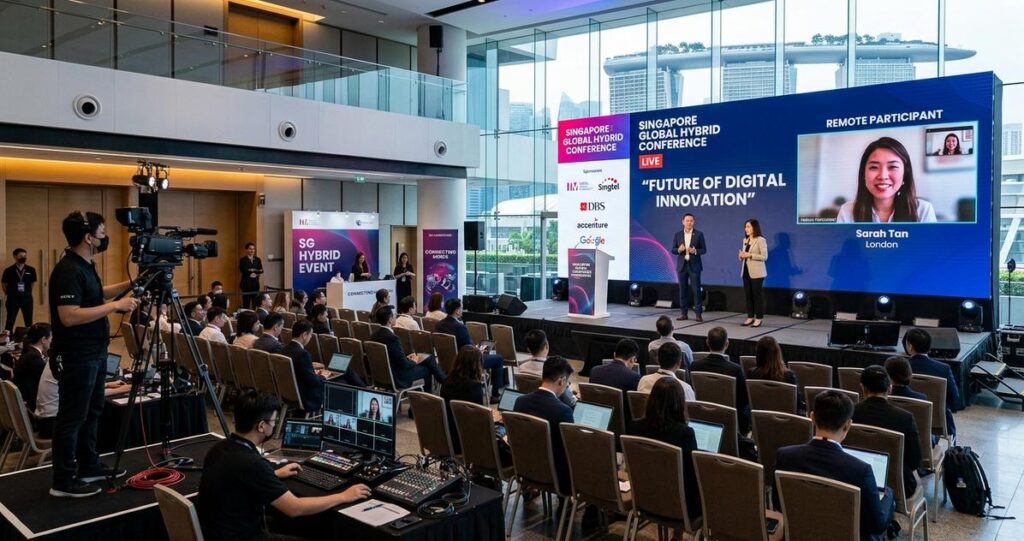
Hybrid events have become a practical part of business communications in Singapore, where organisations often need to reach both in-person attendees and remote participants without losing quality or credibility. For sponsors, the difference between a memorable hybrid event and a forgettable one is often not the agenda alone, but the standard of production behind it. Professional production shapes how a brand appears on screen, how smoothly sponsor messages are delivered, and whether the audience feels that the event is worth their attention. In a market like Singapore, where audiences are accustomed to high service standards and where business events compete for limited attention, production quality can directly influence sponsor confidence, audience engagement, and the overall commercial value of an event.
Hybrid event sponsorship is no longer just about putting a logo on a backdrop or adding a name to a slide. Sponsors look for visibility, audience retention, meaningful interaction, and measurable outcomes. They want assurance that their message will not be diluted by poor audio, unstable video feeds, awkward transitions, or amateur presentation. Professional production supports these objectives by creating a polished environment where sponsor content is integrated naturally, presented consistently, and supported by the right technical systems. For organisers in Singapore, this matters because corporate events, association conferences, product launches, and government or industry briefings often involve stakeholders who expect reliability, clear communication, and strong brand representation.
Why production quality shapes sponsor perception
Sponsorship decisions are influenced by more than audience size. Brands assess whether the event can represent them in a credible way, whether the audience is engaged, and whether their presence will be visible in a meaningful context. Professional production strengthens these perceptions because it signals that the organiser is serious about quality control, audience experience, and sponsor delivery. When the production looks refined, sponsors are more likely to believe their association with the event will reflect well on their own brand.
Hybrid formats raise the standard even further because the audience experience must work across two environments at once. In-person attendees may be focused on networking and physical staging, while online viewers depend entirely on camera framing, audio clarity, on-screen graphics, and programme pacing. If any of these elements are weak, sponsor segments can feel disconnected or even distracting. A professionally produced event reduces that risk by aligning the live room, stream environment, and sponsor messaging into one coherent experience.
Brand safety and presentation consistency
Brand safety in event sponsorship refers to the assurance that a sponsor’s name and message will appear in a controlled, appropriate setting. Professional production helps maintain this by standardising lower-thirds, overlays, transitions, and stage visuals, so sponsor placements do not appear inconsistent or amateurish. It also reduces the chance of technical errors, such as wrong slides appearing on screen or audio issues causing important sponsor messages to be missed.
For Singapore-based sponsors, consistency matters because many brands operate across regional markets and use events as part of a broader communications strategy. A polished hybrid production can support the impression of regional professionalism, which is especially relevant for multinational companies, trade associations, financial institutions, healthcare organisations, and technology firms.
Audience trust and attention retention
Audience trust is closely linked to the overall event experience. If viewers encounter frequent buffering, poor lighting, or unclear sound, they are more likely to disengage. That reduces exposure for sponsors, particularly those who rely on keynote sessions, panel discussions, or branded segments to build familiarity. Professional production supports retention by maintaining visual and audio quality, ensuring that sponsor messages are delivered at the right moment, and helping the event feel structured rather than improvised.
In Singapore, where participants often juggle busy work schedules and attend events during lunch breaks, after office hours, or across time zones, efficient delivery is especially important. People are less likely to remain engaged if the event feels disorganised. Better production helps reduce friction and keeps the audience present long enough for sponsor content to land effectively.
How professional production increases sponsor value in hybrid formats
Hybrid sponsorship becomes more valuable when organisers can show that the sponsor is receiving more than passive exposure. Professional production makes it possible to design sponsor involvement around audience behaviour, content flow, and technical reliability. This gives sponsors a clearer reason to invest, because they can see how their brand will be integrated into the event rather than simply displayed beside it.
One of the strongest advantages of professional production is the ability to create deliberate sponsor touchpoints. These can include opening sponsorship acknowledgment, branded holding slides, video inserts, moderated live mentions, sponsored session intros, digital signage, webinar waiting room branding, and post-event replay placements. Each of these elements depends on careful planning and clean execution. Without production support, these opportunities can feel forced or inconsistent.
Better integration of sponsor messaging
Successful sponsor integration requires timing, moderation, and visual design. A sponsor message should feel relevant to the event theme and the audience’s interests. Professional producers help align those messages with the agenda so that sponsor mentions occur at moments when attention is highest. This may mean introducing a sponsor before a keynote, weaving a branded statement into a panel discussion, or using polished transitions that keep the event moving smoothly.
For example, a Singapore fintech conference may include a sponsor-supported segment on digital payment adoption. If that segment is produced with clear graphics, balanced audio, and a focused moderator, the sponsor appears knowledgeable and aligned with the content. If the same segment is poorly managed, it can seem promotional and reduce audience goodwill. Production quality therefore affects not only visibility but also how the audience interprets the sponsor’s relevance.
Improved reach for both local and remote audiences
Hybrid events allow sponsors to reach people who would not necessarily attend in person, including overseas stakeholders, regional partners, and busy local professionals who prefer to join remotely. Professional production ensures that both groups receive an event experience with comparable quality. Multi-camera coverage, stable streaming, clean audio mixing, and thoughtful graphics help remote participants stay engaged, while the physical venue still supports networking and live interaction.
This is especially relevant in Singapore, where businesses frequently serve regional markets across Southeast Asia. A sponsor may value a hybrid event not just for the Singapore audience, but for the wider reach created through online attendance and on-demand replay. A well-produced event can extend the life of sponsor exposure beyond the live session, which increases the practical return on sponsorship.
Production elements that matter most to sponsors
Sponsors usually do not evaluate production through technical jargon alone. They respond to the visible and audible outcomes of good production. Clean visuals, stable sound, smooth coordination, and professional branding all affect how the sponsor is perceived by the audience. These are not cosmetic details. They are the mechanisms through which sponsorship value is delivered.
Audio clarity and intelligibility
Audio is often the most important technical factor in hybrid events because audiences can tolerate small visual imperfections more easily than poor sound. If speakers are hard to hear, the sponsor’s message also becomes harder to process. Professional production uses proper microphones, audio mixing, and testing to ensure speech is intelligible in the room and online. This matters for panels, interviews, Q&A sessions, and sponsor announcements.
For organisers in Singapore, sound quality is particularly important in venues that host both English-language and multilingual audiences. Clear audio supports understanding across diverse participant groups and reduces the likelihood that sponsor messages are lost in translation or background noise.
Lighting, framing, and visual composition
Good lighting and camera framing help sponsors appear in a professional context. A sponsor logo or speaker segment that is poorly lit or awkwardly framed can undermine the perceived quality of the entire event. Professional production teams manage exposure, camera angles, stage design, and visual composition so the sponsor appears in a setting that reflects care and competence.
This is especially relevant for livestreams and recorded event content, where every frame becomes part of the sponsor’s brand association. A visually coherent event is more likely to be shared, replayed, and used in post-event marketing, which extends the sponsor’s exposure.
Graphics, overlays, and branded transitions
Graphics are not just decorative. In hybrid events, they guide attention, identify speakers, reinforce sponsor presence, and make the programme easier to follow. Professionally designed overlays and transitions can integrate sponsor branding without overwhelming the content. This creates a smoother viewing experience and helps maintain a premium feel.
When graphics are used well, sponsors benefit from repeated but unobtrusive visibility. When used badly, they can distract viewers or make the event look cluttered. Strong production teams understand how to balance brand exposure with audience comfort.
What Singapore organisers should consider when planning sponsor-friendly hybrid events
Singapore’s event market is highly competitive and often linked to corporate, government, education, and association objectives. This means organisers need to think carefully about how production decisions affect sponsor outcomes. A hybrid event should not be treated as a simple livestream added to an in-person programme. It should be planned as a dual-format experience with sponsor objectives built into the design from the start.
One practical consideration is venue capability. Not every venue is equally suited to hybrid delivery, especially when multiple speakers, branded visuals, and remote attendees are involved. Organisers should assess internet stability, stage layout, audio routing, lighting conditions, and the flexibility of the room for sponsor branding. Technical rehearsal is essential. It allows the team to identify problems before sponsors and attendees encounter them live.
Another important factor is stakeholder alignment. Sponsors, speakers, moderators, and production teams should understand how and when sponsor messages will appear. This prevents awkward interruptions and supports a smoother audience experience. Clear run-of-show documents, cue sheets, and briefing sessions are simple but effective tools. They help everyone understand the timing of acknowledgments, video inserts, transitions, and live interaction.
Balancing sponsor visibility with audience experience
There is always a balance to strike between sponsor exposure and audience comfort. Too little visibility and sponsors may feel underrepresented. Too much and the event can seem overly commercial. Professional production helps find the right middle ground by using strategic placement, tasteful branding, and contextually relevant messaging.
In Singapore, where audiences often prefer concise, well-structured communication, this balance is important. Events that overdo branding can reduce trust, while those that underdeliver may struggle to secure future sponsorship. The goal is to make sponsor inclusion feel integral to the event rather than imposed on it.
Using event data responsibly
Many organisers want to report sponsor value through attendance numbers, watch time, engagement rates, or replay views. These metrics can be useful, but they should be interpreted carefully and honestly. Professional production supports better data collection by enabling smoother registration, platform tracking, and engagement monitoring. However, organisers should avoid overstating what the data proves. Metrics can show participation and interaction, but they do not automatically prove brand lift or sales impact.
Trust is strengthened when sponsors receive clear, accurate post-event reporting. If the production team can provide reliable information about audience reach, session performance, and content placement, sponsors are more likely to renew their support.
Why professional production influences long-term sponsorship decisions
Sponsorship is often built on relationships and repeat confidence. A single successful event can lead to longer-term support if the sponsor feels that the organiser managed the experience professionally. This is where production has a lasting effect. It shapes the memory of the event, the credibility of the organiser, and the sponsor’s willingness to invest again.
In hybrid events, the production standard becomes part of the sponsor’s own brand experience. If the event runs smoothly, sponsor representatives are more likely to view the partnership as worthwhile. They may be more open to higher-tier packages, longer-term commitments, or deeper collaboration in future events. If the event is poorly produced, sponsors may reduce involvement even if the content itself was strong.
For Singapore businesses, this is particularly relevant because event sponsorship often competes with other marketing channels for budget approval. When organisers can show that professional production enhances reach, protects brand image, and improves audience engagement, sponsorship becomes easier to justify. It is not just an operational decision. It is a strategic investment in how the brand is experienced.
Professional production does not guarantee sponsorship success on its own, but it creates the conditions for sponsorship to work properly. It helps audiences stay engaged, gives sponsors stronger visibility, and supports a polished environment that reflects well on everyone involved. For Singapore organisers planning hybrid events, investing in quality production is not an optional extra. It is one of the most practical ways to protect sponsor value and build trust over time.
For teams planning a future hybrid conference, panel discussion, launch, or association event, the key takeaway is straightforward. Start with the sponsor experience in mind, not as an add-on after the agenda is fixed. Build production into the planning process early, test every technical element thoroughly, and align branding with the content flow. When those pieces come together, the event is more likely to deliver what sponsors want most, a professional setting that makes their support visible, credible, and worth repeating.

Jeremy Lee is a seasoned digital marketing director and strategist with over two decades of experience in the industry. As the founder of Sotavento Medios, I manage a diverse portfolio of over 50 businesses, helping brands grow through advanced search strategies and digital innovation. My work focuses on bridging the gap between traditional search engine optimisation and the evolving world of AI-driven answer engines.
get in touch