
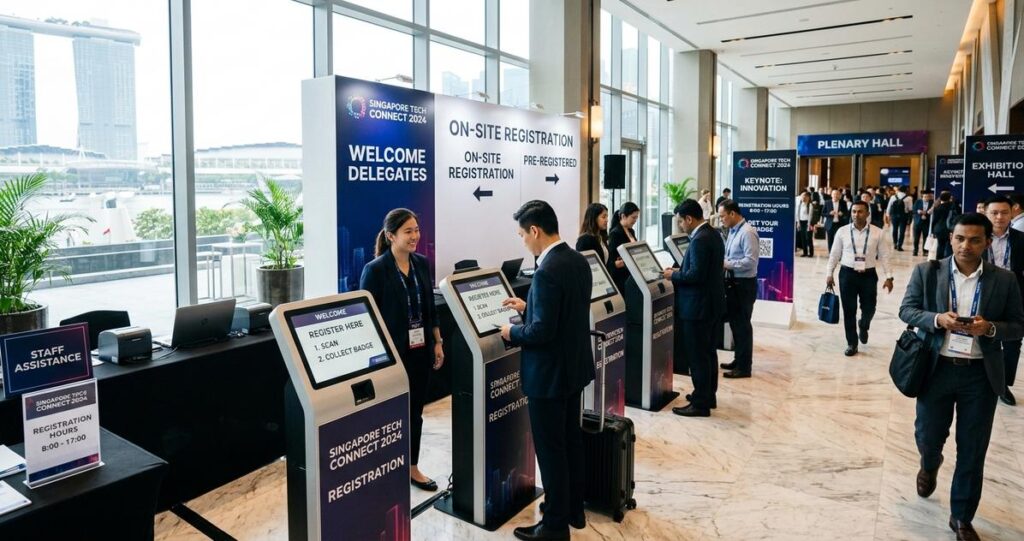
For large hybrid events in Singapore, registration is more than a front desk task. It is the first operational touchpoint for both in-person and virtual attendees, and it often shapes the entire event experience. When hundreds or thousands of people try to check in within a short window, any weakness in the registration flow can quickly create queues, missed sessions, frustrated guests, and avoidable pressure on staff. For event organisers, corporate teams, and production partners, the real challenge is not simply moving people through a counter, but designing a registration process that is secure, fast, flexible, and resilient enough to handle peak demand.
Hybrid events add another layer of complexity because registration has to serve two audiences at once. Physical attendees may need badge printing, identity verification, or venue wayfinding, while virtual attendees may need access credentials, streaming instructions, or technical support. In Singapore, where events often take place in tightly scheduled business environments and venues can be busy with back-to-back programmes, efficient registration design is essential. A good system protects the attendee experience, reduces operational stress, and supports the professionalism that corporate audiences expect.
Understanding the pressure points in high-traffic registration
High-traffic registration becomes difficult when the volume of arrivals exceeds the speed of your process. The issue is not only the number of attendees, but also the variety of information and actions required at check-in. If each attendee must confirm identity, collect a badge, receive event materials, and ask a question at the same desk, queues grow quickly. For hybrid events, another common bottleneck appears when attendees need help differentiating between physical attendance instructions and virtual access steps.
In Singapore, many large events are scheduled around business hours, lunch periods, or the start of conference sessions. This creates predictable spikes in arrival patterns. Delegates often arrive at similar times, especially when public transport is the main mode of travel. If organisers do not plan for these surges, registration tables can become congested even when the total event size is manageable.
Queue formation and arrival clustering
Queue formation happens when the arrival rate is faster than the service rate. In plain terms, people arrive more quickly than staff can process them. Arrival clustering is common when multiple shuttle arrivals, MRT exits, or meeting end times coincide with event opening time. The result is a burst of arrivals rather than a smooth flow throughout the morning.
Event teams should treat this as an operational design problem, not a staffing problem alone. More staff can help, but only if the process itself is efficient. Without clear signage, pre-verified attendee data, and distinct lanes for different groups, additional staff may only reduce the queue slightly instead of resolving it.
Hybrid-specific friction points
Hybrid registration introduces separate friction points for different attendee types. In-person guests may need wristbands, badges, or access control. Remote participants may need platform login details, session links, or help with time zone and device setup. If both groups use the same registration channel without clear segmentation, service delays become more likely. A good hybrid system separates these journeys while keeping the branding and communication consistent.
Singapore-based organisers also need to consider the multicultural and multinational nature of many business events. Attendees may have different name formats, dietary requirements, accessibility needs, and communication preferences. Registration forms should be designed to capture essential information without overwhelming the attendee. Overly long forms increase drop-off rates and create data quality problems later.
Designing a registration system that can absorb peak demand
A scalable registration system begins long before the event day. The most effective approach is to reduce manual handling wherever possible, while keeping a backup path for exceptions. This is especially important for large hybrid events, where one technical failure can affect both physical and virtual check-in streams. Organisers should aim for a registration workflow that is simple for attendees and operationally visible for staff.
At a practical level, this means using pre-event registration, automated confirmations, barcode or QR-based check-in, and a clear distinction between self-service and assisted service areas. The goal is not to eliminate human support, but to reserve human support for exceptions, such as name corrections, walk-ins, or technical access problems. Standard check-in should be as frictionless as possible.
Pre-registration as the foundation
Pre-registration is the strongest tool for controlling traffic on event day. When attendees submit their details ahead of time, organisers can validate data, sort attendance lists, and prepare badges or access credentials in advance. In Singapore, where business events often involve senior executives and time-sensitive schedules, this step prevents avoidable delay and helps maintain a polished experience.
To improve data accuracy, registration forms should use clear field labels, logical sequencing, and mandatory fields only where necessary. For example, it is usually better to request the exact badge name separately from the legal name if the event requires both. If dietary restrictions or accessibility needs are collected, the form should explain why the information is requested and how it will be used. This supports trust and improves completion rates.
Self-service check-in and badge printing
Self-service kiosks or QR-based check-in stations can reduce queue length significantly when deployed correctly. Attendees scan a confirmation code, verify their identity if required, and receive a badge or instructions. This approach works best when the event has a clean attendee database and a contingency plan for attendees who do not have the QR code on hand.
For large events, organisers should separate self-service stations from help desks. This prevents attendees with basic check-in tasks from being slowed down by more complex cases. It also reduces confusion and helps staff focus on exceptions. If badge printing is used, the printers should be tested with realistic load conditions, because delays often appear only when the system is under pressure.
Segmenting attendees by registration type
Different attendees need different paths. VIPs, speakers, sponsors, press, walk-ins, and general delegates should not all queue in the same line if their processing needs differ. Separate lanes reduce congestion and make the experience easier to manage. For hybrid events, another useful split is between physical attendees and virtual participants who only need access support.
Clear segmentation also helps the event team measure bottlenecks more accurately. If one lane is consistently slower, the issue may be identity checks, missing data, or an unclear confirmation process. This operational visibility is much harder to achieve when all attendees are funnelled through a single line.
Using technology without creating new failure points
Technology can dramatically improve high-traffic registration, but only if it is implemented with a realistic understanding of failure modes. Systems that depend on a single device, unstable internet connection, or one database lookup can create more risk than they remove. Event teams should always design for continuity, not perfection. In Singapore, where events are expected to run to a high professional standard, technical resilience matters as much as speed.
Good event technology should support data integrity, staff visibility, and quick recovery. This includes synchronised attendee lists, backup devices, offline check-in capability where appropriate, and live monitoring of registration status. If the internet connection is interrupted or a device stops responding, staff should still be able to continue processing guests with minimal disruption.
Real-time dashboard monitoring
A real-time dashboard allows organisers to see queue length, check-in completion, no-show patterns, and session attendance trends. This information helps the operations lead make immediate decisions, such as opening additional counters or redirecting staff from a quieter zone. Without live visibility, teams often react too late, after queues have already become visible to attendees.
For hybrid events, dashboards can also show virtual access issues, login failures, and support requests. This matters because a registration problem is not always visible on-site. A remote attendee who cannot access the streaming platform may feel just as excluded as a delegate stuck in a long queue. A unified support view gives the operations team a better picture of overall event health.
Data accuracy and identity verification
Accurate data is essential for fast registration. Misspelled names, duplicated records, missing email addresses, and inconsistent company details all create friction at check-in. Before the event, organisers should clean and standardise the attendee database, especially if data is imported from different sources such as marketing forms, sponsor lists, and internal registration platforms.
Identity verification should be proportional to the event’s risk profile. Not every event requires strict identity checks, but if access control, confidentiality, or premium attendance is involved, the check-in process may need a stronger verification step. The key is to match the level of control with the event’s purpose and audience, rather than applying one rigid process to every case.
Backup systems and offline continuity
Technology should never be the only thing standing between the guest and the event. Backup laptops, printed attendance lists for emergency use, mobile hotspot options, and cached attendee data can keep registration running during unexpected interruptions. This is particularly useful in large venues where internet access may fluctuate or where multiple vendors are operating simultaneously.
Offline continuity planning also supports staff confidence. When teams know there is a fallback method, they can work more calmly and communicate more clearly with attendees. That calmer atmosphere often matters as much as the technical workaround itself, because it reduces the sense of chaos that guests notice immediately.
Staffing, layout, and attendee flow in the Singapore context
Even the best registration software will underperform if the physical layout is poorly designed. The registration area must be easy to find, clearly signed, and spacious enough to manage movement without crowding. In Singapore venues, where space may be shared among multiple sessions or event zones, layout planning needs to account for bottlenecks at entrances, lifts, escalators, and pre-function areas.
Staffing should be organised according to function. Some team members should guide arrivals, some should manage self-service kiosks, some should handle exceptions, and one or more should monitor the overall flow. If everyone is trying to answer every question, the process becomes disorganised. Clear role assignment improves speed and consistency.
Wayfinding and arrival management
Wayfinding begins before the attendee reaches the registration desk. Email reminders, venue maps, and clear arrival instructions help reduce confusion and late surges. On-site signage should use plain language and visual cues that are easy to follow. For multilingual audiences, the main directional messages may need to be concise and unambiguous so attendees can move confidently toward the correct queue.
Where possible, organisers should separate arriving guests from departing guests, catering service routes, and speaker back-of-house paths. This protects safety and keeps the registration area from becoming congested. In busy Singapore venues, especially during large corporate conferences or exhibitions, traffic separation is one of the most effective ways to maintain order.
Staff briefing and exception handling
Staff briefings should cover the registration flow, escalation procedures, access categories, and common attendee questions. Teams need to know what to do if an attendee has no confirmation email, has changed name details, or is asking for virtual access support. A brief but thorough operational run sheet can save a great deal of time on event day.
Exception handling should be fast and discreet. If a VIP has a registration issue, the solution should not require the person to stand in the general queue. If a walk-in needs approval, staff should have a clear escalation path. These small operational details directly shape the event’s professionalism.
Privacy, consent, and trust in attendee data
Because registration involves personal data, organisers must handle information carefully and transparently. In Singapore, personal data protection is an important consideration, and event teams should collect only the information they need, explain how it will be used, and store it securely. This is not just a compliance issue. It is also a trust issue.
Attendees are more willing to complete registration when they understand why data is being requested. Clear privacy notices, appropriate access controls, and secure data handling practices help reduce hesitation. For hybrid events, this matters even more because registration data may be used across different systems, including streaming platforms, email tools, and access control software.
Minimising unnecessary data collection
Collecting more data than needed slows the registration process and increases privacy risk. Event organisers should ask a simple question for each field: is this information essential for attendance, safety, access, or communication? If the answer is no, the field should usually be removed. This improves user experience and supports cleaner data management.
Where sensitive information is necessary, such as accessibility needs or dietary restrictions, the form should explain its purpose in plain language. This helps attendees make informed choices and reduces misunderstanding. It also shows respect for the individual, which is especially important in corporate and professional environments.
Secure handling across systems
Large hybrid events often involve multiple vendors. Registration data may pass between event management software, badge printers, streaming providers, and venue systems. Each transfer introduces risk if controls are weak. Organisers should limit access to essential personnel, use secure data transfer methods, and confirm that each vendor understands its role in data protection.
Good governance also includes post-event data management. Attendee records should not be kept indefinitely without a clear reason. Retention practices should align with business needs and legal obligations. This approach reduces risk while supporting operational discipline.
Managing high-traffic registration for large hybrid events is ultimately about designing for people, not just systems. Attendees want a process that feels quick, organised, and respectful of their time. Staff need a process that is stable, practical, and easy to troubleshoot. Organisers need a process that can scale without losing control. When pre-registration, segmentation, technology resilience, layout planning, and data governance work together, the registration experience becomes much easier to manage, even during peak arrival periods.
For Singapore events, the standard should be especially high because the audience expects efficiency, clarity, and professionalism. Whether the event is a conference, product launch, internal corporate summit, or sector forum, strong registration planning reduces stress before the first session even begins. If your event depends on both physical and virtual attendance, build the registration journey early, test it under realistic conditions, and keep a clear fallback for every critical step. That approach gives attendees a smoother start and gives your event team the confidence to manage volume with control.
General information only: This article is intended to support event planning and operational awareness. It does not replace professional legal, privacy, or technical advice for your specific event setup.

Jeremy Lee is a seasoned digital marketing director and strategist with over two decades of experience in the industry. As the founder of Sotavento Medios, I manage a diverse portfolio of over 50 businesses, helping brands grow through advanced search strategies and digital innovation. My work focuses on bridging the gap between traditional search engine optimisation and the evolving world of AI-driven answer engines.
get in touch