
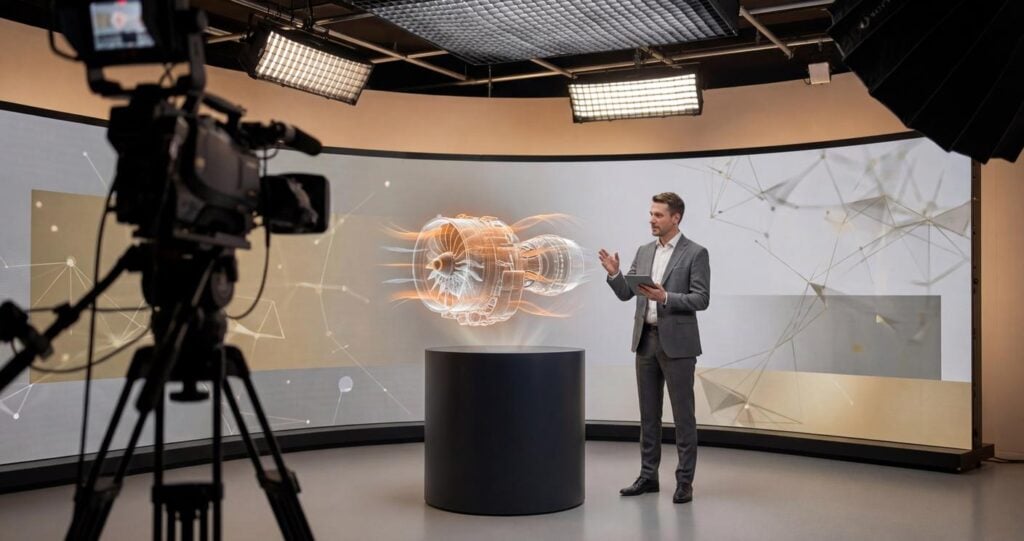
In the domain of high-stakes B2B technical sales, clarity is the ultimate currency. Demonstrating a complex piece of industrial hardware, a sophisticated server architecture, or a multi-layered software platform to enterprise decision-makers requires more than a simple slide deck. The challenge is conveying intricate technical details to a distributed audience in a way that is both engaging and comprehensible. This is where the integration of Augmented Reality (AR) overlays into professional live streaming workflows moves from a conceptual novelty to a mission-critical sales tool. For corporate event planners and production managers, leveraging AR is not about visual effects; it is about engineering a more effective communication channel. Successfully executing an AR-enhanced live stream demands a rigorous approach to production infrastructure, signal flow management, and network architecture. It requires a broadcast engineering mindset applied to a corporate communication objective, ensuring that every layer of the technology stack, from camera lens to the end-user’s screen, is optimized for stability, low latency, and pristine image fidelity.
Core Infrastructure for AR-Enhanced Streaming
Deploying AR overlays in a live environment is fundamentally a task of real-time data and video compositing. This process requires a robust foundation of specialized hardware and software working in perfect synchronization. The stability of the entire production hinges on the performance and proper integration of these core components. An under-specified system will inevitably lead to dropped frames, rendering artifacts, and unacceptable latency, undermining the very purpose of the presentation.
The Graphics Rendering Engine
The heart of any live AR implementation is the real-time graphics rendering engine. Professional broadcast workflows rely on engines like Epic Games’ Unreal Engine or Unity, often paired with broadcast-specific front-ends like Zero Density’s Reality Engine or Pixotope. These platforms are designed to ingest live video feeds, process camera tracking data, and render complex 3D models in real-time at broadcast frame rates, typically 59.94 or 60 frames per second. The computational demand is immense, necessitating high-end graphics processing units (GPUs), such as the NVIDIA RTX A6000 or RTX 4090, capable of handling 4K/UHD textures and complex lighting models without compromising on performance. The rendering server itself must be a purpose-built machine with maximum CPU clock speeds, high-throughput NVMe storage for asset loading, and sufficient RAM to manage large, detailed 3D scenes.
Camera Tracking and Data Ingestion
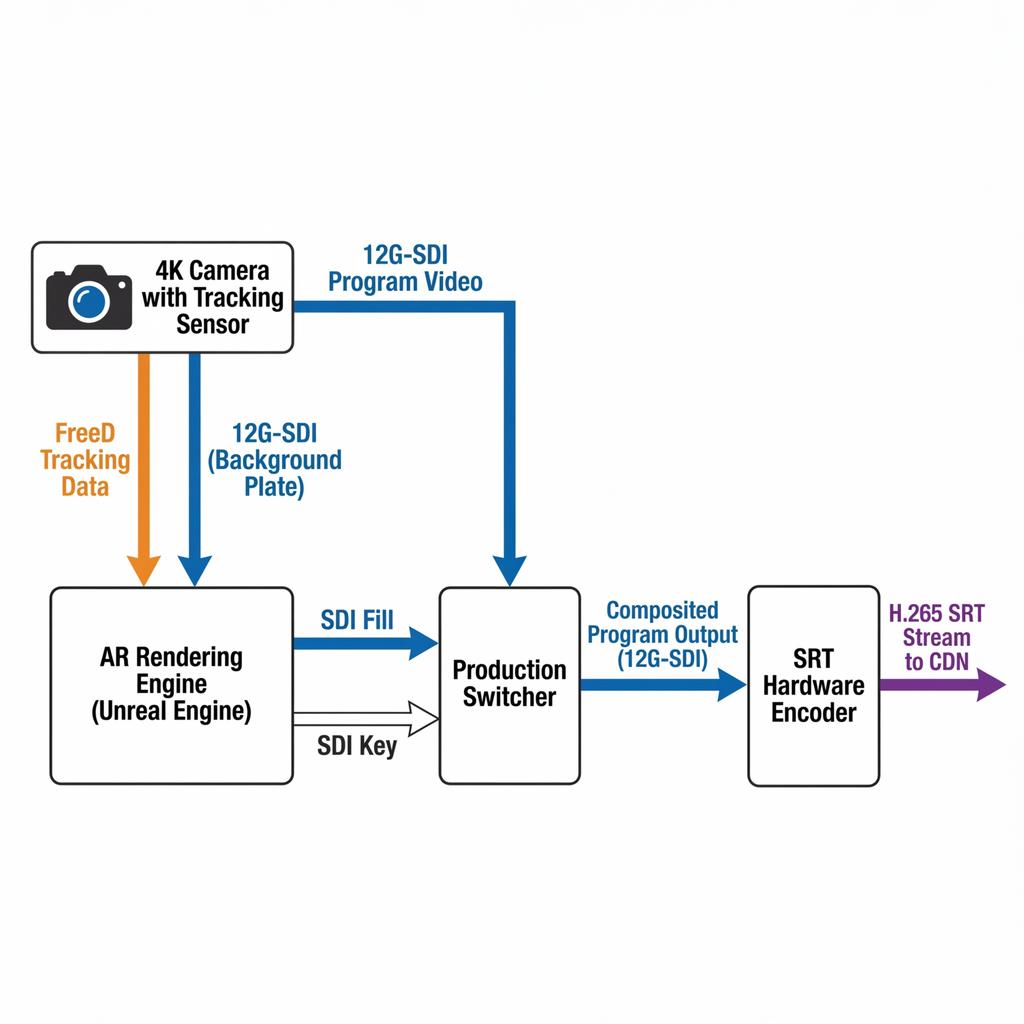
For the AR engine to convincingly place a virtual object into a real-world scene, it must know the precise position, orientation, zoom, and focus of the camera at all times. This is achieved through sophisticated camera tracking systems. Solutions like Mo-Sys StarTracker use reflective markers on the studio ceiling for absolute optical tracking, while Stype offers crane-mounted sensor systems. This tracking data is typically transmitted to the rendering engine over a dedicated network connection using industry-standard protocols like FreeD. FreeD is a UDP-based protocol that sends a continuous stream of positional and lens data for each frame. The integrity of this data stream is critical; any packet loss or jitter will result in the AR elements appearing to drift or lag behind the real-world camera movement, instantly breaking the illusion of integration.
Signal Flow and Keying for Seamless Compositing
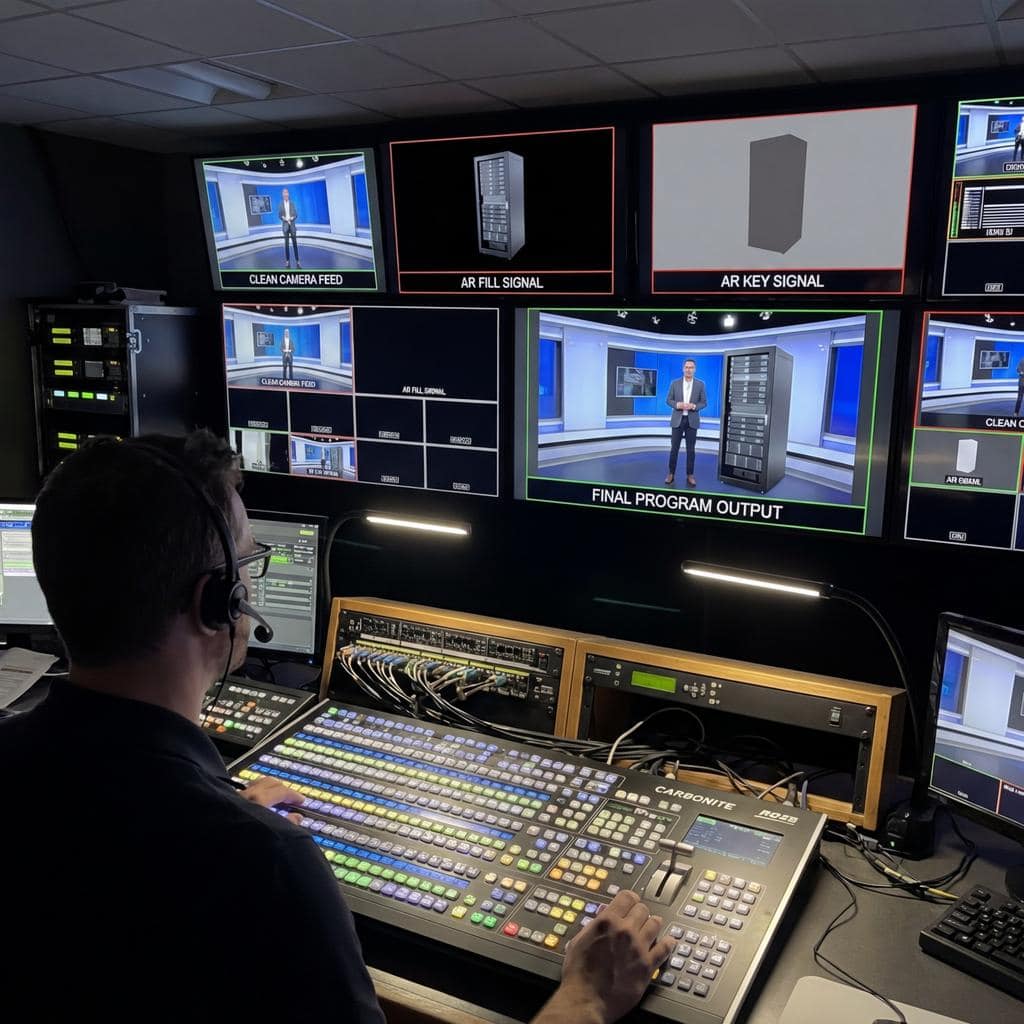
The video signal path in an AR production is more complex than a standard stream. A professional 4K camera, outputting a 12G-SDI (Serial Digital Interface) signal, provides the clean “real-world” video feed. This feed is sent simultaneously to a production video switcher and the AR rendering engine. The rendering engine uses this video as the background plate for its 3D objects. The most professional method for output is not a single combined video feed, but rather separate Fill and Key signals. The Fill signal is the full-color rendered AR object, while the Key signal is a grayscale matte that defines the object’s transparent and opaque areas. These two signals, often sent via dual 6G-SDI or over IP using NDI (Network Device Interface), are fed into a downstream keyer on a production switcher, such as a Ross Carbonite or Blackmagic Design ATEM Constellation. This allows a technical director to perfectly composite the AR graphics over the live camera feed, providing precise control over the final program output.
Integrating AR into the Live Production Workflow
Once the core rendering infrastructure is in place, it must be seamlessly integrated into the broader live production and streaming ecosystem. This involves careful protocol selection, aggressive latency management, and a clear strategy for delivering the final, composited feed to both in-person and remote audiences in a hybrid event context. Each decision in the workflow has a cascading effect on the final viewer experience.
Protocol Selection for Contribution and Distribution
The choice of video transport protocols is critical. For internal contribution, moving the video signals from cameras, AR engines, and other sources to the production switcher, NDI is an exceptionally powerful tool. It allows for the transport of high-quality, low-latency video, audio, and metadata over a standard 10GbE network, drastically reducing complex SDI cabling. However, for external distribution to a content delivery network (CDN), NDI is unsuitable. Here, SRT (Secure Reliable Transport) is the superior protocol over the aging RTMP (Real-Time Messaging Protocol). SRT provides robust error correction and packet recovery, making it ideal for sending a high-bitrate stream over the public internet, which is inherently less reliable than a managed local network. A typical high-quality 1080p60 stream with detailed AR graphics should be encoded using the H.265 (HEVC) codec at a bitrate of 8-10 Mbps to preserve detail, a task well-suited for hardware encoders from manufacturers like Haivision or AJA.
Latency Management from Lens to Screen
In an interactive AR presentation, latency is the primary enemy. The total “lens-to-screen” latency is the sum of delays from every component in the signal chain: camera processing (5-15ms), camera tracking data transmission (10-20ms), AR engine rendering (2-3 frames, or 33-50ms at 60fps), production switcher processing (1-2ms), encoding (50-100ms), and network transit plus CDN buffering (1-5 seconds). While the network delivery portion is the largest contributor, minimizing latency in the production chain is vital for the presenter’s interaction with the AR elements to feel immediate and natural. Using a Genlock signal to synchronize all video sources, employing high-performance hardware, and utilizing low-latency protocols like NDI and SRT are key strategies. The goal is to keep the on-premise production latency low enough that the presenter and a local audience see the AR interaction in near real-time.
Hybrid Event Integration with UC Platforms
For hybrid events, the final program feed containing the AR overlays must be routed to both the in-venue displays and the remote audience’s Unified Communications (UC) platform. To feed the stream into Microsoft Teams, Zoom Events, or Webex, the program output from the switcher (typically as SDI or HDMI) can be converted to a high-quality webcam source using a device like a Magewell or Elgato capture card. A more professional method involves using the NDI output from the switcher and bringing it directly into Teams or Zoom via their native NDI support. This maintains a fully digital, high-quality signal path. It is also critical to manage audio routing carefully. The remote audience requires a mix-minus audio feed that includes the presenter’s microphone and program audio but excludes the audio from the remote participants themselves to prevent echoes and feedback loops.
Network Architecture and Enterprise-Level Scalability
The demands of AR streaming on a corporate network are substantial. The network is not merely a transport layer; it is an active component of the production infrastructure. A consumer-grade or poorly configured enterprise network will quickly become a bottleneck, leading to catastrophic failure during a live event. Scalability and redundancy must be engineered into the architecture from the ground up.
On-Premise Network Requirements
The local network supporting the AR production workflow must be robust. A segregated VLAN (Virtual Local Area Network) with a dedicated 10GbE or faster backbone is the minimum requirement. For video-over-IP workflows using NDI, which can require over 300 Mbps per 4K stream, managed switches with sufficient backplane capacity are essential. Quality of Service (QoS) policies must be implemented to prioritize clocking (PTP), video, and audio traffic over less critical data. All critical components, including the AR rendering engine, production switcher, and encoders, should be connected via high-quality, certified copper or fiber optic cabling to eliminate physical layer issues.
Cloud-Based vs. On-Premise Rendering
While on-premise rendering provides the lowest possible latency and maximum control, it represents a significant capital expenditure. As an alternative, cloud-based rendering using GPU-equipped instances from providers like Amazon Web Services (AWS) or Google Cloud Platform is emerging. This model allows for immense scalability without the hardware investment. However, it introduces a significant latency challenge: the camera feed must be sent to the cloud for rendering, and the Fill/Key signals returned to the on-premise switcher. This round trip can add hundreds of milliseconds of delay. This can be mitigated by using SRT for the transport to and from the cloud and carefully architecting the workflow, but for highly interactive, real-time presentations, on-premise rendering remains the technically superior solution.
Redundancy and Failover Planning
For any mission-critical corporate broadcast, a comprehensive redundancy plan is non-negotiable. In an AR workflow, this means implementing a fully redundant signal path. A common strategy is to have a primary and a secondary (backup) rendering engine running in parallel, receiving the same camera and tracking data. The production switcher can be programmed with macros to instantly switch to the backup Fill/Key signals if the primary engine fails. Similarly, dual streaming encoders should be used, feeding the primary and backup SRT streams to different CDN ingest points. Network redundancy can be achieved using bonded cellular solutions like LiveU or Teradek alongside the primary hard-line internet connection, ensuring the stream remains live even in the event of a total ISP outage.
Ultimately, incorporating AR overlays into technical sales presentations is a powerful strategy for enhancing communication and accelerating comprehension. However, it is a complex production discipline that requires deep expertise in broadcast engineering, real-time graphics, and network infrastructure. By partnering with a technical production team that understands these intricate requirements, enterprises can confidently leverage this technology to create impactful, memorable, and effective sales experiences that set a new industry standard.

Jeremy Lee is a seasoned digital marketing director and strategist with over two decades of experience in the industry. As the founder of Sotavento Medios, I manage a diverse portfolio of over 50 businesses, helping brands grow through advanced search strategies and digital innovation. My work focuses on bridging the gap between traditional search engine optimisation and the evolving world of AI-driven answer engines.
get in touch