
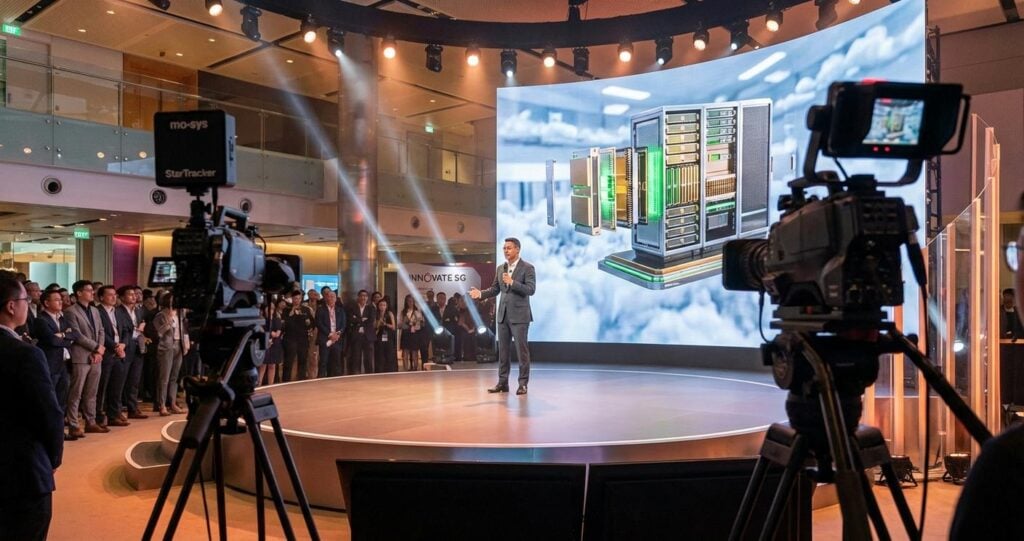
The competitive landscape of technology launches in Singapore demands more than a standard keynote presentation streamed from a hotel ballroom. For high-stakes product reveals and corporate announcements, enterprise decision-makers require a presentation medium that not only conveys information but also creates a lasting, immersive brand experience for both physical and virtual attendees. Traditional green screens and basic virtual sets lack the photorealism and production flexibility needed. This is where Extended Reality (XR) production, built on a foundation of broadcast engineering principles, has emerged as the definitive standard for delivering high-impact, technically flawless hybrid events.
XR production integrates real-time 3D graphics, high-resolution LED displays, and precise camera tracking to create a seamless, interactive virtual environment around a physical presenter. Unlike post-production visual effects, this entire composite is rendered live, in-camera, and ready for immediate streaming. For an IT director, production manager, or event planner, understanding the underlying technical architecture of an XR deployment is critical to evaluating its feasibility and ensuring a successful execution. This involves a deep analysis of the production infrastructure, the hybrid streaming workflow, and the non-negotiable network and redundancy strategies required for an enterprise-grade broadcast.
The Core Infrastructure: Blending Physical and Virtual Production Environments
The foundation of any XR production is the physical stage, often referred to as an LED volume or smart stage. This is not merely a backdrop; it is an integrated system of hardware and software components that must work in perfect synchronization to create a convincing illusion. The quality of this core infrastructure directly impacts the final visual fidelity of the live stream.
The XR Stage and LED Volume Specifications
The primary component is the LED wall itself. For in-camera visual effects (ICVFX), the pixel pitch is a critical specification. A pixel pitch of 2.5mm or lower, typically 1.8mm or 1.5mm, is required to eliminate moiré patterns and ensure the display appears as a solid, high-resolution image to the camera sensor. The volume consists of a main curved background wall, an LED floor, and often an LED ceiling for realistic lighting and reflections. These panels must have a high refresh rate (e.g., 7680 Hz) and a wide color gamut (Rec. 2020) to prevent flicker on camera and allow for accurate color grading in the final program feed. Driving this complex array of pixels is a powerful real-time graphics rendering system, most commonly based on Unreal Engine, disguise, or Pixotope, which processes all incoming data and generates the 3D environment in real-time.
Camera Tracking and Lens Calibration
To maintain the illusion of a cohesive space, the virtual world rendered on the LED walls must react perfectly to the movements of the physical camera. This is achieved through sophisticated camera tracking systems. Systems like Mo-Sys StarTracker or Stype RedSpy use infrared LEDs mounted on the camera and a sensor constellation on the ceiling to provide absolute positional data (X, Y, Z coordinates) and rotational data (pan, tilt, roll) to the render engine. This data stream, often transmitted over a dedicated network, allows the engine to adjust the virtual camera’s perspective in real time. Equally important is lens calibration. Each lens used in the production must be meticulously profiled to create a map of its specific distortion, focus, and zoom characteristics. This encoded lens data ensures that as the camera operator pulls focus or zooms, the virtual background elements react with the correct perspective shift and depth of field, seamlessly blending the real and virtual planes.
Signal Flow and Real-Time Compositing
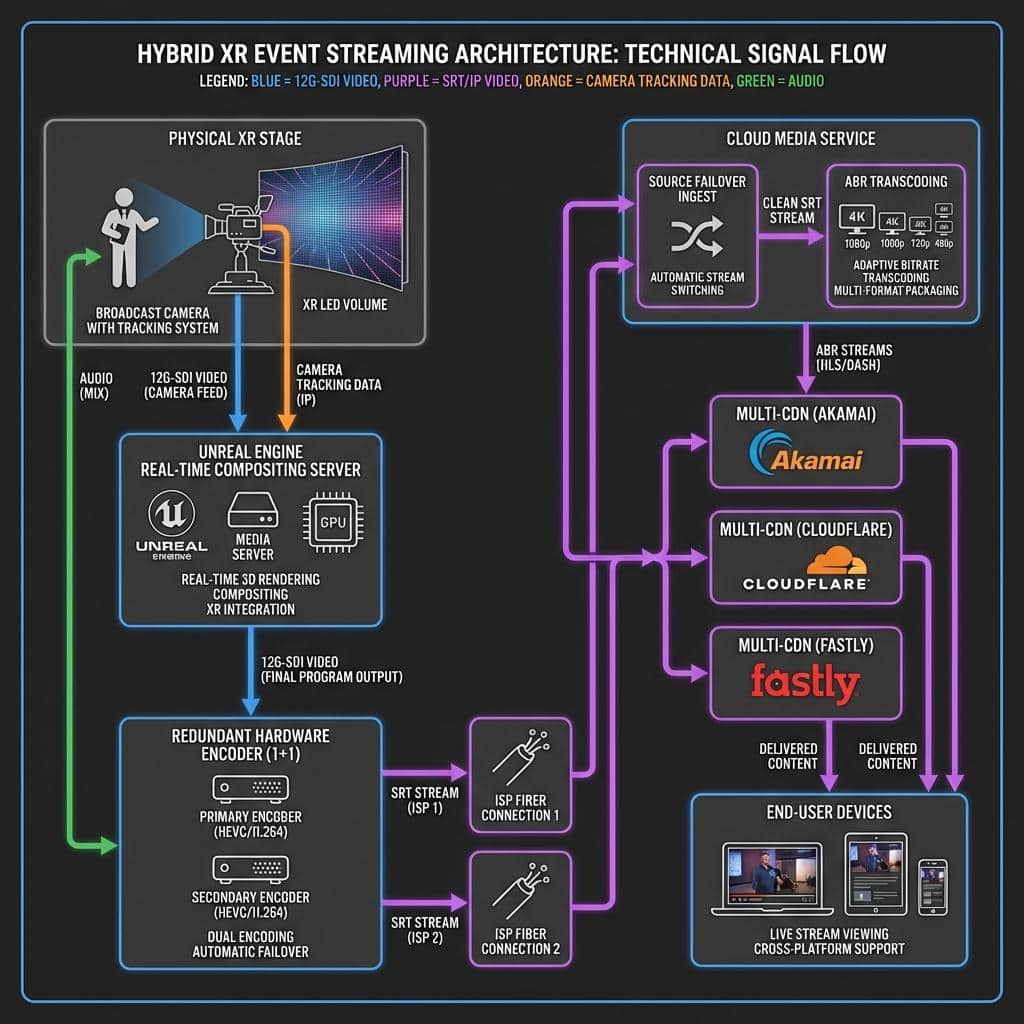
The video signal flow is a complex, high-bandwidth operation requiring broadcast-grade hardware. Each camera, typically outputting a 12G-SDI or 6G-SDI signal for 4K UHD resolution, is fed into the system. Simultaneously, the tracking and lens data are sent to the Unreal Engine render farm. The engine takes the live camera feed, composites the presenter into the 3D environment it is generating, and outputs a final, mixed-reality program feed. This entire process, from camera capture to final composite output, must occur with sub-frame latency. Any noticeable delay would shatter the illusion for the live audience and create synchronization issues for the stream. The final program output is then delivered via 12G-SDI to the master production switcher and the streaming encoding pipeline.
Hybrid Event Streaming Architecture for XR Productions
An XR production’s value is maximized when it serves a hybrid audience flawlessly. This requires a robust streaming architecture capable of delivering a high-quality, low-latency feed to a global audience while integrating remote participants and interactive elements. The architecture must be designed for reliability and scale, moving beyond basic RTMP protocols to enterprise-grade solutions.
On-Premise Contribution Encoding with SRT
The 4K UHD program feed from the XR system must be prepared for internet transport. This is the contribution stage. We use high-performance hardware encoders, such as those from Haivision or AWS Elemental, which support the H.265 (HEVC) codec. HEVC offers approximately 50% greater compression efficiency than H.264 (AVC), allowing for higher quality video at a lower bitrate, which is critical for stable transport. For the transport protocol itself, Secure Reliable Transport (SRT) is the industry standard. Unlike the older RTMP (Real-Time Messaging Protocol), SRT is designed for performance over unpredictable networks like the public internet. It provides robust error correction through packet re-transmission, AES-256 encryption for security, and predictable, low latency, making it the ideal choice for sending a high-value contribution feed from the Singapore venue to cloud processing centers.
Cloud-Based Transcoding and Multi-CDN Delivery
Once the pristine SRT contribution feed arrives at a cloud ingest point, it undergoes transcoding. This process converts the single high-bitrate stream into an adaptive bitrate (ABR) ladder. An ABR ladder consists of multiple versions of the stream at different resolutions and bitrates (e.g., 1080p at 6 Mbps, 720p at 3 Mbps, 480p at 1.5 Mbps). Player applications on the viewer’s end can then intelligently switch between these renditions based on their available network bandwidth, ensuring a smooth playback experience without buffering. This transcoding is handled by cloud services like AWS Elemental MediaLive or Bitmovin. For a global tech launch, delivery cannot rely on a single Content Delivery Network (CDN). A multi-CDN strategy, utilizing providers like Akamai, Cloudflare, and Fastly, provides geographic distribution and redundancy. If one CDN experiences regional performance issues, traffic can be dynamically routed through another, ensuring high availability and low latency for all viewers, regardless of their location.
Integrating Remote Presenters into the XR Volume
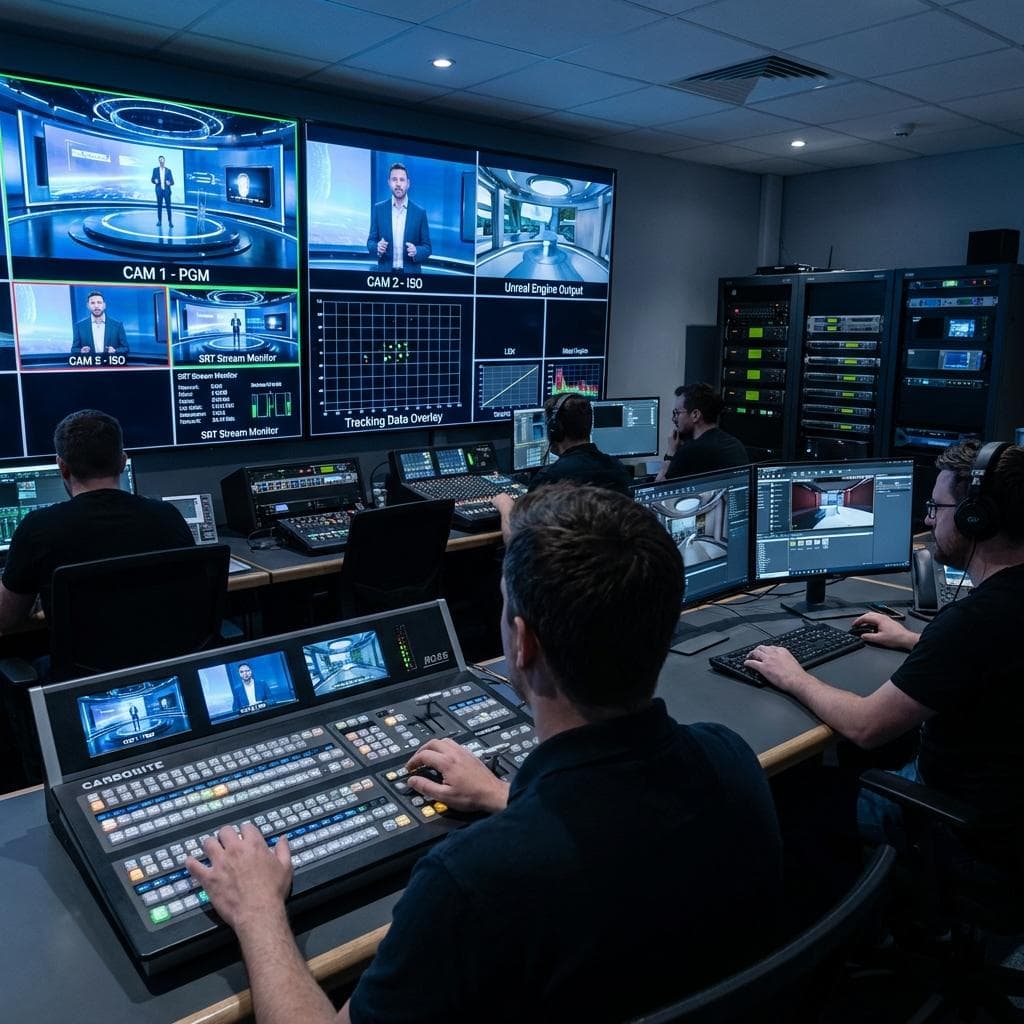
A key advantage of XR is the ability to virtually place remote speakers “on stage” with the physical presenter. This requires a low-latency, bi-directional video and audio workflow. A remote presenter’s feed can be acquired using a dedicated hardware encoder sending an SRT stream back to the production venue. This feed is then ingested into the render engine and composited into the virtual scene. The primary challenge is managing audio and communication. A clean mix-minus must be sent back to the remote presenter, containing the full program audio minus their own voice to prevent echo. A separate, low-latency talkback or intercom over IP (e.g., Unity Intercom, Clear-Com) is essential for the director to provide cues and instructions, ensuring seamless interaction between the on-stage and remote participants.
Network and Redundancy: The Foundation of a Flawless XR Stream
The sophisticated hardware and software of an XR production are entirely dependent on a meticulously planned network infrastructure and a comprehensive redundancy strategy. There is no room for single points of failure in a high-profile corporate launch. Every component, from power to network paths, must have a backup.
On-Site Production Network Architecture
A dedicated, managed, high-speed network is a non-negotiable prerequisite. A 10GbE switched network is the baseline, with 25GbE or 40GbE backbones preferred for larger productions. This network must be segmented using VLANs to isolate and prioritize different types of traffic. For example:
- VLAN 10: Camera tracking data. This is low-bandwidth but extremely latency-sensitive.
- VLAN 20: Video over IP traffic, such as NDI (Network Device Interface) feeds used for monitoring or secondary sources.
- VLAN 30: Control data for lighting, audio mixers (Dante), and production switchers.
- VLAN 40: Outbound internet traffic for the primary SRT contribution stream.
This segmentation prevents network congestion and ensures that time-critical data packets are not delayed. The internet connection itself must be robust, with a dedicated, uncontended synchronous fiber line providing ample upstream bandwidth for the 4K contribution stream.
Redundancy and Failover Protocols
Enterprise-grade reliability is achieved through systematic redundancy. This starts with hardware: power supplies for all critical servers and network switches should be redundant (1+1). The primary contribution encoder should have a secondary encoder running in parallel, ready for immediate failover. The most critical element is stream path diversity. We implement a primary and a secondary SRT stream, each sent over a completely separate physical internet connection from different Internet Service Providers (ISPs). These two streams are sent to the cloud ingest point, which is configured for source-based failover. If the primary stream is interrupted for any reason (e.g., ISP outage, local network failure), the cloud service automatically and instantly switches to the secondary stream, with the switch being imperceptible to the end viewer. This level of planning is the difference between a minor technical issue and a catastrophic broadcast failure.
In conclusion, adopting XR for high-end tech launches in Singapore is not a creative choice; it is a strategic technical decision. It provides an unparalleled platform for brand storytelling and audience engagement in a hybrid world. However, its successful implementation hinges on a deep understanding of broadcast engineering, from LED volume specifications and real-time rendering pipelines to enterprise-grade SRT streaming architectures and multi-layered redundancy protocols. Executing these productions requires a team with proven expertise in live production and network infrastructure to manage the complexity and mitigate the risks, ensuring a flawless and impactful delivery every time.

Jeremy Lee is a seasoned digital marketing director and strategist with over two decades of experience in the industry. As the founder of Sotavento Medios, I manage a diverse portfolio of over 50 businesses, helping brands grow through advanced search strategies and digital innovation. My work focuses on bridging the gap between traditional search engine optimisation and the evolving world of AI-driven answer engines.
get in touch