
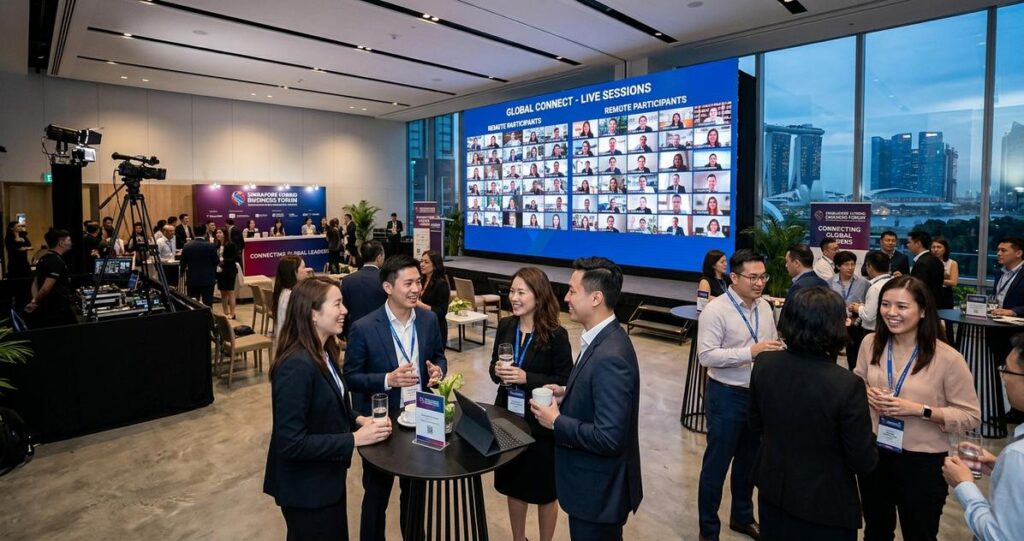
Networking has always been one of the main reasons people attend conferences, trade shows, seminars, and corporate events in Singapore. For many professionals, the value of an event is not only in the keynote speeches or product showcases, but in the chance conversations that happen before sessions, during coffee breaks, and after the official programme ends. Yet the way people connect is changing quickly. In Singapore, where business travel, hybrid work, and digital adoption have all become part of everyday professional life, event organisers are now expected to design networking experiences that work equally well for people in the room and for those joining remotely.
This shift is not just about convenience. It reflects a broader change in how audiences expect to interact, share information, and build relationships. Physical attendees still benefit from face-to-face presence, body language, and spontaneous encounters. Digital attendees, meanwhile, want meaningful participation rather than passive viewing. The future of networking lies in bridging these two experiences so that both groups can exchange ideas, form business connections, and feel equally included. For Singapore-based organisations, this is especially relevant because events often serve regional clients, multinational teams, and a highly connected professional audience. A well-designed hybrid networking strategy can improve accessibility, widen reach, and support stronger long-term engagement without sacrificing quality.
For event planners, business leaders, and brand teams, the core question is no longer whether networking should extend beyond the physical venue. The real question is how to make it work in a way that is structured, authentic, and technically reliable. That requires a combination of event design, production planning, digital tools, and audience understanding. When these pieces are aligned, hybrid networking becomes more than a contingency plan. It becomes a strategic advantage.
Why networking expectations have changed
Traditional networking assumed that all valuable interactions happened in the same room. That model worked well when events were fully in-person and when travel, scheduling, and geography limited who could attend. Today, professionals in Singapore often manage busy calendars, regional responsibilities, and virtual collaboration across time zones. Many people want access to expert content without the friction of travel, while still expecting opportunities to interact with speakers, peers, and potential partners. This has made hybrid and digital networking a practical requirement rather than a novelty.
The change is also behavioural. People are now more comfortable communicating through chat, video calls, and digital platforms, but they still value human connection. Event networking must therefore support different interaction styles. Some participants prefer speaking live on camera, others prefer written chat, and many need structured prompts before they will introduce themselves. If organisers only design for one format, they risk excluding part of the audience. In Singapore’s business environment, where professionalism and efficiency matter, this can weaken the return on investment for sponsors, exhibitors, and attendees alike.
Physical presence still has unique value
In-person networking remains powerful because it allows richer social cues, more informal conversation, and easier relationship-building over time. A handshake, a quick introduction at a reception, or a shared meal can help establish trust faster than a brief online exchange. Physical events also support serendipity, which is often where useful business connections begin. In sectors such as finance, healthcare, technology, education, and professional services, face-to-face contact often helps decision-makers assess credibility and compatibility more quickly.
However, relying only on physical presence limits reach. It excludes people who cannot travel because of schedule constraints, caregiving duties, mobility considerations, or cost. It can also reduce international participation, which matters in Singapore because many events are designed for a regional or cross-border audience. The future is not about replacing physical networking. It is about extending its benefits through thoughtful digital design.
What effective hybrid networking looks like
Hybrid networking is not simply a livestream with a chat box attached. It is a deliberate event strategy that treats physical and digital attendees as part of one connected audience. That means planning networking touchpoints before, during, and after the event, with tools and facilitation that allow people to discover one another, exchange context, and continue conversations beyond the live session. If the digital experience is an afterthought, remote participants will often feel like observers rather than contributors.
The strongest hybrid networking formats use structure to create opportunity. Instead of expecting attendees to network spontaneously, organisers can guide introductions, segment participants by interest, and create multiple participation channels. This approach is especially useful in Singapore, where audiences often appreciate clarity, efficiency, and well-managed schedules. A good hybrid programme respects time while still allowing meaningful human interaction.
Pre-event matchmaking and registration data
Effective networking begins before the event day. Registration forms can collect relevant information such as industry, role, interest areas, and reasons for attending. This data can then be used to suggest relevant sessions, introduce similar attendees, or create curated networking groups. When handled responsibly, this helps participants prepare for more relevant conversations. In a Singapore context, where many events serve B2B audiences, such matching can support more focused business discussions and better use of time.
Organisers must still collect only the information they genuinely need and manage it in line with the Singapore Personal Data Protection Act. Clear consent, transparent purpose statements, and secure handling of participant data are essential. Trust is part of the networking experience, and attendees are more willing to engage when they understand how their information will be used.
Live interaction tools that support both audiences
During the event, networking tools should allow physical and digital participants to connect across the same platform. Common features include moderated chat, Q and A, one-to-one meeting requests, breakout rooms, and interest-based discussion tables. When used well, these tools reduce the gap between the venue and the online audience. A speaker can invite questions from both in-person and remote participants. A sponsor can host a product discussion that includes attendees in the hall and on screen. A moderator can direct introductions so that people know when and how to participate.
The technical standard matters. Stable audio, clear camera work, appropriate screen placement, and reliable moderation all shape whether people feel included. If remote attendees cannot hear questions from the room, or if in-person participants cannot see who is speaking online, networking becomes fragmented. Professional event streaming and hybrid production services help solve this by creating a coherent shared experience rather than two separate events running side by side.
Designing networking that feels natural, not forced
One of the biggest challenges in hybrid networking is making interactions feel genuine. People quickly notice when networking is too scripted or when digital participants are pushed into awkward small talk without context. Good design should lower the barrier to conversation while still leaving room for authenticity. The aim is not to manufacture chemistry. It is to create the conditions where useful conversations can happen more easily.
For Singapore audiences, this often means combining structure with flexibility. Professionals may prefer concise introductions, clear objectives, and sessions that respect time. They also tend to value practical outcomes, such as finding collaborators, learning from peers, or identifying clients and suppliers. Networking formats should therefore be purposeful. Rather than asking attendees to “just mingle,” organisers can create conversation prompts, themed rooms, topic tables, or industry clusters.
Conversation design matters
A useful networking format starts with a clear question or shared interest. For example, a session for healthcare leaders might focus on digital patient engagement. A technology event might group attendees by product development, cybersecurity, or AI deployment. A marketing forum might ask participants to discuss customer retention strategies. This helps avoid awkward silence and gives both physical and digital attendees a natural reason to introduce themselves.
Moderators play a central role here. They can welcome participants, explain how to join discussions, and keep the pace comfortable. They can also draw quieter attendees into the conversation by inviting chat responses or rotating speaking turns. In a hybrid setting, the moderator acts as the bridge between room-based interaction and digital engagement. That role is especially important when the audience is diverse and includes first-time attendees, senior executives, and remote participants joining from different locations.
Short formats often work better than long open sessions
Long, unstructured networking sessions can be difficult to manage online and in person. Shorter, well-defined intervals often work better because they create urgency and reduce downtime. Examples include five-minute introductions, themed breakout discussions, timed one-to-one meetings, or scheduled networking rounds. These formats help participants move from introduction to substantive conversation more quickly.
In Singapore, where participants may be balancing back-to-back meetings and tight schedules, concise formats can improve engagement. They also help event teams manage the hybrid production flow more predictably. When the schedule is clear, both the audience and the technical team can prepare better. That leads to fewer disruptions and a smoother experience overall.
Technology will shape the next phase of networking
The future of networking will increasingly depend on intelligent event technology, but technology alone is not enough. Tools must be selected based on the actual networking outcome they are meant to support. Artificial intelligence, data-driven recommendations, and immersive digital interfaces can help match people more effectively, yet the human element remains central. If the technology is too complex, attendees may disengage. If it is too simple, the networking experience may feel limited.
For Singapore events, technology should solve practical problems. It should help attendees discover relevant contacts, support cross-format participation, and maintain reliable communication between physical and digital spaces. It should also be easy to use across devices, since attendees may join from office desktops, mobile phones, or venue tablets. A smooth user experience matters because networking often fails when people cannot access the platform quickly or understand how to use it.
AI-assisted matchmaking and smart recommendations
Artificial intelligence can support networking by suggesting relevant contacts, sessions, or discussion groups based on attendee profiles and behaviour. For example, someone interested in sustainability may be matched with exhibitors, speakers, or fellow participants working in related areas. These recommendations can reduce random searching and help people make more relevant connections faster. In large hybrid events, this can be especially valuable because the number of possible interactions is much higher than in a small closed-room setting.
Still, AI should be used carefully. Recommendation systems can only be as good as the data they receive, and they should not replace human judgment. Organisers should allow attendees to control their preferences, review suggestions, and opt out where necessary. Transparency is critical because people are more likely to engage when they understand why a recommendation appears. In Singapore, where trust and data governance are taken seriously, responsible use of AI is not optional. It is part of the standard for professional event practice.
Immersive formats and the role of production quality
Newer formats such as virtual lounges, mixed-reality demos, interactive sponsor booths, and live captioning can expand access and engagement. These features are particularly helpful for attendees who cannot remain in the venue for the entire day or who are joining from abroad. However, the success of these tools depends on production quality. Poor audio, unstable connections, or confusing layouts can quickly undermine the experience. Networking depends on trust, and technical failures can interrupt that trust in seconds.
That is why professional hybrid production is now a strategic investment rather than just a technical service. Camera placement, audio clarity, stage design, latency management, and audience support all influence whether participants can communicate naturally. Good production helps people focus on the conversation rather than the mechanics of joining it.
What Singapore organisers should prioritise now
Singapore has a strong reputation as a business events hub, with a professional audience that expects efficiency, reliability, and high standards. This creates both opportunity and responsibility for organisers. Events must now consider accessibility, data protection, technical resilience, and audience diversity from the planning stage. Hybrid networking is not successful because it is trendy. It succeeds because it fits the needs of modern professionals who want flexibility without losing quality.
Organisers should begin by defining the networking objective. Is the goal lead generation, peer learning, sponsor engagement, community building, or all of the above? Different goals require different structures. A trade event may need curated buyer-seller meetings. A leadership forum may need peer roundtables. An association event may need member introductions and post-event follow-up. Once the objective is clear, the networking format can be designed to support it.
Make accessibility part of the experience
Accessible networking is more than physical access to the venue. It also includes captioning for online sessions, clear instructions, flexible participation methods, and communication formats that support different levels of confidence and language comfort. In a multilingual and international city like Singapore, this matters. Some participants may prefer chat over speaking. Others may need written information to follow along. Providing multiple ways to contribute helps more people participate meaningfully.
Accessibility also includes schedule design. Avoiding overly long sessions, building in breaks, and giving remote attendees defined moments to engage can improve attention and participation. When people feel accommodated, they are more likely to stay active in the event and continue the conversation afterwards.
Measure quality, not just attendance
Attendance numbers alone do not tell the full story of networking success. A better measure looks at the quality of interaction, such as whether participants made relevant connections, booked follow-up meetings, asked questions, or joined discussion groups. Feedback from both physical and digital attendees should be reviewed to understand which networking formats worked and where the experience broke down. This is especially important for recurring conferences and corporate events in Singapore, where organisations often want to improve each edition.
Useful indicators include the number of completed introductions, engagement in Q and A, meeting bookings, participant satisfaction, and post-event follow-up activity. These are practical outcomes that reflect whether networking truly happened. When organisers track the right signals, they can refine their approach and build stronger events over time.
Networking is moving toward a more integrated model, where physical and digital participation are no longer treated as separate experiences. The most effective events will be those that combine thoughtful programme design, dependable production, responsible data use, and clear audience facilitation. For Singapore organisations, this creates a valuable opportunity to reach more people while preserving the professionalism and connection that make events worth attending in the first place.
If you are planning a conference, seminar, trade event, or corporate programme, the key takeaway is simple. Start with the networking outcome you want, then design the event format, technology, and facilitation around that goal. When physical and digital attendees can interact with equal confidence and clarity, networking becomes more inclusive, more efficient, and more effective for everyone involved.
General information only. For decisions involving data protection, event compliance, or specific organisational requirements, consult the relevant professional advisers or regulatory guidance in Singapore.
Jeremy Lee is a seasoned digital marketing director and strategist with over two decades of experience in the industry. As the founder of Sotavento Medios, I manage a diverse portfolio of over 50 businesses, helping brands grow through advanced search strategies and digital innovation. My work focuses on bridging the gap between traditional search engine optimisation and the evolving world of AI-driven answer engines.
get in touch