
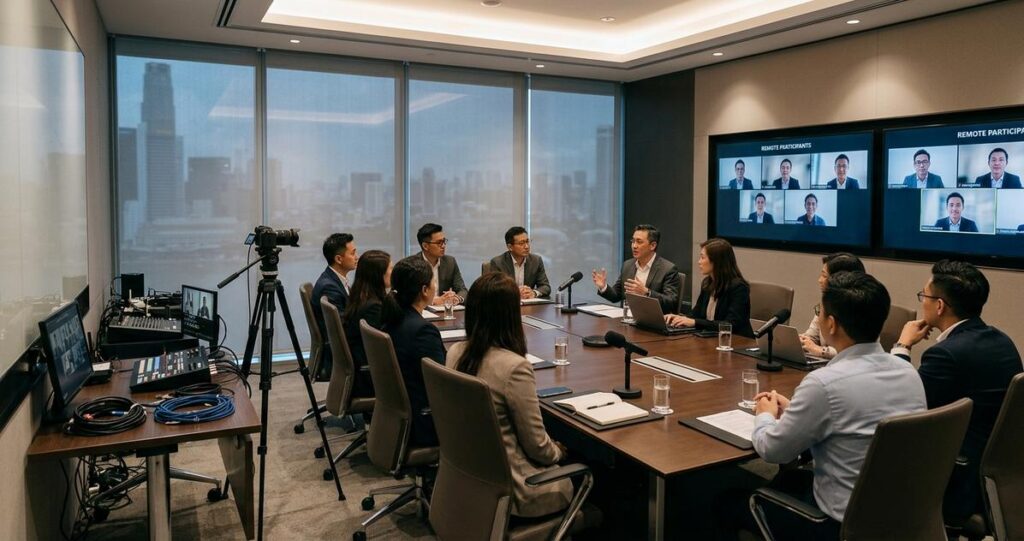
Hybrid forums have become a practical way for organisations in Singapore to bring people together, whether they are in a boardroom at one end of the island or joining remotely from home, the office, or overseas. They are efficient, flexible, and inclusive, but they also create a different kind of risk when the discussion involves sensitive material. Confidential business strategy, legal matters, human resources issues, personal data, patient-related information, and crisis communications all require tighter controls than a standard webinar or public town hall. When a forum includes both in-person and online participation, security cannot be treated as an afterthought, because the weakest link is often not the main stage or the conference platform, but a small process gap such as an exposed link, an unvetted participant, or an audio feed that should not have been open.
For Singapore organisations, this matters even more because privacy, data handling, and operational trust are closely tied to professional credibility. Many businesses here operate across regional teams, and hybrid meetings often involve directors, clinicians, lawyers, educators, HR teams, and government-facing stakeholders. A discussion that is secure in a physical meeting room may become vulnerable once it is streamed, recorded, mirrored to remote participants, or shared through messaging apps. The goal is not to eliminate accessibility. The goal is to protect sensitive content while still allowing the right people to participate safely and productively.
Why sensitive hybrid forums need a higher security standard
A hybrid forum is not simply a meeting with a camera added. It is a dual-environment communication setting in which people attend through two distinct access paths, one physical and one digital. That creates more points where confidentiality can fail. In the room, a participant may overhear a discussion, photograph a slide, or record audio on a mobile device. Online, an invitation may be forwarded, a shared device may be misused, or a conference link may be exposed through unsecured channels. The more sensitive the content, the more important it becomes to design security at every layer, from registration and authentication to recording controls and post-event storage.
Singapore organisations also need to keep local compliance expectations in mind. The Personal Data Protection Act, often referred to as the PDPA, governs how personal data is collected, used, disclosed, and protected by private-sector organisations. While not every sensitive forum involves personal data, many do, especially in employee briefings, customer case reviews, healthcare-adjacent sessions, or partner meetings. Good security practice also supports organisational duties under contractual confidentiality clauses, internal governance policies, and sector-specific standards. In regulated environments, such as finance or healthcare, the expectations are usually stricter than for a general corporate presentation.
Common failure points in hybrid settings
The most common security failures are often procedural rather than technical. An event may use a secure platform, yet the invitation contains no participant instructions. A discussion may be intended for a closed group, yet the physical room allows walk-ins. A recording may be disabled on the platform, but a presenter’s laptop still stores a local copy. A remote attendee may be authenticated correctly, but then shares their screen in an unsecured environment. These problems are preventable when planning starts with the assumption that both the room and the stream need control.
For sensitive discussions, organisations should identify what must remain confidential, who genuinely needs access, and what would happen if information were disclosed outside the intended audience. That simple exercise often reveals whether a forum should be fully closed, partially shared, or split into public and private segments. It is also the right point to decide whether the event should be recorded at all, because recording often introduces the largest long-term risk.
Building a secure access model from registration to attendance
Security begins long before the forum starts. The invitation process should be designed so that only approved participants can access the session. For a sensitive hybrid forum, open links and general public registration are usually inappropriate. Instead, use named invitations, unique login credentials, and attendee verification. If the forum is internal, tie access to the organisation’s identity system where possible. If external participants are involved, pre-approval by the host team should be mandatory.
In Singapore workplaces, this often means aligning event access with corporate directory services, secure guest registration workflows, or manually verified invitation lists. The principle is straightforward, the identity of each attendee should be known before the event begins. This matters for both the physical venue and the online platform. Reception staff, organisers, and moderators should know who is expected to attend, what role each person has, and whether any participant requires special clearance to see certain content.
Authentication and access control
Authentication means confirming that a person is who they claim to be. Access control means limiting what that person can see or do after entry. For hybrid forums, both are essential. A password alone is not enough if the link has been forwarded. Unique access tokens, single sign-on, or multi-factor authentication, where available, offer stronger protection. Multi-factor authentication adds another verification step, such as a code from a phone app or SMS, before access is granted. For highly sensitive meetings, this extra step is often appropriate because it reduces the risk of unauthorised entry from leaked credentials.
Organisers should also use role-based access. In practical terms, that means speakers, moderators, technical staff, and attendees each receive only the permissions they need. A panelist may need screen-sharing rights, while an attendee should not. A technical producer may need access to the back-end streaming controls, but not to confidential discussion files unless required. This “least privilege” approach is a well-established security principle and is especially useful in hybrid events, where multiple people may touch the same system during setup and live operation.
Physical venue checks matter as much as digital controls
Because the forum is hybrid, the room itself must be treated as a secure environment. That includes checking who can enter the venue, whether the doors remain closed, whether staff can prevent casual entry, and whether the room layout exposes sensitive screens to passers-by. If the discussion is highly confidential, consider badge checks at the entrance, controlled seating, and a dedicated holding area for guests. Screens should be positioned to avoid shoulder surfing, which is the act of viewing information over someone’s shoulder without permission. Whiteboards, printed documents, and presenter notes should be cleared before and after the event.
In Singapore, where venues may be shared across multiple tenants or event groups, this becomes especially important. A room booked for a private forum can still be vulnerable if unrelated staff, vendors, or cleaning crews have unsupervised access. Event producers should therefore confirm access windows, lock-down procedures, and asset removal rules with the venue well in advance.
Protecting the content itself, from streaming to recording
Even when access is restricted, sensitive content can still leak if the production workflow is careless. That is why the media side of the forum needs just as much attention as the registration process. The streaming platform, presentation software, file storage system, and production devices should all be assessed for confidentiality risks. If the event includes live slides, embedded videos, speaker notes, or document sharing, every content source should be tested before the forum begins.
Many organisations assume that disabling public visibility on a stream is enough. In reality, the safest approach is layered protection. Use encrypted connections where supported, keep production laptops updated, restrict administrative access to the streaming dashboard, and ensure that recordings are stored in approved repositories with limited access. If the event platform allows waiting rooms, host controls, or attendee approval, these features should be activated for restricted sessions.
Recording, retention, and redistribution
Recording is often the most sensitive part of a hybrid forum because it creates a durable copy of the discussion. Once a recording exists, it may be duplicated, forwarded, clipped, or stored longer than intended. Before enabling recording, organisers should decide whether it is truly necessary. If it is required for compliance, training, or internal reference, the retention period should be defined in advance, along with who can access the file and how it will be deleted when no longer needed.
In Singapore, organisations should be careful not to keep personal data or confidential information longer than necessary for the original purpose. That is consistent with good data governance and aligns with the PDPA’s general expectations around protection and retention. For highly sensitive discussions, a summary document may be safer than a full recording. If a recording is unavoidable, access should be tightly limited, and redistribution should be prohibited unless expressly approved by the owner of the information.
Secure production workflows
Live production teams should use approved equipment rather than ad hoc personal devices. Shared laptops, unmanaged USB drives, and personal cloud storage create unnecessary exposure. File transfers should happen through secure channels, and confidential slide decks should be marked and handled accordingly. If a presenter needs to share classified information, it may be appropriate to preload the content into the production system rather than allowing open screen sharing from an unvetted laptop. Technical rehearsals should also include security checks, not only audio and lighting checks.
A useful question for the production team is simple: if this file, stream, or recording were copied by someone without permission, what would the impact be? If the answer is significant, the workflow needs stronger safeguards. This mindset helps event organisers move from convenience-based planning to risk-based planning, which is the correct approach for sensitive hybrid forums.
Operational discipline during the live forum
Security does not end when the forum starts. In fact, the live session is where most mistakes become visible. Moderation discipline is critical. The host should verify attendees, manage speaking order, monitor chat functions, and watch for unusual behaviour. If the discussion is closed, chat screenshots, file uploads, and public reactions may need to be disabled or tightly controlled. A clear code of conduct should be communicated before the event so participants understand that unauthorised recording, redistribution, or external sharing is prohibited.
For forums involving legal, medical, or HR-sensitive topics, a brief reminder at the start is practical and professional. The moderator can state that the session is confidential, that only registered participants may attend, and that recording by participants is not permitted unless explicitly announced. This is not only about policy enforcement. It also sets expectations and helps responsible attendees support the security posture of the event.
Managing questions and disclosures safely
Question-and-answer segments often expose the most sensitive material because they are spontaneous. A participant may mention a patient case, employee issue, client complaint, or internal project detail without realising the implications. Moderators should therefore screen questions when appropriate, especially in hybrid formats where people may use chat, microphone, or raised-hand features. If the session includes confidential scenarios, the host may decide to collect questions in advance or ask participants to avoid naming individuals and organisations.
In some cases, the safest approach is to separate the forum into public and private portions. A general segment can be streamed more broadly, while a closed discussion takes place later with a restricted audience. This allows organisations to communicate openly without unnecessarily exposing sensitive details. It also gives speakers confidence that they are addressing the right group.
Incident response and escalation
Even well-run events should have a response plan. If an unauthorised participant joins, if confidential files are displayed in error, or if a recording begins unexpectedly, the team should know exactly who has authority to pause the session, remove access, or end the stream. A rapid response matters because a few seconds can be enough for information to be captured. The plan should cover both technical and communication steps, including how to notify internal stakeholders after an incident.
For Singapore organisations, this should be aligned with broader cybersecurity and data governance procedures. Where personal data may be involved, organisations should review whether internal breach handling obligations are triggered. The details will depend on the nature and scale of the incident, so escalation paths should be established before the forum starts rather than improvised after a problem occurs.
How Singapore organisations can make secure hybrid forums sustainable
Long-term security depends on repeatable habits, not one-off caution. Organisations in Singapore can strengthen hybrid forum security by creating a standard operating procedure for sensitive events. That procedure should define who approves the event, who manages access, which platform settings are mandatory, how recordings are handled, and what the venue must provide. It should also include a checklist for moderators and technical producers, because live events move quickly and small mistakes are easy to make under pressure.
Training is equally important. Staff who plan forums may be skilled at logistics but less familiar with confidentiality requirements. They should understand the difference between public, internal, and restricted sessions, as well as the risks of uncontrolled links, open screen sharing, and informal data handling. Regular dry runs help reinforce these habits. A rehearsal should not only test microphones and slides, it should test how the team handles admission, speaker handover, chat moderation, and emergency shutdown.
Vendor management also matters. If a production partner, platform provider, or venue operator is involved, confidentiality expectations should be written clearly into the engagement scope. The team should ask what data the vendor will see, where it will be stored, how long it will be retained, and who can access it. For sensitive work, this should never be left to assumption. Trusted vendors support security by design, but the organising team still owns the risk.
For many Singapore-based organisations, the best results come from partnering with experienced event production teams that understand both the technical and confidentiality requirements of hybrid delivery. A professional production setup can reduce exposure through controlled workflows, reliable moderation support, secure streaming configurations, and disciplined coordination across physical and digital channels. That practical support is especially useful when the discussion involves stakeholders who expect discretion and professionalism.
Hybrid forums can be secure, but only when security is planned as part of the event architecture rather than added after the invitation has gone out. The most effective approach combines verified access, controlled venue entry, restricted platform permissions, careful recording decisions, and a clear response plan. For organisations in Singapore, that approach also needs to fit local privacy and governance expectations. If your forum covers sensitive business, legal, healthcare, or people-related topics, the safest path is to treat confidentiality as a core design requirement from the first planning meeting onward. That mindset protects not only information, but also trust, which is what makes a forum worth attending in the first place.
General information only: This article is intended for general awareness and operational planning. For legal advice, regulatory interpretation, or handling of a specific incident involving personal data or confidential information, consult qualified professionals familiar with the relevant Singapore requirements.
Jeremy Lee is a seasoned digital marketing director and strategist with over two decades of experience in the industry. As the founder of Sotavento Medios, I manage a diverse portfolio of over 50 businesses, helping brands grow through advanced search strategies and digital innovation. My work focuses on bridging the gap between traditional search engine optimisation and the evolving world of AI-driven answer engines.
get in touch