
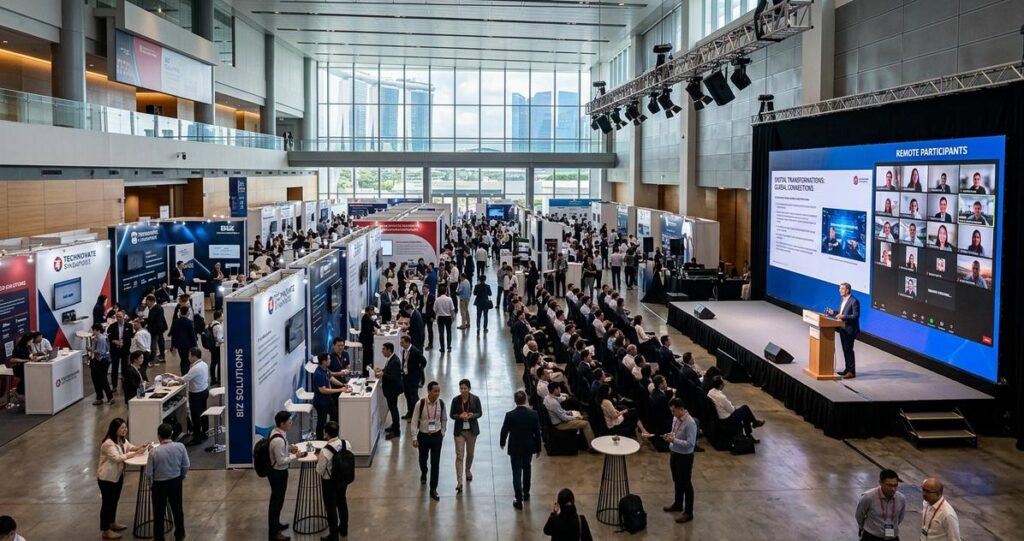
Singapore has long been a natural meeting point for business in Asia. Its connectivity, stable infrastructure, strong convention ecosystem, and multilingual commercial environment make it an important base for trade shows that bring together regional buyers, exhibitors, and decision makers. As event formats evolve, hybrid trade shows, meaning exhibitions that combine physical attendance with a structured online experience, are becoming more relevant for companies that want to reach beyond a single venue or a single day on the calendar. For Singapore businesses, the question is no longer whether hybrid formats will remain useful, but how they will be designed to create measurable value for exhibitors, delegates, and organisers in a market that expects efficiency, professionalism, and reliability.
Hybrid trade shows are not simply a live-streamed stage programme attached to an exhibition hall. When executed properly, they involve a deliberate blend of on-site networking, digital registration, on-demand content, remote speaker participation, live product demonstrations, and data-informed follow-up. In Singapore, where corporate buyers often manage tight schedules and regional travel can be limited by cost, weather, or workload, this format offers practical advantages. It can extend the reach of a show beyond the convention centre, improve accessibility for overseas participants, and support content reuse after the event ends. At the same time, hybrid events demand stronger production planning, clearer audience segmentation, and careful attention to technical resilience, especially when business outcomes depend on seamless interactions between physical and virtual attendees.
The future of hybrid trade shows in Singapore will likely be shaped by three forces. First, buyers increasingly expect flexibility in how they access information and connect with suppliers. Second, organisers must justify event spend by showing tangible engagement rather than relying only on footfall. Third, the local environment, including Singapore’s position as a hub for finance, logistics, technology, healthcare, and advanced manufacturing, rewards formats that can serve regional and global markets without losing the value of face-to-face commerce. For business leaders and event planners, understanding these shifts is essential for building trade shows that are not only modern, but commercially effective.
Why Singapore is well positioned for hybrid trade shows
Singapore offers several structural advantages that support hybrid trade show development. The city-state is a major air and business travel hub, with established convention venues, a dense network of professional services, and a strong digital infrastructure. These factors matter because hybrid events depend on more than cameras and screens. They require reliable connectivity, well-managed venue logistics, secure data handling, and technical teams that can coordinate live presentation, streaming, and audience engagement in real time.
Another strength is the diversity of industries that use Singapore as a regional base. Trade shows in sectors such as biomedical sciences, logistics, energy, information technology, food services, and industrial equipment often draw participants from across Southeast Asia and beyond. Hybrid design allows these sectors to maintain a physical exhibition floor for product inspection and relationship-building while also offering remote access to people who may not be able to travel. This is especially useful for procurement teams, technical specialists, and senior executives who may only need to attend selected sessions or view product launches online.
Access, reach, and business continuity
Hybrid trade shows support access in a way that fully physical events cannot always provide. A potential buyer in Kuala Lumpur, Jakarta, or Tokyo may not have time to attend every relevant show in person, but can still join a live demo, watch a keynote, or connect with an exhibitor through a digital meeting function. That wider reach increases the probability of lead generation and brand visibility. It also adds resilience, because if travel disruption or scheduling conflicts reduce physical attendance, the event can still deliver value through the digital layer.
In Singapore, where companies often serve regional markets and depend on cross-border commercial relationships, continuity matters. Hybrid trade shows make it easier to keep the event accessible to stakeholders who are distributed across different time zones and travel schedules. This does not replace the value of meeting face to face, but it does help preserve the commercial purpose of the show when in-person attendance is incomplete or uneven.
What will define the next generation of hybrid trade shows
The next phase of hybrid trade shows will move beyond basic broadcasting. The most effective events will be designed with two audiences in mind from the start, one onsite and one online, rather than treating the online audience as a secondary add-on. That shift affects programme design, content pacing, booth layout, speaker preparation, and analytics. Organisers that understand this will create richer experiences and better business outcomes.
For exhibitors, the most important change will be the ability to combine physical demonstrations with digital touchpoints. A product that is difficult to assess from a distance, such as industrial machinery, medical equipment, or specialised software, can be shown in the exhibition hall while a remote viewer receives a concise guided demonstration and follow-up materials. For attendees, hybrid access makes it easier to compare suppliers, revisit sessions, and share relevant content with internal stakeholders after the event.
Personalisation and targeted engagement
One major direction for hybrid trade shows is personalisation. Digital platforms can help organisers tailor session recommendations, suggest relevant exhibitors, and connect attendees with suitable suppliers based on industry interests or business roles. This is valuable in Singapore, where trade shows often attract a sophisticated audience that expects relevance rather than generic marketing noise.
Personalisation also improves the use of time. A procurement manager may attend only two live panels, visit a few booths physically, and review the rest on demand later. A regional distributor may prefer scheduled virtual meetings with selected exhibitors rather than wandering the entire venue. When organisers structure hybrid events around these preferences, they make the show more efficient for everyone involved. The challenge is to keep this personalisation useful without becoming intrusive, so clear consent and transparent communication remain important.
Data-driven event design
Another defining feature of future hybrid trade shows is deeper analytics. Traditional events often measure success through attendance numbers and exhibitor feedback. Hybrid events can provide more detailed insights, including session views, dwell time, content downloads, meeting bookings, and follow-up engagement. These metrics help organisers understand which themes attracted the strongest interest and which exhibitor categories generated the most activity.
For Singapore-based organisers, such data can support more strategic planning across future editions. They can identify whether certain sectors prefer morning sessions, whether international viewers engage more with product launches or panel discussions, and which digital features actually drive post-event contact. The value is not in collecting data for its own sake, but in using it to improve programme design, sales conversations, and sponsor packages. This approach supports better decision making for both organisers and exhibitors.
Technology, production quality, and trust are now central to success
Hybrid trade shows depend heavily on the quality of production. A poor audio feed, unstable internet connection, or confusing virtual interface can quickly reduce the value of the entire event. In a market like Singapore, where professional standards are high, audiences will notice when technical execution fails to support the business message. Organisers should therefore treat hybrid production as a core operational function, not as a last-minute media layer.
The most important technical elements include dependable internet redundancy, professional sound capture, proper lighting for speakers and products, clear camera framing, and a platform that is intuitive for users in different time zones. If remote participants are expected to network, the system should make it easy for them to book meetings, ask questions, and find exhibitor information without friction. For onsite audiences, the digital elements should enhance the event rather than distract from it.
Security and privacy considerations
Trust is another central issue. Hybrid trade shows often involve lead capture, registration information, business contact details, and sometimes confidential product demonstrations. Organisers in Singapore should align with established good practice in data protection, including clear consent processes and careful handling of participant information under Singapore’s Personal Data Protection Act. This is especially important when virtual platforms are integrated with exhibitor databases, CRM systems, or third-party tools.
Security also includes the protection of streamed content. Sensitive launches may require access controls, password-protected sessions, or restricted viewing rights. For sectors such as healthcare, finance, or advanced technology, the event format should be designed to prevent unnecessary exposure of commercially sensitive information. Clear rules on recording, sharing, and post-event access help maintain confidence among speakers and exhibitors.
Accessibility and user experience
Hybrid trade shows should also support accessibility. This does not only mean physical access for visitors with mobility needs, it also includes understandable interface design, accurate captions where appropriate, and a content structure that works for attendees with limited time. In Singapore, where trade event audiences are often international and multilingual, plain language and well-organised navigation matter. If the digital experience is too complicated, a large part of the value is lost.
Good user experience begins before the event. Registration should be straightforward, joining instructions should be clear, and the programme should communicate what is live, what is on demand, and what requires booking. Onsite participants should not feel that the online audience is being prioritised at their expense, and remote participants should not feel like passive viewers with no meaningful role. Balanced design is what makes a hybrid format credible.
How exhibitors and organisers can prepare for the future
The businesses that benefit most from hybrid trade shows will be those that prepare early and design with purpose. Exhibitors should define what success looks like before the event. That might mean qualified leads, distributor meetings, product education, or market visibility. Once the objective is clear, the booth and digital assets can be planned to support it. A strong hybrid exhibitor strategy often includes a concise pitch, high-quality visuals, a clear demonstration flow, and a follow-up process that does not depend on memory alone.
Organisers should also rethink the role of content. Not every session needs to be streamed, and not every streamed session needs to be long. Hybrid audiences usually respond better to focused segments, practical demonstrations, and time for interaction. Overly long sessions can lose remote attention quickly. A more effective approach is to combine shorter mainstage presentations with targeted breakout discussions, live Q and A, and downloadable resources that continue the conversation after the event.
Practical planning for Singapore-based teams
Singapore teams planning hybrid trade shows should pay attention to logistics that may seem ordinary but have a direct impact on execution. These include speaker rehearsal time, power backup planning, access to technical support, and coordination between venue staff, AV crews, and digital platform providers. Because many trade events in Singapore attract regional stakeholders with limited time onsite, delays can damage both attendance and trust. Well-prepared scheduling helps avoid that risk.
It also helps to separate the on-site journey from the online journey while keeping both connected. A visitor arriving at the Marina Bay area for a physical exhibition may want quick access to badge collection, networking spaces, and live demos. A remote visitor may want session reminders, a simple booking path, and a digestible agenda. The best hybrid trade shows serve both audiences without forcing them into the same behavioural pattern. That flexibility is what makes the format scalable.
What the future likely looks like for Singapore’s trade event ecosystem
Hybrid trade shows in Singapore are likely to become more specialised, more data-informed, and more outcome-driven. Rather than using hybrid as a broad label, organisers will increasingly choose specific combinations of live, virtual, and on-demand features based on the audience and the commercial objective. Some events will remain strongly physical but add virtual access for international buyers. Others will be designed around a digital-first programme with selected in-person networking moments. The format will be shaped by sector needs, not by a single template.
For the Singapore market, this evolution fits the broader business environment. Companies here often operate across multiple countries, work under time constraints, and expect professional delivery. Hybrid trade shows meet those expectations when they are designed to solve real business problems, such as travel limitations, lead qualification, and post-event follow-up. They also make it easier for organisers to extend the life of an event through archived content, refreshed campaigns, and year-round audience engagement.
At the same time, the future will reward organisers who protect the human value of trade shows. Business still depends on trust, conversation, and credible presentation. Technology can strengthen those qualities, but it cannot replace them. The strongest hybrid events will use digital tools to expand access and improve efficiency while keeping the energy and relationship-building that make trade shows valuable in the first place.
For Singapore-based businesses, the practical takeaway is clear. Hybrid trade shows are not a temporary compromise. They are a mature event model that can support wider reach, better engagement, and more resilient commercial outcomes when planned with discipline. Companies that invest in thoughtful production, clear objectives, and audience-centred design will be better placed to compete in a regional market that increasingly values flexibility as much as presence.
If your organisation is considering a hybrid trade show strategy, start by mapping the audience, the business goals, and the technical requirements together. That simple step often determines whether the event becomes a meaningful commercial platform or just another broadcast. For Singapore’s role as a regional hub, the difference matters.
General information only: This article is intended to support business and event planning awareness. For specific legal, data protection, venue, or technical compliance decisions, consult the relevant professional advisers and applicable Singapore regulations.

Jeremy Lee is a seasoned digital marketing director and strategist with over two decades of experience in the industry. As the founder of Sotavento Medios, I manage a diverse portfolio of over 50 businesses, helping brands grow through advanced search strategies and digital innovation. My work focuses on bridging the gap between traditional search engine optimisation and the evolving world of AI-driven answer engines.
get in touch