
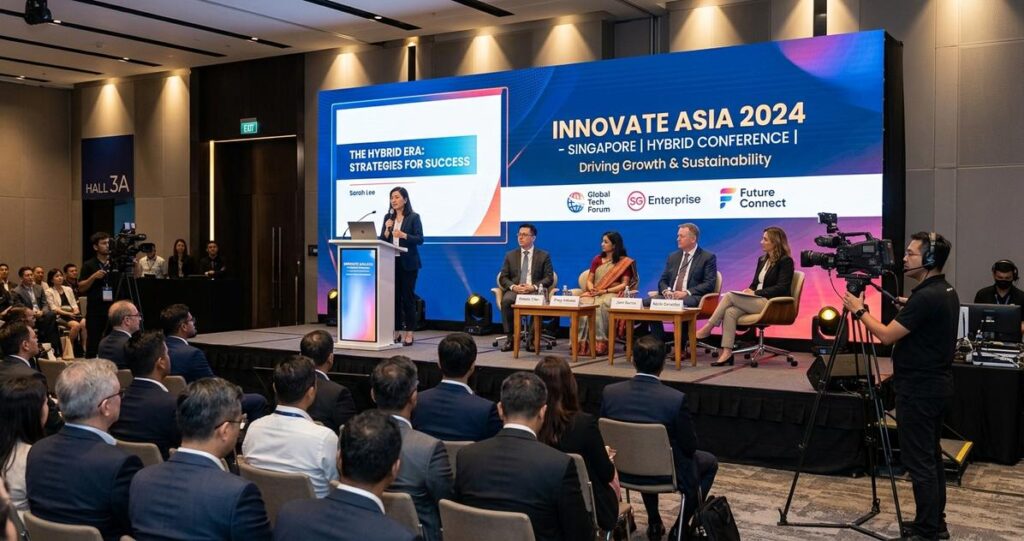
Hybrid events have become a familiar part of Singapore’s business, education, and public sector landscape. Whether it is a townhall with overseas speakers, a product launch streamed to clients across the region, or an association conference with both in-room and remote delegates, the stage now has to serve two audiences at once. That creates a simple but demanding question for organisers, how do you maintain a polished, professional stage environment when some people are physically present and others are participating through a screen?
For Singapore-based brands, the answer matters because expectations are high. Audiences here are used to efficient delivery, clear visuals, strong sound, and events that start on time. A hybrid stage must do more than look attractive. It must support communication, reduce technical friction, and help speakers stay calm and credible. Professionalism is not only about appearance, it is also about coordination, timing, sound discipline, camera awareness, and thoughtful planning that makes the experience feel seamless for everyone involved.
Managing a hybrid stage environment well requires a combination of event production skills, technical understanding, and human judgement. The goal is not to make the stage look perfect in a vacuum. The goal is to make the stage work, for the live audience, the online audience, the speaker, and the production team. In Singapore, where events often involve multilingual participants, compact venue layouts, and tightly scheduled programmes, that balance is especially important.
What makes a hybrid stage different from a traditional stage
A traditional stage is designed mainly for people in the room. A hybrid stage must serve two viewing modes at the same time. That means the stage has to look good from the front row and also translate clearly on camera. Lighting must suit both the human eye and the camera sensor. Audio must be intelligible in the room and through the livestream. Presenter movement must feel natural in person while remaining within the camera frame.
This dual responsibility changes how event teams think about layout and cueing. A speaker may need to stand in a specific mark so that a remote audience can see their face clearly. A screen that feels large enough in the ballroom may still be unreadable on stream if the graphics are too text-heavy. Even the spacing between chairs, lecterns, and LED walls can affect how professional the stage looks to an online viewer. The most effective hybrid setups are built around visibility, consistency, and disciplined stage traffic management.
Audience experience must be designed for both sides
In a hybrid event, the live audience and virtual audience are not identical. The live audience can read body language, sense energy in the room, and hear natural acoustics. The virtual audience depends on camera framing, microphone quality, and graphic clarity. A professional stage environment respects both experiences instead of favouring one entirely. This often means using stage design that feels clean and uncluttered, with enough visual hierarchy to guide attention without overwhelming the frame.
For Singapore events, this is particularly relevant in corporate settings where the stage may need to convey authority, neutrality, and brand consistency. A cluttered stage, excessive cable visibility, or poorly placed sponsor signage can weaken that impression immediately. The audience may not be able to explain what feels wrong, but they will notice that the production feels less controlled.
Planning the stage layout for clarity and control
Professionalism begins well before the event day. The layout of a hybrid stage should be mapped around sightlines, camera positions, audio capture, presenter flow, and technical access. Every item on stage should have a purpose. If it is not helping the message, the audience experience, or the production workflow, it may be creating unnecessary visual noise.
Production teams in Singapore often work in venues with different ceiling heights, stage depths, and floor plans, so there is no single template that fits every event. What remains consistent is the principle of control. The stage should allow presenters to move confidently without colliding with equipment, crossing into camera shadows, or blocking important visuals. Technical staff should also have safe access to adjust microphones, monitor laptops, or troubleshoot devices without disrupting the event.
Stage markings and presenter movement
Clear stage markings help presenters know where to stand, especially when they are balancing eye contact with the room and the camera. Subtle floor tape, movement cues, or pre-event rehearsals can reduce hesitation and awkward repositioning. This is not about restricting speakers unnecessarily. It is about making sure they can focus on delivery instead of wondering where the lens is, whether the microphone is picking up their voice, or whether they are standing too close to a screen.
For panel discussions, movement discipline becomes even more important. Chairs should be placed to preserve sightlines, and each speaker should know when to lean in, when to sit back, and how to use the table space without obstructing microphones or name cards. In a hybrid environment, small physical habits become large visual signals on camera.
Keeping technical equipment discreet but accessible
A professional stage is usually one where the audience notices the message rather than the equipment. That does not mean hiding every device completely. It means integrating microphones, return monitors, confidence screens, and camera equipment in a way that supports the event without distracting from it. Cable management, tidy risers, and clean equipment placement all contribute to that polished look.
Accessibility still matters. If a laptop must be swapped or a microphone battery needs to be changed, the crew should be able to do that quickly and quietly. In Singapore’s fast-paced event environment, smooth technical transitions are part of professionalism. Delays, visible confusion, and hurried adjustments can undermine trust even when the content itself is strong.
Sound, lighting, and visuals that support professional delivery
Audio quality is one of the most important elements in any hybrid event. Poor sound is harder to forgive than imperfect visuals because audiences rely on clear speech to follow the content. In practical terms, that means using appropriate microphones for the speaker type, checking levels in advance, and monitoring audio during the event rather than assuming the first setup will hold throughout the programme. A polished stage must allow speech to remain clear whether the presenter is at a lectern, seated on a panel, or moving between positions.
Lighting is equally important because hybrid audiences depend on camera clarity. A stage may look bright enough in person but still appear flat, dark, or uneven on stream. Good lighting supports facial visibility, reduces harsh shadows, and helps presenters appear composed. In a corporate setting, balanced light also contributes to a sense of authority and calm. This is especially useful when the event involves live announcements, leadership messages, or investor-facing content.
Why camera-friendly lighting matters
Camera-friendly lighting is not simply about brightness. It is about direction, consistency, and colour balance. The camera responds differently from the human eye, so stage lighting that feels natural in the room may still create glare, washed-out skin tones, or patchy contrast on screen. Professional production teams adjust for this by testing the interaction between the stage lighting, the LED wall or backdrop, and the camera settings before the event begins.
For Singapore venues that host both in-person and streamed events, lighting design should also account for warm ambient lighting in the room and the cooler appearance often preferred for camera work. The best results usually come from coordinated planning rather than last-minute adjustment.
Visual content should stay readable and purposeful
Hybrid events often rely on presentation slides, branded backdrops, and live graphics. These need to work for both audiences. Slides that contain too much text can be difficult to read on a smartphone screen. Overly complex animations may distract from the speaker. A professional stage environment uses visuals to reinforce the message, not compete with it.
Large screens, lower-third name graphics, and agenda slides should follow a consistent design language. Font sizes, contrast, and spacing matter. If the online audience cannot read the content without strain, the event is not fully serving its purpose. Good design choices help the event feel credible and efficient, which is particularly important for business audiences in Singapore.
Stage discipline, speaker readiness, and etiquette
Even the best-designed hybrid stage can feel unprofessional if the people on it are unprepared. Speaker readiness is a major part of stage management. Presenters need to understand the flow of the event, where they should stand, how they should use microphones, and what the camera is likely to capture. This is especially true when speakers are unfamiliar with live streaming and may not realise how their movements, gestures, or off-mic comments appear to the remote audience.
Stage discipline also includes punctuality, smooth handovers, and respectful communication between the production team and speakers. Professionalism improves when everyone knows the cue structure. A speaker who waits for the host’s introduction, a moderator who keeps discussion moving, and a crew that responds calmly to changes all contribute to a controlled environment. In Singapore, where many events are tightly timed, this level of discipline is essential.
Briefing speakers before they step on stage
Speaker briefings should be concise but specific. They should cover microphone use, camera awareness, the position of confidence monitors, where to look during speaking segments, and how transitions will happen. If a speaker will be joining remotely for part of the session, the team should also explain how the hybrid handoff works. This reduces uncertainty and helps the speaker project confidence.
It is also useful to brief speakers on practical matters such as water placement, movement boundaries, and interaction with audience questions. When speakers know what to expect, they are less likely to fumble with the setup or interrupt the flow of the programme. A calm speaker usually creates a calmer audience.
Maintaining consistent etiquette behind the scenes
Professionalism is often shaped backstage. Crew communication should be clear, concise, and respectful. Headsets, hand signals, and cue sheets help the team avoid confusion. If adjustments are needed, they should be handled quietly. In a hybrid event, even a minor backstage disruption can be picked up by microphones or seen by remote cameras if the production is not carefully managed.
For organisers in Singapore, this is where experienced event partners add real value. They understand venue logistics, audience expectations, and the importance of keeping the atmosphere smooth from pre-show checks to closing remarks. That consistency is part of the overall brand impression.
Contingency planning and professionalism under pressure
No hybrid event runs perfectly every time. A laptop may fail, a speaker may arrive late, or a remote connection may become unstable. Professionalism is not measured by whether problems occur. It is measured by how the team responds. A strong hybrid stage environment has backup plans for common risks, and the team knows how to activate them without creating panic.
Reliable contingency planning usually includes backup microphones, spare cables, alternative playback options, offline copies of presentation files, and a clear decision chain for technical issues. If a remote speaker loses connection, the host should know how to bridge the gap while the production team restores the link or switches to a different format. Calm, visible control reassures both audiences that the event is still under management.
Preparing for common technical interruptions
Hybrid events depend on multiple connected systems, so a failure in one part can affect the whole experience. That is why pre-event checks matter so much. Audio testing, video routing checks, internet stability checks, and rehearsal of transitions all reduce the chance of visible disruption. When possible, teams should also confirm whether the venue has suitable network support for streaming and whether power distribution can handle the production load safely.
For Singapore event organisers, it is sensible to consider the venue’s operational constraints, peak connectivity demands, and load-in schedules. Early coordination with the venue and technical partners can prevent avoidable stress on event day.
Keeping the audience informed without breaking flow
If a delay occurs, the audience should receive clear, calm information. Long silences make a venue feel disorganised, while overly dramatic announcements can make a minor issue feel bigger than it is. A short explanation, a transitional update, or a host-led bridge segment can preserve professionalism. The key is to stay measured and avoid making the audience feel stranded.
In hybrid production, the remote audience is especially sensitive to pauses and uncertainty because they lack the social cues available in the room. That is why transparent but controlled communication is a mark of quality production.
Why professional hybrid stage management matters for Singapore organisations
Singapore organisations often use hybrid events to reach clients across borders, support internal communication across regional teams, or engage stakeholders who cannot travel. That makes the stage environment part of the organisation’s public face. A clean, well-managed hybrid stage signals competence, preparation, and respect for the audience’s time.
It also protects the value of the content itself. Leaders, speakers, and subject-matter experts deserve a stage that helps them be understood clearly. When the production is professional, the message carries further and lands more effectively. When the production is disorganised, even strong content can feel less persuasive.
For brands in Singapore, that is especially important because event audiences often compare experiences quickly. A viewer may have seen many polished webinars, townhalls, and conferences. The standard is not based on what is possible in theory, but on what feels credible and well executed in practice. That is why hybrid stage management is not a cosmetic detail. It is a core part of communication quality.
Professionalism in a hybrid stage environment comes from thoughtful planning, disciplined execution, and a clear understanding of both live and digital audiences. The best results happen when layout, lighting, sound, visuals, and speaker management all work together. For Singapore events, where precision and efficiency matter, this integrated approach helps organisers deliver a stage that feels calm, credible, and ready for both the room and the stream. When the audience can focus on the message instead of the mechanics, the event has achieved what professional production is meant to do.
Jeremy Lee is a seasoned digital marketing director and strategist with over two decades of experience in the industry. As the founder of Sotavento Medios, I manage a diverse portfolio of over 50 businesses, helping brands grow through advanced search strategies and digital innovation. My work focuses on bridging the gap between traditional search engine optimisation and the evolving world of AI-driven answer engines.
get in touch