
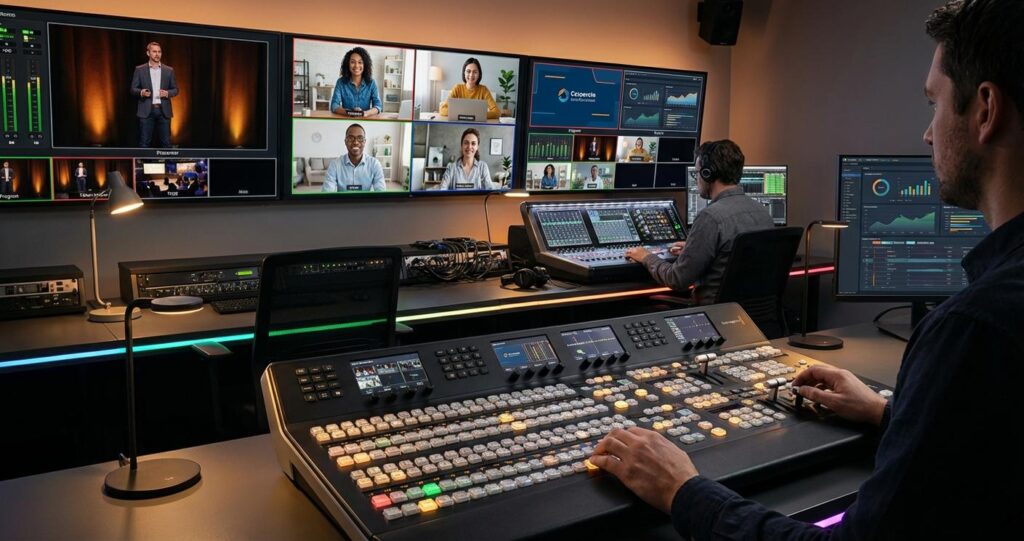
In the domain of professional B2B event streaming and hybrid production, the seamless integration of remote and in-person participants is the benchmark of success. As corporate broadcasts evolve from passive one-to-many transmissions into dynamic, interactive experiences, the technical complexities multiply. One of the most persistent and disruptive challenges is the management of audio-visual feedback loops. This issue, often underestimated in planning, can instantly derail a high-stakes executive town hall or a global sales kick-off, undermining credibility and disengaging the audience. Effectively mitigating feedback is not merely about troubleshooting; it requires a foundational understanding of signal flow, latency, and the deliberate architectural design of communication pathways. For enterprise clients and production managers, mastering feedback control is a non-negotiable component of delivering a broadcast that is both technically flawless and interactively robust.
This technical brief provides an in-depth analysis of the causes of feedback in interactive corporate broadcasts and outlines the specific, enterprise-grade solutions required for its prevention. We will move beyond rudimentary fixes and examine the professional hardware, software, and workflows that enable complex, multi-participant hybrid events. The focus is on building resilient production environments where clear, clean communication is guaranteed, regardless of the number of remote contributors or the geographical distance between them. From the intricacies of mix-minus audio routing to the strategic deployment of return video feeds, these principles are critical for any organization committed to professional-grade virtual and hybrid communication.
The Physics and Architectures of Audio-Visual Feedback
Understanding the root cause of feedback requires a precise diagnosis of the signal path. In a professional production environment, feedback is a symptom of a misconfigured signal loop where an output signal is inadvertently reintroduced as an input. This creates a self-reinforcing cycle that rapidly escalates into the familiar, unpleasant howling of acoustic feedback or the disorienting “hall-of-mirrors” effect in video. In hybrid events, this problem is magnified by the introduction of multiple remote locations, each with its own audio and video inputs and outputs, connected through networks that introduce inherent latency.
Acoustic vs. Digital Feedback Loops
Acoustic feedback is the classic scenario: a microphone picks up the sound from a nearby speaker that is amplifying its own signal. The solution is straightforward physical management, such as moving the microphone, reducing speaker volume, or using directional microphones. Digital feedback, the primary concern in hybrid events, is a more complex issue of signal routing. It occurs when a remote participant’s audio is sent to the main program mix, broadcasted, and then sent back to that same participant as part of their return or monitoring feed. Their microphone then picks up this returned audio from their earpiece or speakers, re-injecting it into the program mix. This digital loop, compounded by network latency, can be more challenging to diagnose and resolve than its acoustic counterpart because it exists entirely within the production system’s signal matrix.
Signal Flow Pathologies in Hybrid Environments
The core of the problem lies in the return feed sent to remote contributors. A remote presenter needs to hear the event’s program audio, including the host and other panelists, to interact naturally. A naive production setup might simply send the main program output, the same feed going to the live stream, back to every participant. This immediately creates a feedback loop for every active remote microphone. The audio travels from the remote participant’s microphone, through the main switcher, into the program mix, and is then routed directly back to the participant’s own monitoring device. The microphone captures this output, and the cycle begins, often resulting in a delayed, echoing effect that quickly becomes unintelligible.
The Role of Latency from SRT, RTMP, and WebRTC
Network transport protocols are a critical variable. A protocol like Real-Time Messaging Protocol (RTMP) typically has a latency of several seconds. If a remote participant using an RTMP-based return feed speaks, they will not hear their own voice come back through the loop for a few seconds, creating a distinct and distracting echo. Secure Reliable Transport (SRT), an increasingly common professional standard, offers much lower latency, often in the sub-second range. While this improves interactivity, it can make feedback loops even more aggressive and harder to manage, as the reinforcing cycle is faster. WebRTC, the protocol used by platforms like Zoom, Teams, and Webex, has the lowest latency but often uses aggressive, built-in echo cancellation (AEC) algorithms. While effective for basic meetings, this AEC can introduce audio artifacts and may not be sufficient for the high-fidelity audio requirements of a professional broadcast, making a properly engineered production workflow superior.

Core Audio Management: The Mix-Minus Solution
The definitive professional solution to digital audio feedback in a multi-contributor broadcast is the creation of a “mix-minus” feed. A mix-minus is a custom audio mix sent to a specific contributor that includes the entire program audio MINUS their own microphone signal. This allows them to hear everyone else in the event in real-time without hearing a delayed version of their own voice, thereby breaking the feedback loop at its source. For an event with five remote panelists, the audio engineer must create and manage five distinct mix-minus feeds in addition to the main program mix.
Defining Mix-Minus: A Technical Primer
Conceptually, a mix-minus is a sub-mix created using the auxiliary (AUX) sends or matrix outputs on a professional audio console. For each remote contributor, the audio engineer selects every audio channel for the mix (the host, other panelists, video playback, etc.) but deliberately omits the channel corresponding to that specific contributor’s microphone. The resulting mix is then routed out of the console through a dedicated output and sent to the contributor’s monitoring device, typically via an SRT encoder or directly through a cloud-based production platform. This process is repeated for every single remote source, ensuring each one receives a unique feed tailored to their needs.
Hardware Implementation: Digital Audio Consoles and Matrix Routers
Professional digital audio consoles, such as the Yamaha QL/CL series, Allen & Heath Avantis, or Behringer Wing, are designed for this task. Their routing matrices allow engineers to easily create numerous independent mixes. An audio signal from a remote source, often de-embedded from a 12G-SDI video signal or received via an IP audio protocol, is brought into an input channel on the console. The engineer then uses the “sends on fader” function to build the mix-minus on each AUX bus, pushing up the faders for all relevant sources except the one for whom the mix is being created. For extremely complex productions, a dedicated audio matrix router like those from BSS or Q-SYS can manage these intricate routing assignments with greater scalability.
Software-Based Mix-Minus: vMix, OBS, and Dante/AES67
Modern software-based video switchers like vMix have sophisticated audio routing capabilities built-in, allowing for the creation of multiple mix-minus feeds without external hardware. vMix utilizes a bus system, where an engineer can assign audio sources to different busses (e.g., Bus A, Bus B) and configure those busses as mix-minus outputs for specific remote callers via vMix Call. While functional, this can become complex to manage at scale. For ultimate flexibility, Audio over IP (AoIP) protocols like Dante and AES67 are the enterprise standard. Dante allows uncompressed, multi-channel audio to be routed over a standard Gigabit Ethernet network with near-zero latency. An engineer can route any audio source to any destination on the network, making the creation of dozens of mix-minus feeds a simple matter of digital patching in the Dante Controller software.
Video Feedback and Confidence Monitoring Challenges
Feedback is not limited to the audio domain. Video feedback, while less common, can be equally jarring. It typically occurs when a remote presenter’s camera captures the screen on which they are viewing the program return feed. This creates the classic “infinity” or “hall of mirrors” visual loop. Proper management of video return signals is therefore just as critical as audio mix-minus for a clean, professional production.
Preventing Video Feedback Loops with Remote Presenters
The simplest way to prevent video feedback is to instruct remote presenters to use a multi-monitor setup. One monitor should be dedicated solely to their camera and teleprompter if used, while a separate monitor displays the return feed from the studio. This physical separation prevents the camera from seeing its own output. Furthermore, presenters should never have the main program stream open in a web browser on the same machine they are using to contribute, as this can introduce both video and audio routing conflicts. All monitoring should be delivered through a managed, dedicated return path from the production team.

Architecting Return Feeds and Multiviews
Instead of sending a full program video return, which can be distracting and increases the risk of feedback, professional workflows often use custom-built return feeds. A common practice is to send a multiview display, showing the other panelists, the active speaker, and perhaps the program host. This gives the remote contributor crucial visual cues for interaction without showing them their own video feed. This can be built using the multiview outputs of a hardware switcher like a Blackmagic Design ATEM Constellation or a Ross Carbonite. The custom multiview is then encoded and sent back via a low-latency SRT stream, providing a high-quality, reliable confidence feed. This approach provides all necessary information while minimizing the risk of a video loop.
NDI and Network-Based Video Routing for Feedback Mitigation
Network Device Interface (NDI), a high-quality, low-latency video-over-IP protocol, offers exceptional flexibility in managing video return feeds. With an NDI-enabled workflow, every video source on the network (cameras, graphics, remote callers) becomes available as a distinct stream. A production team can use NDI routing tools to grab specific sources and send them to an NDI decoder at the remote location. This allows for the creation of completely bespoke return feeds on the fly. For instance, you could send a remote CEO a return feed showing only the live feed of the CFO they are speaking with, bypassing the main program switcher entirely. This granular control is a powerful tool for eliminating video feedback loops and providing a superior experience for high-profile remote talent.
Advanced Infrastructure and Communication Systems
For large-scale corporate broadcasts, managing feedback and communication extends beyond basic mix-minus and requires dedicated, broadcast-grade infrastructure. This ensures that communication between the production crew, hosts, and remote talent is clear, isolated from the program audio, and fully redundant.
Integrating Professional Intercom and IFB Systems
A professional intercom (comms) system is the backbone of any serious production. Systems from manufacturers like Clear-Com and Riedel provide dedicated, full-duplex communication channels for the entire crew. Critically, these systems integrate Interruptible Foldback (IFB) capabilities. An IFB is a one-way audio feed sent to on-air talent, typically through a discreet earpiece. It carries the program audio by default, but allows the director or producer to interrupt the feed with specific instructions (“You have 30 seconds left,” “Look at Camera 2”). By using an IFB system for talent monitoring instead of a simple audio return, the communication line is completely isolated from the main audio mix, making feedback an impossibility. The program audio they hear is for monitoring only and is never intended to be picked up by their microphone.
Cloud Production Platforms and Feedback Management
Fully cloud-based production platforms are architected from the ground up to handle remote contribution and feedback mitigation. Platforms like Grabyo or TVU Producer provide an integrated ecosystem where remote guests join via a web link. The platform automatically manages the audio routing, creating individual mix-minus feeds in the cloud. The producer has a web-based interface to control who hears whom, and all return feeds are managed within the system. This centralizes control and removes the need for complex on-premise routing, making it a scalable solution for events with a high number of geographically dispersed contributors.
Redundancy and Failover for Communication Lines
For mission-critical events, a single point of failure in communication is an unacceptable risk. Professional productions build in redundancy for all critical signal paths, including feedback and monitoring lines. This could involve sending SRT return feeds over two separate internet connections (e.g., primary fiber, backup cellular bonding). For IFB and comms, this might mean having a primary Dante-based system with a backup analog or POTS line available for the director to talk to key talent if the primary network fails. This belt-and-suspenders approach ensures that control over the broadcast and communication with participants is never lost, preserving the integrity of the event even in the face of technical difficulties.
In conclusion, the effective management of feedback loops is a direct reflection of a production’s technical maturity. It is a challenge that demands a proactive, architectural approach rather than a reactive, troubleshooting mindset. By implementing robust audio solutions like mix-minus via hardware or AoIP, designing intelligent video return feeds, and integrating professional communication systems like IFB, production teams can create a stable and predictable environment. This technical foundation allows for seamless, dynamic interaction between hosts, panelists, and audiences, regardless of their physical location. For Spring Forest Studio and our enterprise clients, these advanced workflows are not optional; they are the essential building blocks of a truly professional and engaging corporate broadcast.
Jeremy Lee is a seasoned digital marketing director and strategist with over two decades of experience in the industry. As the founder of Sotavento Medios, I manage a diverse portfolio of over 50 businesses, helping brands grow through advanced search strategies and digital innovation. My work focuses on bridging the gap between traditional search engine optimisation and the evolving world of AI-driven answer engines.
get in touch