
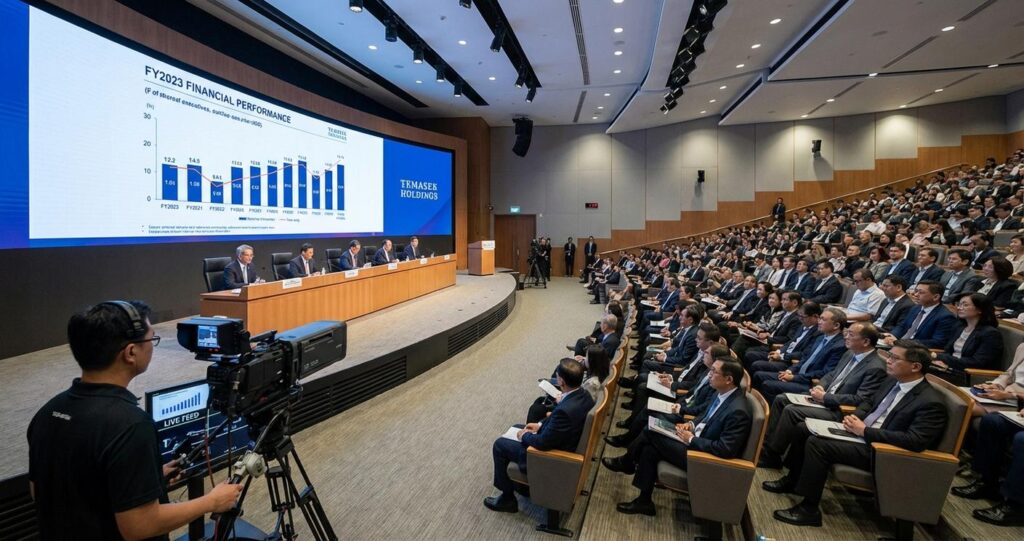
The Uncompromising Mandate: Engineering a Flawless AGM Broadcast
An Annual General Meeting (AGM) for a major Singaporean corporation is not merely a presentation; it is a mission-critical event under intense scrutiny. For stakeholders, board members, and investors, the seamless delivery of information is directly correlated with corporate competence. There is no tolerance for technical failure. This checklist moves beyond basic event planning and into the technical core of broadcast engineering and production infrastructure required to execute a high-stakes, hybrid corporate AGM. We will dissect the granular details of signal flow, protocol selection, hybrid integration, and redundancy strategies that are non-negotiable for a successful outcome. This is the engineering perspective, designed for production managers and IT directors who carry the responsibility for flawless execution.
Core Production Infrastructure and Signal Path Integrity
The foundation of any successful stream is an immaculate signal path, from the camera sensor to the primary production switcher. For a corporate AGM, where visual clarity of financial data and speaker nuance is paramount, compromising on source quality is unacceptable. The entire production chain must be engineered to preserve the highest possible signal integrity.
H3: Source Acquisition and Transport: Beyond HDMI
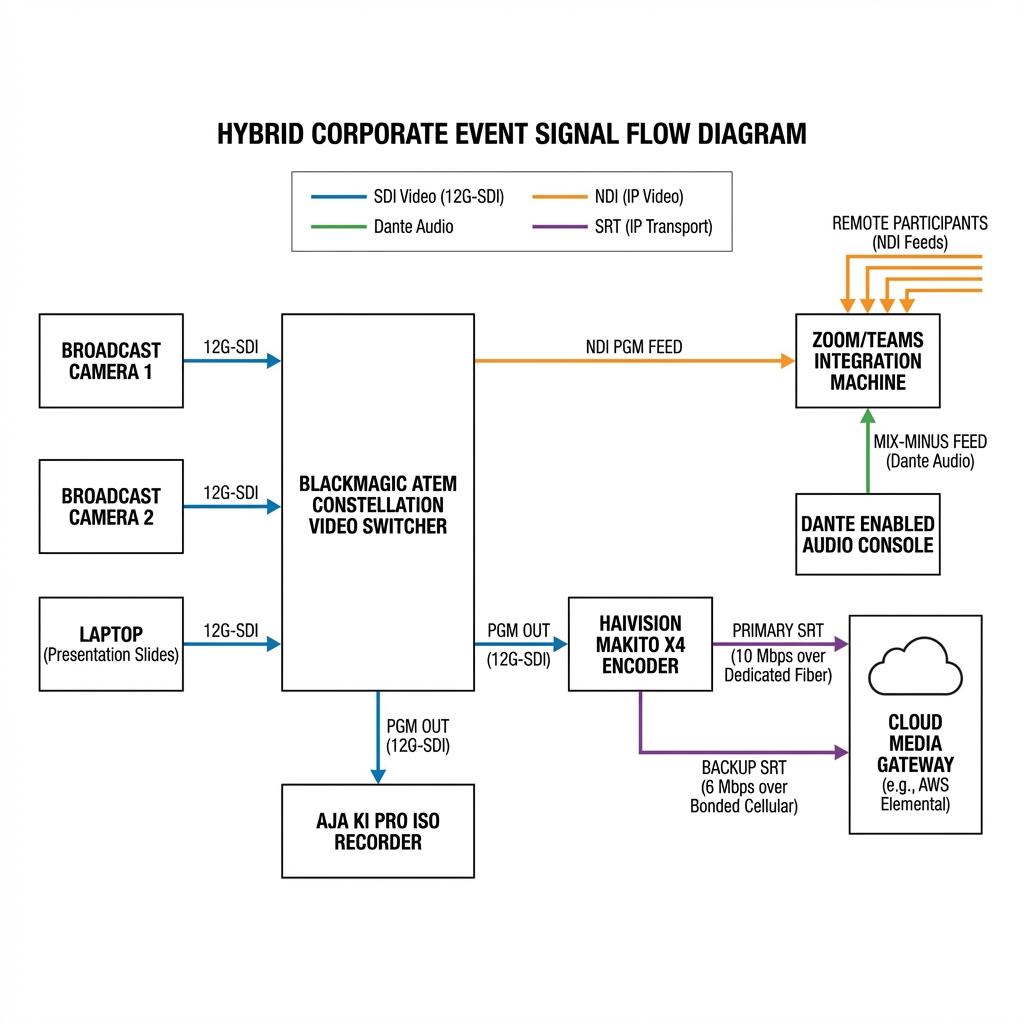
Professional broadcast cameras form the primary acquisition point. For a corporate environment, this means cameras outputting a minimum of a 10-bit 4:2:2 signal to capture the full color depth and dynamic range required for professional keying and color correction. The transport protocol from the camera to the control room is critical. While HDMI is common in prosumer setups, for the cable runs typical in large ballrooms or auditoriums, it is inadequate. We rely on Serial Digital Interface (SDI), specifically 6G-SDI for UHD 30p or 12G-SDI for UHD 60p workflows, to ensure zero-compression and zero-latency signal transport over long distances via a single coaxial cable. For distributed or networked production within a venue, Network Device Interface (NDI) offers a viable IP-based alternative. However, it requires a meticulously planned network infrastructure with sufficient bandwidth (at least 1GbE for standard NDI, and 10GbE for multiple 4K streams) and Quality of Service (QoS) protocols enabled on managed network switches to prioritize video traffic and prevent packet loss.
H3: Centralized Routing and Signal Management
All video and audio sources must terminate at a central routing matrix. A professional video router, such as those from Blackmagic Design or Ross Video, acts as the heart of the production, allowing any source to be patched to any destination without manual cable changes. This provides immense flexibility and redundancy. For example, a primary presentation laptop feed can be routed simultaneously to the production switcher, a backup recorder, and stage confidence monitors. Audio follows a similar principle, preferably using an IP-based protocol like Dante or AES67. This allows for all microphone feeds, embedded SDI audio, and playback sources to be managed and mixed from a central audio console, with the ability to create separate mixes (mix-minus feeds) for remote participants, the main broadcast, and in-room public address systems.
Contribution Encoding and Resilient Transport Protocols
Once a clean program feed leaves the production switcher, it must be encoded and transported to the streaming platform or Content Delivery Network (CDN). This is one of the most frequent points of failure in any live stream. The choice of protocol and encoding parameters dictates the stability, latency, and quality of the final broadcast. For a high-stakes AGM, standard protocols often do not provide the necessary resilience.
H3: SRT as the Enterprise Standard Over RTMP
While Real-Time Messaging Protocol (RTMP) has been a workhorse for years, it is increasingly insufficient for enterprise-level streaming due to its reliance on TCP, which can lead to buffering and dropped frames over unstable networks. We mandate the use of Secure Reliable Transport (SRT) for all our critical event contributions. SRT is an open-source protocol that provides the reliability of TCP with the low latency of UDP. Its key advantage is its sophisticated packet loss recovery mechanism, which re-transmits lost packets far more efficiently than TCP, resulting in a stable stream even over congested public internet connections. It also provides AES-128/256 bit encryption, a critical security consideration for sensitive corporate communications. This protocol requires a professional hardware or software encoder (e.g., Haivision, AJA, vMix) and a receiving server or cloud platform that supports SRT ingest.
H3: Encoding Parameters and Bitrate Strategy
The program feed, typically a 1920x1080p50 or 3840x2160p50 signal, must be compressed for internet delivery. The encoding standard used is either H.264 (AVC) for broad compatibility or H.265 (HEVC) for more efficient compression, which can deliver higher quality at a lower bitrate. For a primary 1080p50 stream, a starting contribution bitrate would be between 8 to 10 Mbps using H.264. This high-quality mezzanine feed is then sent to a cloud transcoding service, like AWS Elemental MediaLive or a similar function within a platform like Vimeo Enterprise. The cloud service then creates an adaptive bitrate (ABR) ladder, a series of lower-resolution and lower-bitrate versions of the stream (e.g., 720p at 4 Mbps, 480p at 2 Mbps). This ensures that viewers with varying internet speeds can receive a continuous stream without buffering, as their player will automatically select the highest quality stream their connection can support.
Hybrid Integration for Shareholder Participation
A modern AGM requires seamless integration between the in-room broadcast production and virtual participation platforms like Zoom, Microsoft Teams, or Webex. This creates a complex audio and video routing challenge. The goal is to make remote participants feel as present as the physical attendees, particularly during critical Q&A sessions, without compromising the main broadcast quality.
H3: Architecting the Hybrid Video Workflow
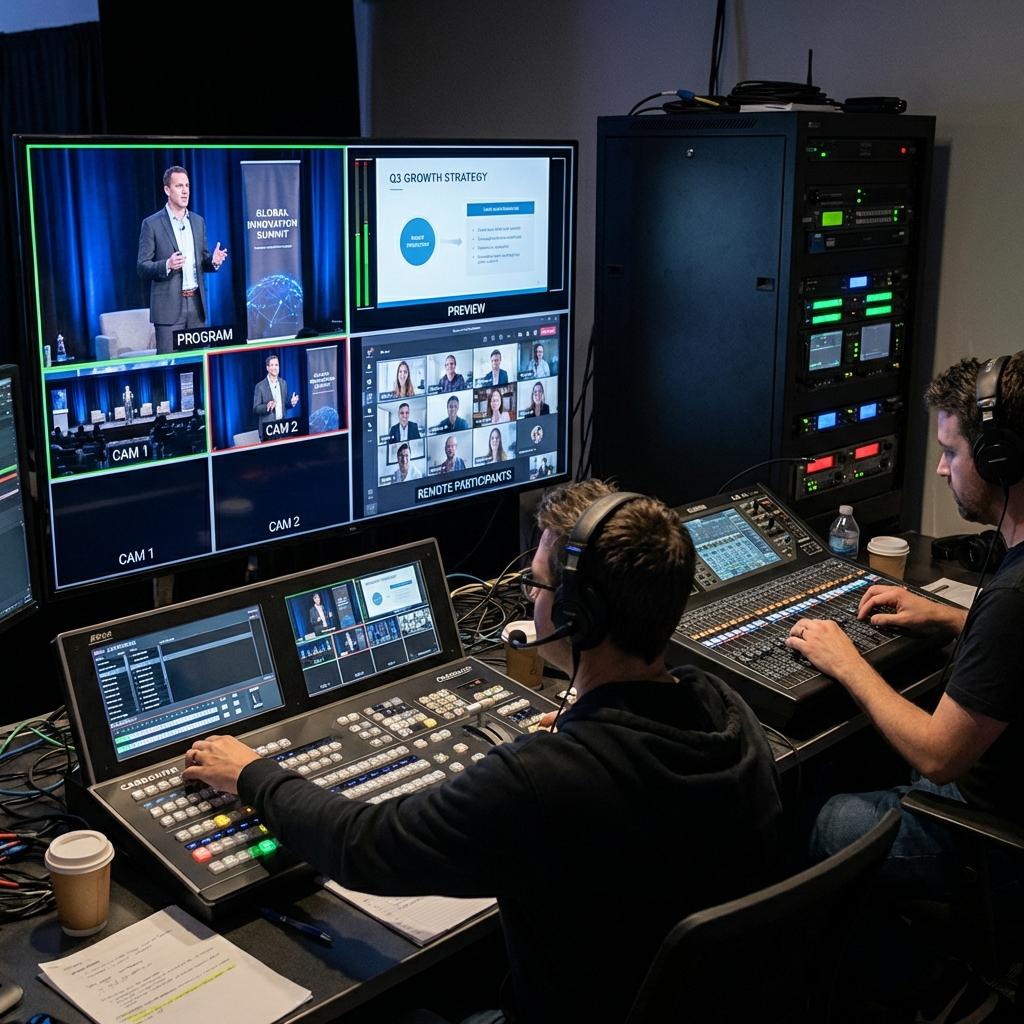
Integrating remote participants requires bringing their video feeds into the main production switcher. A common method is to use a dedicated computer with multiple SDI or NDI outputs, with each output “pinned” to a specific remote panelist or shareholder in the virtual meeting. This allows the technical director to switch to a remote participant as a full-screen source, just like a physical camera in the room. More advanced solutions like the AJA Bridge NDI or BirdDog PLAY allow for converting the NDI output from a meeting platform directly to SDI for integration into a broadcast environment. The return feed back to the remote participants is equally important. This should not be the main program feed, as it would create a disorienting delay for them. Instead, a dedicated low-latency “confidence” feed, often showing a multiview of the main speakers and presentation, is sent back into the meeting platform to keep them engaged.
H3: Advanced Audio Management: The Mix-Minus Imperative
Audio is the most complex element of a hybrid event. The primary challenge is preventing remote participants from hearing an echo of their own voice, which occurs when the main program audio (containing their voice) is sent back to them. The solution is a mix-minus feed. A separate audio mix is created on the audio console for the virtual platform. This mix contains all audio from the event (microphones, video playback) MINUS the audio coming from the remote participants themselves. Each remote participant or group requires its own unique mix-minus. This is a standard practice in broadcast but is often overlooked in corporate events, leading to a confusing and unprofessional experience for remote stakeholders. Professional digital audio consoles and Dante-based audio networks make the creation and routing of these complex mixes manageable.
Redundancy, Failover, and Network Architecture
For an AGM, failure is not an option. A robust redundancy plan must be in place for every critical component in the signal chain, from power to network connectivity to the final CDN delivery. This plan must be documented, tested, and ready for immediate activation.
H3: Path Diversity and Network Resilience
The single greatest point of failure is network connectivity. We engineer a solution based on path diversity. The primary internet connection should be a dedicated, uncontended fiber line from the venue’s provider. The secondary, or backup, connection must be from a completely different provider and, ideally, use a different physical medium. A bonded cellular solution, combining multiple 4G/5G modems from different carriers (e.g., Singtel, StarHub, M1), serves as an excellent independent backup. We configure our encoders to stream in parallel over both paths simultaneously. Using a protocol like SRT with bonding capabilities or a cloud-based service like LiveU, we can ensure that if the primary fiber link degrades or fails, the stream continues uninterrupted over the cellular backup.
H3: Hardware and Power Redundancy
Every critical piece of hardware should have a backup. This means running a fully redundant encoder (an A/B setup). Both encoders receive the same program feed and are configured identically. If the primary encoder fails, the stream from the backup encoder can be activated at the CDN level with minimal disruption. The production switcher itself should have redundant power supplies. All equipment, including cameras, routers, and converters, must be powered through an Uninterruptible Power Supply (UPS) system to guard against power fluctuations or brief outages. For an event of this scale, coordinating with venue facilities to ensure access to independent power circuits for production equipment is a critical preparatory step. This comprehensive approach to redundancy ensures that no single point of failure can jeopardize the entire Annual General Meeting broadcast.
Jeremy Lee is a seasoned digital marketing director and strategist with over two decades of experience in the industry. As the founder of Sotavento Medios, I manage a diverse portfolio of over 50 businesses, helping brands grow through advanced search strategies and digital innovation. My work focuses on bridging the gap between traditional search engine optimisation and the evolving world of AI-driven answer engines.
get in touch