
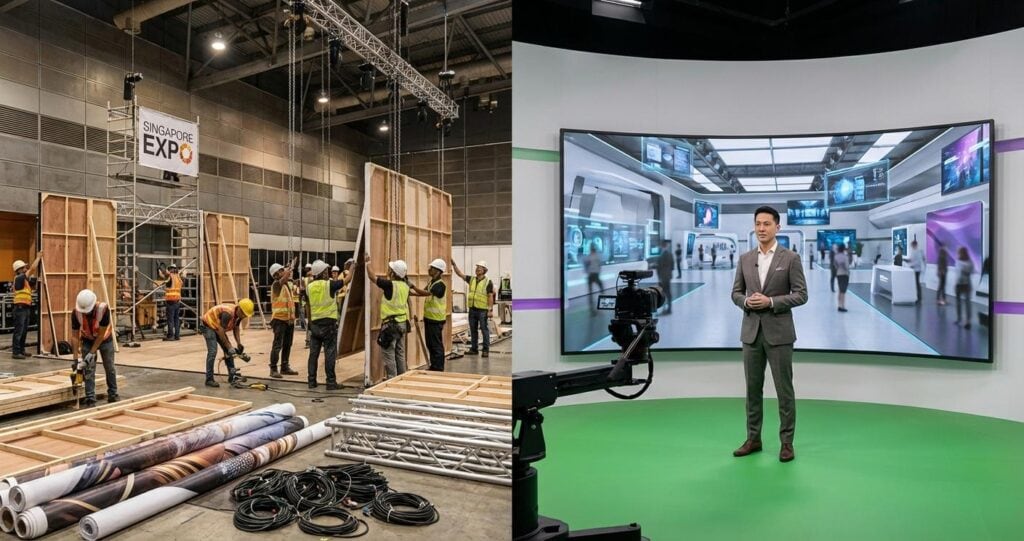
A Technical Analysis: The True Cost of Virtual Sets vs. Physical Builds in Singapore
For enterprise clients and production managers in Singapore, the strategic calculus behind staging a corporate event, product launch, or annual general meeting has reached a critical inflection point. The decision is no longer merely about venue selection and attendee management; it is a complex equation of technical execution, brand immersion, and fiscal responsibility. At the heart of this equation lies a foundational choice: allocating significant operational expenditure towards traditional, physical set construction versus investing in the capital-intensive but highly flexible infrastructure of virtual production. This analysis moves beyond surface-level comparisons to provide a detailed technical breakdown of the Total Cost of Ownership (TCO) for each methodology, offering a clear framework for making informed, high-stakes production decisions in Singapore’s demanding market.
The core challenge is maximizing production value and broadcast quality while navigating the inherent constraints of a dense urban environment. Physical builds, while tangible and familiar, come with a cascade of direct and indirect costs tied to materials, labor, venue footprint, and logistical complexity. Conversely, virtual sets, powered by real-time rendering engines and camera tracking technology, promise unparalleled creative freedom and long-term reusability. However, they demand a substantial initial CapEx investment and a specialized skillset to operate effectively. This article provides a granular examination of the financial and technical trade-offs, enabling stakeholders to accurately forecast budgets and align production strategy with corporate objectives.
Deconstructing the Total Cost of Ownership for Physical Set Builds
The process of budgeting for a physical set is often misleadingly simplified. The quoted price for fabrication is merely the starting point. A comprehensive TCO analysis reveals significant recurring costs and logistical burdens that impact the overall event budget and operational timeline. For hybrid events, these costs are amplified as the set must serve both a live audience and a remote broadcast feed, demanding higher standards of finish and integrated technology.
Direct Material, Fabrication, and Labor Costs
The primary expense is the raw fabrication of the set. This involves custom carpentry, metalwork, and precision-cut scenic elements. In Singapore, sourcing specific materials and skilled labor can be a significant cost driver. A multi-layered set for a corporate summit, featuring branded backdrops, custom lecterns, and integrated LED tile arrangements, requires a team of specialized artisans. Labor costs extend beyond construction to include project management, technical drafting (CAD), and on-site assembly and dismantling crews. Any last-minute design alteration, a common occurrence in corporate event planning, triggers costly change orders and potential timeline disruptions, directly impacting the bottom line.
Venue and Logistical Overheads
Physical sets consume a valuable and expensive commodity in Singapore: square meterage. The required venue footprint must accommodate not only the visible set but also backstage storage, construction staging areas, and safe access routes. This directly increases venue rental costs. The logistical chain introduces further expenses. Transportation of large scenic elements requires specialized freight services. Load-in and load-out periods can span multiple days, each day adding to venue and labor costs. Power distribution is another critical factor; elaborate lighting rigs and embedded video screens necessitate significant power drops and cabling, often requiring licensed electricians and incurring additional charges from the venue. The weight of the set can also impact which venues are even viable, potentially limiting options and increasing costs for venues with the required floor loading capacity.
The Rigidity Deficit: The High Cost of Inflexibility
The most significant hidden cost of a physical build is its inherent inflexibility. Once constructed, the set is static. A multi-segment event with different branding for a keynote, a panel discussion, and a product reveal would traditionally require three separate physical configurations or a single, compromised design. This is a major limitation for dynamic virtual events. If a keynote speaker’s branding changes or a new top-tier sponsor is added a week before the event, altering a physical set is often financially or logistically impossible. This “rigidity deficit” means the production is locked into a single aesthetic, limiting creative agility and the ability to monetize different segments of the event with unique sponsor branding. The entire asset has a lifespan of a single event, with near-zero reusability, representing a complete financial write-off post-event.
Analyzing the CapEx and OpEx of Virtual Production Workflows
Transitioning to a virtual production model fundamentally shifts the cost structure from a per-event operational expense to an initial capital investment in a reusable technology ecosystem. This approach requires a sophisticated understanding of broadcast and IT infrastructure, but offers a powerful long-term financial and creative advantage. The initial investment creates a production platform capable of generating unlimited unique environments for a fraction of the per-event cost of physical builds.
Initial Capital Expenditure: The Technology Stack
The foundation of a professional virtual set is a tightly integrated hardware and software stack. This is a significant one-time investment. Key components include:
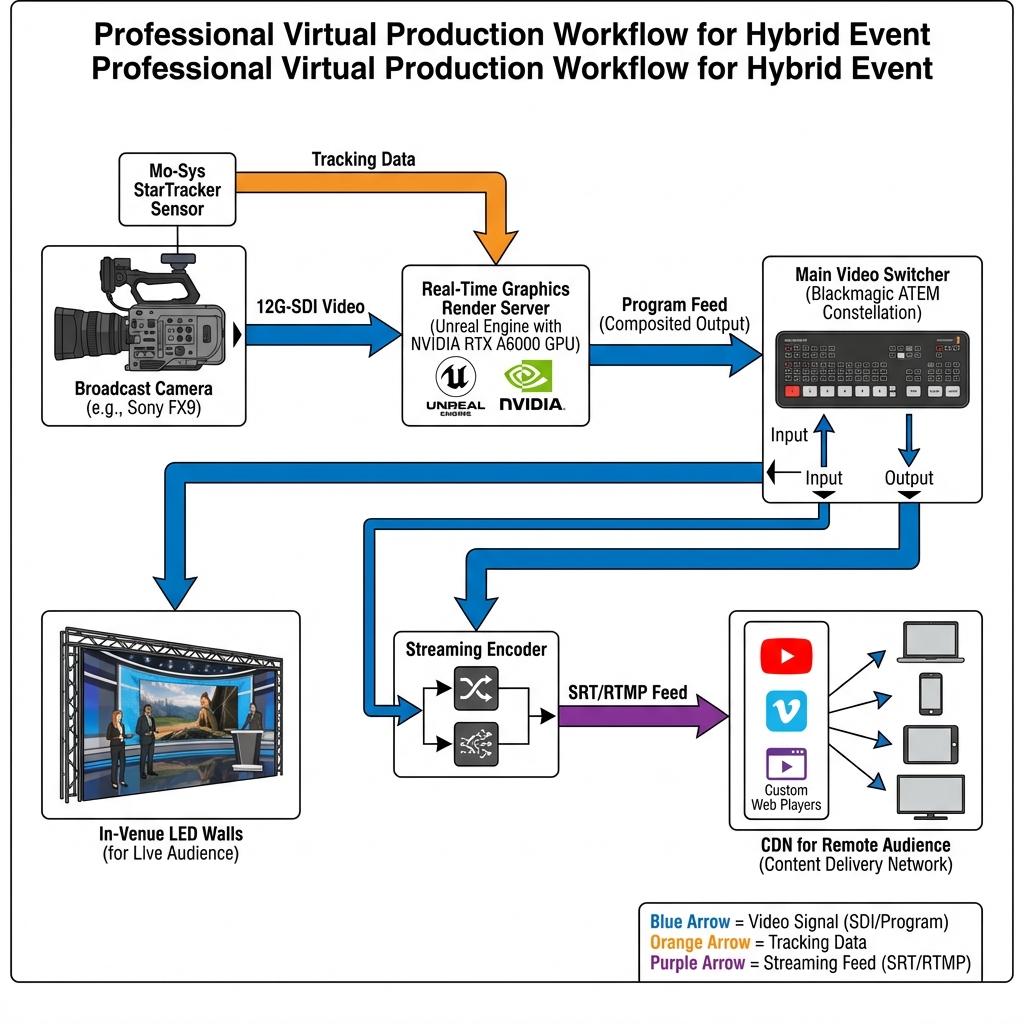
- Real-Time Rendering Engine: This is the brain of the operation. Systems built on engines like Unreal Engine or Brainstorm eStudio require high-performance GPU servers. These servers are typically equipped with multiple NVIDIA RTX A6000 or A5000 GPUs, capable of rendering photorealistic 3D environments at high frame rates (e.g., 1080p50, 2160p50) with minimal latency.
- Camera Tracking System: To seamlessly blend the real and virtual worlds, the system must know the precise position and movement of the physical camera. Industry-standard solutions like Mo-Sys StarTracker or stYpe RedSpy provide real-time tracking data (pan, tilt, zoom, focus, XYZ position) to the rendering engine. This requires specialized hardware sensors on the camera and infrared markers in the studio.
- Broadcast Cameras and Lenses: The system requires professional cameras with genlock capabilities, such as a Blackmagic URSA Broadcast G2 or Sony FX series, to synchronize with the graphics engine. This ensures all video sources operate from the same timing reference, preventing frame tearing and other visual artifacts. Lenses must be calibrated with the tracking system to accurately map lens distortion and focal length.
- Video and Data I/O: High-bandwidth video input/output cards, like the AJA Kona 5 or Blackmagic DeckLink 8K Pro, are essential for moving uncompressed video signals (typically via 12G-SDI) in and out of the render server with the lowest possible latency.
Operational Expenditure: Specialized Talent and Content Pipeline
While a virtual set eliminates costs for physical materials and construction, it introduces new operational expenses centered on specialized labor. Operating a virtual production system requires a different skillset than traditional AV. Key roles include an Unreal Engine Operator, who manages the 3D environment in real-time; a Tracking Technician, who calibrates and monitors the camera tracking system; and a Systems Engineer, who manages the complex signal flow and network infrastructure. Additionally, there is an upfront cost for creating or purchasing the 3D digital assets and environments. However, once created, these assets are infinitely reusable and modifiable, representing a stark contrast to the single-use nature of physical sets.
Infrastructure Requirements: NDI, SRT, and High-Bandwidth Networking
A virtual production studio is a data-intensive environment. The entire workflow relies on a robust, low-latency network infrastructure, typically built on a 10GbE or faster backbone. Protocols like NDI (Network Device Interface) are used to transport high-quality, low-latency video signals over this local network, reducing the need for extensive SDI cabling. For remote elements, such as bringing in a guest speaker into the virtual environment, SRT (Secure Reliable Transport) is the professional standard. SRT provides a stable, encrypted video stream over the public internet, overcoming packet loss and jitter. This network infrastructure is a critical, often overlooked, component of the virtual production budget but is fundamental to its successful operation.
A Comparative ROI Framework for Singapore-Based Hybrid Events
The true financial advantage of virtual sets becomes clear when analyzed over a series of events. The return on investment (ROI) is realized through reusability, reduced logistical overhead, and enhanced creative capacity. This is particularly impactful for companies in Singapore that host multiple corporate events, town halls, or marketing broadcasts throughout the year.
Scenario 1: The Annual Corporate Summit
Consider a large-scale annual summit that previously required a S$100,000 physical set build. This is a one-time use asset. For a similar budget, a company could make a significant down payment on a permanent virtual production setup. While the first event might have a similar all-in cost, the second event’s “set” is now an operational expense, costing only the labor and digital asset creation (e.g., S$20,000) to create a completely new virtual environment. By the third event, the company is realizing an S$80,000 saving compared to their previous model. The virtual set can be instantly changed for different speakers or sessions, offering the production value of multiple physical sets within a single event day, something financially impossible with traditional methods.
Hybrid Event Integration: Signal Flow and Latency Management
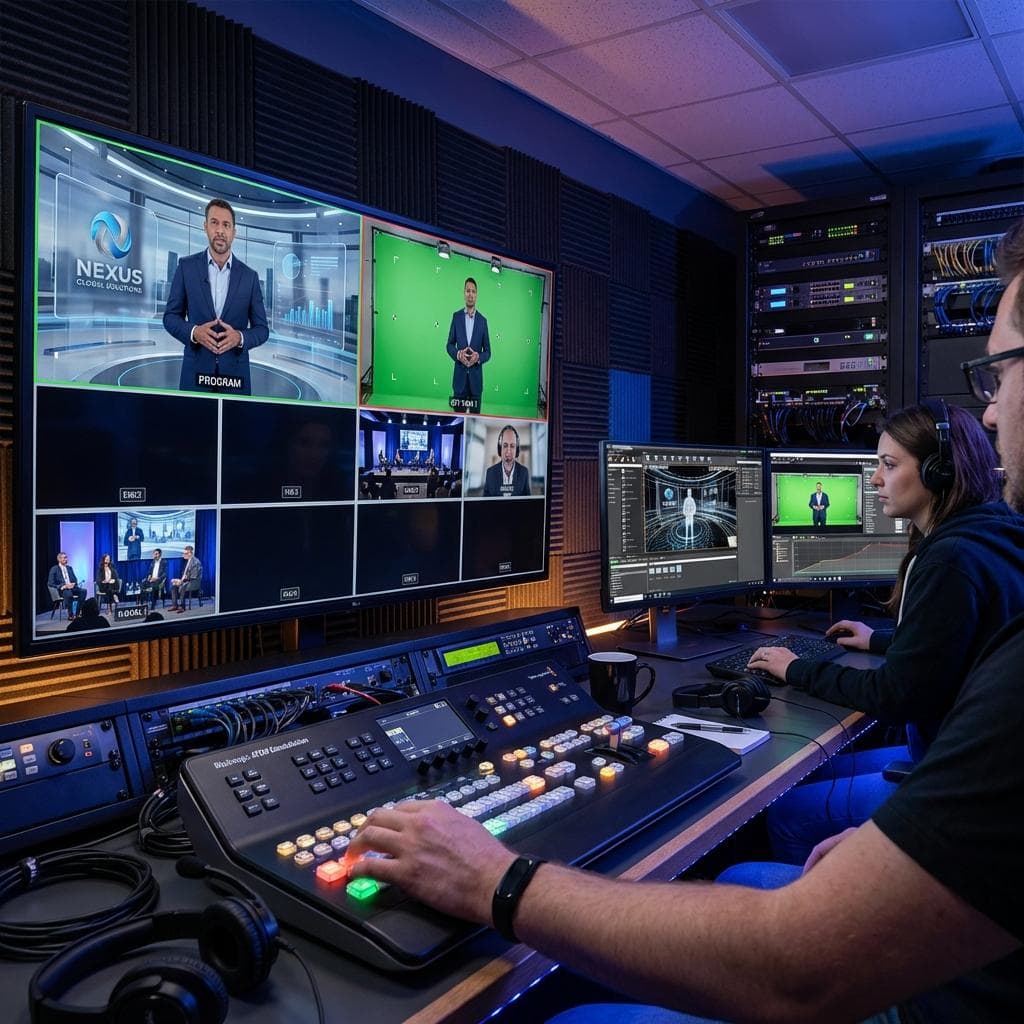
Virtual sets are exceptionally well-suited for the complex signal flow of hybrid events. The final composited program feed, a mix of the real presenter and the virtual background, is generated in the render engine. This signal is then sent via SDI or NDI to the main production switcher (e.g., a Ross Carbonite or Blackmagic ATEM Constellation). From the switcher, the feed can be routed simultaneously to two distinct destinations:
- In-Venue Displays: Sent to large LED walls or projection screens for the physical audience, often referred to as IMAG (Image Magnification).
- Streaming Encoders: Sent to hardware or software encoders for distribution to the remote audience. The feed is encoded into a streamable format using codecs like H.264 or H.265, packaged using protocols like RTMPS for social platforms or SRT for secure enterprise distribution, and sent to a Content Delivery Network (CDN).
Careful management of the signal chain is critical to ensure latency is minimized and that audio and video remain synchronized for both audiences, maintaining a seamless experience for all participants.
Making the Strategic Decision: When to Build, When to Go Virtual
The decision between a physical and virtual set is not a binary choice between old and new technology. It is a strategic decision based on the specific goals, frequency, and nature of the event portfolio. For a one-off event that requires significant physical interaction with the set elements, a traditional build may still be the most direct solution. However, for organizations in Singapore focused on building a long-term, scalable, and sustainable event strategy, the business case for virtual production is overwhelmingly strong.
By shifting the investment from disposable, single-use materials to a reusable, technologically advanced platform, companies can achieve superior production value, unparalleled creative flexibility, and a significantly lower TCO over the lifespan of the equipment. In a market where efficiency, innovation, and sustainability are paramount, virtual production infrastructure is no longer a niche technology but a core component of a modern, future-proof corporate communication strategy. As experts in designing and implementing these complex broadcast-grade systems, Spring Forest Studio provides the technical guidance and integration services necessary to navigate this critical transition, ensuring your production capabilities align with your long-term business objectives.
Jeremy Lee is a seasoned digital marketing director and strategist with over two decades of experience in the industry. As the founder of Sotavento Medios, I manage a diverse portfolio of over 50 businesses, helping brands grow through advanced search strategies and digital innovation. My work focuses on bridging the gap between traditional search engine optimisation and the evolving world of AI-driven answer engines.
get in touch