
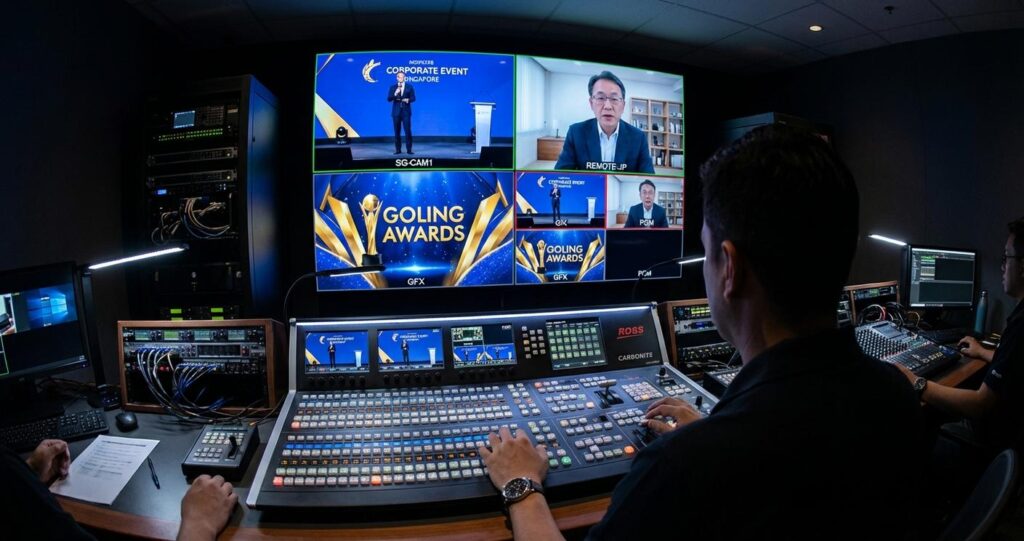
The paradigm for corporate communication has fundamentally shifted, particularly in the geographically diverse and technologically dynamic landscape of Asia. Simple video conferencing solutions, once a temporary fix, are now technically insufficient for high-stakes internal events like employee recognition ceremonies. These events are not mere meetings; they are critical expressions of corporate culture, morale, and appreciation. Consequently, the production value must align with the significance of the message. This requires a transition from rudimentary webcam-based calls to broadcast-grade virtual and hybrid production architectures. For enterprise clients across Asia, from Singapore to Seoul, the challenge involves managing multiple remote presenters, ensuring high-quality signal integrity over variable public internet infrastructure, and delivering a seamless, secure, and scalable viewing experience to a distributed workforce. This evolution demands a deep understanding of professional streaming protocols, network infrastructure, and live production workflows to create an event that truly honors employee achievements and reinforces brand excellence. The technical execution is paramount, as any failure in the delivery chain directly undermines the event’s purpose.
Architecting the Core: From Desktop Solutions to Broadcast-Grade Infrastructure
The initial phase of virtual events was characterized by the use of consumer-grade platforms. However, their inherent limitations in signal control, quality, and reliability quickly became apparent for mission-critical corporate productions. The evolution towards a professional model begins with building a robust technical foundation capable of ingesting, managing, and processing multiple high-quality audio and video sources with broadcast-level precision. This involves moving away from software-only solutions and implementing a hardware-centric and protocol-driven workflow that guarantees stability and quality of service.
Transitioning Beyond Platform Limitations with Professional Protocols
Standard video conferencing platforms like Teams or Zoom utilize proprietary, adaptive protocols optimized for low-latency conversation, not high-quality production. They aggressively compress video, offer minimal manual control over resolution and frame rate, and lack the robust transport mechanisms needed for professional broadcast. To overcome this, the industry has standardized on specific contribution protocols. The Secure Reliable Transport (SRT) protocol has become a cornerstone for remote production, enabling the transmission of high-quality, low-latency video over unreliable networks like the public internet. SRT’s packet recovery mechanism is critical when bringing in feeds from presenters in locations with suboptimal network conditions, a common scenario across Southeast Asia. Unlike the older Real-Time Messaging Protocol (RTMP), SRT offers superior error correction and security with AES-128/256 encryption. Internally, within a local area network (LAN), Network Device Interface (NDI) technology has revolutionized IP-based video workflows. NDI allows for the transport of high-definition and 4K video, audio, and metadata over a standard 1GbE or 10GbE network, drastically reducing the need for traditional point-to-point SDI cabling and increasing system flexibility.
Implementing a Resilient Signal Management and Routing Core
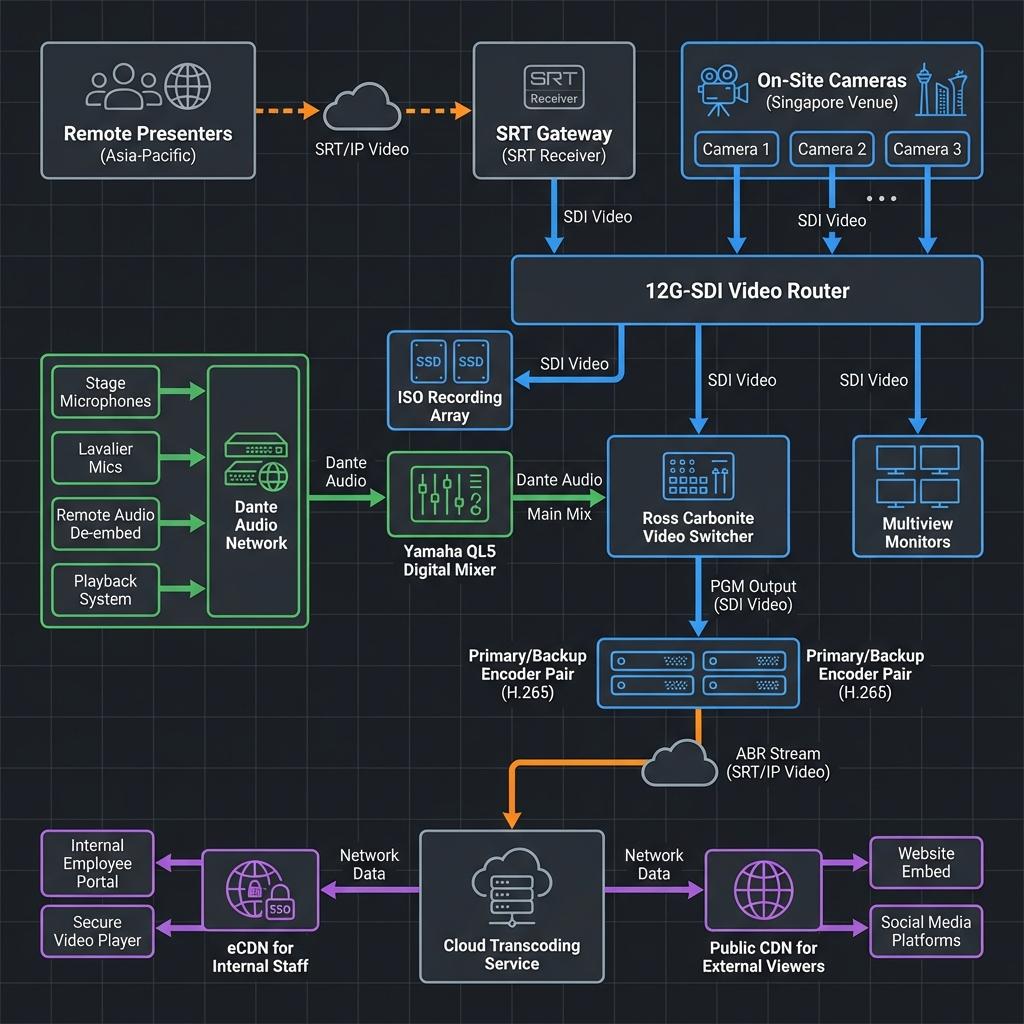
At the heart of any professional production is a centralized signal management system. This is typically built around a Serial Digital Interface (SDI) video router, such as a Blackmagic Design Videohub or Ross Video Ultrix. SDI is a baseband video standard that provides an uncompressed, robust signal path critical for maintaining pristine quality throughout the production chain. Feeds from on-site cameras, playback servers, and remote source decoders are converted to SDI and fed into the router. This allows any source to be routed to any destination: a video switcher, a multiviewer monitor, or an ISO (isolated) recording deck. Genlocking all video sources to a master sync generator is a non-negotiable step. This ensures all signals are frame-accurate, preventing glitches or frame tearing during switching. The ability to route signals cleanly is the foundation of a professional workflow, enabling complex productions to be managed with precision and reliability.
The Hybrid Production Control Room: Integrating Multiple Realities
The modern employee recognition ceremony is often a hybrid affair, combining a physical stage with presenters and awardees joining remotely from across the Asia-Pacific region. The production control room, whether a permanent installation or a portable flypack system, serves as the technical nexus where these disparate elements are unified into a single, cohesive broadcast. This requires a sophisticated integration of hardware and software to manage a multitude of video and audio sources in real-time.
Multi-Source Video Ingest, Switching, and Composition
A hybrid event workflow begins with ingesting all sources. On-site, this means multiple broadcast cameras (e.g., Sony FX9 or Canon C300 series) outputting 1080p50 or 2160p50 signals via 3G-SDI or 12G-SDI. Remote presenters are brought in as SRT feeds, decoded by dedicated hardware decoders (like the Haivision Makito X4) back to an SDI signal. These sources, along with graphics from systems like Vizrt or Chyron and video playback from servers like the Blackmagic HyperDeck, are fed into a production switcher. A switcher like a Ross Carbonite or an ATEM Constellation 8K is used to cut, mix, and create effects. The technical director uses the switcher to build the main Program (PGM) feed that the audience sees. Simultaneously, multiple Auxiliary (AUX) outputs are configured to send specific feeds to different destinations. For example, an AUX bus might send a multiview of all remote presenters to the on-stage host’s confidence monitor, while another AUX sends a return feed with program video back to the remote participants.
Advanced Graphics and Data Integration for a Branded Experience
Employee recognition ceremonies are data-heavy. They involve displaying names, titles, award categories, and pre-recorded video segments. This cannot be achieved effectively with simple screen sharing. A professional workflow integrates a dedicated graphics engine. This system uses pre-built templates that can be populated with awardee data from a spreadsheet or database in real-time. This ensures accuracy and consistency in lower-thirds, full-screen graphics, and animated transitions. The graphics system is typically controlled via the production switcher or by a dedicated graphics operator, and its output (Key and Fill signals) is composited over live video, resulting in a polished, television-quality aesthetic that reinforces the corporate brand and elevates the viewing experience.
Crafting a Coherent Audio Mix for On-Site and Remote Participants
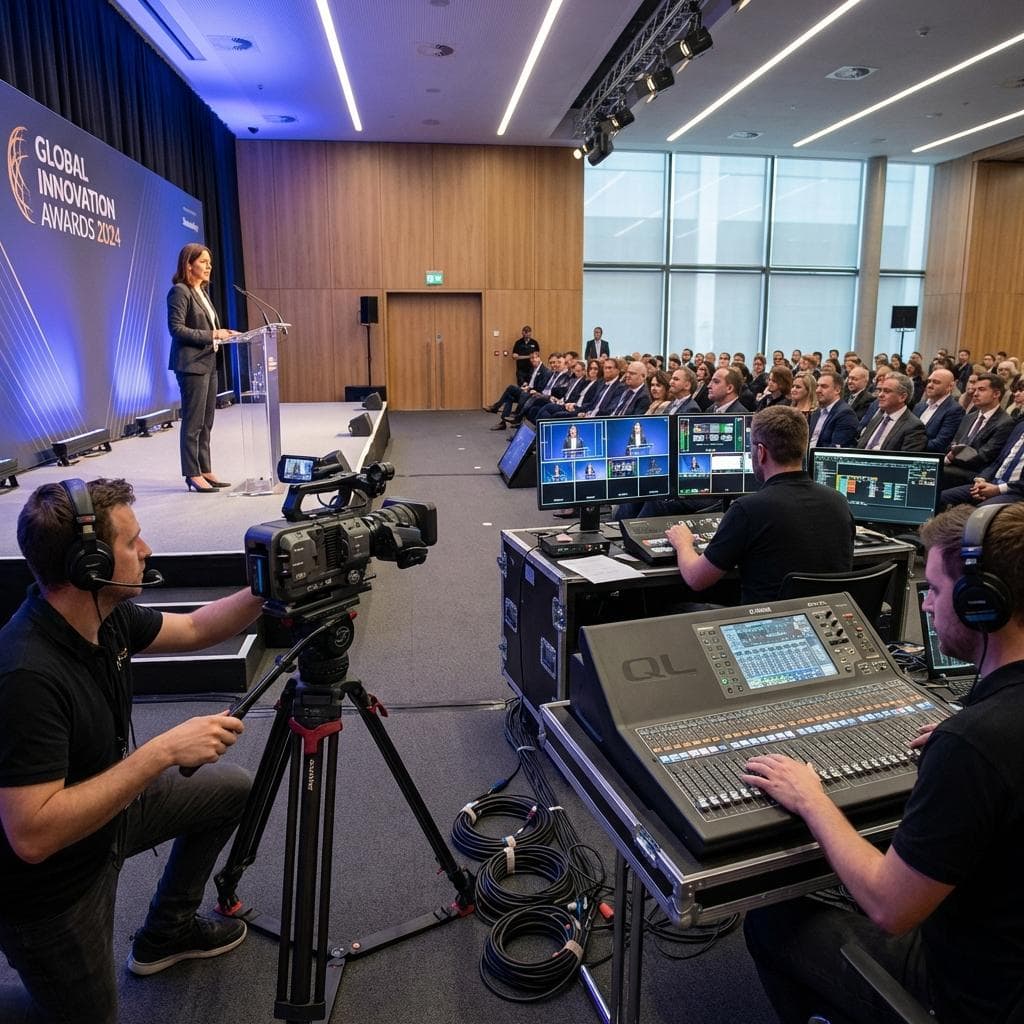
Audio is arguably more critical than video for event success. A hybrid event’s audio architecture is complex. On-site audio from microphones and playback sources is managed on a digital mixing console, such as a Yamaha QL5 or Allen & Heath Avantis. The real challenge is integrating remote participants. A “mix-minus” is created for each remote presenter. This is a custom audio mix containing the full program audio minus the presenter’s own voice, which prevents them from hearing a distracting echo or delay. Increasingly, audio is routed using Audio-over-IP (AoIP) protocols like Dante. Dante allows for hundreds of audio channels to be routed over a standard network infrastructure, providing immense flexibility to send specific audio channels to the main broadcast mix, to a language interpretation system, or to specific monitoring destinations. Careful gain staging, equalization (EQ), and dynamics processing are applied to ensure that the audio from a presenter’s laptop microphone in Manila sounds consistent with the broadcast-quality microphone used on stage in Hong Kong.
Scalable Delivery and Secure Distribution Across a Diverse Region
Once the final program feed is produced, it must be delivered reliably and securely to hundreds or thousands of employees across a region with highly variable network conditions. The distribution strategy must account for internal viewers on the corporate network and external viewers on the public internet, ensuring a high-quality experience for all while protecting sensitive internal communications.
Strategic Encoding and Transcoding for Adaptive Bitrate Streaming
The PGM output from the switcher is sent to a pair of professional encoders, typically in a primary and backup configuration for redundancy. These encoders compress the video using a codec like H.264 (AVC) or the more efficient H.265 (HEVC). The crucial step here is creating an Adaptive Bitrate (ABR) ladder. The source signal is encoded into multiple simultaneous streams at different bitrates and resolutions (e.g., 1080p at 6 Mbps, 720p at 3 Mbps, 480p at 1.5 Mbps). These streams are sent to a cloud media service or a Content Delivery Network (CDN). The video player on the viewer’s device intelligently selects the best possible stream based on their current network bandwidth, seamlessly switching between streams as conditions change. This ABR approach is essential to providing a buffer-free experience for an audience spread from a high-bandwidth office in Singapore to a home office with lower bandwidth in a rural area.
Leveraging Enterprise CDNs for Secure Internal Delivery
Streaming a high-bitrate video to thousands of employees within a corporate network can saturate the company’s internet connection and internal Wide Area Network (WAN) links. To prevent this, an Enterprise Content Delivery Network (eCDN) is deployed. An eCDN solution, from providers like Kollective or Ramp, uses peer-to-peer technology or caching nodes within the corporate firewall. A single high-quality stream enters the network from the outside, and the eCDN distributes it internally, significantly reducing external bandwidth consumption. This ensures that the event does not disrupt other business-critical applications. Access is typically secured through Single Sign-On (SSO) integration with the company’s identity provider, ensuring only authenticated employees can view the stream.
Failover Planning and Redundancy for Mission-Critical Events
For a high-stakes recognition ceremony, failure is not an option. A robust redundancy plan is a core component of the technical architecture. This includes N+1 redundancy for critical hardware like encoders and decoders. It involves using diverse network paths for contribution; for instance, a primary fiber connection backed up by a bonded cellular system (e.g., LiveU). On the distribution side, the encoders should be configured to publish the stream to both a primary and a backup ingest point on the CDN. If the primary ingest server or data center fails, the system can be switched to the backup path with minimal or no interruption to the viewer. This multi-layered approach to redundancy, covering hardware, network, and distribution, provides the resilience needed to execute flawless corporate events.
In conclusion, the modern virtual employee recognition ceremony in Asia has evolved into a complex broadcast production. It requires a strategic combination of on-premise infrastructure, cloud services, and a deep understanding of video and network engineering. By moving beyond consumer-grade tools and adopting a professional broadcast workflow, organizations can produce events that are not only technically flawless but also effectively communicate value, foster connection across geographical divides, and celebrate employee achievements with the prestige they deserve. This technical investment is a direct investment in company culture and employee morale.
Jeremy Lee is a seasoned digital marketing director and strategist with over two decades of experience in the industry. As the founder of Sotavento Medios, I manage a diverse portfolio of over 50 businesses, helping brands grow through advanced search strategies and digital innovation. My work focuses on bridging the gap between traditional search engine optimisation and the evolving world of AI-driven answer engines.
get in touch