

The Imperative for a Proprietary Viewer Portal in Enterprise Communications
In the landscape of multinational corporations (MNCs), communication is not merely a function; it is a strategic asset. Off-the-shelf streaming platforms, while convenient for public-facing content, present significant limitations for internal B2B events like all-hands meetings, shareholder briefings, and sensitive R&D showcases. These platforms lack the granular security, deep brand integration, and data control required for high-stakes corporate communications. Relying on them exposes valuable intellectual property to potential data breaches, dilutes brand identity, and fails to provide the sophisticated Quality of Experience (QoE) analytics that drive enterprise decision-making. The development of a custom, proprietary viewer portal is the definitive solution, transforming event streaming from a simple broadcast into a secure, integrated, and fully branded extension of the corporate digital ecosystem. This is not about building a new YouTube; it is about architecting a secure, private video content delivery network tailored to the precise operational and security demands of your organization.
Core Architecture: Engineering Your Corporate Streaming Ecosystem
The foundation of a proprietary portal is its architecture, which dictates its security, scalability, and integration capabilities. This core infrastructure must be meticulously planned to align with corporate IT governance, compliance standards like ISO 27001, and future communication strategies. The choice between on-premise, cloud, or hybrid models is the first critical decision point, each with distinct implications for control, cost, and performance.
On-Premise vs. Cloud vs. Hybrid Deployment Models
An on-premise solution involves housing all streaming servers, encoders, and content management systems within the corporation’s own data centers. This model offers unparalleled security and control, as no data traverses the public internet until the final delivery stage, which can be restricted to internal networks. It is the preferred model for organizations with extreme security requirements, such as defense contractors or financial institutions. However, it carries a high capital expenditure (CapEx) for hardware and requires specialized in-house expertise for maintenance and scaling. Conversely, a fully cloud-based architecture, utilizing services like Amazon Web Services (AWS), Google Cloud Platform (GCP), or Microsoft Azure, provides immense scalability and global reach with a lower upfront cost, shifting spending to an operational expenditure (OpEx) model. Cloud providers offer robust media services like AWS Elemental MediaLive and MediaPackage, which handle transcoding, packaging, and origin services resiliently. The hybrid model offers a balanced approach, often using on-premise encoders for secure signal acquisition while leveraging the cloud for transcoding, distribution, and the viewer-facing portal itself. This allows an MNC to maintain physical control over raw content while capitalizing on the cloud’s scalability for delivery.
The Video Content Management System (CMS) as the Central Hub
The heart of the portal is the Video CMS. This is far more than a simple library of video files; it is the administrative and logical core that governs all content and user interactions. An enterprise-grade Video CMS must feature robust user authentication, integrating seamlessly with existing corporate directories via protocols like Security Assertion Markup Language (SAML) or System for Cross-domain Identity Management (SCIM) to enable Single Sign-On (SSO) with providers like Azure Active Directory or Okta. This ensures that viewer access is tied directly to corporate credentials and permissions. The CMS also manages metadata, content scheduling, VOD asset lifecycle, and provides the crucial Application Programming Interfaces (APIs) that allow the portal to integrate with other business systems, from learning management systems to internal communications platforms.
Player-Level Customization and API-Driven Interactivity
The video player itself is the ultimate point of brand interaction. Generic, third-party players with intrusive logos and limited functionality are unacceptable in a proprietary system. Using player development kits like Video.js, THEOplayer, or a completely bespoke HTML5 player allows for total control over the user experience. This includes a custom branded skin, accessible controls, and the integration of API-driven features. For example, a player API can pull in real-time data to create dynamic graphic overlays, trigger synchronized slide presentations, or manage interactive elements like polling and moderated Q&A. This level of customization ensures the viewing experience is a seamless extension of the corporate brand and fully integrated with the event’s interactive objectives.
Ingest and Encoding Workflows for Enterprise-Grade Quality
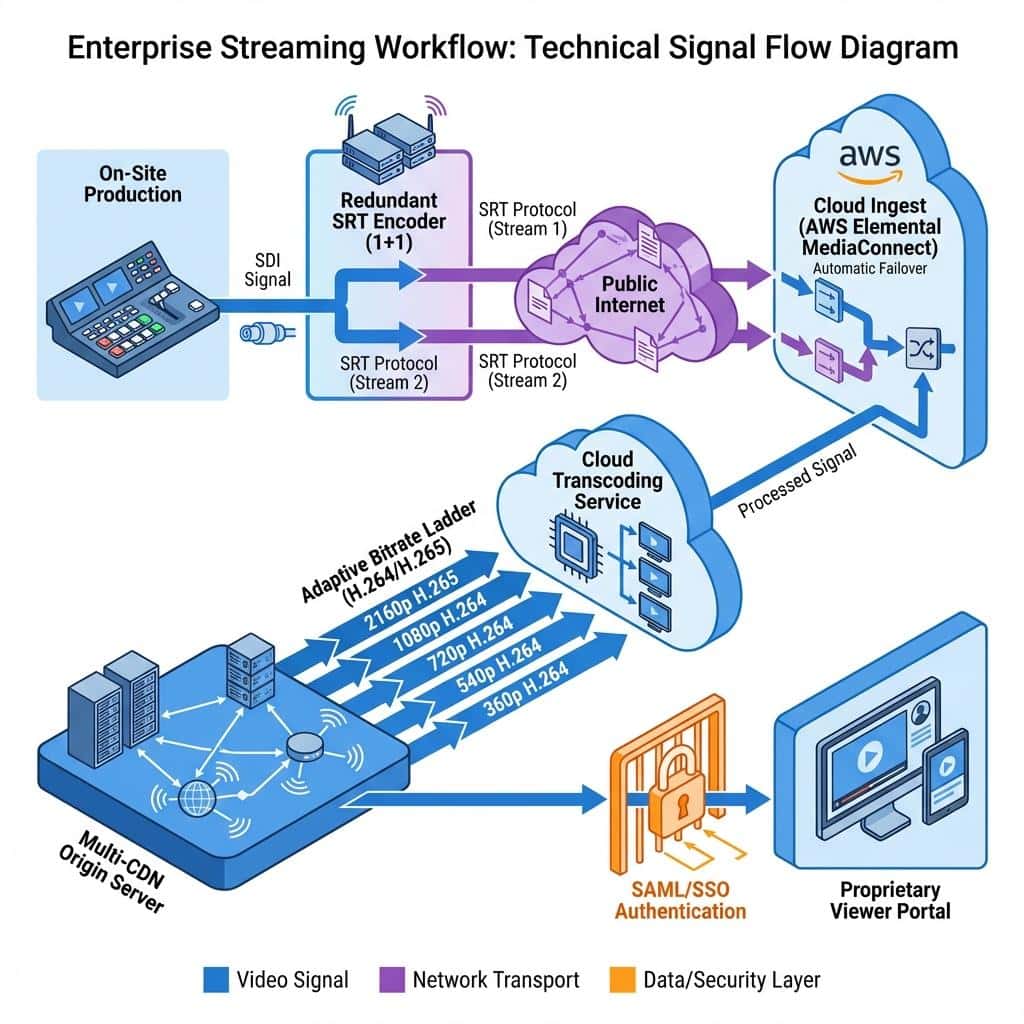
The quality and reliability of the final stream are dictated by the integrity of the signal path from the production site to the viewer. For an MNC, this workflow must be secure, resilient, and capable of delivering broadcast-grade video quality across a variable and often congested global network. This involves moving beyond legacy protocols and implementing a multi-layered strategy for contribution, encoding, and redundancy.
Secure Ingest Protocols: The Shift from RTMP to SRT
For decades, Real-Time Messaging Protocol (RTMP) was the de facto standard for stream contribution. However, its reliance on TCP makes it highly susceptible to packet loss and jitter, resulting in frame drops and instability over suboptimal networks. Furthermore, its security features are limited. The modern standard for professional contribution over the public internet is Secure Reliable Transport (SRT). Developed by Haivision, SRT is an open-source protocol that provides the reliability of TCP with the low latency of UDP. It excels at packet loss recovery through advanced ARQ (Automatic Repeat reQuest) mechanisms and secures content with end-to-end AES-128/256 bit encryption. This makes it the ideal choice for sending high-quality, low-latency program feeds from an event venue to a cloud or on-premise media processing hub, ensuring signal integrity even over long distances.
Adaptive Bitrate (ABR) Encoding and Transcoding Ladders
A single, high-bitrate stream is insufficient for a diverse global audience with varying network conditions. The solution is Adaptive Bitrate (ABR) streaming. The primary program feed, typically ingested at a high mezzanine quality (e.g., 1080p59.94 at 20-50 Mbps using H.264 or H.265/HEVC), is fed into a transcoder. This transcoder creates multiple, time-aligned versions of the stream at different resolutions and bitrates, known as a transcoding ladder. A typical ladder might include: 1080p at 6 Mbps, 720p at 3.5 Mbps, 540p at 2 Mbps, and 360p at 800 Kbps. The video player on the client side then intelligently requests segments from the most appropriate rendition based on real-time network analysis, ensuring a smooth playback experience without buffering. The choice between the H.264 (AVC) codec for maximum compatibility and H.265 (HEVC) for superior compression efficiency at lower bitrates is a key architectural decision.
Architecting Redundancy for High-Availability Streaming
For any mission-critical corporate event, failure is not an option. Redundancy must be architected into every stage of the workflow. At the production site, this means deploying a 1+1 or N+1 configuration for hardware encoders. Two separate encoders process the same SDI or NDI program feed, sending two identical SRT streams over diverse network paths (e.g., primary fiber and cellular backup) to two distinct cloud ingest points. Cloud media services can be configured for seamless input switching, automatically failing over to the secondary source if the primary is interrupted, with the switch being imperceptible to the end viewer. This dual-path contribution strategy mitigates risks from encoder failure, network outages, or upstream provider issues, delivering the 99.999% uptime required for enterprise events.
Advanced Security and Access Control Frameworks
A proprietary portal’s most significant advantage is its ability to enforce a robust, multi-layered security posture that protects sensitive corporate information from unauthorized access and distribution. This goes far beyond a simple password and involves integrating the portal directly into the company’s existing cybersecurity framework.
Authentication via SSO and Authorization with SAML/OAuth 2.0
The first line of defense is ensuring only verified employees or stakeholders can access the portal. The most effective method is Single Sign-On (SSO) integration. By acting as a service provider in a SAML 2.0 or OAuth 2.0 framework, the portal delegates the authentication process to the company’s Identity Provider (IdP), such as Azure AD or Okta. When a user attempts to log in, they are redirected to their familiar corporate login page. Upon successful authentication, the IdP sends a signed assertion back to the portal, confirming the user’s identity and passing attributes like their name, email, and group memberships. This process not only provides a frictionless user experience but also allows for granular authorization. For example, access to a specific stream, like a board meeting, can be restricted to users who are part of the ‘board-members’ group in the corporate directory.
Content Protection with DRM and Forensic Watermarking
While authentication controls access, content protection secures the video stream itself. AES-128 encryption, while a good baseline, can be vulnerable in certain scenarios. For maximum security, a full Digital Rights Management (DRM) system is required. This involves encrypting the content and requiring the player to obtain a license from a license server before playback is permitted. Major DRM systems include Google Widevine (for Chrome, Android, Firefox), Apple FairPlay (for Safari, iOS), and Microsoft PlayReady (for Edge, Xbox). Implementing a multi-DRM solution ensures content is protected across all major platforms. To combat piracy and leaks from authorized viewers (e.g., screen recording), forensic watermarking is essential. This technology embeds a unique, invisible identifier into each individual video stream. If the content appears online, the watermarking pattern can be extracted to pinpoint the exact user session that was the source of the leak, providing a powerful deterrent.
Network-Level Security: Geo-fencing, IP Whitelisting, and Tokenization
The final layer of security operates at the network level to control how and where content is delivered. Geo-fencing can be used to restrict playback to specific countries, which is useful for complying with regional data regulations. IP whitelisting takes this a step further by allowing access only from a predefined list of IP ranges, such as corporate office networks and VPN gateways. To prevent unauthorized sharing of links to the stream, URL tokenization is employed. The content delivery network (CDN) is configured to require a unique, time-limited, and cryptographically signed token as part of the URL for every video segment request. This ensures that even if a link is copied, it will expire quickly and cannot be used by another party, effectively locking down content delivery to the authenticated user’s session.

Jeremy Lee is a seasoned digital marketing director and strategist with over two decades of experience in the industry. As the founder of Sotavento Medios, I manage a diverse portfolio of over 50 businesses, helping brands grow through advanced search strategies and digital innovation. My work focuses on bridging the gap between traditional search engine optimisation and the evolving world of AI-driven answer engines.
get in touch