
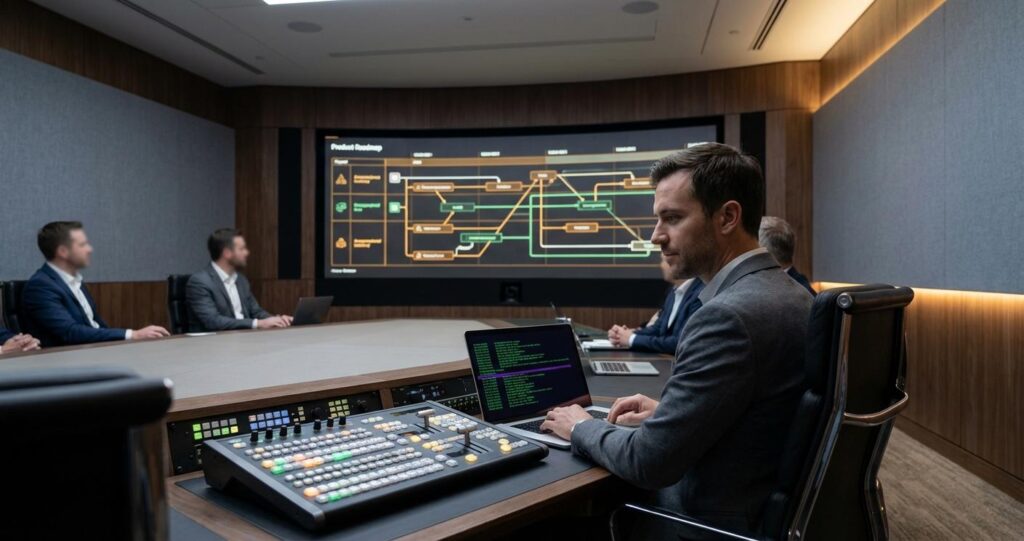
The Zero-Trust Mandate for High-Stakes B2B Streaming
The dissemination of a confidential product roadmap is one of the most sensitive operations a modern enterprise can undertake. For technology, manufacturing, and pharmaceutical companies, the premature release of intellectual property can lead to significant competitive disadvantage and financial loss. When stakeholders are geographically dispersed, the challenge becomes delivering this mission-critical information with broadcast-grade quality and ironclad security. This is not a task for consumer-grade webinar platforms; it requires a meticulously designed, defense-in-depth streaming architecture. Successfully executing a confidential roadmap presentation demands a zero-trust approach where every layer of the production and distribution workflow is inherently secure, from the camera sensor to the stakeholder’s display.
This technical brief outlines the best practices for engineering these secure B2B streaming solutions. We will move beyond basic password protection and explore the network infrastructure, transport protocols, content delivery platforms, and production workflows essential for protecting your most valuable corporate assets. The focus is on building a robust, resilient, and verifiable security posture for live, high-stakes corporate events. For the production managers, IT directors, and AV professionals tasked with this responsibility, understanding these principles is not just a matter of technical execution but of corporate governance and risk management.
Architecting the Secure Network Foundation
Before a single video packet is transmitted, the underlying network infrastructure must be hardened. The security of the entire streaming workflow is predicated on the integrity of the network environment. Attempting to run a confidential stream over an unsecured or public-access network is a foundational error that no amount of application-level security can fully mitigate.
Network Segmentation and Access Control
The first principle of a secure production network is isolation. Production equipment, including cameras, switchers, encoders, and audio mixers, should reside on a dedicated network segment, typically a Virtual LAN (VLAN). This segmentation prevents broadcast traffic from interfering with general corporate data traffic and, more importantly, shields critical production hardware from potential threats on the broader corporate network. Access Control Lists (ACLs) on network switches and firewalls should be configured to strictly limit communication to and from this production VLAN. Only specific, pre-authorized IP addresses and ports required for the streaming workflow should be permitted. For instance, the hardware encoder should only be allowed to communicate with the designated ingest endpoint of the streaming platform, and nothing else.
Implementing Private Network Connections
Whenever possible, avoid traversing the public internet for signal contribution. For presentations originating from a corporate headquarters or a dedicated production studio, a site-to-site VPN (Virtual Private Network) tunnel should be established between the event location and the cloud streaming provider’s ingest point. For maximum security and reliability, services like AWS Direct Connect or Azure ExpressRoute provide a dedicated, private fiber connection directly into the cloud provider’s backbone, completely bypassing the public internet. This offers unparalleled security and guaranteed bandwidth, which is critical for high-bitrate 4K/UHD streams.
Quality of Service (QoS) Configuration
Network stability is a component of security; a denial-of-service attack, whether malicious or unintentional due to network congestion, can derail a confidential event. Implementing Quality of Service (QoS) policies at the network switch and router level is essential. QoS prioritizes specific types of traffic. For streaming, protocols like SRT run over UDP. QoS rules can be configured to mark these UDP packets for expedited handling, ensuring that video and audio data is not dropped or delayed, even if other network activity spikes. This guarantees the low latency and packet-loss resilience required for a professional broadcast.
Ingest and Contribution: Securing the First Mile
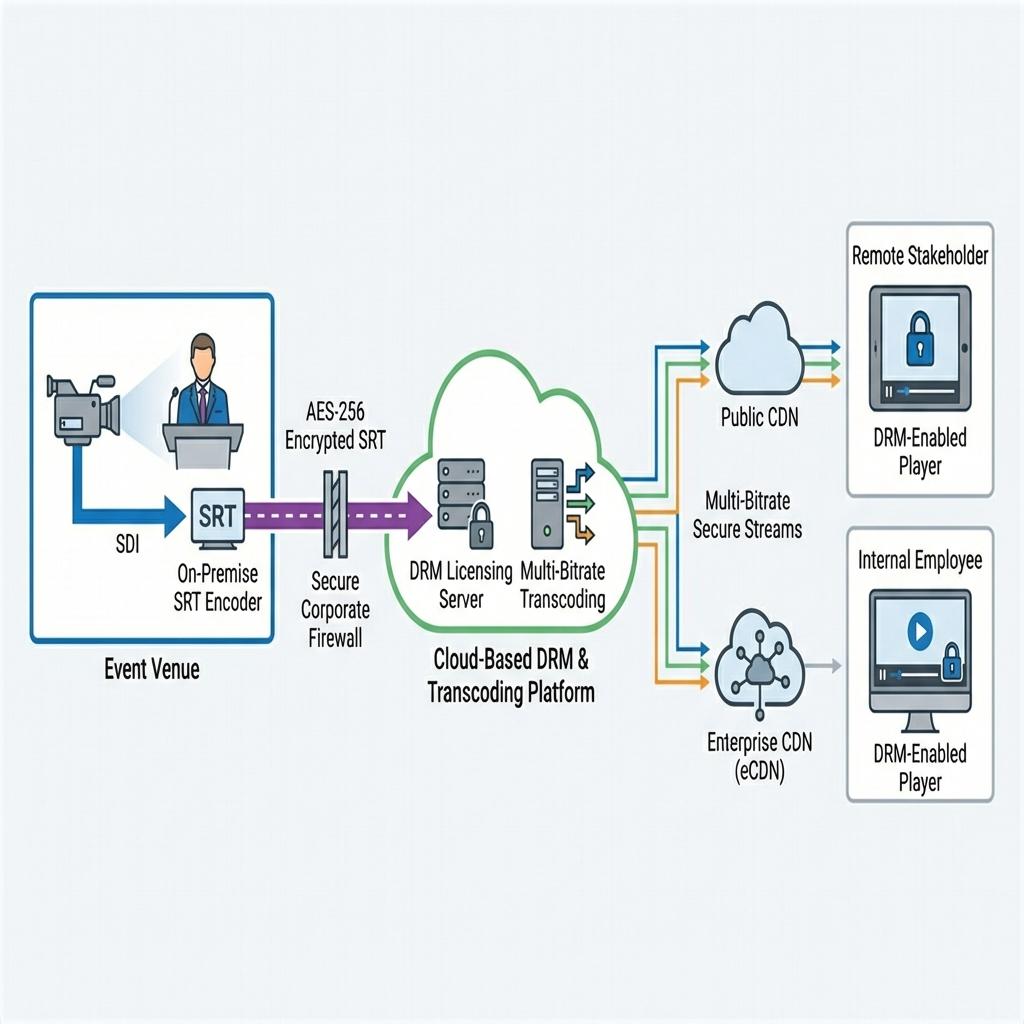
The “first mile” refers to the process of transporting the main program feed from the production switcher or encoder to the cloud platform. This is often the most vulnerable part of the chain, especially when dealing with remote presenters or less-than-ideal network conditions. The choice of transport protocol is the single most important decision in this stage.
Choosing the Right Transport Protocol: SRT vs. RTMPS
While RTMP (Real-Time Messaging Protocol) was a long-standing industry standard, its secure variant, RTMPS, is the bare minimum for any professional stream. RTMPS wraps the stream in a TLS/SSL encryption layer, similar to HTTPS, providing a secure point-to-point connection. However, for high-stakes events, SRT (Secure Reliable Transport) is the superior protocol. Developed by Haivision, SRT is an open-source protocol that provides end-to-end AES-128/256 bit encryption. Crucially, it also includes sophisticated error correction and packet recovery mechanisms, allowing it to maintain a stable, low-latency stream over unreliable networks where RTMPS might fail. Its ability to dynamically adjust to changing network conditions makes it the definitive choice for contributing broadcast-quality video over the public internet.
Hardware Encoding and Signal Integrity
The physical signal flow begins with professional cameras outputting via SDI (Serial Digital Interface), a robust baseband video standard. This signal is fed into a production switcher for live cutting. The final program output from the switcher is then sent to a dedicated hardware encoder. Enterprise-grade encoders from manufacturers like Haivision, AWS Elemental, or AJA are purpose-built for 24/7 reliability and support advanced protocols like SRT. Using a dedicated hardware appliance for encoding and contribution is vastly more stable and secure than relying on software running on a general-purpose computer, which can be susceptible to OS updates, background processes, and software vulnerabilities.
Securing IP-Based Workflows with NDI
In modern production environments, IP-based workflows using protocols like NDI (Network Device Interface) are common. While NDI offers incredible flexibility, it also expands the potential attack surface. When using NDI, it is absolutely critical that the aforementioned network segmentation is in place. The NDI production VLAN should be completely isolated. For the highest security, NDI streams should not be routed across the broader corporate network without specific routing rules and ACLs. NDI traffic can be encrypted, and newer iterations of the standard have improved these security features, but the foundational network security remains paramount.
The Distribution Layer: Platform Security and Redundancy
Once the secure stream reaches the cloud platform, the focus shifts to controlling access and ensuring a flawless viewing experience for authorized stakeholders only. This involves a suite of platform-level security features that work in concert to protect the content during distribution.
Enterprise CDN (eCDN) for Internal Stakeholders
For large organizations where the majority of viewers are internal, an Enterprise Content Delivery Network (eCDN) is a powerful tool. An eCDN solution, such as those from Kollective or Ramp, deploys caching nodes inside the corporate firewall. When an employee watches the stream, they pull the video from a local server on the corporate LAN rather than from the public internet. This drastically reduces the load on the company’s internet connection and keeps all internal viewing traffic securely within the corporate network perimeter, adding a significant layer of security and network efficiency.
Implementing Digital Rights Management (DRM)
For the highest level of security, particularly for external stakeholders, Digital Rights Management (DRM) is non-negotiable. DRM is far more robust than simple encryption. It is a secure licensing technology where the video content is encrypted with a key, and the viewer’s player must obtain a license from a DRM server to unlock and play the content. This process prevents unauthorized downloading and screen recording at the operating system level. The three primary DRM systems are Google Widevine (for Chrome, Firefox, Android), Apple FairPlay (for Safari, iOS), and Microsoft PlayReady (for Edge, Windows). A professional streaming platform must support this multi-DRM approach to secure content across all devices.
Multi-Layered Access Control
Beyond DRM, the platform must offer granular access control. This includes Single Sign-On (SSO) integration with corporate identity providers like Azure Active Directory or Okta, ensuring that only authenticated employees can access the stream. For external stakeholders, token-based authentication (JWT) provides time-limited, secure access. Additional layers include IP whitelisting, which restricts access to specific office IP address ranges, and domain restrictions, which prevent the video player from being embedded on unauthorized websites.
Production Workflow Security: The Human Element
Technology alone cannot guarantee security. The production workflow and the discipline of the technical crew are critical components of a secure broadcast. A leak is often the result of a human process failure, not a technology failure.
Physical Security and Clean Rooms
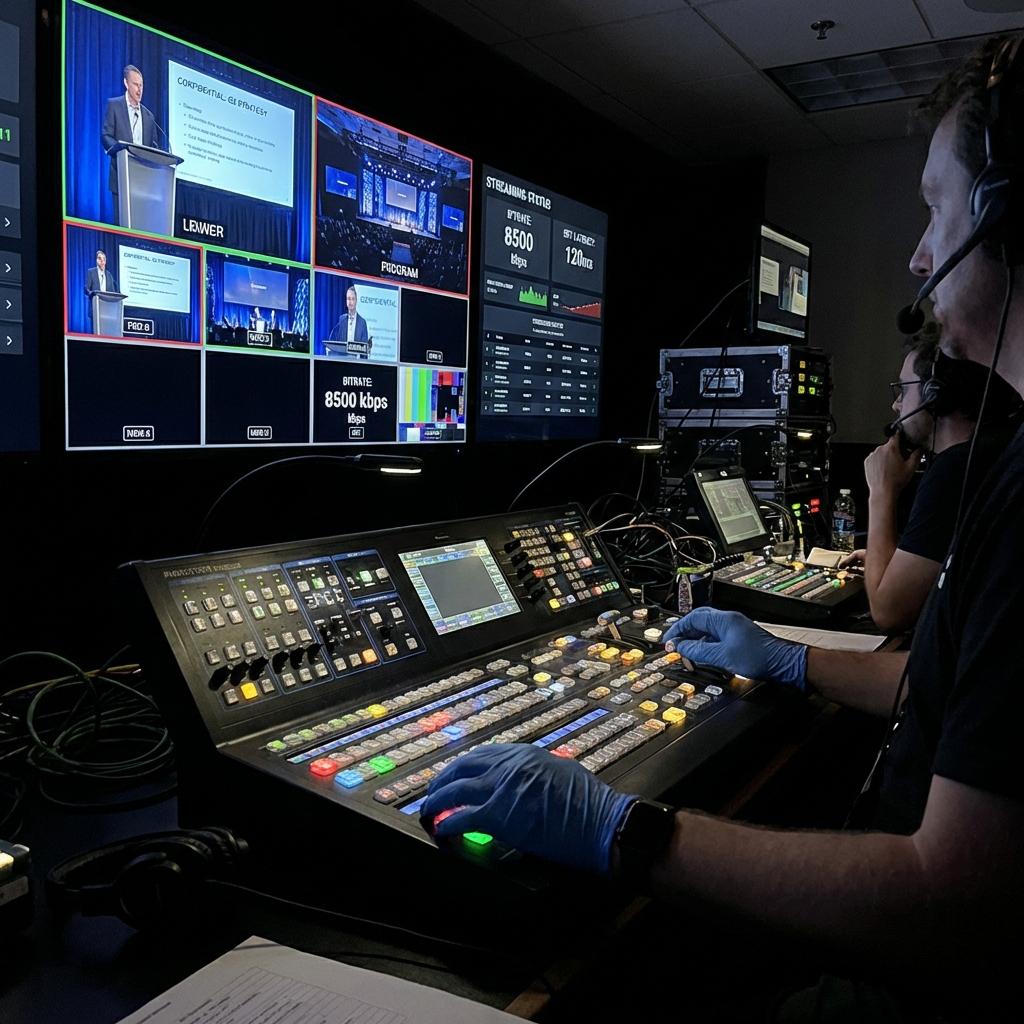
The production control room or on-site broadcast facility should be treated as a “clean room.” Access must be strictly limited to essential production personnel. All mobile phones and recording devices should be prohibited within the secure area during the event. This physical security prevents unauthorized photos or recordings of on-screen content before it is officially streamed.
Forensic Watermarking and Visual Overlays
Forensic watermarking is a powerful deterrent. Unlike a visible logo (a bug), forensic watermarking invisibly embeds a unique, traceable identifier into each individual viewer’s stream. If a recording of the stream is leaked, the watermarking can be extracted from the pirated copy, identifying the exact user account that was the source of the leak. This accountability is often enough to prevent leaks from happening in the first place. This can be combined with a visible watermark that includes the viewer’s name or email address, further discouraging screen captures.
Secure Communication and Post-Event Data Handling
The production crew relies on constant communication. Standard two-way radios can be easily intercepted. All production communications, including director talkback and camera operator instructions, must be conducted over encrypted digital intercom systems like Riedel or Clear-Com. After the event concludes, a strict data management policy must be followed. All ISO (isolated) recordings of cameras and presentation materials should be transferred to encrypted storage. Any temporary files on production machines must be securely erased using certified data destruction methods. The VOD (Video on Demand) asset should only be made available after passing through the same security and access control protocols as the live event.
Protecting a confidential product roadmap stream is a complex, multi-domain challenge that requires deep expertise in network engineering, broadcast technology, and cybersecurity. By implementing a zero-trust framework that encompasses the network, the transport protocol, the distribution platform, and the production workflow, enterprises can confidently share their most critical information with stakeholders, secure in the knowledge that their intellectual property is protected at every point in the chain. At Spring Forest Studio, our technical teams specialize in designing and executing these secure, enterprise-grade streaming solutions for the most demanding corporate events.

Jeremy Lee is a seasoned digital marketing director and strategist with over two decades of experience in the industry. As the founder of Sotavento Medios, I manage a diverse portfolio of over 50 businesses, helping brands grow through advanced search strategies and digital innovation. My work focuses on bridging the gap between traditional search engine optimisation and the evolving world of AI-driven answer engines.
get in touch