
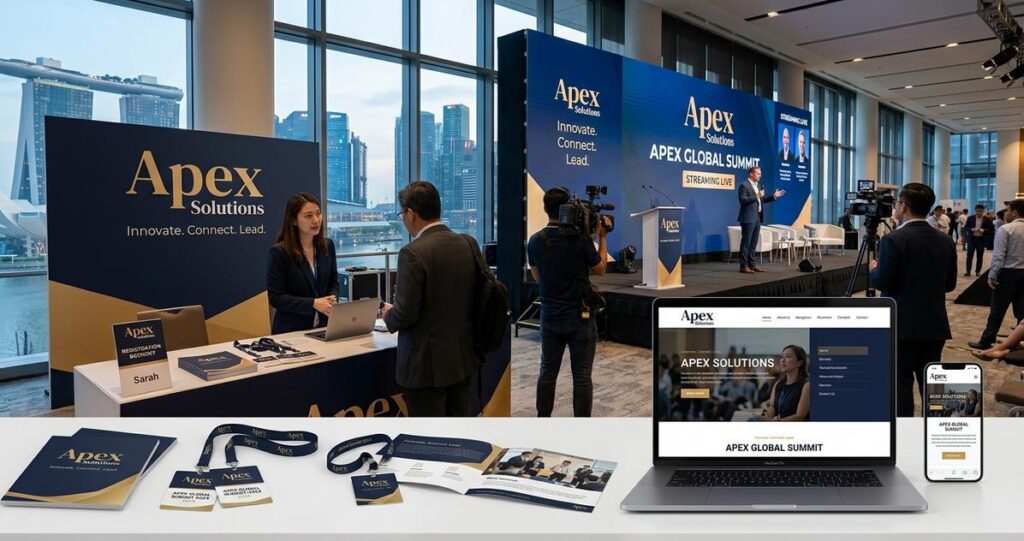
Hybrid branding has become a practical concern for Singapore businesses, not just a design trend. As customers move between physical spaces, websites, social media, mobile apps, livestreams, email, and printed materials, they expect the same organisation to feel recognisable at every touchpoint. For a Singaporean audience that is highly connected, time-conscious, and exposed to both local and international brands, consistency is often what separates a brand that feels trustworthy from one that feels fragmented. Whether a company is a healthcare provider, an education institution, a retail brand, or a professional services firm, the challenge is no longer only about having a logo. It is about maintaining a coherent identity while adapting to different platforms, formats, and audience expectations.
In Singapore, this challenge is especially relevant because consumers and business decision-makers commonly move across multiple channels in a single journey. A person may first see a brand at an industry event in Marina Bay, later search for it on Google, compare it on LinkedIn, and then sign up through a mobile form or video meeting. If the tone, visuals, and messaging shift too much between these channels, confidence can weaken. Hybrid branding addresses this by connecting the strengths of physical and digital experiences into one recognisable identity. Done well, it helps organisations communicate professionalism, reliability, and clarity without forcing every platform to look identical.
What hybrid branding means in practice
Hybrid branding refers to a brand system that works consistently across both offline and online environments. The word “hybrid” is important because it acknowledges that modern branding is no longer confined to one medium. A brand may appear in a conference booth, a livestream overlay, a webinar holding screen, a product brochure, a sales deck, and a website header, all within the same week. The goal is not rigid repetition, but recognisable continuity.
At the core of hybrid branding are a few key elements: visual identity, verbal identity, and experience design. Visual identity includes the logo, colours, typography, imagery style, and graphic system. Verbal identity covers the language, tone, and key messages used across channels. Experience design refers to how the brand feels in use, including navigation, responsiveness, accessibility, and audience interaction. When these elements are aligned, the audience does not need to relearn the brand every time they encounter it.
Why consistency matters more than uniformity
Consistency does not mean every platform should look exactly the same. A LinkedIn post, a physical event backdrop, and a mobile homepage each have different constraints. Instead, consistency means each expression should clearly belong to the same brand family. For example, the same colour palette can be adapted into a digital gradient on a website, a clean title block on a presentation slide, and a large-format visual on a booth wall. The message can also remain aligned while the delivery changes to suit the format.
This distinction is important because many organisations confuse “brand consistency” with “copy-paste design.” In reality, effective hybrid branding is flexible. It allows marketers, designers, and sales teams to adapt materials without losing recognisability. That flexibility is especially useful in Singapore, where many companies operate across regional markets, serve multicultural audiences, and communicate in fast-paced B2B environments.
How hybrid branding evolved from traditional identity systems
Before digital-first communication became normal, branding systems were often built for print, packaging, signage, and broadcast media. Brand guidelines focused heavily on logo spacing, stationery, brochures, and physical advertisements. These standards remain important, but they are no longer sufficient on their own. Today, brands must also consider responsive web design, social media dimensions, motion graphics, livestream overlays, email templates, and virtual meeting assets.
This evolution has changed the role of branding from static control to dynamic governance. Instead of enforcing one fixed layout, brand teams now need systems that can scale across many touchpoints. That means building design components that remain consistent while allowing variation. A good example is a modular brand kit that includes approved font pairings, icon styles, slide layouts, lower-thirds for video, and social media templates. These assets help teams produce content efficiently while preserving identity.
For Singapore organisations, this shift is especially visible in hybrid events and professional communication. Many businesses now combine in-person launches, conference booths, live-streamed panel sessions, and post-event digital content. Each channel serves a different role, but the audience should still recognise the same organisation behind them. Spring Forest Studio and similar production-led brands operate in this space by ensuring that the visual and technical experience support one coherent message across physical and digital formats.
The rise of the multi-channel customer journey
Modern audiences rarely interact with a brand only once. They may encounter it on Instagram, verify it on a website, see colleagues mention it on LinkedIn, and later meet the team at a trade event. This is especially relevant in Singapore, where business networks are tightly connected and reputation travels quickly. If a company’s online presence feels polished but its event presentation feels off-brand, the mismatch can reduce perceived credibility.
Multi-channel journeys also increase the importance of message discipline. A company may have several departments creating content, from marketing and sales to operations and customer service. Without clear brand governance, each team can drift into different styles. Hybrid branding solves this by establishing shared principles, so that every touchpoint supports the same positioning, promises, and personality.
Key building blocks of a strong hybrid brand system
To create a cohesive hybrid identity, organisations need more than a logo file and a colour palette. They need a system that can be interpreted consistently across different teams and formats. The most reliable hybrid brands usually have a documented framework that covers design rules, message structure, usage examples, and approval processes. This is especially useful for fast-moving organisations in Singapore that manage events, partnerships, and digital campaigns simultaneously.
Visual identity systems that adapt well
A practical visual identity system should work in both high-resolution print and screen-based environments. Typography must remain readable on mobile devices and large presentation screens. Colours should be chosen not only for aesthetics, but also for contrast and legibility. Imagery should feel consistent in subject matter, lighting, composition, and editing style. The same applies to iconography and motion graphics, which should follow the same design language as static assets.
Good visual systems are built with adaptability in mind. For example, a brand may use a primary logo for formal documents, a simplified mark for social avatars, and a flexible layout grid for campaigns. The underlying rules remain constant even if the output changes. This makes it easier to maintain quality across different departments and vendors.
Verbal identity and message hierarchy
Visual consistency alone is not enough. A brand also needs a consistent voice. Verbal identity includes how the organisation introduces itself, explains value, addresses customer concerns, and speaks in different contexts. A company that sounds highly technical on its website but overly casual in its event scripts may confuse its audience. The tone should reflect the brand’s positioning while still adapting to the channel.
Message hierarchy matters as well. A clear brand system identifies the primary message, supporting messages, and channel-specific variations. For instance, a B2B service provider may emphasise reliability, technical competence, and responsiveness across all channels, while using a more concise call to action on social media and a more detailed explanation in a proposal deck. That structure helps teams communicate efficiently without drifting away from the brand.
Accessibility and user experience
Hybrid branding also includes accessibility. In practical terms, this means making sure content is usable by as many people as possible. Clear contrast, legible fonts, readable captions, and logical information structure all matter. For digital experiences, brands should consider responsive layouts and keyboard-friendly navigation. For physical environments, they should think about signage clarity, lighting, and readable wayfinding.
Accessibility is not only a technical issue. It is part of the brand experience. A brand that is easy to understand and use signals professionalism and care. In Singapore, where digital literacy is high but audiences are diverse in age, language comfort, and technical familiarity, accessible design supports trust and usability.
Why Singapore businesses need hybrid branding now
Singapore’s business environment makes hybrid branding particularly relevant. The country has a high concentration of SMEs, regional headquarters, and professional services firms that compete on clarity, trust, and operational quality. Many sectors, including finance, education, healthcare, technology, and events, rely on both physical and digital contact points to reach clients and stakeholders. A brand that performs well in one setting but weakens in another can lose momentum quickly.
Hybrid branding also supports the communication habits of Singapore audiences. Professionals often compare vendors through websites, social channels, webinars, and face-to-face meetings before making decisions. Consumers do the same when assessing service providers, memberships, or event experiences. Because expectations are high, inconsistency can create unnecessary friction. A clear brand system helps people move through the journey with less effort.
There is also a practical operational benefit. When a company has a well-structured hybrid brand system, internal teams can produce materials faster and with fewer errors. Marketing does not have to reinvent every asset. Sales teams can use approved templates. Event teams can deploy consistent signage and stage visuals. This reduces duplication and helps maintain professional standards, especially when deadlines are tight.
Hybrid branding in events and professional production
Event environments are one of the clearest examples of hybrid branding in action. A corporate event may involve registration counters, LED screens, livestreams, speaker decks, social media updates, and post-event recap videos. Each element should feel connected. If the stage visuals use one language, the livestream uses another, and the event collateral uses a third, the audience experiences the event as disjointed.
In Singapore, where hybrid and in-person events are common for product launches, conferences, internal townhalls, and stakeholder engagement, brand continuity helps reinforce professionalism. Production teams and brand teams need to work together early, not at the last minute. That collaboration ensures that the event design, camera framing, motion graphics, and presentation slides all support the same identity.
How to maintain consistency without reducing creative flexibility
One of the biggest mistakes organisations make is treating brand consistency as a restriction. In reality, the strongest hybrid brands give teams enough structure to be creative within guardrails. This allows different departments, agencies, and production partners to produce content efficiently while keeping the brand recognisable.
Build a living brand system
A living brand system is a set of guidelines that can be updated as channels evolve. Rather than locking rules into a static PDF that becomes outdated, companies should maintain a practical brand library with examples, templates, approved usage rules, and channel-specific applications. This helps teams stay aligned when new formats emerge, such as short-form vertical video, interactive webinars, or virtual event environments.
For Singapore businesses, this is useful because communication needs can change quickly. A brand may start with corporate stationery and a website, then expand into podcast visuals, livestream graphics, and event backdrops. A living system makes it easier to scale without losing identity.
Use governance and review processes
Consistency depends on governance. That means someone needs to own the brand system, review key materials, and make sure external vendors understand the standards. This is not about slowing down work. It is about preventing avoidable inconsistencies that can weaken trust. A simple review checklist can help teams verify logo use, tone, layout, accessibility, and messaging before publication.
Cross-functional alignment is also important. Marketing, sales, operations, and event teams should share a common understanding of what the brand stands for. When everyone uses the same vocabulary and visual references, execution becomes smoother. This is especially valuable in Singapore’s fast-moving commercial environment, where teams often work across multiple stakeholders and tight turnaround times.
Design for the real context of use
A brand that looks good on a desktop mockup may fail in real use if it cannot survive varied environments. Think about bright event halls, mobile viewing on the MRT, small-screen social content, and bilingual or multilingual communication needs. Hybrid branding should anticipate these conditions. Designers and strategists should test materials in actual usage scenarios, not only in idealised presentations.
This approach is particularly useful for organisations serving Singapore’s diverse audience. Clear structure, readable typography, and adaptable layouts support comprehension across age groups and contexts. The aim is to make the brand feel coherent whether someone is viewing it on a screen, hearing it at an event, or holding it in print.
What strong hybrid branding looks like in day-to-day operations
In everyday business use, strong hybrid branding shows up in small but important ways. The website tone matches the sales deck. The conference banner uses the same visual language as the LinkedIn campaign. The event livestream includes branded motion elements that feel like the website rather than a separate production. The email signature, proposal template, and follow-up materials all reinforce the same identity.
These details matter because audiences notice inconsistency even if they do not consciously analyse it. A polished, coherent brand reduces friction and supports recall. Over time, that consistency can make a brand feel more credible and easier to trust. For Singapore companies competing in crowded markets, this can be a meaningful advantage.
Hybrid branding is no longer an optional design exercise. It is a strategic framework for communicating with clarity across every platform where your audience encounters you. Organisations that invest in adaptable systems, message discipline, and cross-channel governance are better positioned to present themselves professionally in a market that expects both efficiency and credibility.
For businesses operating in Singapore, the practical takeaway is straightforward. Treat your brand as a living system, not a fixed logo file. Align visual and verbal identity across digital and physical touchpoints. Build reusable templates, review processes, and accessibility standards into your workflow. When your audience experiences the same brand logic across a website, event stage, email, and social post, they are more likely to recognise, remember, and trust you.
This article provides general information on branding and communication strategy. For highly regulated industries, legal, compliance, and sector-specific requirements should also be reviewed with the appropriate professionals before implementation.

Jeremy Lee is a seasoned digital marketing director and strategist with over two decades of experience in the industry. As the founder of Sotavento Medios, I manage a diverse portfolio of over 50 businesses, helping brands grow through advanced search strategies and digital innovation. My work focuses on bridging the gap between traditional search engine optimisation and the evolving world of AI-driven answer engines.
get in touch