
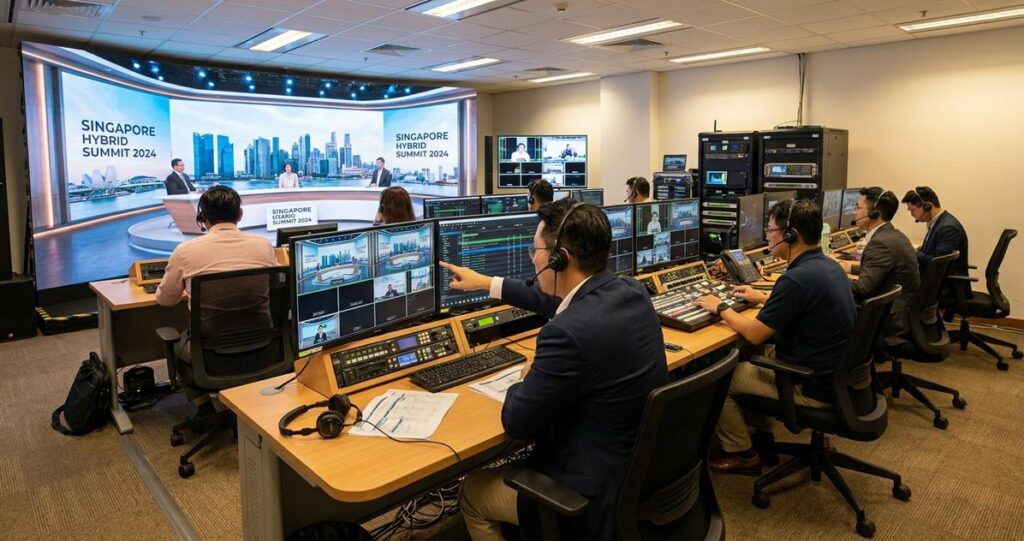
Directing has always been about shaping attention, timing, and emotion. In a traditional studio or on-site event, a director manages cameras, performers, lighting, sound, and audience flow in a physical space. In a real-time virtual environment, the same principles still apply, but the tools, constraints, and decision-making process change significantly. For Singapore-based organisations planning corporate town halls, product launches, government briefings, training sessions, and hybrid conferences, this shift matters because the quality of direction now depends on how well creative intent is translated across screens, platforms, and live workflows.
The move toward real-time virtual production did not remove the need for strong direction. It made direction more complex. Directors must now coordinate virtual sets, live camera switching, graphics, remote contributors, latency management, and audience interaction in a single integrated workflow. A well-directed virtual programme can feel polished, immediate, and credible. A poorly directed one can feel confusing, delayed, or visually disconnected. For audiences in Singapore, where expectations for professionalism, clarity, and technical reliability are high, this is especially important.
Real-time virtual environments are now used beyond entertainment. They support business communication, live education, product marketing, internal engagement, and public sector outreach. Understanding how directing has evolved in this space helps organisations plan better productions, set realistic expectations, and make informed decisions when working with a production partner.
From Stagecraft to Screencraft, How Direction Changed
Traditional directing developed around physical proximity. A director could stand near the stage, monitor rehearsal cues, and make adjustments based on what was happening in the room. In broadcast and live event production, directing expanded to include vision mixing, camera blocking, and timing between speakers, graphics, and live segments. Even so, the environment was still anchored to physical space. Actors, presenters, cameras, and audience all existed in the same location, which made spatial reasoning relatively straightforward.
In a real-time virtual environment, the director no longer sees the full performance as a single physical reality. Instead, the director assembles the final experience from multiple digital layers. These can include a virtual stage, augmented graphics, remote presenters, motion-tracked cameras, and live-rendered backgrounds. The director must understand not only what the audience sees, but also how the system generates that image in real time.
This change has shifted the role from scene management to system orchestration. Timing remains essential, but timing now includes signal latency, rendering speed, scene transitions, and network stability. A director must work closely with technical crew members who manage graphics engines, camera tracking, audio routing, and streaming infrastructure. In practice, the modern director often acts as a creative lead, a live decision-maker, and a translator between artistic intent and technical execution.
Why real-time matters
Real-time production means that visual changes happen instantly, or close to instantly, rather than being fully rendered in post-production. This allows presenters to interact live with digital environments, which creates a more immersive and responsive experience. It also allows directors to adjust cues on the fly, react to unforeseen changes, and maintain the energy of a live event.
For organisations in Singapore, real-time capability is especially useful when events involve international participants across time zones, bilingual or multilingual presentation requirements, or multiple stakeholder approvals. A live environment allows leadership messages and product demonstrations to feel current and interactive, while still maintaining broadcast-level control.
The Director’s New Toolkit in Virtual Production
Modern directing in a virtual environment relies on more than a camera plan and cue sheet. The director now works within a larger digital ecosystem where creative choices are tied to system readiness. This means the toolkit includes visual composition, cue timing, data flow, and platform compatibility. The director has to think in layers, rather than only in shots.
One of the biggest changes is the relationship between the director and the virtual environment itself. In a physical venue, set design is static once the event begins. In a virtual production, the environment can change between scenes, adapt to branding needs, or respond to presenter movement. That flexibility creates powerful storytelling opportunities, but it also demands more pre-production planning and rehearsal.
Virtual cameras and live composition
Virtual cameras function similarly to physical cameras in terms of framing, angle, and motion, but they operate inside a computer-generated environment. The director chooses when to cut between views, when to widen for context, and when to move in for emphasis. The challenge is that these decisions must be made with awareness of tracking accuracy, render performance, and audience perception.
For example, a smooth push-in on a keynote speaker can reinforce an important message, but only if the tracking and render pipeline remain stable. If the system lags, the moment may lose impact. In this setting, directing is inseparable from technical supervision.
Scene design and narrative flow
Real-time virtual environments are not only about visual realism. They are also about narrative structure. The director must think about what each visual state communicates. A corporate town hall may require a clean, authoritative look. A product reveal may need suspense and visual movement. A training event may benefit from simpler layouts that reduce distraction and improve comprehension.
Good direction ensures that visual changes support the message instead of competing with it. This is where pre-production becomes critical. Storyboards, scene maps, and rehearsal runs help the team identify where presenter movement, graphics, and camera changes should occur. In Singapore, where many business events are tightly scheduled and often delivered to distributed teams, this preparation can make the difference between a seamless event and a stressful one.
How Live Decision-Making Has Become More Technical
Live direction in virtual environments requires rapid judgment under conditions that are less forgiving than traditional event settings. The director must observe the speaker, the virtual scene, the camera feed, the audio mix, and the output stream at the same time. If one component falls out of sync, the overall experience can suffer immediately.
This is why virtual directing often requires an expanded control room structure. Depending on the scale of the event, responsibilities may be divided among a vision director, technical director, audio engineer, graphics operator, streaming operator, and stage manager. The director coordinates these roles so that the production remains coherent and responsive.
Latency and timing
Latency is the delay between an action and its visible result. In a real-time virtual environment, latency can affect lip-sync, cue timing, remote interaction, and graphics changes. Even small delays can make a live programme feel awkward. Directors therefore need to plan for buffer times, communication protocols, and fallback procedures.
This is particularly important when speakers are remote. A presenter joining from a home office or another country may experience internet delays that differ from the studio feed. The director must anticipate how these delays affect conversation pacing and whether questions, reactions, or demonstrations need to be adjusted.
Redundancy and contingency planning
Strong direction in virtual production includes contingency thinking. If a live camera feed fails, the director needs a backup shot. If a graphic does not load, the team needs a simpler visual option. If a remote guest disconnects, the programme should still continue smoothly. This kind of planning is not about pessimism. It is about protecting the audience experience and maintaining trust.
In Singapore’s corporate environment, where reliability reflects directly on brand perception, contingency planning is a core part of professional directing. Clients are often evaluating not only the content of the event, but also how calmly and competently the production team responds to pressure.
Directing for Audience Engagement in a Hybrid World
Hybrid events combine in-room participants with remote viewers. This format has become a practical choice for organisations that need wider reach without losing the value of live interaction. However, hybrid production changes the director’s priorities. The audience is no longer a single group in one venue. It is a split audience with different attention patterns, screen sizes, and engagement expectations.
The director must therefore shape the experience for both the physical and digital viewer. In-room attendees respond to presence, atmosphere, and stage energy. Remote viewers respond to framing, audio clarity, graphic readability, and pacing. The best-directed hybrid event respects both experiences without making either one feel secondary.
Maintaining clarity on small screens
Many viewers now watch from phones, tablets, or laptops. That changes how shot composition and graphics should be planned. Small text, cluttered backgrounds, and overly complex transitions can reduce comprehension. Directors should work with designers and presenters to keep visual communication simple, legible, and intentional.
This is especially relevant for Singapore audiences who often consume content on the move, between meetings, or during commuting windows. If a virtual event is difficult to follow on a smaller device, engagement will drop quickly.
Interaction design and pacing
Audience engagement in a virtual environment depends on more than visuals. It also depends on pace, transitions, and interaction design. Polls, Q and A sessions, live captions, and moderated chat can strengthen participation when used appropriately. The director must decide when to open the floor, when to move from one segment to the next, and how to avoid long stretches of passive viewing.
Good pacing is one of the most overlooked aspects of direction. Too many transitions can make an event feel fragmented. Too little variation can make it feel flat. Effective directors balance momentum with clarity so that the audience stays oriented throughout the programme.
The Singapore Context, Practical Considerations for Real-Time Virtual Direction
Singapore’s event environment places a premium on efficiency, professionalism, and technical readiness. Organisations here often work across sectors such as finance, healthcare, education, technology, logistics, and public service. Each of these sectors may have different compliance expectations, approval workflows, and communication styles, but they share a common need for reliable execution. A real-time virtual event that is well directed can support internal alignment, customer confidence, and cross-border communication.
Singapore also has a highly connected audience with strong expectations for digital quality. Many viewers are used to clear corporate presentations, live-streamed launches, and well-produced webinars. This means directors must pay close attention to audio quality, visual consistency, and message discipline. The production should feel polished without becoming overdesigned.
Language and multicultural communication
Directing in Singapore often means supporting multilingual or cross-cultural communication. Presenters may speak English with varying accents, or switch between English and other languages during a session. A director should work closely with the production team to ensure that subtitles, lower-thirds, and on-screen graphics support understanding. Where appropriate, bilingual support can improve accessibility and audience retention.
Clarity is especially important when events involve senior leadership, regulatory topics, or employee briefings. The director should avoid unnecessary visual complexity and keep transitions clean so the message remains the focus.
Venue integration and remote coordination
Many Singapore events take place in hotels, convention centres, corporate headquarters, and studio environments. Some productions use a hybrid format where part of the team is on site and part is remote. In such cases, directing becomes an exercise in coordination across locations. Reliable internet, signal testing, communication discipline, and role clarity all matter.
Because venue conditions can vary, pre-event site checks are essential. The director should confirm camera paths, monitor placement, lighting conditions, audio pickup, and backup connectivity where possible. This practical groundwork reduces stress during the live programme and helps the team maintain a professional standard.
What Strong Real-Time Direction Looks Like Today
Strong directing in a real-time virtual environment is visible in what the audience does not notice. The experience feels smooth, the speaker appears confident, the visuals support the message, and transitions feel deliberate. Achieving this requires more than technical proficiency. It requires editorial judgment, event discipline, and a clear understanding of audience needs.
For organisations planning virtual or hybrid events, the most effective approach is to involve the director early, ideally during concept development rather than just on event day. This allows the team to design a programme that matches the technical environment instead of forcing the environment to fit a late-stage creative idea. Early collaboration also helps align branding, content sequencing, and technical feasibility.
A well-directed virtual event can do more than present information. It can build credibility, reinforce brand identity, and make a complex message easier to understand. In Singapore’s fast-moving business climate, that kind of clarity is valuable. When direction is thoughtful and technically grounded, real-time virtual production becomes a practical communication tool rather than just a visual novelty.
For organisations exploring this format, the key takeaway is simple. Treat directing as an integrated discipline, not an afterthought. Invest in pre-production, rehearse thoroughly, plan for contingencies, and choose a production partner that understands both creative storytelling and live technical execution. That combination is what turns a virtual setup into a convincing, effective live experience.
This article is for general information and event planning awareness only. For specific production requirements, technical assessments, or venue-related decisions, consult a qualified event production professional.

Jeremy Lee is a seasoned digital marketing director and strategist with over two decades of experience in the industry. As the founder of Sotavento Medios, I manage a diverse portfolio of over 50 businesses, helping brands grow through advanced search strategies and digital innovation. My work focuses on bridging the gap between traditional search engine optimisation and the evolving world of AI-driven answer engines.
get in touch