
In the dynamic landscape of B2B event streaming and hybrid production, the pursuit of immersive, high-impact visual experiences is paramount. Enterprise decision-makers, AV professionals, and production managers increasingly seek advanced solutions to elevate corporate events, product launches, and virtual conferences. This requires a deep technical understanding of underlying production methodologies. While traditional green screen techniques have long served as a staple for virtual backgrounds, the advent of LED wall-based Extended Reality (XR) production is redefining the possibilities, offering a paradigm shift in visual fidelity, on-set interactivity, and post-production efficiency. Understanding the fundamental technical distinctions between these two approaches is crucial for optimizing workflows, managing budgets, and delivering truly enterprise-grade streaming solutions.
Understanding Traditional Green Screen Production for Virtual Events
Traditional green screen production, leveraging chroma keying technology, involves isolating a foreground subject from a monochromatic background, typically a specific shade of green or blue. This allows for the seamless insertion of a virtual environment during post-production or in real-time. For B2B streaming, this technique has been widely adopted for virtual presentations, remote speaker integration, and basic virtual set designs. The technical workflow typically involves capturing video feeds from multiple cameras (e.g., Blackmagic URSA Broadcast G2, Sony PXW-Z750) feeding into a video switcher (e.g., Ross Carbonite, Grass Valley K-Frame) and then into a dedicated chroma keyer hardware unit (e.g., Ultimatte 12, FOR-A HVS-2000) or software-based solution integrated within a graphics engine (e.g., Vizrt, ChyronHego). The clean plate extraction relies heavily on precise lighting, uniform color saturation of the green screen fabric, and careful spill suppression algorithms to prevent color artifacts on the subject.
Technical Requirements and Workflow for Chroma Keying
Achieving a professional chroma key requires meticulous attention to technical detail. Illumination must be even across the entire green screen surface, typically aiming for a luminance differential of no more than 10-15% across the frame to ensure consistent keying. Lighting ratios for the foreground subject and background must be carefully balanced to avoid shadows on the screen and to match the prospective virtual environment’s light directionality. Cameras are typically configured for 4:2:2 or 4:4:4 color sampling to maximize color information for the keying process, especially when dealing with complex edge detail such as hair or translucent materials. Video signals are often transported via SDI (Serial Digital Interface) over coaxial cables, supporting resolutions up to 12G-SDI for 4K/UHD, or increasingly over IP using NDI (Network Device Interface) or SMPTE ST 2110 for high-bandwidth, low-latency transport across an enterprise network infrastructure. Audio signal flow involves dedicated mixing consoles (e.g., Yamaha Rivage PM series, Behringer X32) with inputs from lavalier microphones (e.g., Sennheiser EW 112 G4) and ambient room microphones, feeding into the streaming encoder alongside the video program feed. Latency management, especially in hybrid setups where remote presenters interact with on-site elements, requires careful synchronization of video and audio feeds, often relying on genlock synchronization across all cameras and video sources to maintain frame accuracy.
Limitations in B2B Contexts and Post-Production Dependency
Despite its utility, green screen production presents several technical limitations for advanced B2B event streaming. A primary challenge is the lack of real-time reflections and refractions on physical objects within the studio, which breaks the illusion of immersion. Talent cannot visually reference virtual elements directly, leading to disjointed eye lines and interaction. Furthermore, the inherent flatness of a green screen environment makes dynamic camera movements and changes in perspective complex, often requiring sophisticated camera tracking systems (e.g., Mo-Sys StarTracker, Stype Follower) to match the virtual camera movement with the physical camera. Color spill, even with advanced keyers, remains a constant concern, particularly with subjects wearing green clothing or having reflective surfaces. This often necessitates additional color grading and post-production efforts to clean up edges and achieve a truly convincing composite, which can introduce delays and increase operational costs, especially for live-to-stream or low-latency hybrid productions. For enterprise clients requiring instantaneous feedback and highly interactive virtual environments, these limitations can hinder the desired level of realism and engagement.
The Paradigm Shift: LED Wall XR Production and Virtual Studios
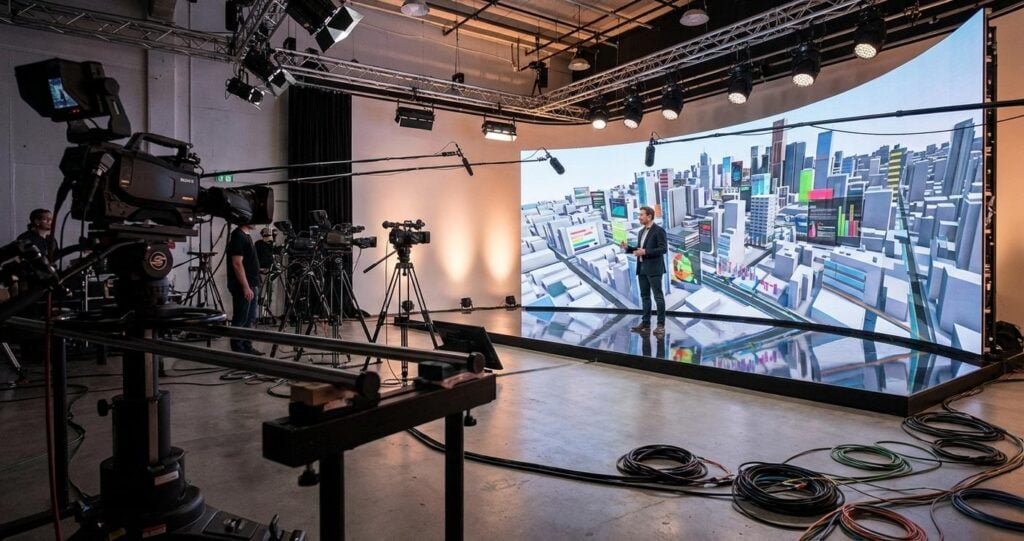
Extended Reality (XR) production, particularly utilizing large-format LED walls, represents a significant advancement over traditional green screen methods for B2B events. XR production integrates virtual environments directly into the physical space by displaying high-resolution, real-time rendered graphics on an LED backdrop, effectively creating an “in-camera VFX” scenario. This eliminates the need for chroma keying for the main background and allows for more natural lighting, reflections, and subject interaction with the virtual world. The core of an LED wall XR setup involves a powerful real-time graphics engine (e.g., Unreal Engine, Disguise vx media servers) driving the content displayed on high-pixel-density LED panels (e.g., Absen, ROE Visual, Leyard). Camera tracking systems are integral, providing precise positional and rotational data of the physical camera to the graphics engine, ensuring the virtual perspective matches the physical camera’s viewpoint instantaneously.
In-Camera VFX and Real-time Rendering Advantages
The primary advantage of LED wall XR production lies in its ability to achieve in-camera visual effects. What the camera sees is largely the final composite, dramatically reducing or eliminating complex post-production work for the background. This is crucial for live B2B streaming where immediate output and minimal latency are critical. Real-time rendering engines process complex 3D environments, particle effects, and dynamic lighting on powerful GPU clusters, often equipped with NVIDIA A100 or RTX series cards, rendering content at frame rates typically 50fps or 60fps to match broadcast standards. The content is then output via DisplayPort 1.4 or HDMI 2.1 to LED wall processors (e.g., Brompton Technology Tessera SX40, NovaStar H series), which handle scaling, color calibration, and distribution to the individual LED panels. This workflow allows for dynamic camera movements without chroma key artifacts, enabling virtual camera extensions and parallax shifts that enhance audience immersion. For hybrid events, this means on-site presenters can interact with a visually rich, contextually relevant virtual environment that is also streamed live to remote participants, bridging the physical and digital divides more effectively.
Enhanced Realism and Interactive Elements for Corporate Events
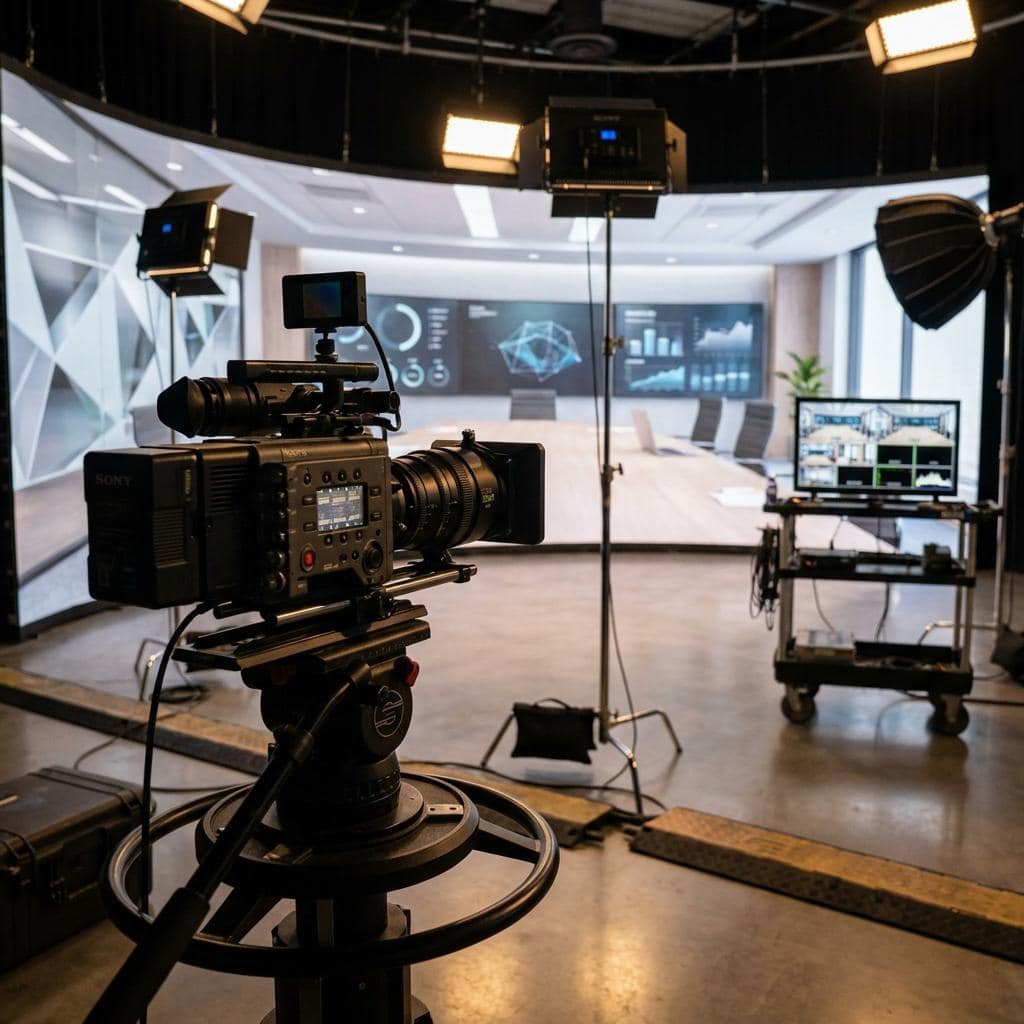
The physical presence of the LED wall provides realistic ambient light and reflections on the talent and foreground objects, a capability fundamentally absent in green screen setups. This significantly enhances the visual fidelity and believability of the virtual environment. Furthermore, interactive elements can be seamlessly integrated. Presenters can directly point to or manipulate virtual data visualizations, 3D models of products, or interactive dashboards displayed on the LED wall, fostering a more engaging and intuitive presentation style. These interactive elements are often driven by external control systems, such as touch screens or motion sensors, feeding data back to the real-time graphics engine. For enterprise applications such as corporate town halls, investor briefings, or highly specialized product launches, this level of realism and interaction translates into a more professional and impactful broadcast, reinforcing brand authority and message clarity. The ability to switch between pre-rendered scenes and dynamically generated content on the fly, driven by an event timeline or operator commands, provides unparalleled flexibility in live production scenarios.
Technical Architecture and Workflow Comparison
A detailed comparison of the technical architectures of green screen and LED wall XR productions reveals fundamental differences in infrastructure, signal flow, and operational complexities. Both demand robust video routing, precise synchronization, and high-performance encoding, but their core processing paradigms diverge significantly.
Signal Flow and Hardware Differences
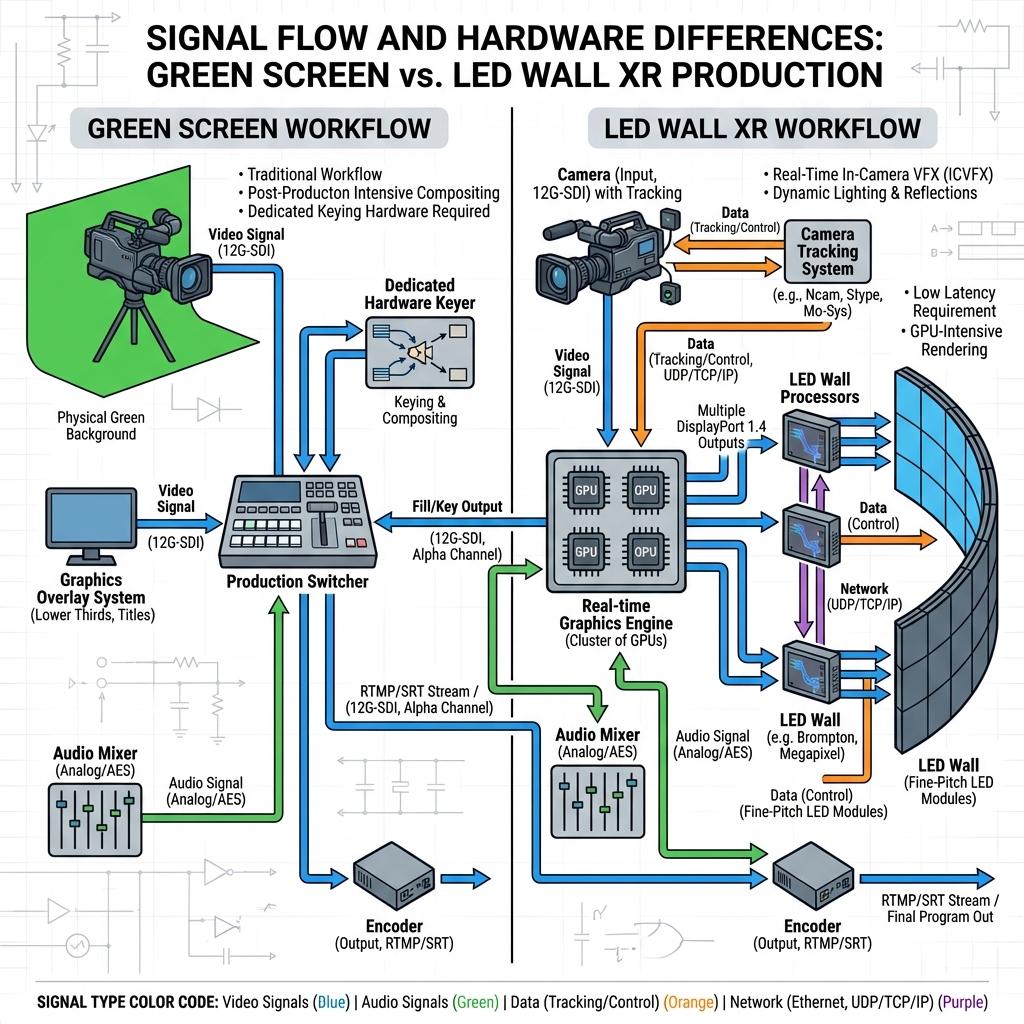
In a traditional green screen workflow, camera signals (e.g., 1080p60 SDI) enter a production switcher, then route to a dedicated hardware keyer. The keyer outputs a composited signal, which may then go through a graphics overlay system (e.g., Ross Xpression, ChyronHego PRIME) for lower thirds or supplementary visuals, before being sent to an encoder. Audio is mixed separately and embedded into the program SDI feed prior to encoding. Network infrastructure supports control signals and potentially NDI feeds, but the core video processing often remains baseband SDI.
Conversely, an LED wall XR workflow involves multiple high-bandwidth signal paths. Camera feeds are ingested into the production switcher, but crucially, a clean camera signal (without graphics) is also sent to the camera tracking system. The tracking data is transmitted via IP (e.g., UDP or TCP/IP) to the real-time graphics engine. This engine, often a cluster of powerful workstations, renders the virtual environment, incorporating the camera tracking data to dynamically adjust the perspective. The rendered output, often a 10-bit or 12-bit signal at 4K resolution, is sent via multiple DisplayPort or HDMI outputs to the LED wall processors. These processors tile the content across the physical LED panels. An additional video output from the graphics engine, often a separate fill and key signal for foreground elements, is sent to the production switcher for final layering with the physical camera feed. All elements within the virtual scene, including lighting and reflections, are computed in real-time by the graphics engine. Network infrastructure is critical for high-speed data transfer between tracking systems, graphics engines, and potentially remote control surfaces, demanding gigabit or 10-gigabit Ethernet with low latency.
Software, Rendering Engines, and Synchronization
Green screen relies on dedicated chroma keying algorithms, either hardware-accelerated or software-based within video switchers or graphics systems. These algorithms are optimized for color isolation and spill suppression. The virtual environment itself is often a pre-rendered still image or video clip.
LED wall XR, however, is powered by sophisticated real-time 3D rendering engines like Unreal Engine or Unity, often integrated with specialized media server software (e.g., Disguise, Notch). These engines leverage GPU acceleration to render complex volumetric scenes, dynamic lighting, and interactive elements at high frame rates. Synchronization is paramount. All cameras, the LED wall, and the graphics engine must be genlocked to a master black burst or tri-level sync generator to ensure frame-accurate alignment. The camera tracking system’s data must be precisely synchronized with the video frames from the physical camera to prevent parallax errors or visual anomalies in the virtual environment. Furthermore, audio synchronization between physical and virtual elements, and subsequent encoding, must adhere to professional broadcast standards like SMPTE ST 2067 (IMF) or AES67 for network audio transport, ensuring lip-sync accuracy within 1-2 frames (40-80 ms) for live streaming.
Key Technical Considerations for Enterprise Implementation
Deploying either green screen or LED wall XR for enterprise B2B events requires careful consideration of several technical factors that directly impact performance, scalability, and budget.
Latency, Color Calibration, and Content Pipelines
Latency: For green screen, end-to-end latency from camera capture to program output can be managed within acceptable limits (typically 2-5 frames or 80-200 ms) depending on the keyer and switcher processing. For LED wall XR, however, the real-time rendering pipeline introduces additional processing. Minimizing latency between camera tracking, graphics engine rendering, LED wall processing, and program output is critical. Professional systems aim for sub-3-frame latency (under 120 ms) from glass-to-glass, demanding high-performance GPUs, optimized engine configurations, and low-latency LED wall processors.
Color Calibration: Green screen requires precise color matching between the physical key color and the keyer’s reference. LED wall XR demands extensive color calibration across the entire LED surface to ensure consistent color temperature, luminance, and gamma, matching the physical studio lighting and camera profiles. This often involves spectroradiometers and specialized calibration software to create 3D LUTs (Look-Up Tables) that are applied to the LED wall processors and cameras, ensuring visual cohesion between the physical foreground and the virtual background.
Content Pipelines: Green screen often uses pre-rendered video loops or still images for backgrounds. LED wall XR requires a sophisticated content pipeline capable of generating and managing real-time 3D assets, textures, animations, and interactive elements. This necessitates specialized 3D artists, technical directors, and potentially custom shader development, integrating with enterprise asset management systems and version control for virtual content.
Scalability, Redundancy, and Integration with Enterprise Platforms
Scalability: Green screen setups are relatively easy to scale in terms of adding more cameras or keyers for multiple talent. LED wall XR scalability involves expanding the physical LED volume, increasing graphics rendering power (e.g., adding more GPU nodes or virtual machines in a cloud environment), and ensuring network bandwidth can handle increased tracking data and high-resolution video feeds. For large-scale corporate events, this can involve distributed rendering across multiple media servers.
Redundancy and Failover: Both systems require robust redundancy. For green screen, redundant keyers, switchers, and encoders are standard. In LED wall XR, redundancy extends to camera tracking systems, graphics engine servers (e.g., active-standby configurations), and LED wall processors. A complete failover strategy for the entire XR system, including automatic content synchronization between primary and backup systems, is essential for mission-critical B2B broadcasts.
Integration with Enterprise Platforms: For hybrid events, both green screen and XR productions must seamlessly integrate with enterprise communication platforms like Microsoft Teams, Zoom, or Webex. This involves providing clean program feeds (video and mixed audio) from the production switcher/encoder to these platforms, often via RTMP (Real-Time Messaging Protocol) or SRT (Secure Reliable Transport) protocols for secure and reliable contribution. For bidirectional interaction, return feeds from these platforms need to be integrated into the multiview monitoring system and potentially routed back to the talent or LED wall for displaying remote participants.
Strategic Deployment and Future Outlook for B2B Immersive Experiences
The strategic choice between green screen and LED wall XR production for B2B events hinges on specific technical requirements, creative aspirations, and budgetary parameters. While green screen remains a cost-effective solution for simpler virtual backgrounds and remote talent integration, LED wall XR offers a significant leap in visual realism and interactive capabilities, aligning with the growing demand for highly immersive corporate experiences.
Actionable Technical Recommendations for Enterprise Clients
- Perform a Detailed Technical Assessment: Evaluate existing AV infrastructure, network capabilities (Gigabit Ethernet minimum, 10GbE recommended for XR), and available power distribution. Determine specific resolution, frame rate, and latency targets.
- Invest in Professional-Grade Equipment: For green screen, prioritize high-quality keyers (hardware preferred for live production), uniform lighting kits, and professional chroma key fabric. For XR, focus on high-pixel-pitch LED panels (P2.6mm or finer for optimal camera results), robust camera tracking systems, and enterprise-grade media servers with powerful GPUs.
- Develop a Comprehensive Content Strategy: For green screen, prepare assets optimized for chroma key compositing. For XR, invest in 3D content creation and real-time graphics expertise, ensuring virtual environments are optimized for real-time rendering performance.
- Prioritize Network Infrastructure: Ensure dedicated, high-bandwidth network segments for video transport (NDI, SMPTE ST 2110) and control data in XR environments. Implement QoS (Quality of Service) to prioritize critical streaming traffic.
- Plan for Redundancy and Training: Implement N+1 redundancy for all critical components (keyers, switchers, encoders, graphics servers). Train technical staff extensively on the intricacies of each production methodology, including advanced troubleshooting for real-time rendering and tracking systems.
- Consider Hybrid Solutions: For complex B2B events, a hybrid approach combining a smaller LED volume for talent interaction with green screen extensions for wider shots can offer a balance of realism and flexibility, optimizing resource allocation.
The Evolution of XR in Corporate Events and Streaming
The trajectory of XR technology in B2B event streaming points towards increasingly sophisticated and accessible solutions. Advancements in LED technology, particularly MicroLED and MiniLED, promise higher resolutions and greater brightness, further enhancing visual fidelity. Real-time rendering engines are continually optimizing for efficiency and visual complexity, enabling more photorealistic environments. The integration of AI-driven tools for content generation, automated calibration, and intelligent tracking will streamline workflows. Furthermore, the convergence of cloud computing with XR production, enabling distributed rendering and virtualized control rooms, offers unprecedented scalability and geographic flexibility for global enterprise events. Spring Forest Studio remains at the forefront of these innovations, providing the technical expertise and infrastructure to implement these advanced production methodologies, ensuring B2B clients deliver unparalleled immersive experiences for their audiences worldwide. This evolution underscores a commitment to pushing the boundaries of what is technically achievable in enterprise event streaming, transforming virtual and hybrid engagements into truly captivating spectacles.

Jeremy Lee is a seasoned digital marketing director and strategist with over two decades of experience in the industry. As the founder of Sotavento Medios, I manage a diverse portfolio of over 50 businesses, helping brands grow through advanced search strategies and digital innovation. My work focuses on bridging the gap between traditional search engine optimisation and the evolving world of AI-driven answer engines.
get in touch