
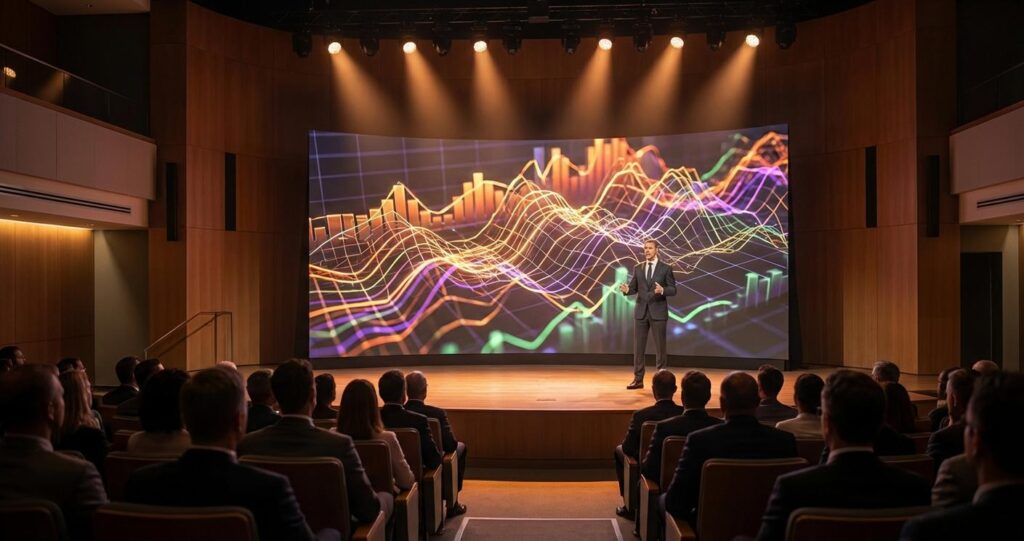
The Next Frontier in Financial Storytelling: Integrating Real-Time 3D Data Visualisations into Global Investor Pitches
In the high-stakes environment of global investor relations, the clarity and impact of data presentation are paramount. Traditional slide decks, while functional, often fail to convey the dynamic, multi-faceted nature of complex financial models, market projections, and corporate performance metrics. For enterprise decision-makers and production managers tasked with delivering these critical communications, the challenge is to move beyond static charts and create an immersive, engaging narrative. The solution lies in a broadcast-level approach: integrating real-time 3D data visualizations directly into the live hybrid event stream. This is not about adding animated graphics; it is a fundamental re-architecture of the production workflow, merging enterprise data APIs with powerful real-time rendering engines and distributing the result through a resilient, low-latency streaming infrastructure. Executing this requires a deep understanding of signal flow, data integration, video encoding, and network transport protocols to ensure a flawless presentation for both in-person stakeholders and a global virtual audience.
Graphics and Data Integration: The Core of the Real-Time Visualisation Workflow
The foundation of a dynamic investor presentation is the seamless link between live financial data and a 3D graphics rendering engine. This process transforms raw numbers into a visually compelling story that can be manipulated and explored in real-time by the presenter.
Selecting the Real-Time Rendering Platform
The choice of rendering engine is critical and depends on the complexity of the visualization and the required level of data integration. Platforms like Unreal Engine and Unity, traditionally used for game development, offer photorealistic rendering capabilities and extensive programmability through their Blueprints or C# scripting environments, respectively. These are ideal for creating bespoke, interactive 3D worlds that represent market landscapes or supply chains. For broadcast-centric workflows, solutions like Vizrt’s Viz Engine or Chyron’s PRIME Platform are purpose-built for live production. They excel at template-based graphics, lower-third supers, and data-driven charts, and integrate natively into broadcast control systems. The decision hinges on whether the creative vision demands the cinematic quality of a game engine or the rapid, template-driven deployment of a broadcast graphics system.
Live Data Ingestion and Processing
To be truly effective, the visualizations must be driven by live data. This requires establishing a robust pipeline from the data source to the rendering engine. The most common method involves using APIs, where the graphics system polls a secure endpoint to retrieve data formatted in JSON (JavaScript Object Notation) or XML (eXtensible Markup Language). The engine’s internal logic then parses this data and applies it to the 3D objects’ properties, such as scale, color, or position. For example, a rising stock price from a live market feed could dynamically increase the height of a virtual bar chart. This requires a dedicated graphics server with sufficient processing power not only for rendering but also for handling network requests and data parsing without introducing latency or frame drops. The hardware infrastructure for this typically includes multi-core CPUs, substantial RAM, and professional-grade GPUs like the NVIDIA RTX A-series, which provide the necessary CUDA cores for real-time ray tracing and processing.
Hardware and I/O for Production Integration
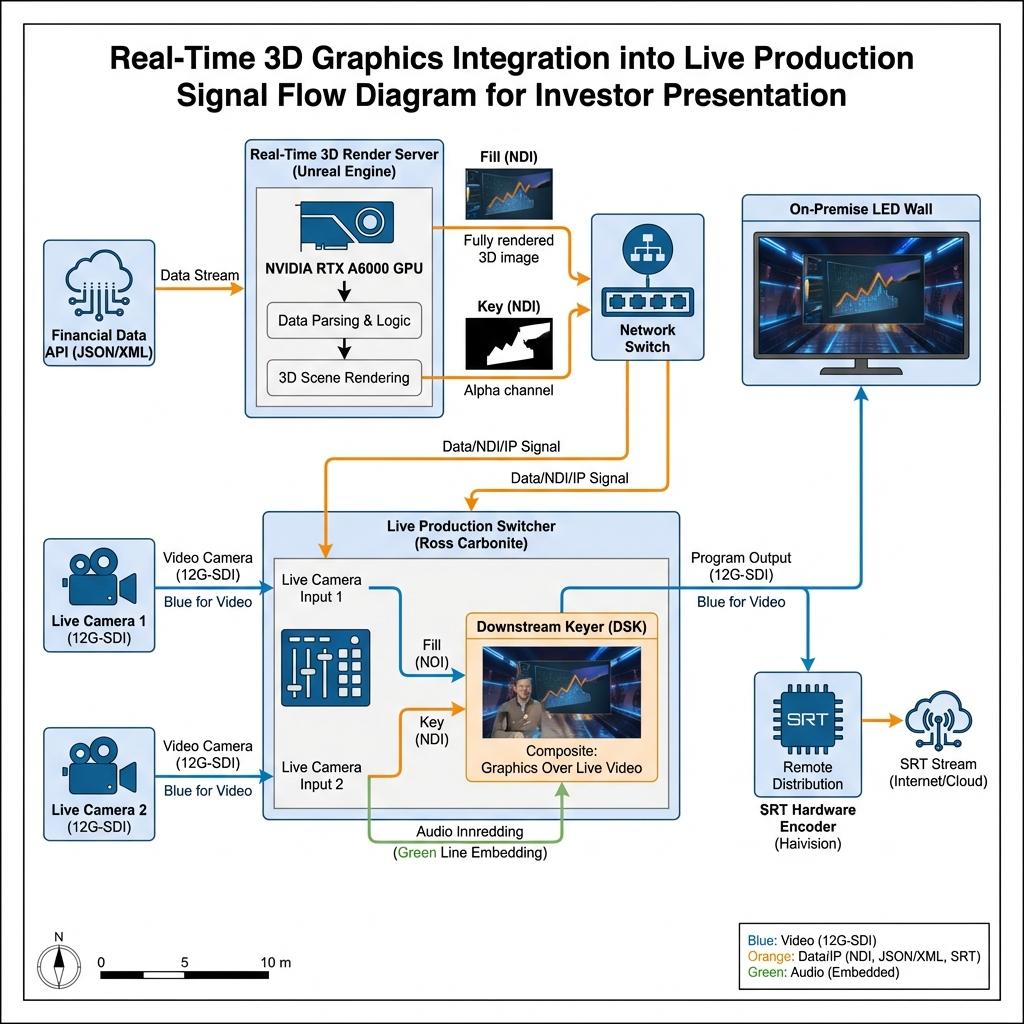
The rendered graphics must be output from the rendering server as a professional video signal. This is accomplished using specialized I/O (Input/Output) cards, such as those from AJA (KONA series) or Blackmagic Design (DeckLink series). These cards convert the internally rendered frames into a standard baseband video signal, typically Serial Digital Interface (SDI), at resolutions up to 4K/UHD (3840×2160) at 59.94 frames per second. Critically, these outputs often provide separate Fill and Key signals. The Fill signal is the full-color graphic, while the Key signal (or Alpha Channel) is a grayscale matte that defines areas of transparency. This pair allows a downstream production switcher to perfectly composite the 3D graphics over another video source, such as a live camera shot of the presenter.
Signal Flow and Production Architecture: Merging Graphics with Live Video
With the 3D visualizations generated, the next engineering challenge is to integrate them flawlessly into the live production environment. This involves designing a precise signal flow that accounts for timing, compositing, and control across both IP and baseband video transport methods.
IP-Based Integration with NDI
Network Device Interface (NDI), a protocol developed by NewTek, has become a standard for transporting high-quality, low-latency video over standard gigabit Ethernet networks. A rendering engine running on a server can output its Fill and Key signals as an NDI source on the network. A production switcher, also on the same network, can then ingest this NDI source directly, eliminating the need for physical SDI cables. This offers incredible flexibility, allowing the graphics server to be located anywhere within the facility. However, it requires a carefully managed network infrastructure. Full-bandwidth NDI for a 4K UHD signal can consume upwards of 300-400 Mbps, necessitating a 10GbE network backbone with switches that support multicast and have sufficient non-blocking switching capacity to handle multiple NDI streams simultaneously. For bandwidth-constrained environments, NDI|HX offers a more compressed alternative, though at the cost of slightly higher latency and potential compression artifacts.
Traditional Baseband SDI Workflows
The most reliable and deterministic method for signal transport remains SDI. In this workflow, the Fill and Key outputs from the graphics server’s I/O card are connected via dual 12G-SDI cables to two corresponding inputs on the main production switcher, such as a Ross Carbonite Ultra or a Grass Valley K-Frame. To ensure perfect timing alignment between the graphics and live camera sources, all devices in the chain must be synchronized to a common reference signal, a process known as genlocking. A master sync pulse generator (SPG) provides a black burst or tri-level sync signal to all cameras, the switcher, and the graphics server’s I/O card, ensuring all video frames are generated at the exact same instant and preventing timing-related artifacts like tearing or jitter during switching and compositing.
Compositing and Live Switching
Within the production switcher, the graphics are composited over live video using a keyer, typically a downstream keyer (DSK) or a dedicated effects bus (ME). The switcher uses the Key signal to cut a “hole” in the background video layer (e.g., the presenter on stage) and seamlessly inserts the Fill signal into that hole. This allows the presenter to appear as if they are standing in front of, or even inside, the 3D data visualization. The technical director can then switch between different camera angles and pre-composed graphic layouts to build a dynamic program feed for the audience.
Hybrid Event Delivery: Encoding and Global Distribution Strategy
An investor pitch with integrated 3D graphics must be delivered flawlessly to two distinct audiences: the in-person attendees and the global remote participants. This necessitates a dual-path distribution strategy with a focus on quality, reliability, and security.
The Dual-Program Feed Philosophy
The production switcher generates a primary Program output feed. This feed must be routed to two independent chains. The first chain serves the on-premise venue, feeding projectors, confidence monitors, and large-format LED walls via an SDI-based video routing matrix. The second chain is directed to a dedicated streaming encoder. It is often necessary to create a slightly different feed for the remote audience, for example, including specific lower-thirds or picture-in-picture effects that are not needed for the in-venue displays. This is achieved using a secondary ME bus or an auxiliary output from the switcher to create a “clean feed” or a “dirty feed” as required.
Advanced Encoding and Transport with SRT
For high-value corporate streams, the RTMP (Real-Time Messaging Protocol) is often insufficient due to its sensitivity to network packet loss. The modern standard for contribution-grade streaming is SRT (Secure Reliable Transport). SRT is a transport protocol that provides error correction and packet recovery, ensuring a stable stream even over congested public internet connections. The Program feed is sent via SDI to a professional hardware encoder (e.g., from Haivision or AJA) which compresses the video using an efficient codec like H.265/HEVC (High Efficiency Video Coding). H.265 can deliver comparable quality to H.264/AVC at roughly half the bitrate, which is critical for conserving bandwidth. The encoder then wraps this compressed video in the SRT protocol for transmission to the cloud video platform or a dedicated SRT gateway.
Enterprise CDN and Secure Player Integration
The SRT feed is received by an ingest server at the cloud video platform, where it is transcoded into an adaptive bitrate (ABR) ladder. This process creates multiple simultaneous streams at different resolutions and bitrates (e.g., 1080p at 6 Mbps, 720p at 3 Mbps, 480p at 1.5 Mbps). The video player on the viewer’s end can then intelligently switch between these streams based on their available bandwidth, ensuring a smooth playback experience. For investor relations events, security is non-negotiable. The stream should be protected with AES-128/256 encryption, and the embedded player should use token-based authentication or domain restriction to ensure only authorized individuals can view the content.
Mission-Critical Redundancy and Failover
For an event as crucial as an investor pitch, there is no tolerance for technical failure. A comprehensive redundancy plan must be implemented across the entire production chain.
Hardware and Path Redundancy
A best practice is to deploy a fully redundant signal path. This includes a primary and a backup hardware encoder, each receiving the same Program feed from the switcher. Each encoder should transmit its SRT stream over a separate internet connection. Network path diversity can be achieved using bonded cellular technology (combining multiple cellular carriers) alongside a primary fiber or ethernet connection. This ensures that if one network path fails, the stream continues uninterrupted over the other. Similarly, a backup 3D graphics rendering server should be running in parallel, ready to take over instantly if the primary server encounters an issue. This 1+1 or N+1 redundancy model is the hallmark of professional broadcast engineering.
Proactive Monitoring and QoS
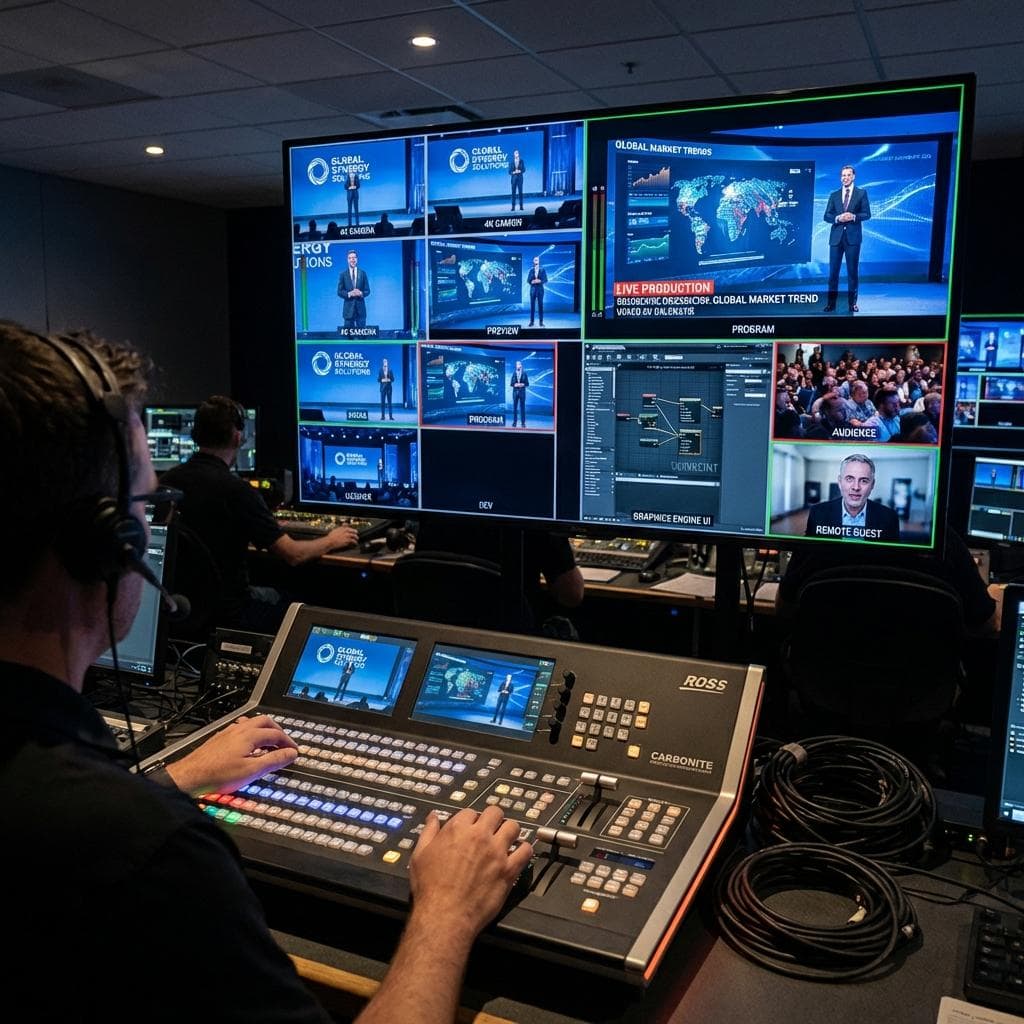
Throughout the event, a dedicated transmission engineer must monitor the health of all systems. This is done using a multiviewer that displays all video sources, preview and program feeds, and waveform/vectorscope monitors to verify signal integrity and color accuracy. Network monitoring tools are used to track the health of the SRT stream, monitoring metrics like latency, jitter, and packet loss. On the corporate LAN, Quality of Service (QoS) policies should be implemented to prioritize video traffic (specifically NDI and SRT packets) over general data traffic, preventing congestion from other office network activity from impacting the stream.
By architecting a production workflow that combines real-time data integration, advanced 3D graphics, and a broadcast-grade, resilient streaming infrastructure, organizations can transform their investor communications. This technical fusion elevates the pitch deck from a simple presentation into a powerful, data-driven narrative that captivates and informs stakeholders on a global scale. Spring Forest Studio specializes in designing and executing these complex hybrid production solutions, ensuring your most critical messages are delivered with precision and impact.

Jeremy Lee is a seasoned digital marketing director and strategist with over two decades of experience in the industry. As the founder of Sotavento Medios, I manage a diverse portfolio of over 50 businesses, helping brands grow through advanced search strategies and digital innovation. My work focuses on bridging the gap between traditional search engine optimisation and the evolving world of AI-driven answer engines.
get in touch