
Foundational Infrastructure: Integrating Unreal Engine into a Broadcast Workflow
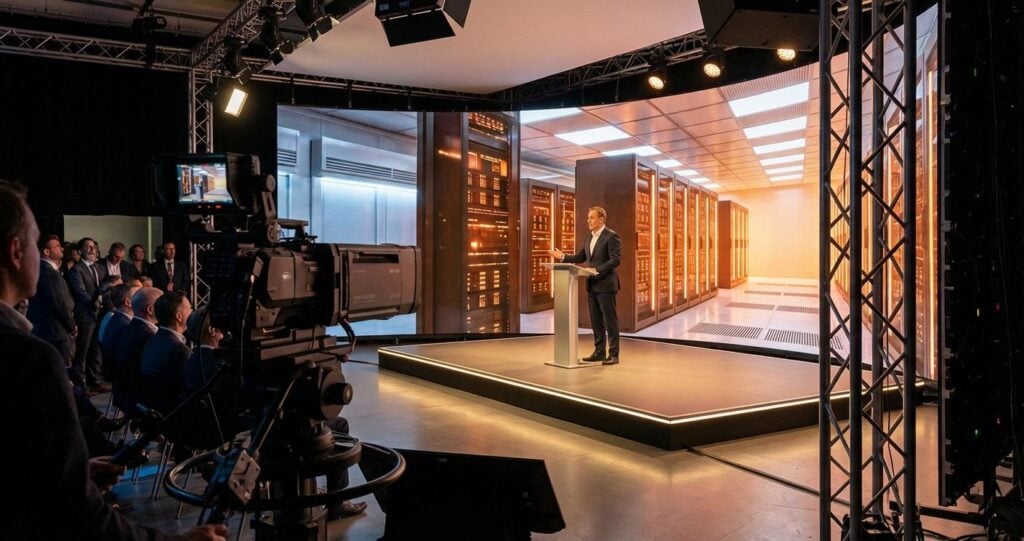
The transition from traditional keynotes to Unreal Engine (UE) driven virtual productions is not merely an aesthetic upgrade; it is a fundamental infrastructure overhaul that merges broadcast engineering principles with real-time graphics processing. For corporate event planners and IT directors, understanding this foundational layer is critical for successful implementation. The core challenge lies in seamlessly integrating a real-time rendering engine, traditionally used in game development, into a deterministic, low-latency live video production chain that demands frame-accurate synchronization and signal integrity.
Signal Ingest and Talent Compositing
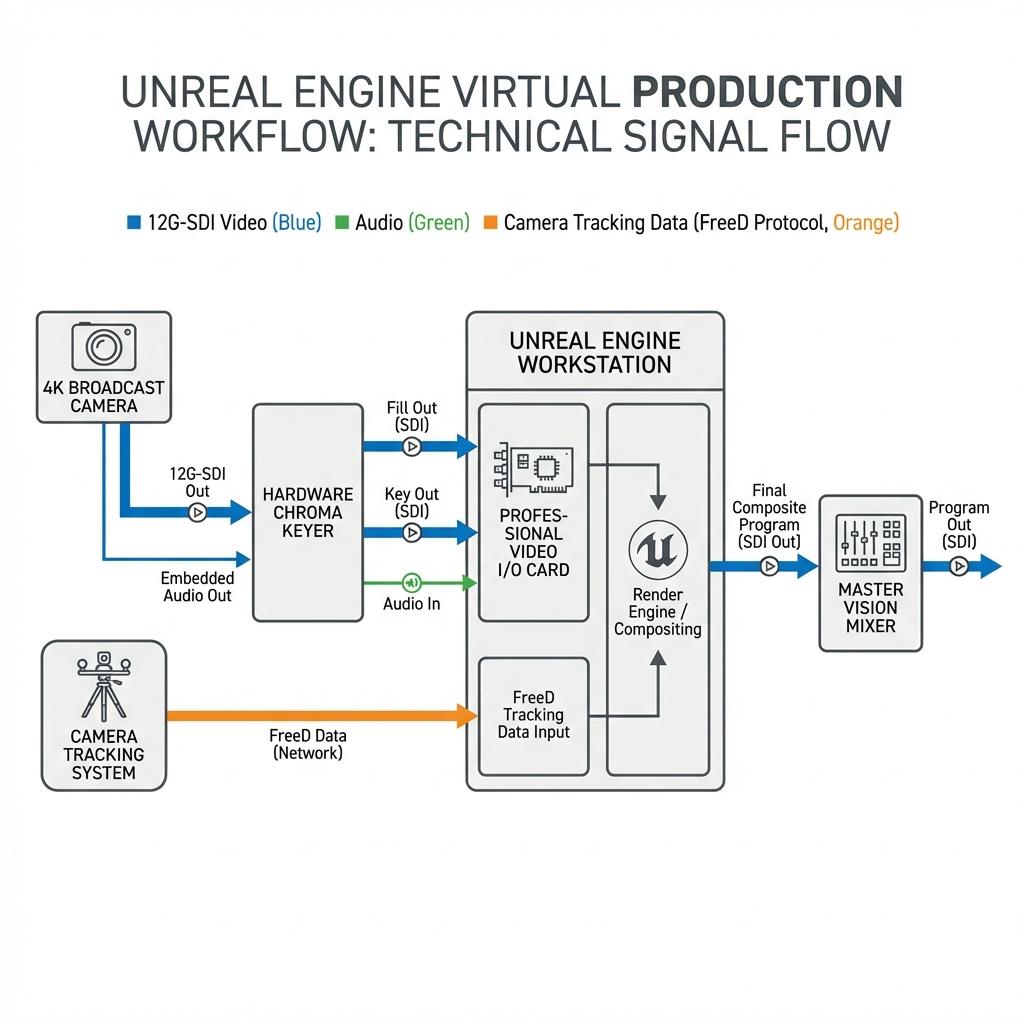
The process begins with the acquisition of the live presenter. This requires broadcast-quality cameras, typically 4K UHD models like the Sony FX6 or Canon C300 Mark III, outputting a clean, uncompressed signal over a 12G-SDI (Serial Digital Interface) connection. This 12 Gbps connection is essential for transmitting a 3840×2160 resolution signal at up to 60 frames per second (fps) with 10-bit color depth, providing the fidelity needed for a flawless composite. The presenter is filmed against a precision-lit green screen. The quality of the chroma key is paramount; uneven lighting introduces color spill and artifacts that break the illusion of the virtual environment. The SDI signal is then routed, often via a matrix switcher like a Blackmagic Design Videohub, to a dedicated hardware chroma keyer. While software keying within UE is possible, for mission-critical B2B events, a hardware solution such as an Ultimatte 12 HD provides superior edge processing and control, offloading this intensive task from the graphics workstation. The keyed talent feed (alpha and fill signals) is then ingested by the Unreal Engine workstation through a professional video I/O card, like an AJA Kona 5 or Blackmagic DeckLink 8K Pro. This card converts the SDI baseband video signal into data that the workstation’s CPU and GPU can process in real-time.
Real-Time Rendering Hardware Requirements
The workstation running Unreal Engine is the heart of the production. Its specifications must be robust enough to render complex, photorealistic 3D environments in real-time at the target resolution and frame rate, typically 1080p60 or 2160p30. The Graphics Processing Unit (GPU) is the most critical component. Professional-grade NVIDIA RTX A6000 or high-end consumer GeForce RTX 4090 cards with at least 24 GB of VRAM are standard requirements. These GPUs provide the necessary CUDA cores for rendering and Tensor cores for AI-driven features like denoising. The CPU, while secondary to the GPU for rendering, must be powerful enough to handle asset management, logic execution, and data I/O without bottlenecking the system; a multi-core processor like an Intel Core i9 or AMD Threadripper is recommended. System memory requirements start at 64 GB of DDR4 or DDR5 RAM, but 128 GB is preferable for large, texture-heavy scenes. High-speed NVMe solid-state drives are mandatory for loading complex environments and assets without introducing stutter or delays during a live production.
Video I/O and Synchronization
Maintaining signal synchronization across all sources is a non-negotiable requirement in any broadcast environment. In a UE workflow, the rendered output from the engine must be perfectly in sync with the live camera feed of the presenter. This is achieved using a master sync generator that provides a tri-level sync reference signal to all broadcast equipment, including the cameras, the video switcher, and the video I/O card in the UE workstation. This process, known as Genlock, ensures that all devices scan their frames at the exact same time, eliminating frame tearing and timing drift. The I/O card uses this reference signal to clock the rendered frames coming from Unreal Engine, ensuring the final composited output, sent back out over SDI, is perfectly stable and conforms to SMPTE (Society of Motion Picture and Television Engineers) timing standards. Without proper Genlock, the integration between the live and virtual elements would be visibly unstable and unprofessional.
Advanced Production Techniques with UE-Powered Virtual Sets
Once the foundational infrastructure is in place, production teams can leverage Unreal Engine’s advanced capabilities to create dynamic and interactive keynote experiences that are impossible with static backdrops. This is where the technology moves from being a simple replacement for a green screen to a powerful storytelling and data visualization tool. The focus shifts from simple compositing to creating a responsive and immersive world that the presenter can interact with, enhancing audience engagement and information retention.
Camera Tracking and Parallax
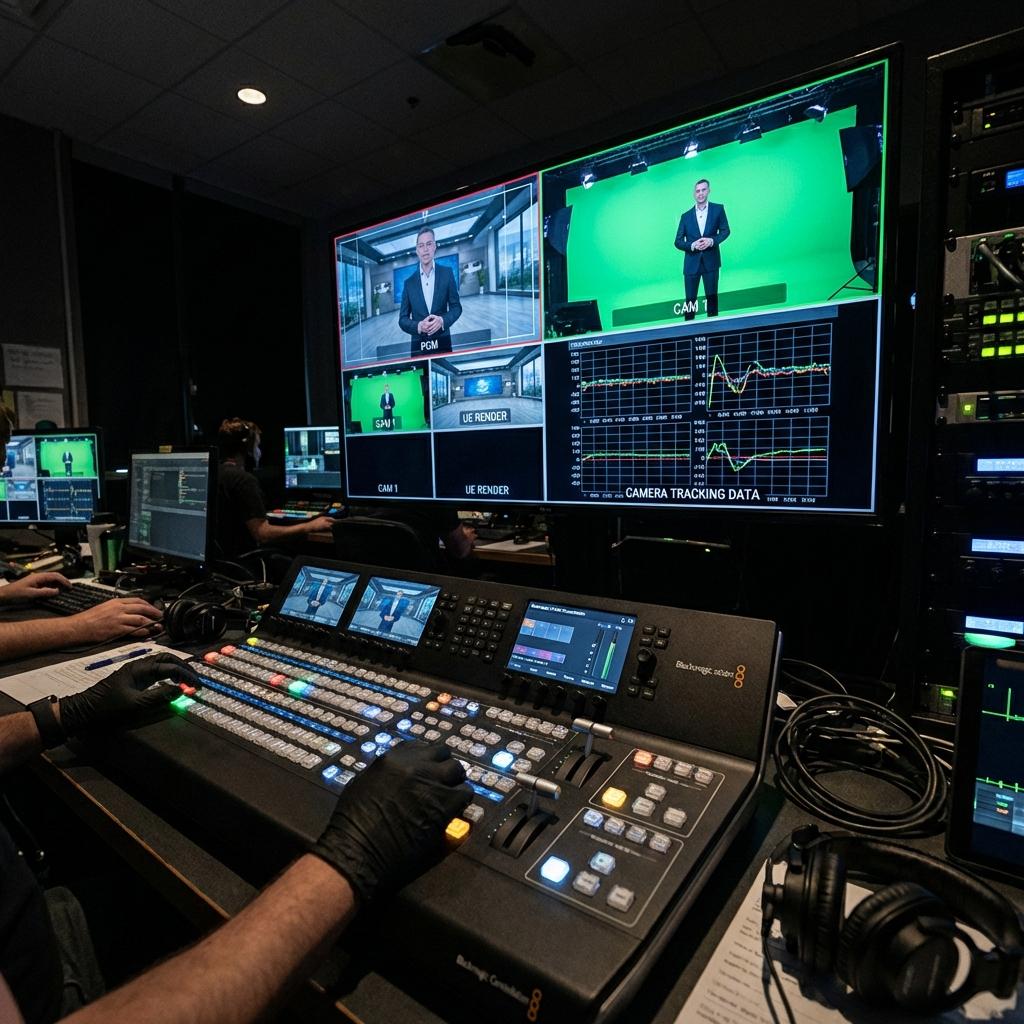
The key to making a virtual set believable is creating a sense of depth and perspective that changes with camera movement. This is accomplished through camera tracking. Specialized hardware systems from companies like Mo-Sys or Stype are attached to the broadcast camera. These systems use a combination of optical sensors, infrared markers, and gyroscopes to precisely measure the camera’s position (X, Y, Z coordinates), rotation (pan, tilt, roll), and lens parameters (zoom, focus, iris) in real-time. This tracking data is streamed over a network connection to the Unreal Engine workstation, typically using the FreeD protocol. UE uses this data to drive its virtual camera, ensuring that its movement perfectly mirrors the physical camera. When the physical camera pans, tilts, or cranes, the virtual background responds accordingly, creating a natural parallax effect. This dynamic perspective is what convinces the audience that the presenter is truly occupying the virtual space, a critical factor for high-stakes corporate presentations.
NDI and SRT for Flexible Signal Distribution
Modern production workflows increasingly rely on IP-based protocols for signal distribution, offering greater flexibility than traditional point-to-point SDI cabling. Network Device Interface (NDI), a protocol developed by NewTek, is instrumental in UE workflows. The final composited program feed from the UE workstation can be output as a high-quality, low-latency NDI stream over a standard 10GbE local area network. This allows multiple destinations to access the feed simultaneously without the need for an SDI router. For example, the program feed can be sent to a primary vision mixer (like a Ross Carbonite or vMix), to multiview monitors for the production crew, and to ISO (isolated) recording decks. For contribution to the cloud and delivery to the audience, Secure Reliable Transport (SRT) is the protocol of choice. SRT provides the reliability of TCP-based connections with the low latency of UDP, making it ideal for sending the final encoded program feed over the public internet. A typical workflow involves sending an SRT stream from a hardware encoder on-site to a cloud media server like AWS Elemental MediaLive or Wowza Streaming Engine, which then handles transcoding and delivery to a Content Delivery Network (CDN).
Data-Driven Graphics and Interactive Elements
Unreal Engine’s power extends beyond creating static photorealistic environments. Its Blueprint visual scripting system allows for the integration of external data sources via APIs to drive real-time graphics. This capability can transform a keynote from a passive presentation into a dynamic data visualization. For a financial results presentation, live market data could be fed into UE to animate 3D charts and graphs behind the CEO. For a product launch, technical specifications and performance metrics could be visualized in an immersive, exploded view of the product. Furthermore, this interactivity can extend to the audience. Live polling results, Q&A submissions from a hybrid event platform, or social media feeds can be ingested and displayed as dynamic elements within the virtual set, allowing the presenter to address audience feedback in a visually compelling way.
Encoding, Streaming, and Delivery for Hybrid and Virtual Audiences
The final stage of the production chain involves encoding the master program feed and delivering it reliably to a distributed corporate audience. This critical phase ensures that the high production value created in the virtual studio is preserved and experienced with maximum quality and minimum latency. For hybrid events, this also includes integrating the professional feed into enterprise collaboration platforms without compromising its integrity.
The Master Program Feed and Encoding Strategy
The final composited output, which includes the UE virtual environment, the keyed presenter, and any additional graphic overlays from the main vision mixer, constitutes the master program feed. This feed is typically sent via SDI to a dedicated encoder. For professional B2B events, a hardware encoder (e.g., from Haivision, Elemental, or AJA) is preferred over software for its processing stability and reliability. The encoding settings are critical. The H.264 codec remains the standard for maximum compatibility across devices, while the H.265 (HEVC) codec offers superior compression efficiency, delivering higher quality at a lower bitrate, which is advantageous for 4K/UHD streaming. A common configuration for a high-quality 1080p60 stream is a Constant Bitrate (CBR) of 8-10 Mbps. CBR is often chosen over Variable Bitrate (VBR) for live streaming as it provides a predictable and stable data flow, which is easier for networks and receiving clients to handle. For a 4K30 stream, a CBR of 20-25 Mbps using H.265 is a typical starting point.
Redundancy and Failover Architecture
For any high-stakes corporate event, there is no tolerance for failure. A robust redundancy and failover strategy is not optional. This starts with a fully redundant signal path on-site, including a primary and a secondary hardware encoder. Each encoder should be connected to a separate power circuit and network switch. Crucially, path diversity must be implemented for the internet connection. This means each encoder sends its SRT stream over a different ISP, ensuring that a single provider outage does not disrupt the event. On the cloud side, the media server infrastructure should also be redundant. The primary and secondary SRT feeds are ingested by separate cloud instances, often in different availability zones. A seamless failover mechanism is configured, so if the primary stream is interrupted for even a few seconds, the system automatically switches to the secondary stream without any disruption for the end-viewer. This multi-layered approach to redundancy provides the resilience required for enterprise-level event streaming.
Integrating with Enterprise Platforms for Hybrid Events
A common requirement for corporate town halls and B2B events is reaching an internal audience through platforms like Microsoft Teams, Zoom Events, or Webex. Integrating a high-production-value UE stream into these platforms presents a unique set of challenges. These platforms are designed for webcam-quality video and often aggressively compress incoming feeds. The most reliable method is to use a hardware encoder that can output an RTMP (Real-Time Messaging Protocol) or RTMPS stream, which can then be ingested by the platform’s “live event” or webinar feature. Another increasingly popular method is using NDI. Many of these platforms now have NDI support, allowing the program feed from the vision mixer to be sent directly to the Teams or Zoom client running on the production network. This bypasses the need for physical capture devices but requires careful network configuration to manage bandwidth. Audio synchronization is a key consideration; ensuring there is no lip-sync drift between the high-quality video feed and the audio being processed by the collaboration platform requires careful testing and the use of audio delay tools within the production workflow.
Jeremy Lee is a seasoned digital marketing director and strategist with over two decades of experience in the industry. As the founder of Sotavento Medios, I manage a diverse portfolio of over 50 businesses, helping brands grow through advanced search strategies and digital innovation. My work focuses on bridging the gap between traditional search engine optimisation and the evolving world of AI-driven answer engines.
get in touch