
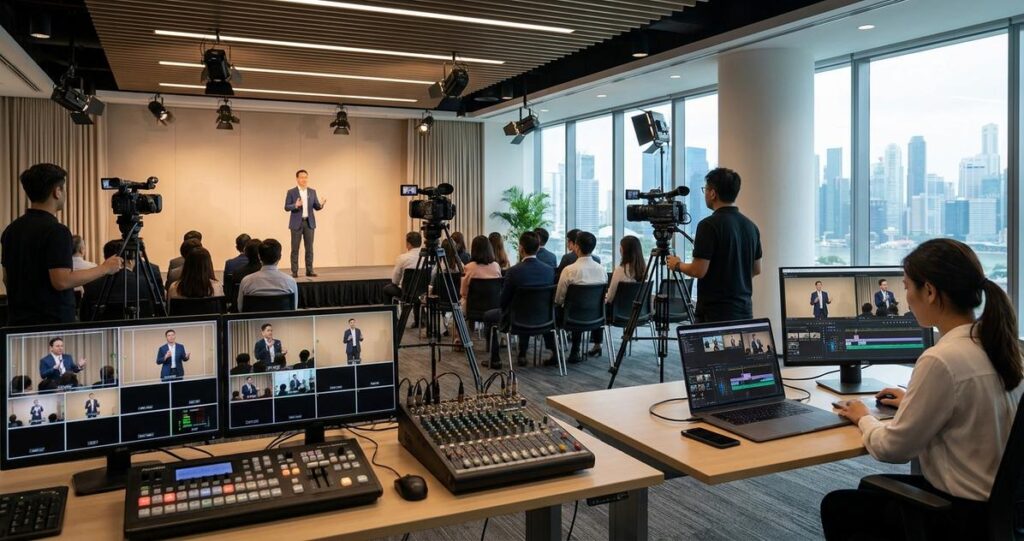
Hybrid events have changed what audiences expect from professional gatherings in Singapore. When a conference, town hall, product launch, or training session ends, the value does not stop at the live broadcast. For many organisations, the real return begins when the recorded sessions, edited highlights, speaker clips, and supporting materials are repackaged into on-demand content. This matters in Singapore because audiences are time constrained, teams are often distributed across different sites or time zones, and many businesses serve regional stakeholders who cannot all join at the same moment.
On-demand content is simply event content that remains available after the live session, usually as full recordings, highlights, short clips, or topic-based resources. In business terms, it extends the life of a single event, makes the content easier to revisit, and helps convert attention into measurable outcomes such as lead generation, employee learning, internal communication, and brand trust. For Singaporean organisations that invest significantly in hybrid production, this post-event layer is not an optional extra. It is part of how the initial investment continues to work after the event day.
For B2B teams, especially in sectors such as finance, technology, healthcare, education, government-related communications, and professional services, on-demand content can help close the gap between a live audience and a much larger secondary audience. It also supports more inclusive access for people who could not attend because of work schedules, caregiving responsibilities, travel, or timing differences across Asia-Pacific markets. When planned properly, it becomes a practical asset that supports marketing, communications, training, and stakeholder engagement at the same time.
Why on-demand content matters after a hybrid event
Hybrid events combine in-person and virtual participation, but the audience captured during the live window is only part of the total opportunity. Once the event ends, many people still want to watch a keynote, review a panel discussion, or share a specific insight with a colleague. On-demand content makes that possible without requiring the audience to be present at a fixed time. This convenience is important in Singapore, where business schedules are tight and many professionals manage meetings across multiple markets in a single week.
From a business perspective, the first advantage is extended reach. A live session may attract the immediate audience, but recorded content can continue to attract viewers long after the event has finished. The second advantage is flexibility. People can watch at their own pace, pause, replay, and focus on the sections most relevant to them. The third advantage is asset reuse. A well-produced event recording can be turned into multiple formats, such as a full replay, short social clips, a quote card series, a blog article, internal learning material, or sales enablement content.
This matters because event budgets are often justified by outcomes, not attendance alone. If an organisation measures success only on the number of people who showed up live, it may miss the wider commercial and communication value. On-demand distribution helps demonstrate that the event had a longer tail of engagement and a broader practical use across the business.
Extending the event lifecycle
A hybrid event usually requires significant planning, logistics, speaker coordination, and technical production. If the resulting content disappears after one day, a large share of that value is lost. On-demand distribution extends the lifecycle by keeping the event useful for weeks or months. For example, a Singapore technology company hosting a thought leadership forum can use the recorded keynote for lead nurturing, while the panel discussion may support internal training or customer education.
This longer lifecycle also improves efficiency. Instead of creating separate materials for every communication need, one well-structured recording can be repurposed across channels. That reduces duplication, keeps messaging consistent, and helps teams maximise their existing content investment.
Meeting the expectations of a busy audience
Singapore audiences are generally comfortable with digital access and expect information to be available in convenient formats. Many decision-makers cannot attend every live event because of overlapping commitments, regional travel, or operational responsibilities. On-demand content respects that reality. It allows people to engage when they are ready, rather than forcing them to fit into a narrow live schedule.
This is especially valuable for events aimed at senior executives, technical specialists, and cross-functional teams. These groups often want concise, relevant information rather than a full-length replay of every segment. By offering searchable or segmented content, organisations make it easier for audiences to get value quickly.
How on-demand content supports measurable business goals
The business value of on-demand content is strongest when it is linked to a clear objective. Different teams will use it differently, but the underlying principle is the same, the content should support a business outcome beyond simple visibility. In practice, this could mean generating sales leads, strengthening employer branding, improving internal knowledge transfer, or supporting stakeholder education.
When event teams and business stakeholders define those goals early, they can plan the recording and editing process accordingly. A speaker session intended for demand generation may need a strong opening, clear call to action, and an easy registration pathway for follow-up materials. A training session intended for staff development may need chapter markers, downloadable slides, and a short recap of key points. A public-facing event may need subtitles, approved speaker quotes, and branded visuals suitable for sharing.
Lead generation and sales enablement
For B2B organisations, recorded event content can become a practical sales and marketing asset. Prospective clients often need more than one interaction before they are ready to engage with a provider. On-demand content offers a low-friction way to introduce expertise, showcase thought leadership, and keep the organisation top of mind. A well-edited session can support follow-up emails, account-based marketing, and nurturing campaigns.
Sales teams also benefit from having high-quality recordings they can share with prospects who missed the live event. Instead of sending a generic brochure, they can send a relevant session clip that addresses a specific concern, such as digital transformation, production quality, audience engagement, or communications strategy. This makes the follow-up more useful and more credible.
Internal communication and workforce learning
On-demand content is not only for external audiences. Many Singapore organisations use it to support internal communication, leadership alignment, and staff training. If a town hall, compliance briefing, or leadership address is recorded and made available on demand, employees who were on leave, in the field, or working different shifts can still access the information. This is particularly useful in organisations with distributed teams, frontline staff, or regional offices.
Recorded sessions also support knowledge retention. People often absorb information more effectively when they can revisit it. A single viewing may not be enough for complex topics, especially where technical details or strategic updates are involved. On-demand access allows employees to review material at their own pace, which supports clearer understanding and better recall.
Brand authority and stakeholder trust
Consistent, well-produced content can strengthen how an organisation is perceived. In Singapore’s competitive B2B environment, audiences tend to notice whether a brand communicates clearly, professionally, and with substance. On-demand content helps showcase that standard. It allows organisations to present speaker expertise, event quality, and message consistency in a format that stakeholders can inspect for themselves.
Trust is built not only through what is said during the live event, but also through what remains available afterwards. If the content is easy to access, clearly labelled, and professionally edited, it signals that the organisation values transparency and audience convenience. That can be particularly important for thought leadership, public engagement, or sensitive communication where credibility matters.
What makes on-demand content effective in Singapore
Not all recordings perform equally well. A simple raw replay may be useful, but it does not always maximise value. Effective on-demand content is planned with audience use in mind. That means thinking about what the audience needs, how they will search for the material, and what format will make the content easiest to consume. In Singapore, where time efficiency and professional polish are highly valued, these details matter.
Good on-demand content typically has clear structure, clean audio, reliable visuals, and logical chaptering. It should be easy to find, easy to watch, and easy to share. Accessibility also matters. Captions or subtitles can improve comprehension, especially in multilingual environments or when audiences are watching without sound. Clear metadata, descriptive titles, and topic tagging also help people find the right section faster.
Editing for clarity, not just completeness
Many event teams assume that the full recording is the most valuable version. In reality, the best format often depends on the purpose. A complete replay may suit people who want the full context, but shorter edited segments may perform better for social sharing, internal consumption, or sales follow-up. Editing is not about removing substance. It is about making the content more usable.
For example, a 60-minute panel discussion can be repurposed into several topic-based clips, each focused on one clear insight. A keynote can be paired with chapter markers so viewers can jump to the sections that matter most. If the event includes a product demonstration, that segment can be extracted for customer-facing use. These choices improve audience experience and make the content easier to deploy across business functions.
Accessibility and user experience
Accessibility is an important part of trustworthy content design. Subtitles, readable layouts, clear contrast, and intuitive navigation make on-demand material easier for more people to use. This is especially relevant when the audience includes busy professionals watching on mobile devices or in office settings where audio cannot always be played aloud.
User experience also includes the platform itself. If viewers must struggle with login barriers, broken links, or poor playback quality, they are less likely to return. A smooth experience increases the likelihood that people will finish the recording, engage with related materials, and remember the event positively.
Building an on-demand strategy that supports business goals
To capture the full value of post-event content, organisations should treat the on-demand plan as part of the event strategy, not as an afterthought. That means deciding early what should be recorded, how the content will be edited, who will approve it, where it will live, and how it will be promoted. For Singapore businesses, this is especially important because multiple stakeholders, such as marketing, corporate communications, sales, human resources, and legal or compliance teams, may need to review the material.
A practical strategy usually starts with content mapping. Before the event, the team should identify which sessions have long-term value and which moments are most likely to be reused. Not every session needs the same treatment. A keynote may deserve a polished replay and highlight clips, while breakout sessions may only need selected segments. Clear planning helps the production team capture the right material with the right camera angles, audio setup, and presenter consent.
Distribution is the next step. On-demand content can live on a branded event site, a company website, a secure portal, a learning management system, or a customer resource hub, depending on the audience and the purpose. Promotion should be specific rather than generic. Instead of saying the recording is available, the organisation should explain why it is worth watching. For example, a one-line summary of the main insight, the speaker’s credibility, and the practical benefit will usually outperform a vague announcement.
Governance, consent, and content control
Singapore organisations should also pay attention to content governance. Recorded sessions may include speaker presentations, audience questions, client names, visual materials, or commercially sensitive information. Before publishing on demand, the organisation should confirm that the necessary permissions are in place and that any required edits have been made. This is particularly important for events involving customer data, regulated sectors, or external speakers who may have contractual rights over their presentation materials.
Good governance does more than reduce risk. It also improves confidence across teams. When marketing, legal, and event production teams have a clear workflow, the content can move faster from capture to publication without compromising quality. That allows the organisation to publish while the event is still fresh in people’s minds, which typically improves engagement.
Measuring value beyond views
Views alone do not tell the full story. A useful on-demand strategy should track metrics that match the business goal. For marketing, that may include watch time, click-throughs, form fills, or qualified follow-up conversations. For internal communication, it may include completion rates, repeat viewing, or feedback from staff. For learning and development, the relevant measures may be attendance at training follow-up sessions or improved completion of related modules.
In Singapore, where many B2B organisations work across regional teams, these metrics help show whether the content is reaching the right audience and supporting the intended business function. Over time, this also helps event planners make better decisions about which sessions deserve the most investment in production and post-production.
Practical examples for Singapore businesses
A financial services firm in Singapore might host a hybrid forum on digital onboarding for clients. The live event serves invited attendees, but the on-demand version can be used by relationship managers when introducing the topic to prospects. Short clips can support email outreach, while the full replay can be placed in a gated resource library for interested decision-makers.
A healthcare organisation may run a hybrid symposium for internal and external stakeholders. The recording can support ongoing professional education, provided the necessary approvals and controls are in place. Edited highlights can also help communicate key messages to staff who were unable to attend. The value here is not simply in replaying the event, but in making the information available in a form that is easier to revisit and apply.
A professional services firm might host a leadership panel on workplace transformation. The on-demand version can be broken into chapters on leadership, productivity, and team culture. The same content can then support thought leadership, recruitment branding, and client conversations. In each case, the original event becomes a content source with multiple uses.
For organisations in Singapore, this approach makes particular sense because business audiences often appreciate concise, practical information delivered with credibility. If the event content is strong, there is no reason to confine its value to a single live session. With careful planning, the recording can continue to inform, persuade, and support action long after the event day has ended.
On-demand content is most effective when it is treated as a strategic business asset. It extends audience reach, improves convenience, supports internal and external communication, and helps organisations make better use of the investment already made in the event. For Singapore businesses working in competitive sectors, this is a smart way to turn a hybrid event into something that continues to deliver value in measurable and meaningful ways. For any organisation planning its next hybrid event, the question should not be whether to create on-demand content, but how to design it so it supports the next stage of the business conversation.
General information only: This article provides business and communications guidance, not legal, regulatory, or medical advice. Organisations should assess their own content governance, consent processes, and internal policies before publishing event recordings.

Jeremy Lee is a seasoned digital marketing director and strategist with over two decades of experience in the industry. As the founder of Sotavento Medios, I manage a diverse portfolio of over 50 businesses, helping brands grow through advanced search strategies and digital innovation. My work focuses on bridging the gap between traditional search engine optimisation and the evolving world of AI-driven answer engines.
get in touch