
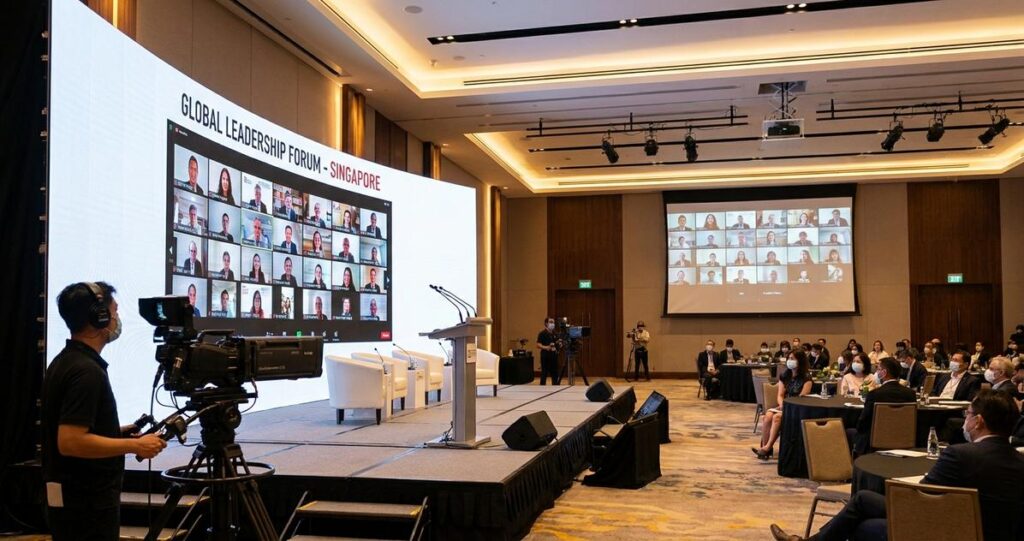
Singapore has become comfortable with hybrid communication, from board meetings and town halls to training sessions, community forums, and medical education events. Yet many organisations still struggle to make the in-room and online audience feel equally included. A polished livestream alone does not create a unified experience. True hybrid success depends on designing one event journey, where physical and virtual participants can access the same information, contribute in meaningful ways, and feel that their presence matters.
For companies, associations, educational institutions, and public sector teams in Singapore, this matters for practical reasons. Hybrid delivery can improve reach across time constraints, office locations, and varying accessibility needs. It can also support teams that include overseas colleagues, work-from-home staff, and partners who cannot travel easily between sites. The challenge is not simply technical. It is about event design, communication flow, audience psychology, production discipline, and a clear understanding of what each group needs to participate fully.
A unified experience does not mean making the two audiences identical. Physical attendees have a different sensory environment, while virtual peers depend on the screen, the audio feed, and the quality of interaction tools. The goal is to remove the feeling that one side is an afterthought. When planning is done well, the event feels coordinated, responsive, and inclusive, whether someone is seated in a conference hall at Suntec, joining from an office in One-North, or logging in from home after work.
Start with one event strategy, not two separate audiences
The most common reason hybrid events feel fragmented is that planners think about them as two programmes running side by side. That approach often creates duplication, inconsistent messaging, and uneven engagement. A stronger model is to design a single event strategy, then adapt the delivery format for both physical and virtual participation. This begins with one set of objectives, one agenda logic, and one moderation plan that accounts for both environments.
When the event purpose is clear, decisions become easier. If the objective is knowledge transfer, the content must be structured so both groups can follow the same narrative without missing essential context. If the purpose is discussion, then interaction tools such as live Q&A, polls, and moderated chat should be built into the programme from the start. If the purpose is relationship building, then planners need intentional networking moments that work both on-site and online.
Define the audience journey early
Map the full experience from registration to post-event follow-up. Physical attendees may need venue directions, badge collection, seating guidance, and meal arrangements. Virtual participants may need platform login instructions, technical checks, and a simple explanation of how to ask questions. When these paths are designed separately but with the same standard of care, both groups feel considered.
In Singapore, where many attendees move between office, transit, and venue environments, the communication before the event should be concise and practical. Provide clear timing, exact access details, and the agenda in local time. If a venue has limited parking or specific entry points, state that plainly. If the virtual platform requires a browser update or app installation, say so in advance and keep the steps minimal. Good preparation reduces avoidable friction and keeps attention on the content.
Align the programme with both attention spans
Hybrid audiences tend to drift when sessions are too long or when one group waits while the other catches up. A unified experience works better when the programme is paced in shorter blocks, with clear transitions and regular interaction. This does not mean every session must be brief, but it does mean the structure should support attention and participation. Breaks, questions, and speaker changes should be planned with the online audience in mind, because long stretches without interaction can quickly reduce engagement.
Use the same content hierarchy for both groups. The opening should establish the topic, the middle should deliver the core insights, and the close should reinforce the key takeaways. If extra detail is needed for one audience, make it accessible through downloadable materials, follow-up notes, or a moderated appendix session rather than burdening the live programme.
Design interaction so both groups can contribute in real time
Interaction is the point where many hybrid events succeed or fail. If questions from the room dominate while online comments are ignored, virtual attendees will feel invisible. If the online platform is the only place where engagement happens, physical attendees may feel disconnected from the live environment. A unified experience gives both groups real opportunities to participate, and it does so in a way that feels fair and intuitive.
The key is to avoid forcing one audience to adapt entirely to the other. Instead, create a shared participation system. This can include live polls, moderated Q&A, reaction prompts, and structured breakout discussions. The moderator should actively balance inputs from the room and the chat, and the speaker should acknowledge both sources of feedback. Even simple practices, such as reading one in-room question and one online question alternately, can make a big difference.
Use moderation as the bridge between spaces
A skilled moderator is essential in hybrid settings. The moderator does more than introduce speakers. They translate the energy of the room into a format that the virtual audience can follow, and they ensure that online questions are not lost in the flow of a live stage discussion. In practice, this means monitoring the chat, cueing the speaker, and signalling when a question comes from online versus onsite. It also means keeping the session on time without cutting off participation prematurely.
For Singapore-based corporate and professional events, moderation should be culturally clear and efficient. Many attendees appreciate concise facilitation, but clarity should never come at the expense of warmth. A moderator who can smoothly manage transitions, repeat important questions, and set expectations for response time helps both groups feel respected.
Build interaction around equal access
Equal access does not mean identical tools. Physical participants might engage through microphones in the room, table discussions, or QR-code polls. Virtual participants might engage through chat, reaction buttons, or live annotation tools. The important point is that each group has a direct route into the conversation. Avoid creating participation steps that only favour one side, such as asking online attendees to wait passively while the room gets priority by default.
If the event involves sensitive or technical topics, consider using pre-submitted questions to supplement live interaction. This can help prevent silence, reduce pressure on speakers, and create a more inclusive discussion. In educational or professional development settings, structured prompts often work better than open-ended requests for questions, especially when participants come from different seniority levels or are unfamiliar with public speaking.
Make production choices that support one shared experience
The technical side of a hybrid event is not merely background infrastructure. Audio, camera work, slide visibility, lighting, and switching between speakers all shape whether the audience feels present in the same room. Poor sound quality is one of the fastest ways to break the sense of connection. If online participants cannot hear clearly, they stop feeling part of the event. If the camera framing is unsteady or the slides are unreadable, they will struggle to stay engaged even if the content is strong.
In Singapore, where event venues range from hotel ballrooms to corporate boardrooms and campus auditoriums, production planning must adapt to the space. Room acoustics, internet stability, and stage layout differ widely. A professional hybrid setup should be tested in the actual venue whenever possible. Never assume that a venue’s standard AV package is sufficient for a dual-audience programme. The requirements for a livestream are different from those for a local projector, and the standards for a serious hybrid event should reflect that difference.
Prioritise sound and visibility
Audio should be treated as the highest production priority. Clear speech, stable microphone levels, and proper speaker placement matter more than visual effects. When people speak from the stage, use microphones that are designed for the room and for broadcast capture, not just for in-person amplification. If panelists move around, make sure they can still be heard consistently. For virtual participants, audio clarity often determines whether they can follow a discussion or tune out.
Visibility matters just as much. Slides must be legible on smaller screens, especially if participants are joining on laptops or mobile devices. Avoid dense text, tiny fonts, and overly busy graphics. If the event includes demonstrations, product views, or medical or technical visuals, ensure the camera angle and screen share are planned to show the detail clearly. This is particularly important for training sessions, investor briefings, and technical seminars where precision matters.
Plan for redundancy and technical control
Reliable hybrid delivery requires backup planning. Use stable internet connectivity, backup audio paths, spare cables, and a technical team that knows how to respond quickly when something changes. If a speaker joins remotely, test their connection beforehand and have a backup method of communication available. If there is a delay or disruption, the programme should have a contingency plan so the audience is not left uncertain.
Having a dedicated technical director or producer helps maintain control over the experience. This person should coordinate the live stage, the stream, the presentation files, and the participant interface. In a unified hybrid event, the audience should not notice the complexity behind the scenes. They should experience only a smooth flow, clear communication, and a sense that the event is under control.
Create parity in content, not just presence
Parity means that both physical and virtual participants receive the same level of value, even if their experience formats differ. This is more than a question of broadcasting the room to a screen. It involves shaping content so the online audience is not reduced to passive viewers. It also means ensuring that the in-room audience is not disadvantaged by the need to keep the stream running.
One practical method is to design content blocks that work well in both settings. Use clear speaker introductions, concise transitions, and visual support that reinforces spoken content. Avoid depending heavily on informal side conversations that are easy for the room to hear but impossible for online participants to access. If networking is an important part of the event, create specific digital touchpoints or post-session sessions rather than assuming that a livestream can recreate spontaneous hallway conversations.
Respect the differences between formats
Physical attendees benefit from direct human presence, informal exchanges, and the atmosphere of the venue. Virtual attendees benefit from convenience, flexibility, and the ability to join from anywhere. A good hybrid design respects these differences rather than pretending they do not exist. The task is to make each format valuable in its own way while preserving a shared sense of occasion.
For example, an opening keynote can be delivered to both audiences at the same time, followed by moderated Q&A that alternates between the room and online questions. A networking segment might be structured so physical participants meet face to face while virtual participants join themed breakout rooms or one-to-one digital appointments. This approach prevents either group from feeling like they are waiting for the other to finish using the room.
Keep branding and messaging consistent
A unified experience also depends on visual and verbal consistency. Registration pages, reminder emails, on-screen graphics, stage signage, and speaker notes should all reflect the same tone and message. In Singapore, where many events are multilingual or serve mixed professional audiences, clarity of language is especially important. Use simple, direct wording and avoid unnecessary jargon when explaining participation steps.
Consistency builds trust. When the audience sees the same event identity across channels, they are more likely to feel that they are taking part in one coordinated experience rather than a patchwork of unrelated systems. That sense of coherence strengthens credibility and improves overall satisfaction.
Measure success through engagement, accessibility, and continuity
After the event, organisers should assess more than attendance numbers. A unified hybrid experience should be evaluated through indicators such as participation balance, audio and visual quality, ease of access, audience feedback, and the continuity of discussion after the live session. Did both audiences have a fair chance to contribute? Were questions handled well? Did the technology help the programme, or distract from it? These are the questions that reveal whether the event design truly worked.
Feedback can be collected through post-event surveys, follow-up calls, and internal debriefs with speakers and production staff. Look for patterns in comments from both groups. If virtual participants repeatedly mention late audio, unclear slides, or lack of interaction, that points to a structural issue rather than a one-off glitch. If in-room participants felt the online component interrupted the flow, that may indicate a need for better moderation or pacing.
Accessibility should also be part of the evaluation. Consider whether captions, readable slides, clear instructions, and simple navigation were available and useful. While not every event requires the same accessibility features, inclusive design is increasingly important for professional events and public-facing programmes. When possible, use approaches that support a wider range of participants without creating unnecessary complexity.
For organisations in Singapore, a thoughtful hybrid model can support better reach across different working patterns and stakeholder groups. It can also reduce the risk of excluding people who cannot attend in person due to time, travel, or mobility constraints. The best events do not force people to choose between being physically present and being meaningfully involved. They create a shared experience that feels deliberate, accessible, and professionally executed.
To create that result, start with one strategy, design interaction for both groups, invest in strong production, and test every element in advance. Make the communication clear, keep the content balanced, and use moderation to connect the room with the stream. When these pieces work together, physical and virtual peers stop feeling like separate audiences. They become part of one event community, experiencing the same message with the same level of respect and attention.
Medical note: This article is for general information only and does not constitute medical advice. If your event includes health-related content, patient education, or clinical demonstrations, engage qualified healthcare professionals and follow the relevant institutional, ethical, and regulatory requirements.
Jeremy Lee is a seasoned digital marketing director and strategist with over two decades of experience in the industry. As the founder of Sotavento Medios, I manage a diverse portfolio of over 50 businesses, helping brands grow through advanced search strategies and digital innovation. My work focuses on bridging the gap between traditional search engine optimisation and the evolving world of AI-driven answer engines.
get in touch