
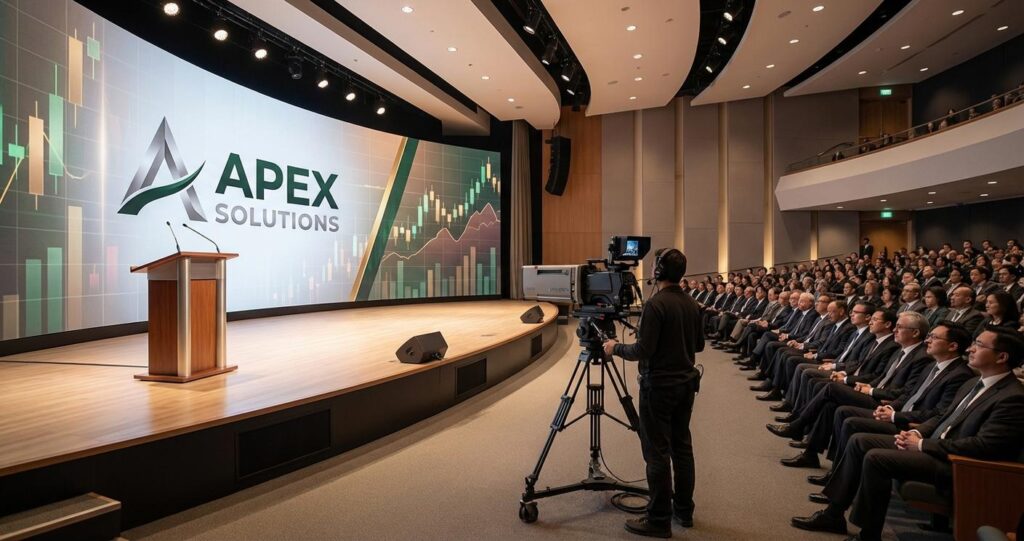
The Annual General Meeting (AGM) has transformed from a purely physical, in-room event to a complex digital and hybrid affair, a shift accelerated by regulatory adaptations and technological advancements in Singapore. For corporate event planners, IT directors, and production managers, this evolution presents a significant technical challenge that extends far beyond a simple webinar setup. Successfully executing a digital or hybrid AGM demands a broadcast-grade production philosophy centered on security, reliability, and seamless integration of physical and virtual components. This is not a task for consumer-grade platforms; it requires a deep understanding of enterprise streaming infrastructure, professional signal flow, and robust redundancy protocols to uphold the principles of transparency and shareholder engagement that are legally mandated.
The technical objective of a modern AGM is to create a unified, high-quality experience for all stakeholders, regardless of their location. This involves managing multi-camera feeds from the event venue, integrating remote presenters, facilitating secure Q&A and voting, and delivering a low-latency, high-availability stream to a geographically dispersed audience. Achieving this requires a meticulously planned architecture that accounts for every potential point of failure, from signal acquisition at the camera sensor to final delivery on a shareholder’s device. This article provides a technical deep-dive into the critical production and streaming infrastructure required to engineer a successful digital AGM in the current corporate landscape.
Foundational Production and Contribution Infrastructure
The bedrock of any professional AGM broadcast is the on-site production core. This is where raw audio and video signals are captured, mixed, and prepared for encoding and transmission. The quality and reliability of this foundation directly impact every subsequent step in the streaming workflow.
Signal Acquisition and Routing Architecture
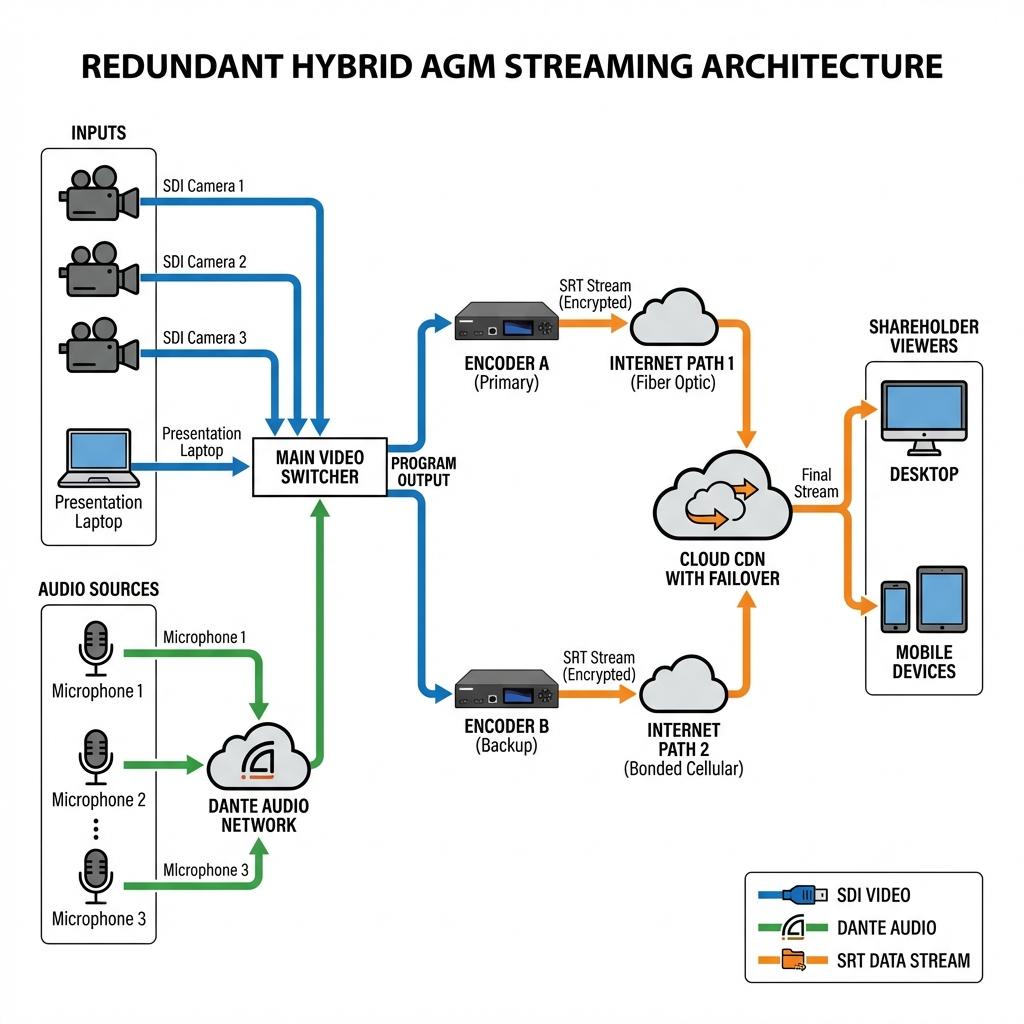
Signal acquisition for a hybrid AGM typically involves a multi-camera setup. A minimum configuration often includes a wide shot of the stage or boardroom, medium shots of the main speakers or panel, and a dedicated camera for the Q&A session moderator. For these applications, broadcast-quality cameras utilizing Serial Digital Interface (SDI) outputs, specifically 3G-SDI or 6G-SDI for 1080p and UHD resolutions respectively, are the industry standard. SDI provides a robust, uncompressed video signal over long cable runs (up to 100 meters) and ensures frame-accurate synchronization. In more flexible or complex environments, Network Device Interface (NDI) technology offers a compelling alternative, allowing high-quality, low-latency video to be transmitted over a standard Gigabit Ethernet network. This simplifies cabling but requires a carefully managed network with sufficient bandwidth and Quality of Service (QoS) configurations to prioritize video traffic. All camera feeds, along with audio from professional microphones, are routed to a central video production switcher, such as a Blackmagic Design ATEM Constellation or a Ross Video Carbonite. This hardware is the operational heart of the event, allowing a technical director to cut between camera angles, integrate presentation slides, and insert professional lower-third graphics in real-time. The primary output from the switcher, known as the Program feed, is then sent to the encoding stage.
Encoding Protocols: SRT as the Enterprise Standard
Once the final Program feed is produced, it must be encoded and transmitted to the streaming platform or Content Delivery Network (CDN). While Real-Time Messaging Protocol (RTMP) was once the de facto standard, it is no longer sufficient for high-stakes corporate events due to its susceptibility to packet loss and network jitter. The modern enterprise standard is Secure Reliable Transport (SRT). SRT is an open-source protocol designed for high-performance video streaming over unpredictable networks like the public internet. It provides robust error correction through an intelligent packet retransmission mechanism (ARQ), ensuring a stable stream even with network fluctuations. Furthermore, SRT offers end-to-end AES-128/256 bit encryption, a critical requirement for sensitive corporate communications. A typical AGM stream might be encoded using the H.264 or H.265 (HEVC) codec at a resolution of 1920×1080 at 50 or 59.94 frames per second, with a variable bitrate (VBR) targeting 6-8 Mbps. Using a professional hardware encoder, we would configure the SRT stream with a latency buffer of approximately 4x the round-trip time of the network path to provide a balance between low delay and maximum stability.
Architecting the Hybrid Experience: Integrating Remote Participants
A true hybrid AGM seamlessly integrates virtual attendees, allowing them to participate in Q&A and polling with the same level of access as those in the physical room. This creates significant technical complexity, primarily in managing bi-directional audio and video feeds without compromising the main broadcast.
Bi-Directional Signal Flow and Audio Management
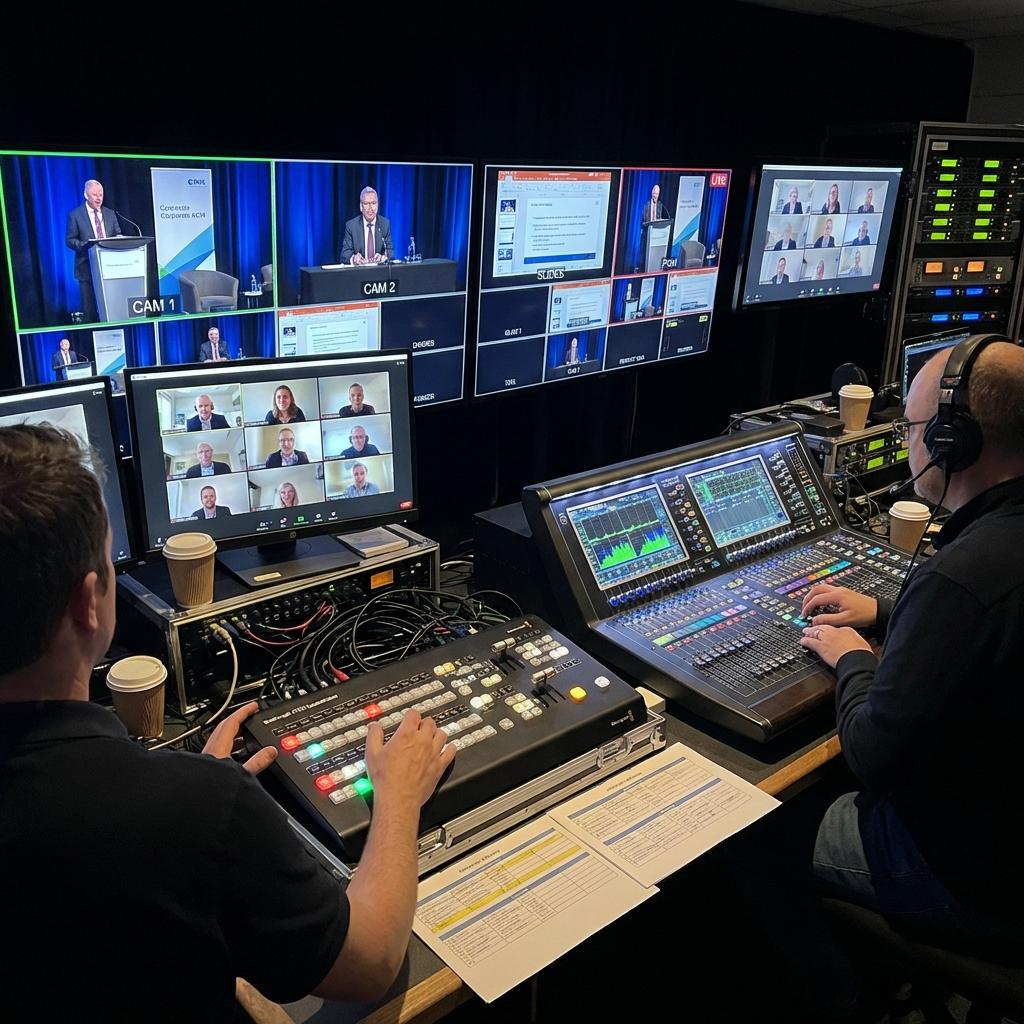
Integrating remote participants from platforms like Zoom, Microsoft Teams, or Webex into a professional broadcast requires a carefully managed signal flow. A common approach is to use a dedicated computer with a professional video I/O device (e.g., from AJA or Blackmagic Design) to convert the platform’s video output into a standard SDI or NDI signal. This signal can then be treated as another source on the main video switcher. The more critical challenge is audio. To prevent remote participants from hearing an echo of themselves, a mix-minus audio feed must be created. This is a custom audio mix sent back to the virtual platform that includes the program audio from the venue microphones but subtracts the audio from the remote participants themselves. This is configured on a professional digital audio console with multiple auxiliary outputs. A dedicated operator, often called a Virtual Audience Manager, is essential to coordinate with remote speakers, manage their audio levels, and ensure their feed is clean before it is sent to the main program mix.
Secure Viewer Access and Platform Integration
For a compliant AGM, access to the live stream must be restricted to verified shareholders. This requires a streaming platform with robust security features beyond a simple password. Token-based authentication, or “signed URLs,” is a common method where each viewer is provided a unique, time-sensitive link that cannot be shared. The platform’s player should be hosted on a custom-branded webpage, providing a professional look and feel. The platform must also feature robust, API-driven Q&A and live polling modules. These APIs allow for integration with shareholder verification systems to ensure that only eligible attendees can submit questions or vote. The data from these interactions must be captured, logged, and time-stamped for compliance and archival purposes. Relying on the native chat or polling functions of consumer-grade platforms is often insufficient for the stringent auditing requirements of a public company’s AGM.
Ensuring High Availability with Full Redundancy
For an event as critical as an AGM, failure is not an option. A high-availability streaming architecture is non-negotiable. This involves building complete redundancy into every critical component of the signal chain to protect against hardware failure, network outages, or power interruptions.
Implementing A/B Redundancy Chains
A full A/B redundancy workflow duplicates the entire transmission path. This starts with the Program feed from the video switcher being sent to two independent hardware encoders (an A and a B unit). Each encoder is connected to a separate, physically diverse internet connection. For example, the primary ‘A’ encoder might use a dedicated fiber optic line, while the backup ‘B’ encoder uses a bonded cellular solution (combining multiple 4G/5G carriers) or a secondary ISP. Both encoders transmit identical, synchronized SRT streams to the CDN. The CDN is configured to ingest both the primary and backup streams and will automatically failover to the backup stream if the primary signal is lost for even a few seconds. This seamless switching is imperceptible to the end viewer. This level of redundancy extends to power, with all critical equipment connected to an Uninterruptible Power Supply (UPS) to guard against power failures.
Network Infrastructure and Pre-Event Validation
The on-site network is a common point of failure. A dedicated, managed network should be established for the streaming operations, completely isolated from venue Wi-Fi or other shared traffic. A minimum of 50 Mbps of symmetrical, uncontended bandwidth is recommended for a primary 1080p SRT stream with sufficient overhead for a backup stream and production communication. Network switches should be configured with QoS policies to prioritize the SRT packets from the encoders above all other traffic. Before the event, a comprehensive network stress test and a full-scale transmission test should be conducted for an extended period (at least 60 minutes). This involves running the encoders at the target bitrate and monitoring the stream’s health at the CDN, analyzing metrics like packet loss, jitter, and round-trip time to validate the stability of the entire workflow well before shareholders join the stream.
Advanced Production Elements for Corporate Governance
Beyond the core streaming technology, advanced production elements play a vital role in conveying information clearly and professionally, which is central to the AGM’s purpose of transparency and corporate governance.
Real-Time Graphics and Data Integration
Professional graphics are essential for a polished broadcast. This includes lower-third titles identifying each speaker and their position, full-screen graphics to display agenda items or formal resolutions, and picture-in-picture compositions to show a speaker alongside their presentation slides. For live voting, data integration is key. Using graphics platforms with real-time data capabilities, such as Singular.live or Vizrt, polling results can be fed directly from the shareholder platform via an API and displayed as animated charts or graphs on screen within seconds of the poll closing. This provides immediate, transparent feedback to all attendees and reinforces the integrity of the voting process.
ISO Recording for Compliance and Archiving
For compliance and post-event auditing, a complete record of the AGM is mandatory. While a simple recording of the main program feed is standard, a more robust approach is isolated (ISO) recording. Professional video switchers and dedicated recording hardware can capture the video feed from every single camera, as well as the final program output, as separate, high-quality video files. These are typically recorded in professional codecs like Apple ProRes or Avid DNxHD. This provides immense flexibility for post-event needs. For example, if a specific speaker’s audio was unclear in the live mix, it can be corrected using their clean ISO microphone feed. Most importantly, it creates a comprehensive, multi-angle archive of the entire proceedings, providing an indisputable record for regulatory purposes.
In conclusion, the modern digital AGM is a complex broadcast event that requires a sophisticated and resilient technical architecture. Moving away from simplistic web conferencing tools to a professional production workflow built on standards like SDI and SRT, and designed with full redundancy, is the only way to meet the security, reliability, and transparency requirements of corporate governance in Singapore. The successful execution of a hybrid AGM is a direct reflection of a company’s commitment to clear and accessible shareholder communication. It demands meticulous planning, professional-grade equipment, and the expertise of a technical team versed in the nuances of live, high-stakes corporate broadcasting.
Jeremy Lee is a seasoned digital marketing director and strategist with over two decades of experience in the industry. As the founder of Sotavento Medios, I manage a diverse portfolio of over 50 businesses, helping brands grow through advanced search strategies and digital innovation. My work focuses on bridging the gap between traditional search engine optimisation and the evolving world of AI-driven answer engines.
get in touch