
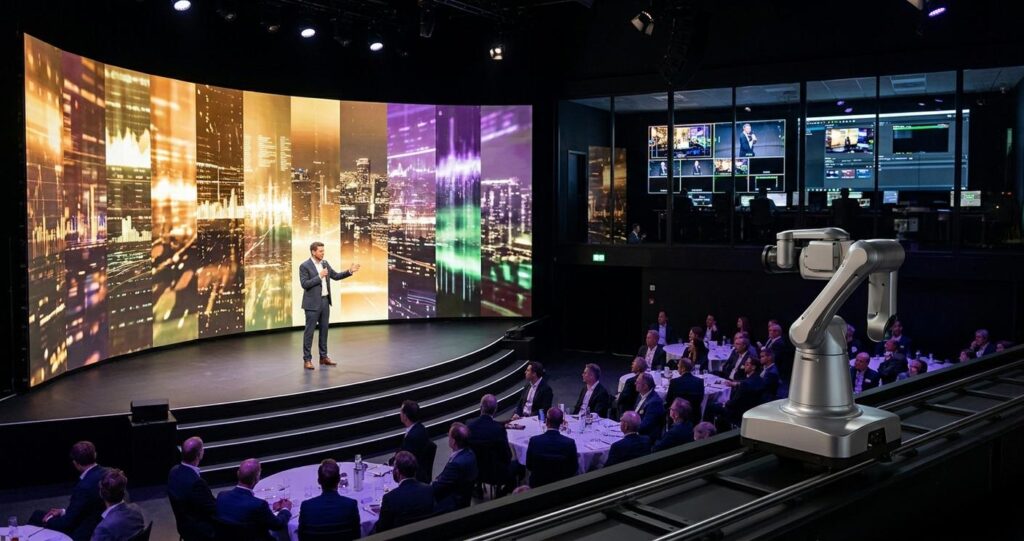
In the evolving landscape of B2B event production and enterprise streaming, the demand for highly engaging and visually sophisticated presentations has never been more critical. Static, manually operated cameras, while foundational, often fall short in capturing the dynamism required to hold the attention of today’s discerning virtual and hybrid audiences. The modern corporate event, whether an executive keynote, a product launch, or an internal town hall, necessitates a level of production polish that rivals broadcast television. Spring Forest Studio understands this imperative, recognizing that achieving true audience immersion hinges on leveraging advanced technologies.
This article delves into the transformative advantages of real-time camera tracking for dynamic presentations, providing a deep technical analysis for corporate event planners, AV professionals, production managers, and IT directors. We will explore how sophisticated automated camera systems enhance visual storytelling, streamline production workflows, and integrate seamlessly with enterprise-grade streaming infrastructure. By meticulously orchestrating camera movements with presentation content and presenter actions, real-time tracking systems elevate standard corporate communications into compelling, memorable experiences. This isn’t merely about automating a process; it’s about unlocking new dimensions of visual engagement, ensuring every nuance of a presentation is captured with precision, consistency, and a professional aesthetic that combats viewer fatigue in extended virtual or hybrid sessions.
Unpacking the Core Technology: How Real-Time Camera Tracking Systems Function
At its foundation, real-time camera tracking involves the precise, automated acquisition of camera positional and rotational data, translating physical movements into digital commands that control robotic camera systems or inform augmented reality (AR) graphics engines. These systems operate on various technical principles, each optimized for specific production demands and environmental conditions. Understanding these methodologies is crucial for selecting the appropriate enterprise-grade solution.
Optical Tracking Architectures
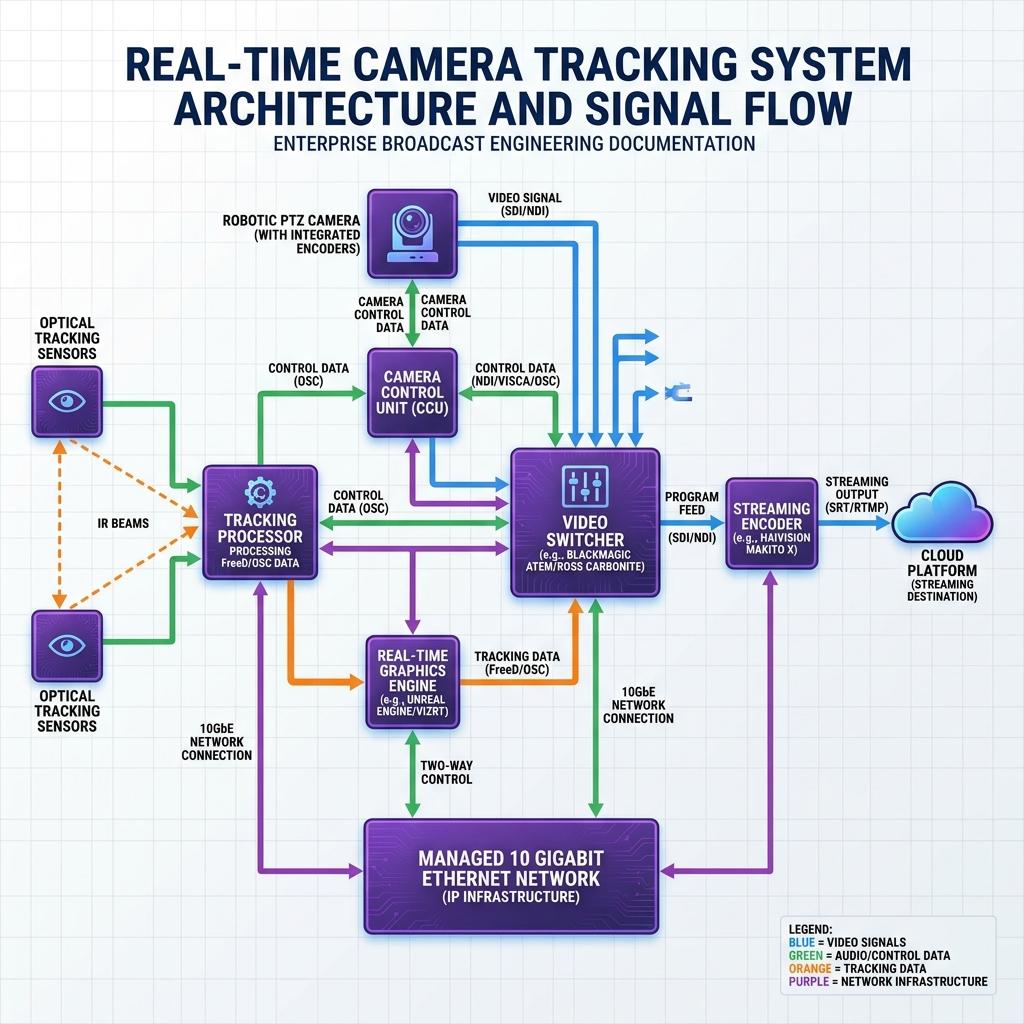
Optical tracking systems utilize computer vision algorithms to detect and calculate the position of passive or active markers within a defined spatial volume. Passive markers, typically reflective spheres or patterns, are observed by specialized infrared (IR) cameras or stereo vision systems mounted in the production environment. These IR cameras, distinct from the primary program cameras, feed positional data to a dedicated tracking processor. The processor triangulates the marker positions, deriving the camera’s exact XYZ coordinates and its pan, tilt, roll (PTR) orientation. Active markers, conversely, emit their own IR or LED signals, often synchronized with the tracking cameras for improved signal-to-noise ratio and resistance to ambient light interference. Accuracy in high-end optical systems can achieve sub-millimeter precision, with latency as low as a few milliseconds, critical for seamless AR overlays and tight presenter framing. Data from these systems is often transmitted via established protocols such as FreeD (a common broadcast standard for camera tracking data), or through proprietary IP-based protocols over a dedicated Ethernet network, ensuring minimal jitter and deterministic delivery to downstream systems like video switchers or real-time graphics engines (e.g., Unreal Engine, Vizrt, ChyronHego).
Mechanical Tracking Systems and PTZ Integration
Mechanical tracking systems are often integrated directly into robotic camera pedestals, robotic heads, or specialized Pan-Tilt-Zoom (PTZ) cameras. These systems rely on precision encoders embedded within the camera’s mechanical axes. As the camera pans, tilts, or zooms, the encoders generate electrical pulses, which are then converted into precise angular and focal length data. For enterprise-grade PTZ cameras, especially those supporting NDI|HX3 or full NDI, this tracking data can be embedded within the IP stream itself or transmitted concurrently via protocols like VISCA over IP, Pelco D/P, or proprietary API calls. High-end robotic heads used in broadcast and large-scale corporate events offer extreme repeatability and smooth, repeatable motion, crucial for complex programmed shots. They often feature integrated lens data systems that accurately report focus and iris settings alongside PTR, providing a complete kinematic dataset for advanced production requirements. The advantage here is often a simpler setup, as the tracking is intrinsic to the camera hardware itself, reducing external sensor requirements and simplifying calibration, although precise homing and calibration remain essential for absolute positional accuracy.
Hybrid Tracking Solutions and Data Fusion
For the most demanding B2B presentations, hybrid tracking solutions combine the strengths of both optical and mechanical methods. For instance, a robotic camera head might provide its intrinsic mechanical encoder data, while an optical system provides absolute positional referencing or tracks a presenter’s movements independently. Data fusion algorithms then correlate these disparate datasets, often employing Kalman filters or similar probabilistic methods, to yield an even more robust and accurate tracking stream. This redundancy enhances reliability and allows for dynamic adjustments to potential drift or inaccuracies from a single source. The fused data is then timestamped and synchronized, ensuring precise alignment with video frames from SDI (SMPTE 259M, 292M, 424M, 2081-1, 2082-1) or IP (SMPTE 2110, NDI) video sources, a prerequisite for professional-grade live production and AR integration. The ability to integrate with diverse data streams, including external sensor data or even biometric inputs, presents a future pathway for truly adaptive and intelligent camera automation in enterprise environments.
Enhancing Visual Storytelling: Dynamic Shot Composition and Presenter Engagement
The primary benefit of real-time camera tracking in B2B presentations lies in its ability to transcend static, predictable visuals, injecting a dynamic narrative quality that directly impacts audience engagement. This capability moves beyond simple automation; it enables a sophisticated form of visual storytelling that was previously unattainable without a team of highly skilled camera operators.
Automated Shot Framing and Presenter Orchestration
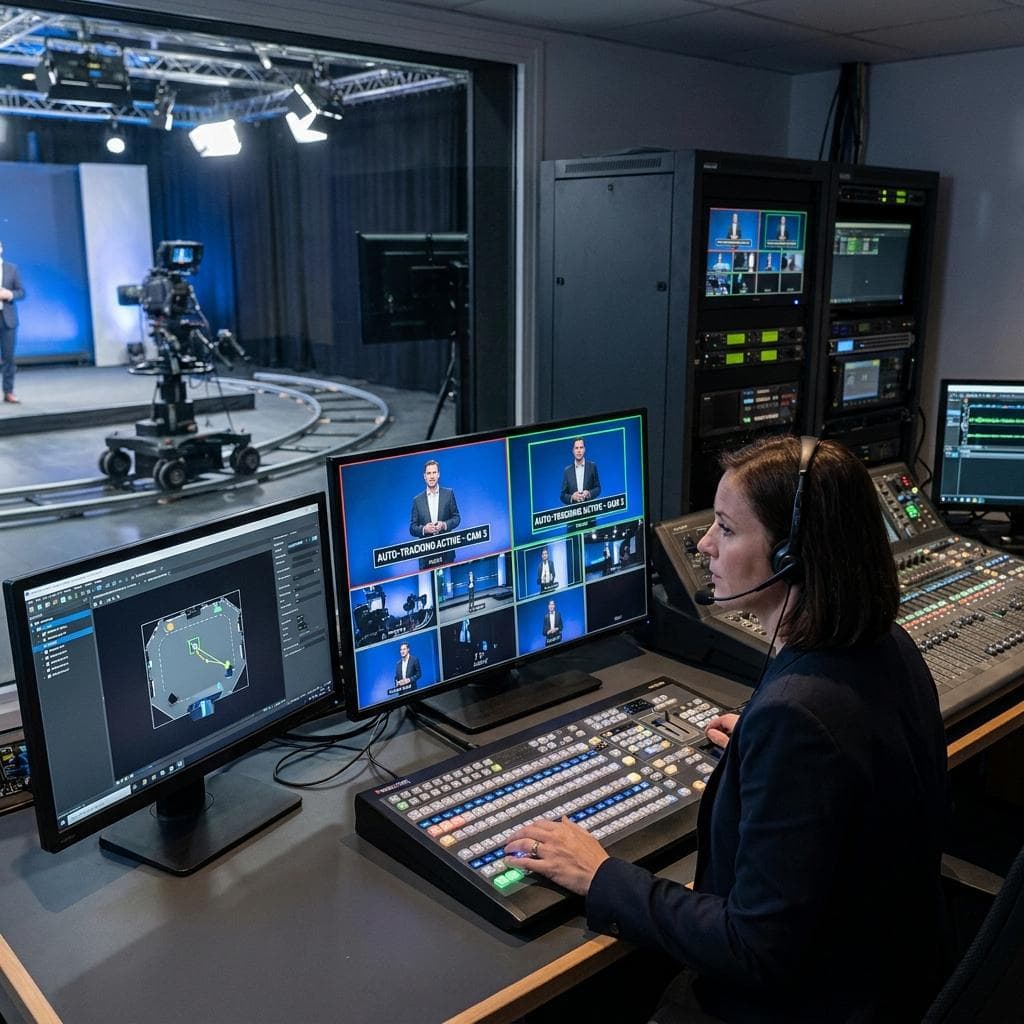
One of the most compelling applications is automated shot framing. Instead of a fixed wide shot or a single static close-up, tracking systems can be programmed to maintain optimal framing of a presenter as they move naturally across a stage or presentation area. This involves continuous adjustments to pan, tilt, and zoom, ensuring the presenter remains precisely centered and proportionally framed within the shot, adhering to established broadcast safe zones. For a walking presenter, the system can smoothly follow their trajectory, executing elegant dolly, crane, or jib-like movements with programmed precision. This not only enhances visual flow but also reduces the cognitive load on the presenter, allowing them to focus entirely on their content without concern for staying “in frame.” In multi-presenter scenarios, the system can intelligently transition between speakers based on audio cues (e.g., active microphone detection), presenter position, or programmed sequences, delivering a seamless and visually engaging exchange without manual intervention. These automated movements can be pre-programmed in a virtual environment, allowing for pre-visualization and refinement of complex camera paths before the live event, significantly reducing setup time and on-the-fly adjustments.
Dynamic Transitions and Content Synchronization
Real-time camera tracking unlocks a new dimension of dynamic transitions. Instead of abrupt cuts between static shots, the system can execute fluid, pre-defined camera moves that serve as integral parts of the presentation narrative. Imagine a wide shot of a stage smoothly zooming and panning to a tight close-up of a specific product on a podium, or a camera subtly pulling back to reveal an augmented reality graphic alongside the presenter. These transitions can be meticulously synchronized with presentation software (e.g., PowerPoint, Keynote) via control protocols like OSC (Open Sound Control) or through proprietary APIs, triggering specific camera presets or movements at precise moments during a slide change or video playback. This synchronization capability allows for a truly immersive experience where visual elements, presenter actions, and camera perspectives coalesce into a cohesive, impactful message. For hybrid events, this dynamic visual language is crucial for maintaining the engagement of both the physical and virtual audiences, ensuring parity in the viewing experience. By eliminating jarring cuts and introducing cinematic movement, the production quality elevates to broadcast-grade standards, critical for maintaining the attention of enterprise stakeholders.
Seamless Integration with Enterprise Production Workflows and Infrastructure
Implementing real-time camera tracking in a B2B event streaming environment requires meticulous planning and seamless integration with existing enterprise-grade production infrastructure. The true power of these systems lies not in their standalone capabilities, but in their ability to augment and enhance the entire live production workflow.
Video Switching, Control, and Signal Flow
Tracked camera feeds, whether originating from traditional broadcast cameras with robotic heads (connected via SDI or fiber, e.g., SMPTE 292M for HD, SMPTE 424M for 3G-SDI, or SMPTE 2082-1 for 12G-SDI 4K/UHD) or from advanced PTZ cameras (utilizing NDI, NDI|HX3, or SRT streams), must integrate flawlessly with the production switcher. Professional video switchers from manufacturers like Ross Video, Grass Valley, Blackmagic Design ATEM, or Panasonic AV-HS series are designed to handle multiple high-resolution inputs. Camera control units (CCUs) for broadcast cameras interface with the robotic heads, relaying pan, tilt, zoom, focus, and iris data, often via serial protocols or IP. For NDI-enabled PTZ cameras, control signals are embedded or run concurrently over the same network. The tracking data itself, typically in FreeD or a similar IP-based format, feeds into a central production control system or a dedicated AR graphics engine. This system then correlates the camera’s position and orientation with virtual elements, rendering the composite output that is then ingested by the switcher. Audio signal flow is equally critical, often managed by separate professional audio mixers (e.g., Yamaha Rivage PM series, Digico SD series) that provide program audio, auxiliary sends for hybrid platforms, and talkback systems for production crew. All these elements must be precisely synchronized, often leveraging genlock (black burst or tri-level sync) to ensure phase alignment of video signals, preventing artifacts and maintaining visual integrity.
Network Infrastructure and Streaming Protocols
The backbone of any sophisticated B2B streaming operation is robust network infrastructure. Real-time camera tracking systems, especially those utilizing IP-based control and NDI video streams, demand dedicated network segments. A managed Gigabit or 10 Gigabit Ethernet network, often with VLAN segmentation, is essential to isolate critical control data and high-bandwidth video traffic. Quality of Service (QoS) configurations must prioritize NDI streams, FreeD data, and control signals to minimize latency and packet loss, which can manifest as jerky camera movements or misaligned AR graphics. For encoding and streaming, the output from the program switcher is fed into enterprise-grade encoders (e.g., Elemental Live, Haivision Makito X) that compress the video using H.264 (AVC) or H.265 (HEVC) codecs. These encoders typically support a range of streaming protocols including RTMP/RTMPS for broad platform compatibility, and increasingly, SRT (Secure Reliable Transport) for secure, high-quality, low-latency transport over unpredictable networks. Cloud-based streaming platforms (e.g., AWS Elemental MediaLive, Azure Media Services) or on-premise streaming servers then distribute the content. For hybrid events, integration with platforms like Microsoft Teams, Zoom, or Webex is achieved via dedicated hardware or software bridges that convert the program feed into a virtual camera input, often leveraging NDI virtual input drivers for seamless incorporation into the meeting environment.
Scalability, Redundancy, and Quality of Service
Enterprise-grade deployments require built-in scalability and robust redundancy. A camera tracking system should be capable of managing multiple tracked cameras simultaneously, allowing for complex multi-angle productions. Redundant control paths, dual-power supplies on critical hardware, and failover mechanisms for streaming encoders are non-negotiable. For instance, an active-passive encoder setup ensures that if the primary encoder fails, a secondary unit seamlessly takes over, maintaining an uninterrupted stream. Network redundancy, often via Link Aggregation Groups (LAG) or redundant network switches, mitigates single points of failure. Quality of Service (QoS) on the network not only prioritizes critical data but also reserves bandwidth, preventing congestion during peak usage. Monitoring systems, including multiview displays, network analytics tools, and audio metering, provide real-time feedback to the production team, allowing for immediate identification and rectification of any anomalies. The entire infrastructure must be designed to meet stringent Service Level Agreements (SLAs), ensuring reliable, high-quality delivery for mission-critical corporate communications.
Operational Efficiency, Scalability, and Redundancy for Enterprise Deployments
Beyond the immediate visual enhancements, real-time camera tracking systems deliver substantial operational benefits for B2B event production, leading to increased efficiency, greater consistency, and a foundation for scalable, future-proof streaming solutions.
Reduced Crew Requirements and Consistent Output
One of the most tangible advantages is the significant reduction in required camera operators. A single technical director or automation specialist can manage multiple tracked cameras, freeing up valuable human resources for other critical production roles such as graphics operation, audio mixing, or content management. This operational efficiency translates directly into cost savings, particularly for recurring corporate events or in-house studio productions. Moreover, automated systems ensure unparalleled consistency and repeatability. Once a camera path or a specific shot sequence is programmed and refined, it can be executed identically for every presentation, every speaker, and every event. This eliminates human variability, guaranteeing a consistently polished and professional output, which is paramount for maintaining brand image and technical excellence in enterprise communications. The ability to recall precise camera presets, including pan, tilt, zoom, focus, and iris settings, ensures that every shot is exactly as intended, every time.
Pre-visualization, Programming, and Adaptability
Modern camera tracking software often includes robust pre-visualization tools, allowing production teams to design, simulate, and refine complex camera movements and shot sequences in a virtual environment before stepping onto the physical stage. This capability enables meticulous planning, identifying potential issues or aesthetic improvements without consuming valuable on-site setup time. Programmed movements can be tightly integrated with presentation content, triggered by specific cues or timecodes. This level of adaptability means the system can precisely follow a speaker’s flow, zoom into relevant details at just the right moment, or transition to a wider shot to accommodate multiple presenters entering the frame. For events requiring rapid reconfiguration or multiple identical sessions, the ability to load and execute pre-built show files provides unparalleled flexibility and speed. Furthermore, the system can adapt to changes; if a presenter deviates from a script, intelligent tracking algorithms can dynamically adjust, maintaining optimal framing and ensuring the audience’s focus remains on the speaker and their message.
Designing for Redundancy and Failover
In enterprise-level B2B streaming, system resilience is non-negotiable. Real-time camera tracking solutions must be designed with redundancy and failover strategies in mind. This includes redundant power supplies for all critical components, network paths with Link Aggregation Groups (LAG) or redundant switches, and in some cases, hot-swappable tracking processors. Control protocols like FreeD or NDI can be transmitted over redundant network interfaces, ensuring that a single network path failure does not disrupt camera movement. For complex AR applications, redundant graphics engines can be deployed in an active-standby configuration, ready to take over rendering if the primary system encounters an issue. Furthermore, professional robotic camera heads often include manual override capabilities, allowing a skilled operator to take control in an emergency. This layered approach to redundancy, from hardware components to network pathways and control logic, ensures maximum uptime and mitigates the risk of catastrophic failures during critical corporate broadcasts. Implementing a comprehensive monitoring solution, capable of tracking the health and performance of every system component, is also vital for proactive issue detection and rapid resolution.
Elevating B2B Event Experiences with Intelligent Camera Automation
The integration of real-time camera tracking technology represents a pivotal advancement in B2B event streaming and hybrid production. It transitions corporate presentations from static, often visually monotonous, affairs into dynamic, engaging, and broadcast-quality experiences. For corporate event planners, AV professionals, production managers, and IT directors, the benefits extend far beyond aesthetics, encompassing enhanced audience engagement, significant operational efficiencies, and a future-proof foundation for sophisticated content delivery.
By leveraging advanced optical, mechanical, and hybrid tracking systems, B2B organizations can achieve automated, precise, and repeatable camera movements that keep presenters perfectly framed, facilitate seamless transitions, and integrate flawlessly with augmented reality elements. This technical sophistication translates directly into a more immersive and impactful viewing experience for both virtual and physical attendees, crucial for combating digital fatigue and maximizing message retention. Furthermore, the ability to reduce manual camera operator requirements while ensuring consistent, high-quality output streamlines production workflows, reduces operational costs, and empowers production teams to focus on higher-level creative and technical execution.
Spring Forest Studio is at the forefront of implementing these cutting-edge solutions, providing the deep technical expertise required to design, deploy, and manage enterprise-grade real-time camera tracking systems. Our team understands the intricacies of integrating these technologies into complex production ecosystems, from robust network infrastructure and advanced streaming protocols (SRT, NDI, RTMP) to seamless compatibility with professional video switchers and hybrid event platforms. We are committed to delivering solutions that not only meet but exceed the rigorous demands of corporate broadcast standards, ensuring your presentations are not just seen, but truly experienced. Partner with Spring Forest Studio to transform your next corporate event into a masterclass in dynamic, technically excellent, and audience-centric communication.
Jeremy Lee is a seasoned digital marketing director and strategist with over two decades of experience in the industry. As the founder of Sotavento Medios, I manage a diverse portfolio of over 50 businesses, helping brands grow through advanced search strategies and digital innovation. My work focuses on bridging the gap between traditional search engine optimisation and the evolving world of AI-driven answer engines.
get in touch