
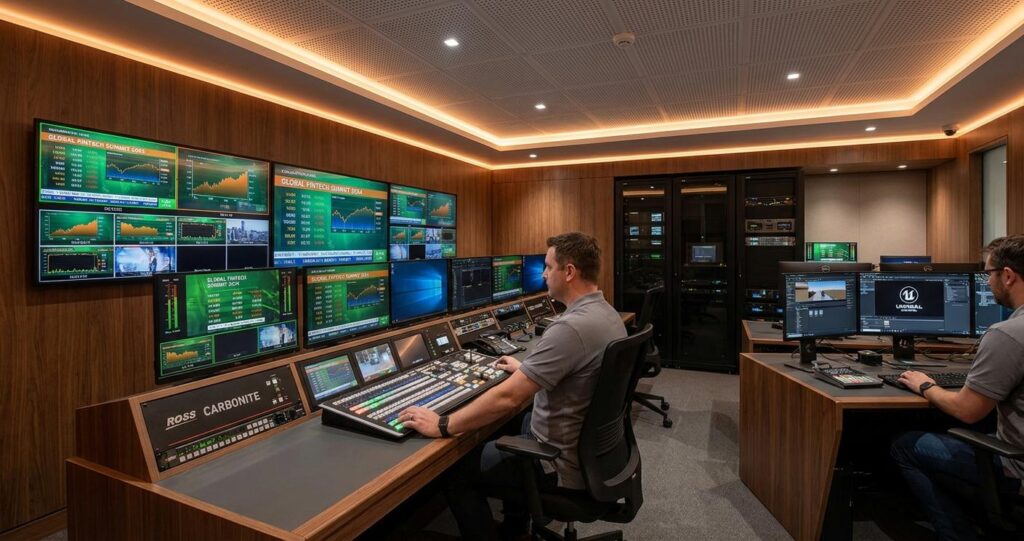
In the high-stakes realm of fintech, effective communication of complex financial data is paramount. Traditional static graphics and two-dimensional charts, while functional, often fail to capture the dynamic, immediate nature of market fluctuations and economic indicators. For professional B2B event streaming and hybrid productions, particularly within the financial sector, the demand for sophisticated, immersive data visualization has never been higher. Integrating real-time data into 3D graphic overlays transforms raw numbers into compelling, easily digestible visual narratives, offering unparalleled clarity and engagement for corporate event planners, AV professionals, and enterprise decision-makers. This advanced technical approach elevates event production from mere information dissemination to an immersive, authoritative experience, critical for conveying insights with impact.
The Imperative of Dynamic Data Visualization in Fintech Events
The financial services industry operates on a foundation of rapidly evolving data. From live stock tickers and cryptocurrency valuations to complex algorithmic trading results and economic forecasts, information latency can have significant consequences. For B2B events—whether a quarterly earnings call, an investor day, or a global financial summit—presenting this data with accuracy, speed, and visual appeal is a competitive differentiator. Static graphical elements are inherently limited; they require manual updates, introduce potential for error, and lack the fluidity to represent continuous change. This often leads to a disjointed viewing experience and diminishes the perceived professionalism of the presentation.
Real-time 3D graphic overlays address these challenges directly. By dynamically linking live data feeds to three-dimensional models, charts, and textual displays, presenters can illustrate intricate financial trends, portfolio performance, and market sentiment as they unfold. This not only enhances comprehension but also significantly boosts audience engagement in both physical and virtual event settings. The shift from static to dynamic visualization is not merely an aesthetic upgrade; it is a fundamental evolution in how critical financial intelligence is conveyed, directly impacting decision-making and perceived authority within the enterprise landscape.
Core Technologies for Real-Time Data Ingestion and Processing
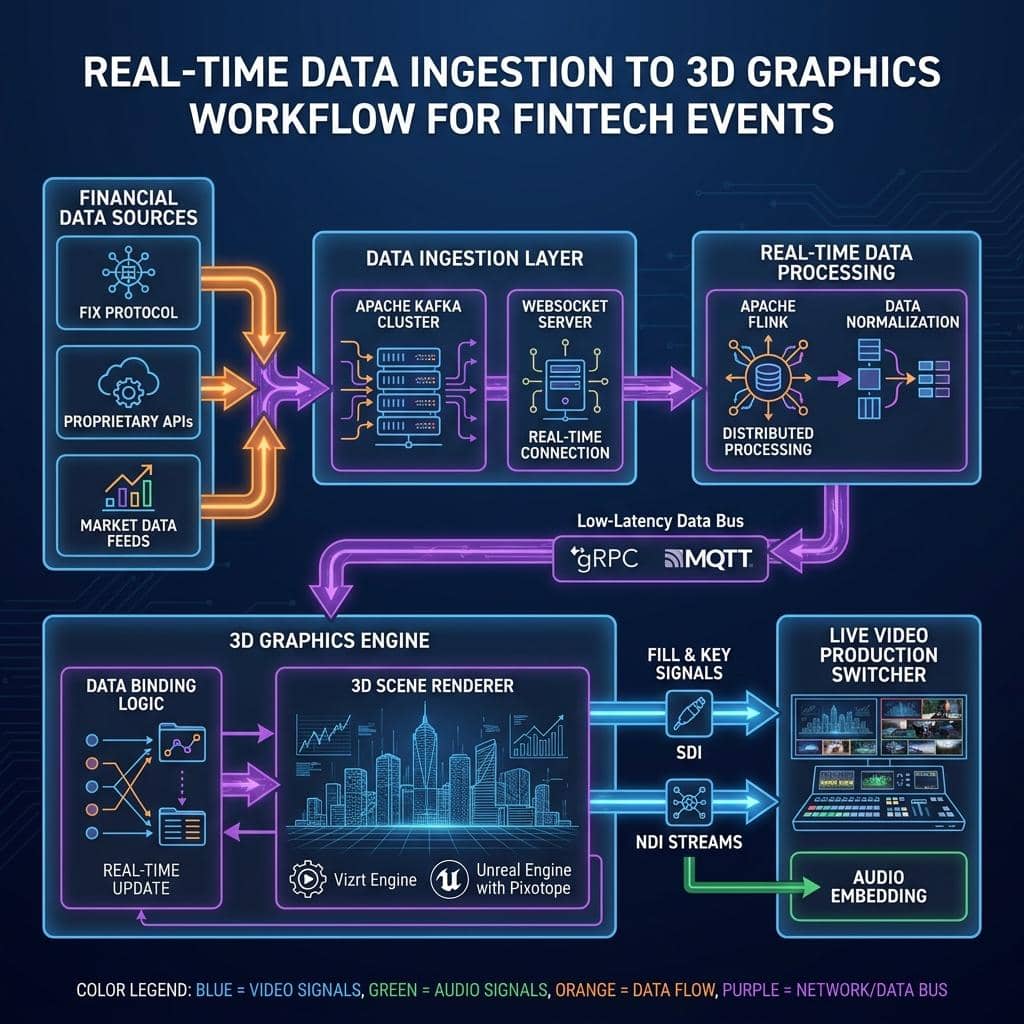
The foundation of effective real-time 3D graphic overlays lies in a robust, low-latency data ingestion and processing pipeline. For fintech applications, data sources are diverse and often high-velocity. These include proprietary trading APIs, direct market data feeds (e.g., FIX protocol), financial news wires, economic indicators from governmental agencies, and internal enterprise databases. The technical challenge is to capture, normalize, and distribute this data to the graphics engine with minimal delay and maximum reliability.
Data Ingestion and Transport Protocols
- Proprietary APIs and RESTful Services: Many financial institutions provide internal APIs for accessing real-time data. These typically utilize RESTful architectures, though for high-volume, low-latency scenarios, WebSockets or gRPC are often preferred for their persistent, bi-directional communication capabilities. WebSockets maintain an open connection, significantly reducing overhead compared to repeated HTTP requests, making them suitable for continuous data streams like live quotes.
- FIX Protocol (Financial Information eXchange): The industry standard for electronic communication of financial transactions and market data. Implementing a FIX engine for data ingestion is common for direct exchange connectivity, providing granular control over market data subscriptions.
- Message Brokers: Technologies such as Apache Kafka or RabbitMQ are indispensable for handling high-throughput, fault-tolerant data streaming. Kafka, in particular, excels at processing millions of events per second, serving as a resilient backbone for ingesting diverse data streams, transforming them, and distributing them to downstream consumers like graphics engines. Its publish-subscribe model ensures decoupled architecture and scalability.
- Low-Latency Databases and Caching: In-memory databases (e.g., Redis, Apache Ignite) or specialized time-series databases are often employed to store and serve transient, real-time data. Caching layers are crucial for reducing the load on primary data sources and accelerating data retrieval for the graphics system.
Data Processing and Transformation
Raw financial data often requires aggregation, normalization, and contextualization before it can be effectively visualized. Stream processing frameworks like Apache Flink or Spark Streaming enable real-time analytics, allowing for calculations of moving averages, volatility indicators, and custom algorithmic triggers. These systems can process data in milliseconds, ensuring that the visual representation remains synchronized with the underlying market reality. For instance, a stream processing job might ingest raw tick data, calculate a 10-second simple moving average, and then push this processed metric to a Kafka topic that the graphics engine subscribes to. Robust error handling and data validation are critical at every stage to prevent erroneous data from manifesting on air, which could have severe implications in a fintech context.
3D Graphics Engine Integration and Rendering Workflows
The choice of 3D graphics engine and its integration into the production workflow dictate the visual fidelity and responsiveness of the overlays. Professional broadcast graphics systems are specifically engineered for live event scenarios, offering robust data integration capabilities and high-quality real-time rendering.
Professional 3D Graphics Platforms
- Vizrt (Viz Artist/Engine): A widely adopted platform in broadcast, offering powerful 3D design tools and a dedicated real-time render engine. Vizrt engines are adept at ingesting external data feeds and mapping them to complex 3D scenes. They provide robust data connectors and scripting capabilities to manage dynamic content updates.
- ChyronHego (PRIME Graphics Platform): Another industry leader, ChyronHego offers comprehensive graphics solutions, including advanced 3D rendering and data visualization. Their systems are designed for high-end live production, supporting various input/output formats and tight integration with production switchers.
- Unreal Engine (with nDisplay or Pixotope): While primarily a gaming engine, Unreal Engine has rapidly gained traction in virtual production and broadcast graphics due to its photorealistic rendering capabilities and extensive customization options. Integrating live data into Unreal Engine often involves custom C++ or Blueprint scripting, leveraging plugins, or using specialized broadcast tools like Pixotope, which provides a production-ready layer on top of Unreal for AR/VR/XR and data-driven graphics.
Data Binding and Animation Logic
Once the data is processed, it must be bound to specific parameters within the 3D graphic scene. This involves mapping data fields (e.g., stock price, percentage change, volume) to properties of 3D objects (e.g., height of a bar chart, rotation of a globe, color of a status indicator, numerical text display). Key elements include:
- Template-based Workflows: Graphics designers create templates with placeholders for dynamic data. The graphics engine or a control application populates these placeholders with real-time values.
- Scripting and API Integration: For complex interactions and conditional logic, scripting languages (e.g., Python, Lua, or proprietary languages within graphics platforms) are used to define how data drives animations, transitions, and visual states of the 3D elements.
- Data Protocol Integration: Graphics engines typically offer direct integration with common data protocols or middleware. For instance, a Viz Engine can directly subscribe to a Kafka topic or connect to a WebSocket server to receive updated financial metrics, triggering immediate graphic changes.
Rendering and Output Formats
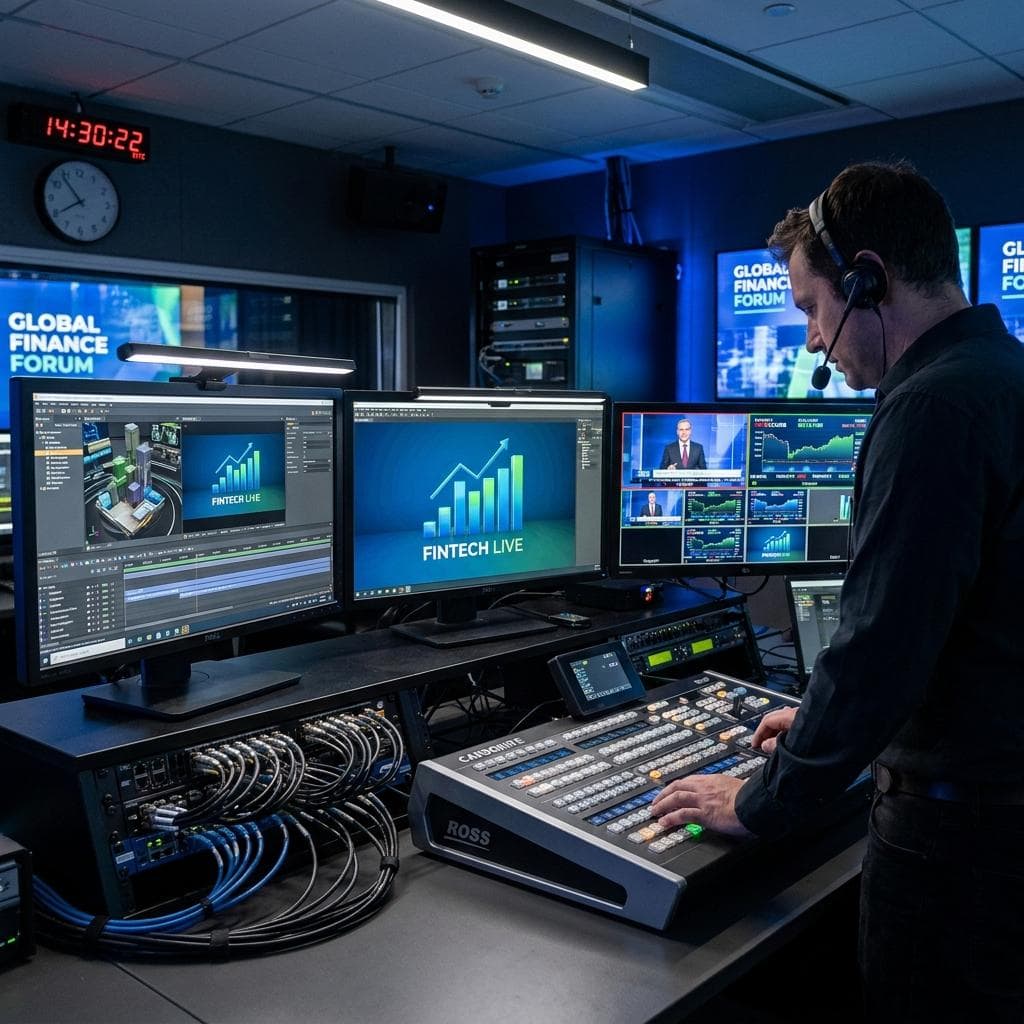
The rendered 3D graphics, complete with real-time data overlays, must be output in a format suitable for integration into the live video production switcher. Professional broadcast standards are critical for maintaining video quality and synchronization.
- SDI (Serial Digital Interface): Historically the backbone of broadcast, SDI (e.g., 3G-SDI, 12G-SDI for 4K/UHD) provides uncompressed digital video transmission over coaxial cable. Graphics engines typically output fill and key signals via two separate SDI channels, allowing a video switcher to overlay the graphics cleanly onto the program video.
- NDI (Network Device Interface): A rapidly evolving IP-based standard that allows for high-quality, low-latency video, audio, and metadata transmission over standard Ethernet networks. NDI|HX (High Efficiency) is a compressed variant suitable for lower bandwidth environments, while full NDI offers near-lossless quality. NDI simplifies signal routing and enables flexible integration with software-defined production workflows. Graphics engines can output NDI streams directly, eliminating the need for physical SDI cables.
- SMPTE ST 2110: A suite of professional IP media standards for uncompressed video, audio, and ancillary data over IP networks. For large-scale enterprise broadcast facilities and data centers, ST 2110 provides a highly scalable and flexible infrastructure for transporting discrete media flows, enabling advanced processing and routing. Graphics systems designed for this environment output separate IP streams for video, audio, and metadata, ensuring precise synchronization and quality.
- HDMI 2.1: While primarily a consumer interface, HDMI 2.1 is increasingly capable of handling professional resolutions and frame rates (up to 4K120 or 8K60) and can be used in some professional contexts, particularly for monitoring or direct display output, though it lacks the robustness and professional features of SDI or NDI for complex production routing.
Integrating Overlays into the Live Production Environment
Seamless integration of the rendered 3D graphic overlays into the live program feed is a critical phase of professional event streaming. This involves precise timing, signal management, and robust switching capabilities to ensure a polished final output for both physical and virtual audiences.
Video Switching and Keying Techniques
Professional video switchers are at the heart of this integration. Equipment such as Ross Carbonite, Grass Valley K-Frame, or Blackmagic ATEM Constellation series provide the necessary processing power and input/output flexibility. The keying process is fundamental:
- Luma Key: Uses the luminance (brightness) of a source to create transparency. Less common for complex graphics but suitable for simple white-on-black or black-on-white text.
- Chroma Key: The well-known “green screen” effect, where a specific color is removed to reveal the background video. Can be used if graphics are rendered on a solid color background, but less efficient for real-time overlays with dynamic content.
- External Key (Fill & Key): This is the professional standard for integrating computer-generated graphics. The graphics engine outputs two synchronized signals: the “fill” signal (the full color image of the graphics) and the “key” signal (a monochrome alpha channel that defines transparency). The video switcher uses the key signal to precisely cut a hole in the background video and insert the fill signal, creating a seamless overlay. This method ensures crisp edges and proper transparency for complex 3D elements.
- Internal Keyers: Some advanced graphics engines or switchers can internally generate the key signal from the fill, or offer DVE (Digital Video Effects) keyers for sophisticated transitions and manipulations.
Synchronization and Latency Management
Achieving perfect synchronization between the live video feed, audio, and the real-time data-driven graphics is paramount. Any drift introduces an unprofessional appearance. Key aspects include:
- Genlock: A master sync generator provides a common timing reference (e.g., blackburst or tri-level sync) to all video equipment, including cameras, graphics engines, and switchers. This ensures that all video sources are precisely aligned at the frame level, preventing glitches or tears during transitions.
- Frame Buffers and Delay Management: Even with genlock, processing delays in various components (encoders, decoders, network transit) can introduce latency. Professional switchers and processing gear offer frame synchronizers and adjustable delays to align all signals precisely before mixing them into the program feed.
- Audio-Video Synchronization: Maintaining lip-sync is crucial. Audio processing often has lower inherent latency than video. Dedicated audio delays or embedded audio processing within video switchers ensure that audio and video remain in perfect alignment.
Hybrid Event Considerations
For hybrid fintech events, the integration strategy must account for both the physical audience (large screens, LED walls) and the virtual audience (webcasting platforms like Zoom Events, Microsoft Teams Live, Webex Events). The 3D graphic overlays must render effectively across all these outputs:
- Multi-Output Rendering: Graphics engines should be capable of rendering graphics in various resolutions and aspect ratios simultaneously to cater to different display requirements.
- Webcasting Platform Integration: The final program feed, including integrated graphics, is encoded and streamed to enterprise-grade webcasting platforms. Ensuring high-quality H.264/H.265 encoding with appropriate bitrates (e.g., 5-15 Mbps for 1080p, 15-30 Mbps for 4K) is vital for optimal delivery to virtual attendees. SRT (Secure Reliable Transport) protocol is increasingly used for contribution links due to its reliability over unpredictable networks, minimizing packet loss and jitter for the live program feed.
- Augmented Reality Overlays: In sophisticated hybrid setups, AR elements driven by real-time data can be composited over live camera feeds, making the physical stage itself a dynamic data visualization canvas. This requires precise camera tracking systems (e.g., Mo-Sys, Stype) integrated with the graphics engine.
Enterprise-Grade Infrastructure and Scalability Considerations
Deploying real-time data-driven 3D graphic overlays in a B2B fintech environment demands a robust, scalable, and secure enterprise infrastructure. Reliability, redundancy, and network performance are non-negotiable.
Network Infrastructure Requirements
Professional event streaming, especially with IP-based workflows like NDI or SMPTE ST 2110, places significant demands on the network. A dedicated, high-bandwidth network is essential:
- Dedicated VLANs: Separating video, audio, data, and control traffic onto distinct VLANs (Virtual Local Area Networks) prevents congestion and ensures Quality of Service (QoS) for critical streams.
- Gigabit/10 Gigabit Ethernet: For NDI workflows, a 1 Gigabit Ethernet infrastructure is sufficient for NDI|HX, but full NDI streams (especially 4K) require 10 Gigabit Ethernet (10 GbE) switches and network interfaces. For SMPTE ST 2110, 25 GbE or 100 GbE is common for uncompressed 4K and higher resolutions.
- Managed Switches: Enterprise-grade managed switches (e.g., Cisco Nexus, Arista) with multicast support (IGMP snooping) are essential for efficient routing of IP-based media, preventing network flooding.
- Internet Bandwidth: For outbound streaming to CDNs (Content Delivery Networks) and webcasting platforms, redundant, high-capacity internet connections are critical. A minimum of 50-100 Mbps dedicated upload bandwidth is recommended for a single 1080p stream, with significantly more for multiple streams or higher resolutions, incorporating ample headroom for burst traffic and failover.
Redundancy and Failover Strategies
In a live fintech event, any failure can have severe financial or reputational consequences. Redundancy must be built into every critical component:
- Dual Data Feeds: Redundant primary and secondary data sources and processing pipelines ensure continuous data flow even if one fails. Automated failover mechanisms are essential.
- Graphics Engine Redundancy: Running two graphics engines in parallel, with one acting as a hot-standby, provides immediate failover. Professional switchers can be configured to detect a loss of signal from the primary engine and seamlessly switch to the secondary.
- Power Redundancy: All critical equipment, from servers to switchers, should be connected to uninterruptible power supplies (UPS) and, ideally, redundant power feeds.
- Network Path Redundancy: Utilizing redundant network switches and dual network paths ensures that a single point of failure in the network infrastructure does not disrupt the event. Link aggregation (LAG) and resilient network protocols contribute to this.
Cloud-Based vs. On-Premise Solutions
The decision between cloud and on-premise infrastructure often balances control, cost, and scalability:
- On-Premise: Offers maximum control over security, latency, and customization. Ideal for highly sensitive data and ultra-low-latency applications where dedicated hardware provides guaranteed performance. However, it requires significant upfront capital investment and ongoing maintenance.
- Cloud-Based: Provides elasticity and scalability, allowing resources (e.g., virtual machines for graphics rendering, data processing clusters) to be provisioned on demand. This is advantageous for events with fluctuating resource requirements or for distributed teams. Cloud providers (AWS, Google Cloud, Azure) offer secure environments, but careful network design is needed to minimize latency between on-site production and cloud-rendered graphics. Hybrid cloud models, where sensitive data processing remains on-premise while rendering scales in the cloud, are increasingly common.
Security Protocols for Financial Data
The highly sensitive nature of financial data necessitates stringent security measures throughout the entire workflow:
- End-to-End Encryption: All data in transit, from ingestion to graphic rendering, must be encrypted using industry-standard protocols (e.g., TLS 1.2/1.3, AES-256).
- Access Control: Strict role-based access control (RBAC) must be implemented for all systems involved, ensuring only authorized personnel can access or modify data and production settings.
- Firewalls and Intrusion Detection: Robust network firewalls and intrusion detection/prevention systems are essential to protect the infrastructure from cyber threats. Regular security audits and penetration testing are also critical.
The integration of real-time data into 3D graphic overlays represents the pinnacle of technical sophistication for B2B fintech event streaming. It transforms complex financial information into dynamic, engaging, and highly authoritative visual experiences. By leveraging professional-grade data pipelines, advanced graphics engines, broadcast-standard video workflows, and resilient enterprise infrastructure, Spring Forest Studio empowers corporate event planners, AV professionals, and IT directors to deliver unparalleled streaming and hybrid event productions. Our expertise ensures not only technical excellence but also the strategic advantage of superior communication in a data-driven world. Partner with us to elevate your next financial event from merely informative to truly impactful and memorable, solidifying your brand’s position as a leader in innovation and transparency.

Jeremy Lee is a seasoned digital marketing director and strategist with over two decades of experience in the industry. As the founder of Sotavento Medios, I manage a diverse portfolio of over 50 businesses, helping brands grow through advanced search strategies and digital innovation. My work focuses on bridging the gap between traditional search engine optimisation and the evolving world of AI-driven answer engines.
get in touch