
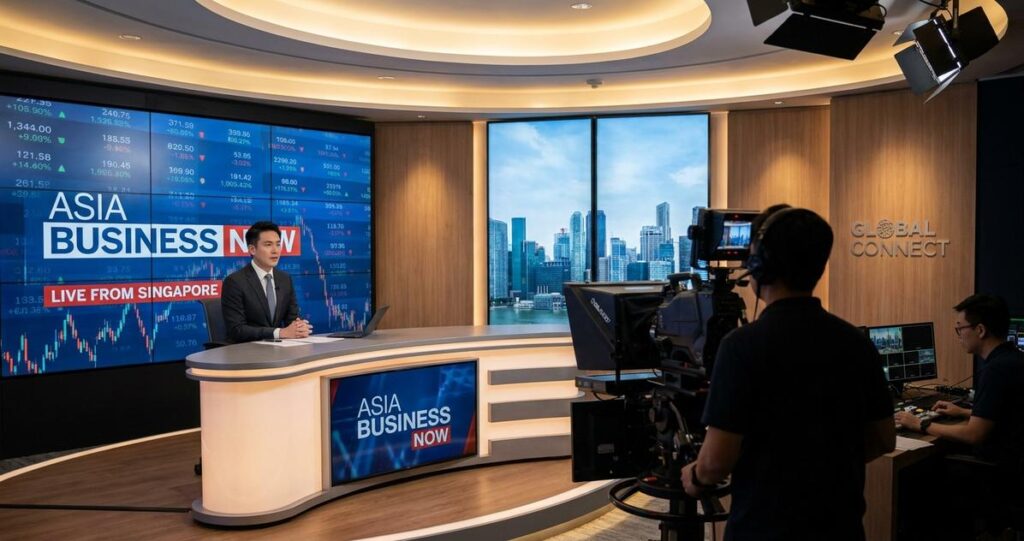
For many Singapore businesses, monthly updates are no longer just internal reporting sessions. They are now an important part of how leadership communicates performance, aligns teams across offices, and maintains confidence among stakeholders. As more companies adopt hybrid work, regional collaboration, and digital-first communication, the way these updates are produced matters almost as much as the message itself. A modular virtual set gives organisations a practical, polished, and flexible way to present monthly business updates without needing to rebuild the entire production environment each time.
A modular virtual set is a production design built from reusable visual components such as branded backgrounds, animated panels, virtual screens, data zones, and interchangeable scene elements. Instead of constructing a completely new studio look for every update, the production team can adapt the set layout to suit the topic, speaker, or business unit. For companies in Singapore, where boardrooms, regional offices, and remote teams often need to communicate efficiently across time zones, this approach can improve consistency while reducing operational friction. It also supports the growing expectation that business communication should feel professional, visually clear, and easy to follow.
The value of modular virtual sets is not simply visual. They can help businesses present information in a more structured way, support better viewer attention, and make recurring updates easier to produce. For monthly reports that may include revenue performance, project milestones, operational KPIs, customer initiatives, or cross-department announcements, a modular setup allows each segment to have its own visual space while maintaining a coherent brand identity. In a market such as Singapore, where many organisations operate in competitive, time-sensitive environments, efficiency and presentation quality are both important.
Why modular virtual sets suit recurring business updates
Monthly business updates follow a pattern. They are repeated regularly, often by the same leadership team or department heads, and the structure usually remains familiar to employees, shareholders, or regional stakeholders. Because the format is recurring, it makes sense to design a production environment that can be reused and updated efficiently. A modular virtual set supports that need by allowing the production team to change only what is necessary, such as graphics, headlines, presenter framing, or topic-specific visual panels, while keeping the overall look consistent.
This approach is particularly relevant in Singapore, where many organisations value punctuality, clarity, and professionalism in corporate communication. A set that can be quickly reconfigured for finance reviews, sales updates, HR announcements, or strategic town halls helps teams avoid repetitive design work. It also reduces the risk of visual inconsistency between departments, which can happen when different teams create presentations independently. Consistent presentation design helps viewers recognise the organisation’s identity and makes the content easier to absorb.
Consistency strengthens audience comprehension
People understand recurring information more easily when the visual structure stays stable. In monthly updates, the audience often wants to compare this month’s performance with the previous one, identify priorities, and remember key action points. A modular virtual set creates a predictable framework that supports this process. When charts, speaker windows, agenda items, and highlight panels appear in familiar positions, viewers can focus on the content rather than adjusting to a completely new layout each time.
For internal audiences in Singapore, this can be especially useful in multilingual and multicultural workplaces. A clear, consistent layout helps reduce confusion, particularly when updates include detailed operational information or multiple presenters. It also benefits teams joining from different locations, including staff working from home, regional offices, or overseas branches. The structure gives every participant a shared visual reference, which is important in hybrid communication.
Reusable design improves operational efficiency
Monthly updates often follow a tight production schedule. Slides are revised close to the event date, speakers may change, and business priorities can shift at the last minute. Modular virtual sets give production teams more flexibility because the core scene can remain stable while individual panels or graphics are swapped quickly. This can be especially helpful for Singapore-based companies that manage multiple approvals across communications, finance, and leadership teams.
In practical terms, reusable design can shorten setup time, simplify revisions, and reduce the need for repeated creative rebuilding. Instead of starting from scratch for each broadcast, the production team can work from approved brand elements and update only the relevant assets. That makes it easier to deliver a polished result on a regular schedule, which is important for monthly reporting cycles.
How modular virtual sets improve communication quality
Good business updates need more than attractive visuals. They need a clear communication structure that helps audiences understand what matters and what action is expected. Modular virtual sets support this by making it easier to organise information into distinct visual areas. A presenter can stay framed cleanly on screen while supporting content appears beside or behind them in a controlled way. This keeps the presentation dynamic without becoming visually cluttered.
In many corporate settings, especially during hybrid events, communication quality depends on how well technical production supports the speaker. A modular set allows different content types to be presented in a way that suits the message. For example, a financial review may benefit from charts and numeric panels, while an HR update may need a warmer, more conversational visual style. A modular system makes these changes possible without compromising brand identity.
Supports better attention management
Viewers of monthly updates often multitask. They may be joining from the office, a meeting room, or a home workspace while checking email or handling other responsibilities. Because attention is limited, the presentation needs to direct the eye efficiently. Modular virtual sets help do that by separating information into controlled sections. This avoids the common problem of overcrowded slides or static camera shots that make long updates feel flat.
When content is organised clearly, viewers can more easily follow the presenter’s explanation and retain the key points. This is particularly important when leadership is sharing strategic decisions, operational changes, or performance indicators. Clear visual hierarchy supports better understanding and reduces the chance that critical information is overlooked.
Creates a more professional on-screen presence
First impressions matter in corporate communication. A professional virtual set signals preparation, discipline, and attention to detail. For Singapore companies that communicate with regional offices, investors, business partners, or internal teams across seniority levels, presentation quality contributes to credibility. A modular virtual set helps the organisation look well-organised without the expense and complexity of a fully custom studio rebuild each month.
Professionalism is not just about aesthetics. It also affects how seriously viewers receive the message. When the visual environment supports the speaker, the audience is more likely to focus on the substance of the update. That is useful in monthly business meetings where leaders need to communicate both good news and difficult decisions with clarity and confidence.
Practical advantages for Singapore organisations
Singapore’s business environment places a premium on efficiency, reliability, and adaptability. Many organisations operate across multiple functions and markets, and monthly updates often need to speak to diverse audiences. Modular virtual sets are well suited to this context because they can be adjusted for different departments, audience groups, or event formats while preserving a consistent corporate identity.
For companies working with distributed teams, the hybrid event model is now common. Some participants may be physically present in a studio or office, while others join remotely through video platforms. A modular set helps create a unified viewing experience by giving the broadcast a polished visual anchor. This matters when leadership wants remote staff to feel included rather than treated as secondary participants.
Useful for multi-market and regional communication
Many Singapore-headquartered businesses operate across Southeast Asia and beyond. Monthly updates may need to suit local staff as well as regional stakeholders, each with different expectations and priorities. A modular virtual set allows the same core production to be adapted for different versions of the update, such as a short internal briefing, a leadership webcast, or a regional town hall. The visual structure can remain consistent while the content is tailored to the audience.
This adaptability helps businesses avoid producing entirely separate events for every audience group. Instead, they can work from one flexible design system and update language, charts, or speaker segments as needed. That is an efficient approach for organisations that need to communicate regularly without expanding production complexity unnecessarily.
Aligns with modern hybrid production workflows
Event streaming and hybrid production now depend on coordinated workflows involving camera operators, vision mixers, graphics teams, presenters, and technical support. A modular virtual set fits naturally into this environment because it can be preplanned and technically integrated into the production design. This helps the broadcast team keep transitions smooth and ensures that key visual assets are ready when needed.
For monthly business updates, that predictability is valuable. It reduces last-minute changes to the studio layout and helps teams concentrate on message accuracy and delivery. It also supports smoother rehearsals, because presenters can practise in a stable on-screen environment rather than adjusting to a completely different visual concept every month.
What to consider before adopting a modular virtual set
Although modular virtual sets offer strong advantages, they work best when the organisation has clear communication goals. The design should support the content, not distract from it. Before choosing this approach, companies should think about the type of monthly update they run, the number of speakers involved, the expected audience size, and the visual identity they want to maintain. A well-designed modular set should feel purposeful, not busy.
It is also important to coordinate the set design with the presentation style. If the business update is highly data-driven, the layout should make room for charts, figures, and on-screen explanations. If the session is more leadership-focused, the set should support a confident speaking presence and avoid overcrowding the frame. In both cases, the principle is the same, the visual design should make the information easier to deliver and easier to understand.
Branding, accessibility, and technical planning matter
Brand consistency is one of the strongest advantages of modular sets, but it should be handled carefully. Colours, typography, motion graphics, and logo placement should follow established brand guidelines so the presentation looks cohesive across repeated events. At the same time, designers should avoid overloading the screen with too many animated elements or dense text. Simplicity supports clarity.
Accessibility also matters. On-screen text should be readable, contrast should be strong enough for viewers in different lighting conditions, and important information should not rely only on colour cues. Since monthly business updates often include detailed figures and fast-moving visuals, the design should make content legible on common viewing devices, including laptops and mobile screens. This is especially relevant for hybrid audiences in Singapore, where participants may join from different settings and devices.
Technical planning is equally important. The virtual set must be tested with the actual production workflow, including cameras, lighting, speaker positions, graphics integration, and streaming platform requirements. When these elements are aligned early, the production is more stable and the live event is less vulnerable to avoidable errors. For recurring business updates, this preparation pays off over time because the production can be refined from one month to the next.
Building a more effective monthly update format
Modular virtual sets are most effective when they are part of a broader communication strategy. The event should have a clear agenda, a disciplined visual format, and a presenter style that matches the audience. When those elements work together, monthly updates become easier to follow and more valuable to the people watching. They can also help leaders communicate change in a way that feels organised and dependable.
For Singapore businesses, the practical benefits are clear. Modular sets can support faster production turnaround, stronger brand consistency, better audience comprehension, and a more professional on-screen presence. They are particularly useful for organisations that run frequent updates, manage hybrid teams, or communicate across multiple markets. While the set design itself does not replace good content, it strengthens the delivery of that content in a measurable and useful way.
Companies considering this format should start by defining what their monthly update needs to achieve. If the goal is to keep employees informed, reinforce leadership visibility, and present data clearly, modular virtual sets are a strong fit. If the goal includes regional consistency or repeated use across different departments, the value becomes even greater. A thoughtful production setup helps monthly updates become a reliable communication tool, not just a routine meeting on the calendar.
As with any corporate communication decision, organisations should work with experienced event production professionals who understand hybrid delivery, broadcast-quality presentation, and the demands of recurring business events. For teams in Singapore, that means choosing a production approach that is practical, scalable, and aligned with the standards audiences now expect.
General information only: This article is intended to support awareness and communication planning. It is not medical advice or a substitute for professional consultation in situations where specific organisational, technical, or compliance guidance is required.

Jeremy Lee is a seasoned digital marketing director and strategist with over two decades of experience in the industry. As the founder of Sotavento Medios, I manage a diverse portfolio of over 50 businesses, helping brands grow through advanced search strategies and digital innovation. My work focuses on bridging the gap between traditional search engine optimisation and the evolving world of AI-driven answer engines.
get in touch