
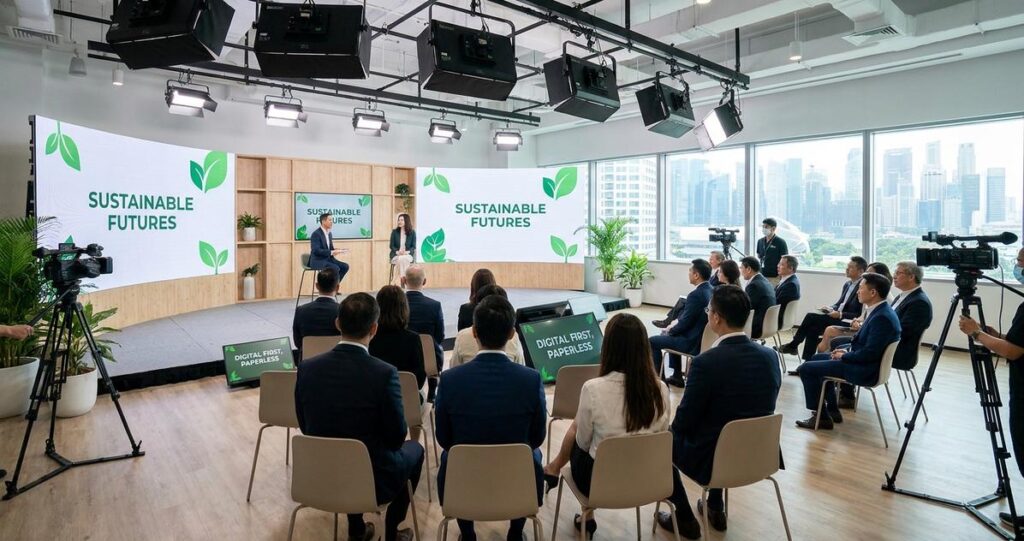
Events are still an essential part of how businesses in Singapore connect with clients, employees, partners, and the public. Yet many organisations are also rethinking the environmental cost of gathering people in a physical venue, especially when the event objective can be achieved through live streaming, hybrid formats, or fully virtual production. In a city where time, space, and transport planning already influence how events are run, the move toward virtual production is not just a convenience choice. It is also a practical sustainability strategy that can reduce travel demand, lower material consumption, and improve operational efficiency, while still delivering a polished audience experience.
For Singapore-based companies, the environmental question is especially relevant because event planning often involves venue energy use, printed collateral, freight movement, catering waste, and the carbon impact of attendees travelling across the island or flying in from overseas. Virtual production does not eliminate every environmental footprint, because it still relies on electricity, internet infrastructure, and digital equipment. However, when it is designed thoughtfully, it can materially reduce many of the most resource-intensive parts of event delivery. The key is understanding where the impact comes from, what can realistically be reduced, and how to design streaming and hybrid events in a way that is both credible and professionally executed.
This matters for brands that want sustainability to be more than a marketing phrase. It also matters for organisers who need to balance stakeholder expectations, budget discipline, and audience reach. A well-planned virtual or hybrid event can support environmental goals without compromising clarity, accessibility, or production quality. The following sections explain how virtual production contributes to lower environmental impact, what the main trade-offs are, and how Singapore organisations can put these ideas into practice.
How virtual production reduces the environmental footprint of events
Virtual production refers to the use of live streaming, remote presentation tools, digital backdrops, and studio-based or platform-based production to deliver an event without requiring every participant to be physically present. In event sustainability, the biggest environmental advantage usually comes from reducing travel. When speakers, delegates, and viewers no longer need to move to a venue, organisers can cut down on private car use, ride-hailing trips, flight emissions, and other transport-related impacts. For Singapore, this is particularly important for events that would otherwise involve regional participants flying in from neighbouring countries or long-haul markets.
Another major benefit is the reduction in venue-related resource use. Large in-person events often require air conditioning for large spaces, lighting, staging, printed signage, bottled water, physical registrations, and food service. A virtual event typically needs fewer materials and less waste generation. Even when a hybrid format is used, the in-person component can be scaled more efficiently, which may reduce the number of rooms required, the amount of set construction, and the volume of disposable items used throughout the event.
There is also a logistical advantage. Physical events often generate environmental costs through repeated deliveries, courier services, and excess production of assets that are discarded after a single use. Virtual production reduces the need for shipping bulky exhibition materials and can minimise single-use fabrication. In practice, this allows event teams to work with reusable templates, digital graphics, and adaptable set elements that can serve multiple campaigns across a year.
Travel reduction is usually the largest contributor
For many events, attendee travel is one of the most significant sources of emissions. This is particularly true for conferences, product launches, and training sessions that draw audiences from different parts of the region. Virtual attendance can avoid the emissions associated with long-distance travel entirely, while hybrid formats can reserve travel for only the people whose physical presence adds the most value. In Singapore, where business activity is highly connected to regional hubs, this can meaningfully reduce the environmental load tied to event participation.
It is useful to think of virtual production as a way to match event format to event purpose. If the event goal is knowledge sharing, internal communication, or public engagement, a digital-first or hybrid model is often enough. If the goal is hands-on networking, equipment demonstrations, or formal ceremonies, then physical attendance may still be important, but the audience can be limited to those who truly need to be there.
Material efficiency improves when events move online
Printed programmes, temporary stage builds, large vinyl banners, and one-time-use decor all have environmental costs. When events move into a virtual environment, much of this material becomes unnecessary. Digital invitations, online agendas, and screen-based branding can replace many printed assets. This does not mean design quality must suffer. In well-produced virtual events, digital visual systems can be refreshed quickly, localised for different audiences, and reused across campaigns without creating physical waste.
There is also less risk of overproduction. Traditional events often require organisers to print or fabricate more than they need to account for uncertainty. Virtual production reduces that pressure because digital assets can be updated more flexibly. The result is often a cleaner operations model with fewer leftovers and less disposal after the event ends.
What Singapore organisers should consider when planning greener virtual events
Singapore has a mature event ecosystem, strong digital connectivity, and a high level of business adoption for online communication. These conditions make virtual production practical, but they also create a need for disciplined planning. A greener virtual event is not simply one that happens online. It is one that is intentionally designed to avoid unnecessary waste at every stage, from pre-production to post-event asset management. This includes energy use, vendor coordination, equipment planning, and content strategy.
One of the most important considerations is venue and studio selection. If a live studio or filming location is used, organisers should look at how efficiently the space is powered, cooled, and operated. Singapore’s tropical climate means air conditioning is often a major energy load in indoor venues. Choosing an appropriately sized studio and avoiding overprovisioning can help reduce unnecessary electricity use. Similarly, if a hotel ballroom or event hall is used for hybrid production, keeping the physical footprint aligned with actual attendance can make a noticeable difference in operational intensity.
Organisers should also think about how speakers and staff participate. Remote contribution can reduce commuting and make participation more efficient, but it needs to be stable and professionally managed. When a speaker joins from home or office, the production team should provide guidance on lighting, audio, internet connectivity, and framing. This improves content quality while avoiding last-minute travel or on-site duplication of staff roles.
Energy use still matters, even in a virtual format
Virtual production lowers some forms of environmental impact, but it is not impact-free. Cameras, lighting, encoding systems, laptops, display monitors, networking equipment, and cooling systems all consume electricity. If a production is poorly managed, it can still become inefficient. The goal is not to claim that digital events have zero emissions. The goal is to keep the production lean, technically robust, and proportional to the audience need.
In Singapore, where electricity demand is closely linked to cooling and digital operations, an efficient event setup should use the minimum number of devices needed to achieve the creative and technical result. LED lighting, power management practices, and right-sized technical teams can all help. Reusing equipment between events also matters. Extending the useful life of cameras, microphones, and switching hardware reduces the need for frequent replacement and helps limit e-waste.
Data and content planning can reduce waste before the event begins
Many sustainability gains come before the event even starts. Clear planning helps reduce unnecessary revisions, duplicate file handling, and rushed production decisions that can lead to wasteful rework. Organisers should define the event objective early, confirm the format, and avoid building more creative assets than the audience actually needs. A concise run-of-show, a reusable motion graphic package, and a stable presentation template can often deliver a better attendee experience than an overcomplicated visual system that takes more resources to build and maintain.
This is particularly relevant for corporate events, town halls, and training sessions in Singapore, where the same organisation may run multiple events across a year. Designing a modular event package allows the team to reuse visual assets, lower design waste, and preserve consistency. For example, a company can develop a standard branded opening sequence, a set of lower-third graphics, and a reusable digital agenda structure that can be adapted for different campaigns instead of rebuilt each time.
Practical ways to make virtual production more sustainable without reducing quality
Sustainable event design works best when it is built into operations rather than added as an afterthought. The strongest results usually come from small, disciplined decisions that cumulatively reduce impact. These decisions should support both sustainability and audience experience, because an event that looks polished but is wasteful is not truly efficient, and an event that is environmentally careful but technically poor may fail to achieve its communication goals.
Choose the right format for the right audience
Not every event needs to be fully virtual. The most environmentally responsible format is the one that achieves the purpose with the least unnecessary resource use. Internal updates, expert panels, product demos, and educational sessions often work well in a virtual or hybrid format. Networking-heavy events, hands-on exhibitions, and sensitive stakeholder meetings may still need in-person participation. A thoughtful organiser evaluates the audience need, the event objective, and the likelihood that digital delivery will meet the same outcome.
In Singapore, this approach can be especially useful for regional business communications. A company can bring together local staff in a studio while allowing overseas teams to join remotely, rather than flying every participant into Singapore. The environmental benefit is strongest when travel is reduced strategically, not simply when an event label changes from physical to hybrid.
Use reusable digital assets and modular production design
Reusable assets are one of the simplest ways to reduce waste. Instead of designing a new visual identity for every event, teams can create a modular system that adapts across multiple sessions. This includes templates for title slides, speaker introductions, agenda screens, and branded transitions. A modular approach reduces design time, limits production waste, and supports a more consistent viewer experience.
The same principle applies to physical set elements in hybrid production. Neutral, durable, and reusable stage components are generally preferable to custom-built structures that are discarded after a single use. Where physical props are necessary, they should be selected for durability, storage, and repeat use. This is an operational decision as much as a sustainability decision.
Reduce food, freight, and disposable items where possible
Hybrid events still involve catering, transport, and on-site materials if participants are physically present. The environmental advantage depends on limiting these inputs to what is necessary. Smaller in-person attendance can reduce catering waste and lower the need for packaging, napkins, bottled drinks, and disposable service ware. When food is provided, organisers should work with caterers on realistic portioning and waste-minimisation practices.
Freight is another area where planning matters. Heavy or oversized exhibition materials, last-minute shipments, and one-time-use items all add to the environmental burden. Whenever possible, use digital displays, local sourcing, and existing venue infrastructure rather than shipping bespoke items across multiple locations. In Singapore’s compact geography, local vendor coordination can often reduce unnecessary transport while still maintaining high production standards.
How to communicate sustainability honestly in event marketing
Many audiences are increasingly attentive to environmental claims, which means organisers should be careful not to overstate the sustainability benefits of virtual production. Trust is built through transparent language and practical choices. If an event is virtual, it may have a lower footprint than a comparable physical event, but that does not mean it has no footprint. If a hybrid event is designed to reduce travel, it is appropriate to explain that the format helps reduce unnecessary movement while preserving essential in-person interactions.
Singapore organisations should avoid vague terms that are difficult to verify, such as claiming an event is “green” without explaining what was actually done. More credible communication includes specific actions, such as reducing travel through remote attendance, using reusable production assets, limiting print materials, and choosing a right-sized venue. Where measurements are available, they should be based on recognised methods rather than promotional language. In practice, carbon accounting and event emissions estimation should be handled carefully, especially if the organiser intends to publish a sustainability statement.
For public-facing campaigns, it is also useful to align event messaging with broader organisational sustainability policies. If the company already uses paperless registration, encourages public transport, or tracks supplier practices, the event can be presented as part of a larger operational commitment rather than a one-off gesture. This strengthens credibility and helps the audience understand that sustainability is built into the process, not added only for appearances.
What good virtual production looks like in a Singapore context
In Singapore, a strong virtual event strategy combines technical reliability, audience accessibility, and responsible resource use. The best productions tend to be simple where they should be simple, and sophisticated where they truly need added value. For example, a regional leadership briefing might use a compact studio, remote executive speakers, digital event registration, and one set of reusable graphics. A product launch might integrate live demonstrations with streamed interviews, while keeping the physical footprint modest. An internal training session might use a simple, well-lit setup with clear audio and stable delivery rather than an elaborate stage build.
The practical benefit is not just environmental. Efficient virtual production often improves schedule control, lowers operational complexity, and gives organisers more flexibility when plans change. In Singapore’s fast-moving business environment, that flexibility can be as important as the sustainability benefit. It allows teams to reach wider audiences without assuming that every interaction must happen in the same room.
For organisations that want to move in this direction, the most effective first step is to review the event brief. Ask whether every component requires physical attendance, whether travel can be reduced, whether the production design is reusable, and whether printed or disposable materials can be removed. These questions are simple, but they create a more sustainable planning culture over time.
If your organisation is considering a streamed or hybrid event, the most responsible approach is to plan for both audience experience and environmental efficiency from the start. Virtual production can help reduce the environmental impact of events, especially when it replaces unnecessary travel, cuts down on disposable materials, and uses reusable technical assets. The goal is not perfection. The goal is a professional event model that is fit for purpose, measured in its resource use, and respectful of the realities of Singapore’s business and sustainability expectations.
General information only: This article is intended to support awareness and event planning. For formal sustainability reporting, emissions accounting, or corporate compliance decisions, consult qualified specialists familiar with your organisation’s requirements and the relevant Singapore standards and reporting framework.

Jeremy Lee is a seasoned digital marketing director and strategist with over two decades of experience in the industry. As the founder of Sotavento Medios, I manage a diverse portfolio of over 50 businesses, helping brands grow through advanced search strategies and digital innovation. My work focuses on bridging the gap between traditional search engine optimisation and the evolving world of AI-driven answer engines.
get in touch