
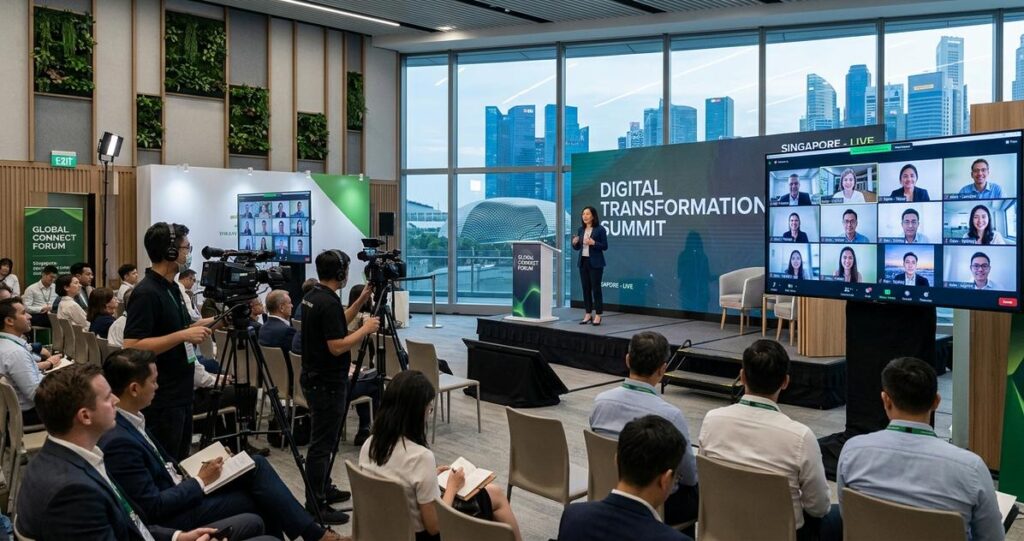
For many Singapore companies, corporate governance is no longer judged only by board independence, audit controls, or disclosure quality. Stakeholders now expect organisations to show that they can operate responsibly, reduce unnecessary environmental impact, and still maintain strong oversight and participation. Hybrid events, which combine in-person and virtual attendance, have become a practical way to support these goals. They help boards, management teams, shareholders, employees, and partners participate more flexibly while reducing travel demand, improving accessibility, and supporting more efficient use of resources.
In Singapore, this matters because the business environment is highly connected, time-sensitive, and increasingly conscious of sustainability. Companies often manage regional teams, cross-border investors, and busy leadership schedules. A hybrid model can make annual general meetings, stakeholder briefings, staff town halls, training sessions, and industry forums more inclusive and more efficient. When designed well, hybrid events are not just a convenience. They can strengthen governance processes by improving participation, preserving records, supporting transparency, and aligning event operations with broader sustainability objectives.
To understand their value, it helps to look at hybrid events not as a temporary workaround, but as a structural improvement in how organisations communicate and make decisions. Governance is ultimately about accountability, participation, and controls. Sustainability is about using resources responsibly and planning for long-term resilience. Hybrid events sit at the intersection of both.
How Hybrid Events Support Better Governance Practices
Corporate governance depends on the ability of organisations to communicate clearly, gather input fairly, and document decisions accurately. Hybrid events support these functions by expanding access without removing the value of in-person engagement. They can help ensure that directors, shareholders, employees, regulators, or other relevant stakeholders have a practical way to join, even when travel, mobility, schedule, or location constraints exist.
For many organisations in Singapore, this is especially relevant for events involving participants across different time zones in Southeast Asia or beyond. A hybrid format allows key individuals to join remotely while the physical meeting continues for those present on site. This reduces the chance that important voices are absent simply because of logistical barriers. In governance terms, that means the process becomes more inclusive and potentially more representative.
Improving participation and accessibility
One of the clearest governance benefits of hybrid events is broader participation. Shareholders, staff, and stakeholders who cannot attend in person may still follow proceedings, ask questions, or receive updates through a virtual platform. This matters because participation is more than attendance. It is the practical ability to observe, engage, and respond.
In Singapore, accessibility can also support older participants, caregivers, employees with mobility concerns, and busy professionals who cannot always commute during peak periods. A hybrid setup can reduce friction while still maintaining the formal structure of the event. For listed companies, associations, and large private organisations, that improved reach can contribute to better stakeholder confidence.
Strengthening documentation and audit readiness
Hybrid events are often supported by digital registration systems, live streaming tools, Q and A functions, polling features, and recording options. These tools create a clearer operational trail than many traditional in-person-only events. Minutes, attendance logs, voting records, and presentation materials can be captured and stored more systematically. That supports internal governance, compliance, and audit readiness.
In a Singapore context, where organisations are generally expected to maintain reliable records and consistent procedures, this is a meaningful advantage. A well-run hybrid event can reduce confusion about attendance, timing, and engagement. It can also make it easier for management teams to review issues raised during the session and follow up appropriately.
Supporting transparency and trust
Transparency is central to sustainable corporate governance. Hybrid events can support transparency by making presentations and discussions visible to more people in real time. When stakeholders can hear the same information at the same time, there is less reliance on second-hand summaries. This can improve perceived fairness and reduce misunderstandings.
That said, transparency depends on execution. A hybrid event must have clear rules, stable technology, and a structured flow. If remote participants cannot hear clearly, or if questions from online attendees are not handled properly, confidence can weaken. For this reason, governance teams should treat event design as part of the control environment, not just as a communications task.
The Sustainability Gains of Hybrid Event Design
Sustainability in corporate governance is not only about reporting or policy statements. It also involves operational choices that reduce waste and resource use. Hybrid events can contribute to this by lowering the need for unnecessary travel, reducing printed materials, and allowing organisers to plan more efficiently. These changes may seem modest on their own, but across repeated events they can support a more responsible operating model.
For Singapore-based organisations, where office space, transport demand, and energy use are all important considerations, the ability to design events more efficiently has real value. Hybrid events also align with the broader expectation that businesses should improve resource use while maintaining service quality and stakeholder access. When the format is intentional, not improvised, the environmental and operational benefits can be significant.
Reducing travel-related emissions and time costs
Travel is often one of the most visible sources of avoidable emissions in corporate events, especially when participants fly in from other cities or commute across long distances for brief meetings. Hybrid events can reduce the need for travel by allowing people to join remotely when physical presence is not essential. This lowers emissions associated with transportation and also saves time.
For Singapore companies with regional management teams, this is particularly useful. A leadership presentation or stakeholder engagement session may not require everyone to be in the same room. By reserving physical attendance for those who need it most, organisations can use time and travel more efficiently. That supports both sustainability and productivity.
Cutting paper use and supporting digital workflows
Hybrid events often rely more heavily on digital materials, such as electronic agendas, slide decks, e-certificates, and online registration forms. This can reduce paper use significantly compared with fully printed event packs. It also makes updates easier, since organisers can revise a digital agenda without reprinting documents.
From a governance perspective, digital workflows can improve consistency. Documents are easier to archive, retrieve, and share securely with the right people. From a sustainability perspective, fewer printed materials mean less waste and less demand for physical production. For Singapore organisations aiming to modernise operations, this is a practical step that supports environmental responsibility without sacrificing professionalism.
Using space and resources more efficiently
Physical events often require large venues, extensive catering, transport coordination, and on-site staffing. Hybrid events can sometimes reduce the scale of these requirements because not every participant needs to be accommodated in person. A smaller physical footprint can mean less energy use, less food waste, and more efficient allocation of event resources.
This does not mean hybrid events are automatically low impact. They still require proper equipment, strong internet connectivity, and technical support. However, a well-planned hybrid model can create a more measured use of resources. For organisations that host recurring events, this can contribute to a more sustainable event strategy over time.
Why Hybrid Events Fit Singapore’s Corporate Environment
Singapore is well suited to hybrid event adoption because it combines strong digital infrastructure, a highly connected business ecosystem, and a practical corporate culture focused on efficiency. Many organisations already work across local and regional markets, so the ability to include remote participants is a natural extension of how business is done. Hybrid events also align with Singapore’s longstanding emphasis on digital adoption, business continuity, and operational discipline.
For governance teams, the local context matters. Board members, investors, employees, and partners may not all be in the same location, even when they are part of the same organisation. Hybrid formats reduce the need to choose between accessibility and formality. They also allow companies to respond more flexibly to scheduling challenges, travel disruptions, and other operational constraints.
Suitable use cases in Singapore organisations
Hybrid events are especially useful for annual general meetings, extraordinary general meetings, investor updates, training sessions, town halls, sustainability briefings, and partner forums. In these settings, the organisation often needs to combine a formal agenda with live interaction. A hybrid format gives the host the ability to deliver a structured event while still allowing questions and engagement from a broader audience.
For smaller companies, a hybrid event can offer a more professional communication channel without requiring every stakeholder to travel. For larger organisations, it can help manage scale and reach. Either way, the format supports a governance culture that values inclusion, documentation, and responsiveness.
Balancing in-person value with digital convenience
Some governance processes benefit from face-to-face interaction. In-person attendance can support relationship building, nuanced discussion, and quicker informal clarification. Hybrid events do not remove those advantages. Instead, they preserve them for the people who need to be physically present while making room for others to join remotely.
This balance is important. A strong hybrid model does not treat virtual attendees as an afterthought. It gives them a meaningful role through clear audio, visible presentations, moderated questions, and reliable access. When both audiences are considered from the start, the event becomes stronger overall.
Good Practices for Designing Responsible Hybrid Events
To realise the governance and sustainability benefits of hybrid events, organisations need disciplined planning. A poor setup can create confusion, weaken engagement, and frustrate participants. A well-designed event, on the other hand, can reinforce credibility and operational confidence. The key is to treat the event as a system, not just a broadcast.
For Singapore businesses, this means involving event producers, IT support, communications teams, and governance stakeholders early in the planning process. It also means testing technology properly, defining roles clearly, and preparing for disruptions. Hybrid events work best when the organisation anticipates both technical and human needs.
Build for reliable access and interaction
The technical foundation of a hybrid event should include stable internet connectivity, high-quality audio, clear camera coverage, and a platform that supports live interaction. Remote participants should be able to hear, see, and participate without unnecessary delay. If the event includes voting, polling, or formal questions, the system should be tested in advance to ensure accuracy and fairness.
Accessibility also includes practical details such as captions where appropriate, readable slides, and clear instructions for joining the session. These features improve usability and help more participants engage effectively.
Protect data and manage privacy carefully
Many hybrid events involve registration data, attendee lists, contact details, and sometimes sensitive corporate information. Good governance requires careful handling of this data. Organisations should use secure platforms, control access appropriately, and communicate clearly about how data will be used and retained.
Privacy and cybersecurity are not separate from sustainability or governance. They are part of responsible event management. A trustworthy hybrid event respects participant data while maintaining a professional standard of delivery.
Measure what matters
Organisations should review hybrid events using practical governance and sustainability indicators. These may include attendance patterns, engagement levels, technical reliability, material usage, and follow-up actions completed after the event. The goal is not to chase vanity metrics, but to understand whether the format is improving participation, reducing waste, and supporting decision-making.
For recurring corporate events, this review process helps refine future planning. Over time, organisations can identify which sessions work best in hybrid form and where in-person attendance remains important. That leads to better resource allocation and stronger stakeholder experience.
What Singapore Companies Should Keep in Mind
Hybrid events are not automatically sustainable or governance-enhancing just because they use technology. Their value depends on thoughtful design, reliable delivery, and clear purpose. A poorly managed hybrid event can frustrate attendees and waste resources. A well-managed one can improve inclusion, accountability, and efficiency at the same time.
Singapore companies should think of hybrid events as part of a broader strategy for responsible business conduct. That means aligning event design with the organisation’s governance framework, stakeholder communication practices, and sustainability goals. It also means recognising that convenience alone is not the measure of success. The real question is whether the format helps the organisation operate more responsibly and communicate more effectively.
For boards, leadership teams, and corporate secretariat functions, the opportunity is clear. Hybrid events can make participation easier, create better records, reduce avoidable waste, and support a more resilient event model. When combined with sound planning and competent technical delivery, they become a practical tool for sustainable corporate governance in Singapore.
If your organisation is considering a hybrid format for a shareholder meeting, corporate town hall, or sustainability event, the most effective approach is to start with the governance objective, then design the event structure around it. That way, the technology serves the purpose, not the other way around.
General information only: This article is intended for corporate awareness and does not replace legal, compliance, or professional event-planning advice. Organisations should assess their own governance requirements, stakeholder needs, and technical setup before implementing a hybrid event model.

Jeremy Lee is a seasoned digital marketing director and strategist with over two decades of experience in the industry. As the founder of Sotavento Medios, I manage a diverse portfolio of over 50 businesses, helping brands grow through advanced search strategies and digital innovation. My work focuses on bridging the gap between traditional search engine optimisation and the evolving world of AI-driven answer engines.
get in touch