
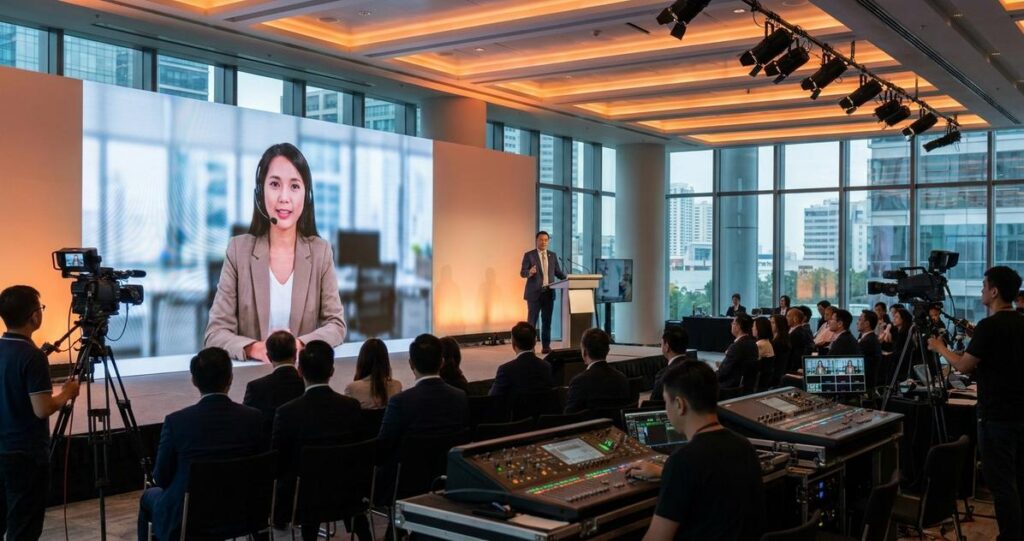
Hybrid events have become a practical reality for many organisations in Singapore, from corporate town halls and product launches to association conferences and government-linked forums. When a programme includes both a physical stage and a virtual stage, the transition between speakers can become one of the most fragile moments in the entire event flow. If the handoff is not handled carefully, the audience may experience silence, confusion, delayed audio, awkward camera framing, or a noticeable drop in energy. For Singapore audiences, who are accustomed to polished presentation standards and efficient event delivery, these transitions matter more than many planners first assume.
Managing speaker transitions well is not simply about asking the next person to stand by. It requires coordination between the moderator, technical crew, stage manager, streaming team, and speakers themselves. The goal is to make the experience feel seamless whether someone is standing on a physical stage in Marina Bay, joining from a home office in Bukit Timah, or connecting from overseas. A strong transition protects audience attention, supports speaker confidence, and reduces technical risk. In hybrid production, the transition is often the point where event planning is either reinforced or exposed.
In Singapore, this challenge is shaped by practical realities. Many events bring together local and regional speakers across time zones. Some delegates attend in person while others join through platforms such as Zoom, Microsoft Teams, or other streaming environments used by professional production teams. Venue acoustics, internet stability, multilingual programme needs, and tight run-of-show schedules all influence how smooth the handoff feels. The good news is that with the right structure, speaker transitions can be managed in a way that feels calm, professional, and natural.
Why speaker transitions are often the hardest part of a hybrid programme
A hybrid event combines two audience experiences at once. The people in the room see the stage directly, while the virtual audience depends on camera framing, switching, audio routing, and timing cues. A transition that feels effortless to the live audience may still fail online if the next speaker is not brought into the stream at the right moment or if their microphone is not active. This is why transition planning must be treated as a production task, not just a speaking order on a programme sheet.
One common issue is mismatch in pacing. In a physical setting, a moderator can pause briefly, walk across stage, and introduce the next speaker with eye contact and body language. Online, the same moment may require a camera switch, a lower third title, a sound check, and a feed confirmation. If the pacing is too fast, the virtual audience may miss the transition. If it is too slow, the room can lose momentum. Effective hybrid production balances both sides at the same time.
Another challenge is speaker readiness. Physical speakers may feel more confident because they can see the room and receive live cues from the stage team. Virtual speakers, on the other hand, may be managing home equipment, screen sharing, lighting, and connectivity from a different location. Without a clear handoff process, they may begin speaking before their audio is clean or before the host has completed the introduction. In a Singapore event environment where professionalism is expected, these missteps are highly visible.
Build the transition around a clear run-of-show and speaker map
The most reliable way to manage transitions is to create a detailed run-of-show, sometimes called a programme cue sheet. This document should do more than list session titles and timings. It should identify who is speaking next, whether the speaker is on site or virtual, who introduces them, what technical cues are required, and what the contingency plan is if the connection fails. For hybrid events, the run-of-show is the operational backbone that keeps the entire experience aligned.
A speaker map is also useful. This is a simple visual plan that shows the sequence of speakers, the platform they are using, the location of each speaker, and the responsible production contact. For example, a panel discussion in Singapore may begin with an in-room moderator, then switch to a virtual subject matter expert based in Kuala Lumpur, and later return to a physical speaker from a local enterprise. Mapping these switches in advance helps the crew anticipate audio routing, camera framing, and timing.
The programme should also account for buffer time. Even when the event is tightly scheduled, transitions should include enough room for a handover, applause, a short technical pause if required, and a fallback option. Buffer time is especially important when speakers are joining across different devices or when the event uses a translated feed, interpretation channel, or live captioning service. When the schedule is too compressed, one small delay can affect the rest of the session.
Assign ownership for each transition
Every transition should have one clear owner. In many productions, this is the stage manager or show caller, working closely with the technical director. The host or moderator owns the verbal handoff, but the stage manager ensures the cue is executed. This division matters because confusion often happens when no one is certain who is responsible for the next move. Clear ownership prevents overlap, hesitation, and missed cues.
It helps to define who will: signal the speaker, open the microphone, confirm the correct camera angle, update the slide deck if needed, and give the host a final go-ahead. In Singapore venues with experienced event teams, these responsibilities are often managed smoothly, but the process still needs to be documented for every event. Even seasoned speakers benefit from clarity.
Prepare speakers differently depending on whether they are physical or virtual
Speakers perform better when they know exactly how they will enter the programme. A physical speaker should know where to stand, when to approach the microphone, whether they will be introduced before entering the stage, and how long the handoff will take. A virtual speaker should know when to log in, whether they will remain muted until introduced, whether their camera should be on before they are brought on screen, and what to do if the platform reconnects unexpectedly.
These differences may seem minor, but they affect confidence and timing. For a physical stage, the speaker can adjust to the room in real time. For a virtual stage, the speaker must rely on the production team to bridge the gap between their device and the audience. A well-prepared virtual speaker is usually given a pre-event briefing that covers background, lighting, camera angle, microphone choice, internet connection, and the speaking sequence. This briefing should be practical and concise.
In Singapore, where many professionals move between office, home, and event spaces during the workweek, virtual speaking conditions can vary widely. Some join from corporate meeting rooms with stable networks, while others connect from home or from overseas business travel. The production team should not assume a single standard setup. Instead, they should verify what each speaker is using and adapt the transition plan accordingly.
Run a technical rehearsal for every high-stakes handoff
A technical rehearsal is one of the most effective ways to prevent transition problems. This rehearsal should test the actual sequence of speaker changes, not just the opening and closing of the event. If the programme will move from an in-room keynote to a virtual panelist, the production team should rehearse that exact handoff. The crew should check audio levels, camera switching, presentation sharing, and the speaker introduction order.
Rehearsals also reduce the likelihood of awkward silence. Silence may be acceptable in some contexts, but in a hybrid event it often creates the impression that something has gone wrong. A short rehearsal gives the host and technical team a chance to practise transitions that feel natural on both sides of the screen. For events with important stakeholders, this preparation is usually worth the time.
Use the moderator as the bridge between the physical and virtual room
The moderator, emcee, or session chair is often the most important human link in a hybrid transition. Their role is not just to introduce speakers. They guide attention, maintain pacing, and help both audiences feel that they are part of one coherent session. A strong moderator knows how to signpost what is happening, acknowledge the change in format, and keep the energy level steady.
For example, instead of saying only, “Now we move to our next speaker,” the moderator can use a more useful bridge, such as, “We will now hear from our colleague joining virtually from our regional office, and I will hand over once the screen is live.” This tells the room what to expect and gives the production team a short window to complete the switch. It also reassures the virtual audience that the transition is intentional and controlled.
Moderators should avoid speaking over the technical handoff. If the next speaker is joining from a remote platform, the moderator should allow enough time for the incoming feed to stabilise before introducing them fully. A rushed introduction can create crosstalk or confusion if the speaker is not yet ready. Good moderation is about timing as much as language.
Keep introductions short, specific, and relevant
Long introductions can slow down the programme, especially when there are multiple speaker changes in a short period. Keep the introduction focused on the reason the speaker is relevant to the audience. Mention the topic, role, or expertise that matters most to the session. If the event is bilingual or multilingual, work with the production team to ensure the transition supports the chosen language flow without dragging the schedule.
Specificity also helps the audience understand the change in format. If a speaker is virtual, say so clearly. If a speaker is taking over from the stage floor after a recorded segment, say that clearly too. Transparency reduces the sense of disruption and makes the event feel deliberate.
Strengthen the technical flow so the transition feels invisible
Technical execution is where transition quality is won or lost. The audience should not have to think about whether the right microphone is live or whether the correct speaker window is on screen. This requires careful coordination among audio, video, and streaming teams. The aim is not perfection for its own sake. The aim is consistency, so the audience can remain focused on the message rather than the mechanics.
Audio is usually the first priority. A virtual speaker may sound flat or distant if the wrong microphone profile is used. A physical speaker may be difficult to hear if room sound dominates the stream. The technical team should match audio levels across speakers as closely as possible. This creates a smoother listening experience and avoids the jarring effect of sudden volume changes when the programme shifts between stage and screen.
Video framing matters as well. The camera should clearly show the speaker who is currently active, and the switching should be deliberate rather than frantic. If the event includes slides, picture-in-picture, or a split-screen format, the layout should be tested before the live programme begins. This is especially important for corporate events and conferences in Singapore where attendees often expect broadcast-quality presentation standards.
Plan for latency and platform delay
Latency is the delay between what happens in one location and when it appears in another. In hybrid events, even a short delay can affect timing between the stage and the virtual feed. This is why speakers should not interrupt each other across physical and online spaces without planning. If the virtual speaker is meant to respond to a physical speaker, the moderator should build in a pause and guide the exchange carefully.
Platform delay is normal in streamed environments, but it must be accounted for in the script. A good production team will rehearse cross-format exchanges so the moderator knows when to pause, when to ask the question, and when to give the remote speaker room to answer. This is especially useful in panel sessions where quick back-and-forth exchanges are expected.
Manage contingencies without disrupting the audience experience
Even a well-prepared hybrid event may face a dropped connection, a microphone issue, a late speaker arrival, or an unexpected schedule overrun. The difference between a minor issue and a major disruption is usually the contingency plan. Every event should have a backup process for bringing in the next speaker, whether that means moving to a pre-loaded video segment, extending the moderator’s remarks, or reordering the session slightly while the technical team resolves the issue.
For Singapore events, where venues often host back-to-back programmes and time management is strict, contingency planning is particularly important. If a virtual speaker loses connection, the moderator should know whether to continue with the next item, invite a different speaker, or pause briefly. The audience should never be left guessing. A calm, confident handover protects the credibility of the event even when something goes wrong behind the scenes.
It is also wise to prepare a communication protocol for internal staff. Production crew, registration teams, and programme leads should know who makes the call when a transition needs to change. This reduces panic and avoids mixed messages. The audience should see a professional programme, not the internal stress behind it.
Use a recovery script for common problems
A recovery script is a short set of prepared lines that the moderator can use if the next speaker is delayed or unavailable. It should sound natural and not overly scripted, but it should give the audience a clear sense that the programme remains under control. This can include a brief recap of the last point, a transition to a related topic, or a short acknowledgment that the next speaker will join shortly. The purpose is to protect flow without making the problem feel larger than it is.
For virtual speakers, the recovery plan should also include a reconnection procedure. The technical team should know how to re-establish the feed, whether the speaker should rejoin via the same link, and who will signal when the speaker is visible and audible again. These procedures reduce downtime and help the programme recover smoothly.
What Singapore event teams should prioritise before the live day
In Singapore, event planners often work with tight schedules, premium venues, and audiences that value professionalism and clarity. Speaker transitions should therefore be treated as a core part of event design, not an afterthought. Before the live day, teams should confirm the run-of-show, rehearse critical handoffs, test all devices, brief speakers on their entry points, and assign a named owner for each transition. If the event includes leaders, clients, or public-facing stakeholders, this preparation becomes even more important.
Another practical step is to review the event from the perspective of both audiences. Ask what the physical audience will see and hear, then ask the same question for the virtual audience. If the answer differs too much, the transition may need to be redesigned. The best hybrid events are not identical experiences, but they should feel equally considered and equally professional.
If your event involves health, safety, or other regulated content, always ensure the speakers and moderators use language that is accurate, relevant, and approved for the context. For general public-facing information, it is also sensible to keep any claims conservative and evidence-based. That approach builds trust, which is especially important in Singapore’s information-conscious environment.
For organisations looking to improve hybrid delivery, the practical question is not whether transitions will matter, but how much time and planning they will receive. Speaker handoffs are one of the easiest places for a programme to lose momentum, yet they are also one of the easiest to improve with better preparation. When the physical stage and virtual stage are connected thoughtfully, the audience experiences a single event rather than two separate worlds.
Strong transitions are built on three things: clear planning, disciplined technical execution, and confident moderation. If those elements are in place, the shift from physical to virtual, or virtual back to physical, can feel smooth enough that the audience barely notices it. That is usually the mark of a well-produced hybrid event. The message stays central, the speakers stay composed, and the audience stays engaged from one handoff to the next.
Jeremy Lee is a seasoned digital marketing director and strategist with over two decades of experience in the industry. As the founder of Sotavento Medios, I manage a diverse portfolio of over 50 businesses, helping brands grow through advanced search strategies and digital innovation. My work focuses on bridging the gap between traditional search engine optimisation and the evolving world of AI-driven answer engines.
get in touch