
Unlocking Dynamic Engagement: The Technical Imperative of Multi-Camera Production for Executive Panels
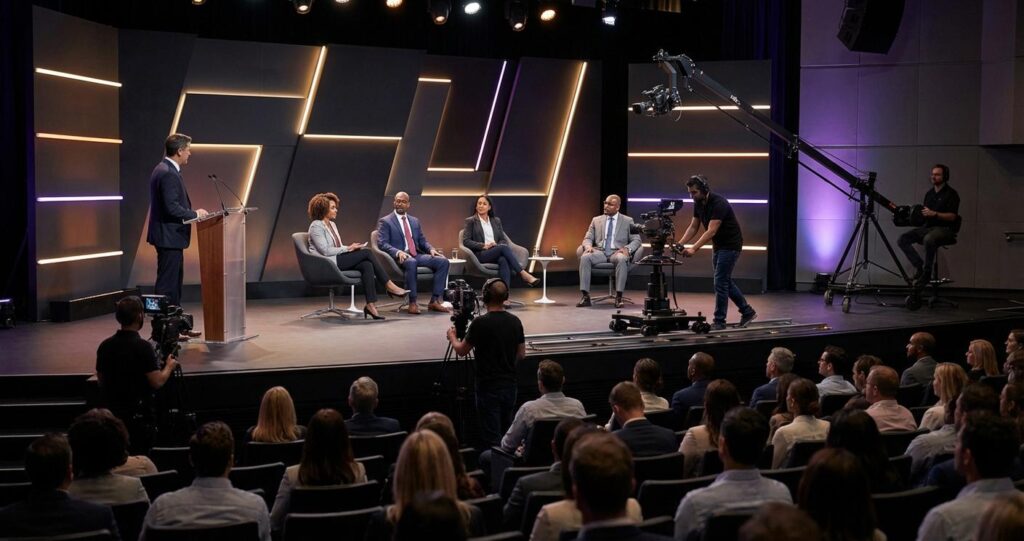
In the enterprise ecosystem, an executive panel discussion is a high-stakes communication event. It is a direct channel for leadership to convey strategy, instill confidence, and engage with key stakeholders. However, the technical execution of these events often fails to match the caliber of the message. A single, static camera feed, reminiscent of a basic webcam call, fundamentally undermines the authority and dynamism of the discussion. It creates a passive viewing experience that struggles to hold the attention of a discerning professional audience, whether they are in the room or participating remotely. For corporate event planners, AV professionals, and IT directors tasked with delivering flawless B2B events, transitioning to a multi-camera production workflow is not an aesthetic upgrade; it is a strategic necessity. This approach elevates the broadcast from a simple presentation to a compelling, television-style production that enhances clarity, maintains viewer engagement, and properly showcases executive presence. This technical examination explores the critical infrastructure, production workflows, and streaming protocols required to successfully implement a multi-camera setup for hybrid and in-person executive panel discussions.
Foundational Infrastructure: Signal Integrity and Routing Architecture
The bedrock of any professional multi-camera production is a robust and reliable signal transport and routing architecture. The choice of infrastructure directly impacts latency, reliability, and scalability. The decision between traditional baseband video and modern IP-based workflows is a primary consideration, each with distinct advantages depending on the environment and existing network infrastructure. It is this core system that ensures every camera angle, audio source, and graphic element is delivered to the production switcher with perfect synchronization and uncompromising quality.
Baseband vs. IP: Choosing Your Signal Path
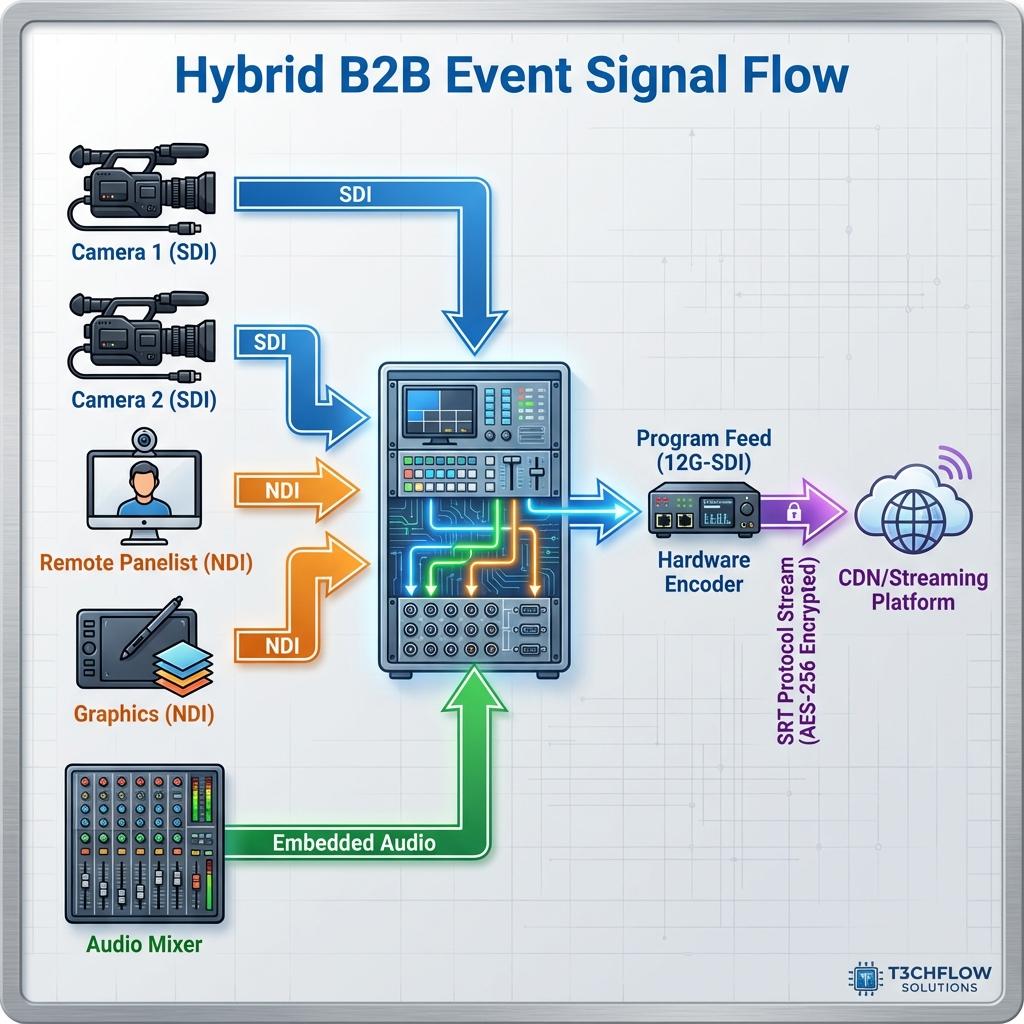
The traditional standard for professional video transport is Serial Digital Interface (SDI), a coaxial-based cabling solution prized for its rock-solid reliability, near-zero latency, and deterministic performance. For high-resolution productions, standards like 12G-SDI provide the necessary bandwidth to carry an uncompressed 4K Ultra High Definition (UHD) signal at 60 frames per second over a single cable, making it an ideal choice for mission-critical applications within a production truck or a dedicated event space. Conversely, IP-based workflows, prominently featuring protocols like NDI (Network Device Interface), offer tremendous flexibility and scalability by transporting high-quality, low-latency video over standard Gigabit Ethernet networks. NDI comes in two primary flavors: full-bandwidth NDI, which provides visually lossless quality comparable to SDI, and NDI|HX, a compressed variant that requires significantly less bandwidth, making it suitable for congested networks or Wi-Fi connectivity. An effective architecture might leverage a hybrid approach: using SDI for critical camera-to-switcher connections and NDI for integrating graphics, remote participant feeds, and secondary distribution within a venue.
Video Switching and Production Control
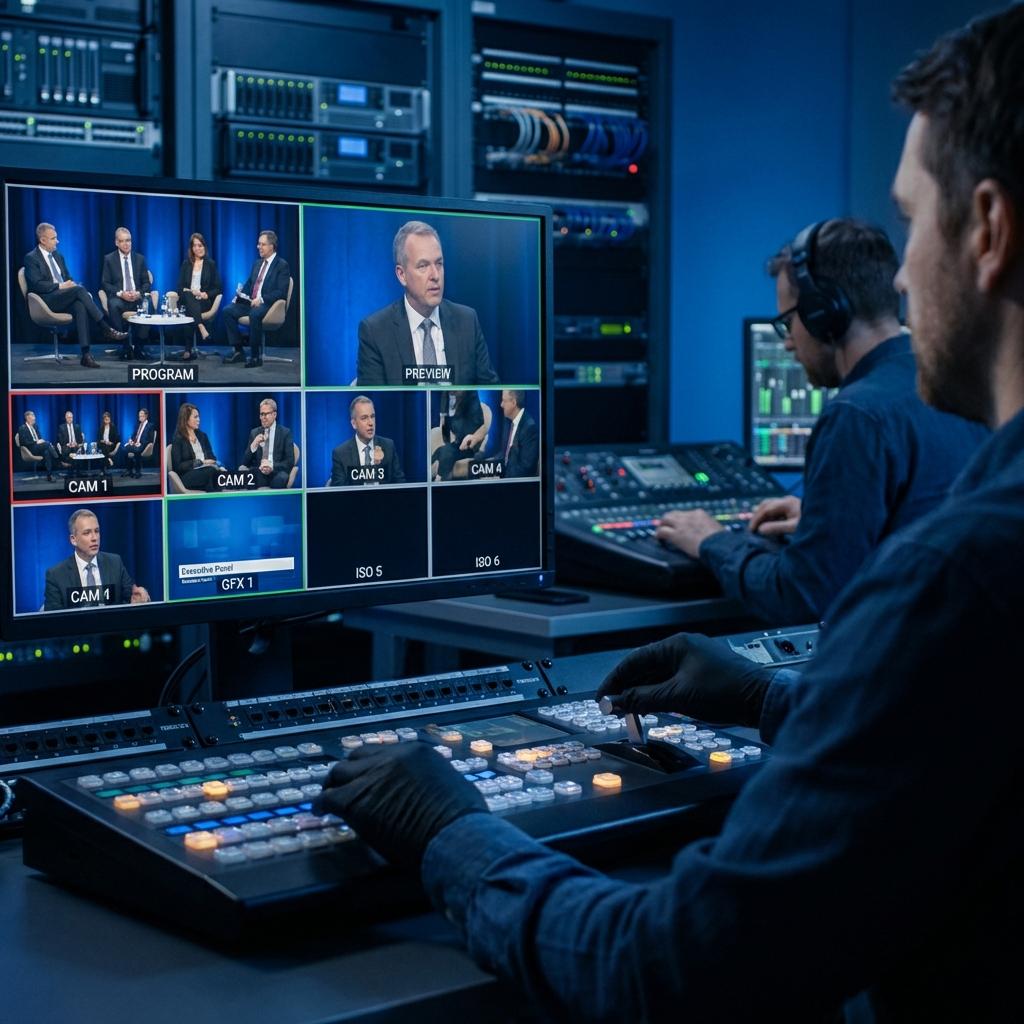
The heart of a multi-camera production is the video switcher, or vision mixer. This hardware or software-based system allows a Technical Director (TD) to select and transition between various video sources in real-time. Professional switchers, such as those from Blackmagic Design, Ross Video, or Grass Valley, operate with a Program and Preview bus architecture. The Program bus represents the live output feed being sent to the encoder and in-room screens, while the Preview bus allows the TD to cue up the next shot without affecting the live output. A crucial component of the control setup is the multiview monitor, which displays all camera inputs, graphics channels, and the Program and Preview feeds on a single screen. This gives the entire production team complete situational awareness. The TD, guided by the show director, uses the switcher to perform cuts, dissolves, wipes, and keying operations, creating a seamless and engaging narrative flow by switching between wide shots, speaker close-ups, and panel two-shots.
Audio Integration: Ensuring Pristine Dialogue
Superior audio quality is non-negotiable for an executive panel. A multi-camera setup must be paired with a professional audio workflow. This typically involves outfitting each panelist with a discrete lavalier microphone and providing the moderator with a handheld or tabletop microphone. These sources are fed into a professional audio mixing console where an audio engineer performs gain staging, equalization (EQ), and dynamics processing for each channel to ensure maximum clarity and consistent levels. The final mixed audio is then embedded into the primary SDI or NDI program video feed. This synchronization is critical for maintaining lip-sync. For hybrid events with remote panelists, the engineer must create a mix-minus feed for each remote contributor. This custom audio mix includes the full program audio minus that specific contributor’s own voice, preventing distracting echo and feedback on their end.
Enhancing Viewer Engagement and Information Delivery
A multi-camera infrastructure is the foundation upon which a more engaging and informative viewing experience is built. The ability to dynamically switch between different perspectives and overlay contextual information transforms a passive broadcast into an active storytelling medium. This control allows the production team to direct the audience’s focus, emphasize key points, and reinforce brand identity, ensuring the core message resonates with maximum impact.
Dynamic Storytelling through Camera Angles
The strategic use of multiple camera angles is the most significant advantage of this production style. A typical setup for a four-person panel includes a wide master shot to establish the scene, a medium close-up (MCU) on each panelist, and a “two-shot” that captures interaction between two speakers. The director can call for a cut to the MCU of the person speaking, ensuring the audience can clearly see their expression and non-verbal cues. When another panelist reacts, a quick cut to their MCU captures that reaction, adding a layer of dynamic interaction. The wide shot is used to re-establish context, show the panelists as a cohesive group, and cover transitions. This intentional direction guides the viewer’s attention and creates a rhythm that is far more engaging than a single, locked-off shot. It mirrors the production quality that audiences have come to expect from professional broadcast media, implicitly lending more weight and authority to the content.
Integrating Lower Thirds and Branded Graphics
Professional productions require branded visual elements to provide context and reinforce corporate identity. A production switcher’s keying functionality is essential for this. A downstream keyer (DSK) or upstream keyer allows for the overlaying of graphics, such as lower-third titles that identify each speaker with their name and title. These graphics are typically generated from a dedicated character generator (CG) system like Chyron or software like ProPresenter and fed into the switcher as a separate input with an alpha channel (a key signal). This allows the graphic to be cleanly composited over the live video. Beyond lower thirds, this capability is used for displaying presentation slides, corporate logos, and full-screen title cards, ensuring the entire broadcast is professionally branded and visually cohesive.
ISO Recording for Post-Production and Archival
A significant technical benefit of a multi-camera workflow is the ability to perform isolated camera recording, or ISO recording. While the live program feed is switched and sent to the streaming encoder, a separate recording system captures the clean, raw feed from each individual camera simultaneously. Professional recorders like the Blackmagic HyperDeck or integrated switcher capabilities can record these ISO feeds in high-quality codecs like Apple ProRes or Avid DNxHD. This provides immense post-production flexibility. If a live switching error occurred, it can be corrected in the edit. The content can be completely re-edited with different pacing for on-demand viewing. High-quality promotional clips or social media cutdowns can be created from the full-resolution source material, dramatically extending the value and lifecycle of the event content far beyond the live stream.
Advanced Hybrid Event Integration and Streaming Protocols
For hybrid events, the production challenge extends beyond the physical venue to encompass a global digital audience and remote participants. This requires a robust encoding and transport strategy that prioritizes security, reliability, and low latency. The choice of streaming protocols and the method of integrating remote feeds into the production are critical technical decisions that define the success of a hybrid executive panel.
Encoding for Delivery: Codecs and Bitrate Management
The final program feed from the switcher must be compressed for delivery over the internet. This is the job of a hardware or software encoder. The encoder converts the video into a streamable format using a codec like H.264 (Advanced Video Coding) or the more efficient H.265 (High-Efficiency Video Coding). For enterprise streaming, a Constant Bitrate (CBR) is often preferred to ensure a stable and predictable data stream. To optimize the viewing experience for a diverse audience with varying internet speeds, Adaptive Bitrate Streaming (ABR) is implemented. The encoder creates multiple versions of the stream at different bitrates and resolutions (e.g., 1080p at 6 Mbps, 720p at 3 Mbps, 480p at 1.5 Mbps). The viewer’s video player automatically selects the highest quality stream their connection can support without buffering, ensuring a smooth playback experience for all.
The Protocol Stack: From RTMP to SRT
The protocol used to transport the encoded video from the venue to the streaming platform is a critical link in the chain. While RTMP (Real-Time Messaging Protocol) was the long-standing standard, it lacks features essential for professional B2B broadcasts. The modern successor is SRT (Secure Reliable Transport), an open-source protocol designed for high-performance streaming over unpredictable networks like the public internet. SRT’s key advantages include advanced packet loss recovery using ARQ (Automatic Repeat Request), end-to-end AES-256 encryption for security, and stable, low-latency performance. For corporate events where security and reliability are paramount, SRT provides the assurance that the stream will reach its destination securely and with the highest possible quality, even over challenging network conditions.
Integrating Remote Panelists via Contribution Feeds
Seamlessly incorporating remote executives requires a more sophisticated approach than simply screen-sharing a consumer video conferencing application. The goal is to treat the remote participant as just another camera source in the switcher. This is achieved by using professional features within platforms like Microsoft Teams and Zoom, such as NDI output, which provides an isolated video feed for each participant. These NDI feeds can be brought directly into the production switcher over the local network. This allows the TD to switch to the remote panelist as a full-screen, high-quality source, just like any of the physical cameras in the room. This professional integration, combined with the aforementioned mix-minus audio feed, ensures that remote contributors are presented with the same level of quality and importance as their in-person counterparts, creating a truly unified hybrid experience.
Ultimately, a multi-camera production transforms an executive panel discussion from a static monologue into a dynamic, engaging dialogue. It provides the technical tools to direct audience attention, convey complex information clearly, and package the entire event in a format that reflects the professionalism of the enterprise it represents. By investing in the right signal architecture, production control, and streaming protocols, organizations can ensure their most important messages are not just delivered, but are also received with the impact they deserve. This commitment to production excellence is a direct investment in the clarity and authority of executive communication.
Jeremy Lee is a seasoned digital marketing director and strategist with over two decades of experience in the industry. As the founder of Sotavento Medios, I manage a diverse portfolio of over 50 businesses, helping brands grow through advanced search strategies and digital innovation. My work focuses on bridging the gap between traditional search engine optimisation and the evolving world of AI-driven answer engines.
get in touch