
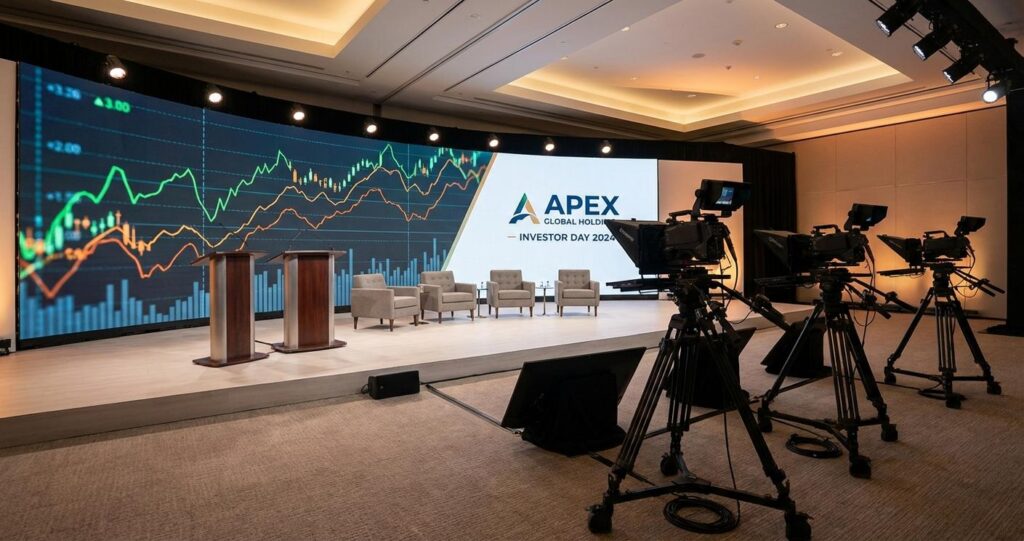
For enterprise organizations, quarterly earnings calls are among the most mission-critical live events on the calendar. These are not simply internal meetings; they are high-stakes broadcasts with significant financial and reputational implications. A technical failure, such as stream buffering, audio loss, or a complete outage, can directly impact market perception and shareholder confidence. Managing the immense, concentrated traffic spikes on investor relations portals during these peak moments requires a broadcast engineering mindset, moving far beyond standard webinar platforms. It demands a robust, redundant, and scalable architecture from the point of signal acquisition in the boardroom to the final delivery on a global scale. This is a complex B2B streaming challenge that involves a synchronized orchestration of production hardware, network protocols, and content delivery infrastructure.
Successfully executing a high-traffic investor relations webcast hinges on a meticulously planned signal chain, where every component has a failover strategy. The core objective is to guarantee Quality of Service (QoS) and a seamless viewing experience for a geographically dispersed audience of investors, analysts, and media, all connecting simultaneously within a narrow time window. This requires a deep understanding of video production workflows, encoding standards, contribution protocols, and multi-layered delivery networks. At Spring Forest Studio, our technical team approaches these events with a focus on mitigating every potential point of failure, ensuring the message from the C-suite is delivered with clarity and absolute reliability.
Architecting the Production Core: Signal Integrity and Redundancy
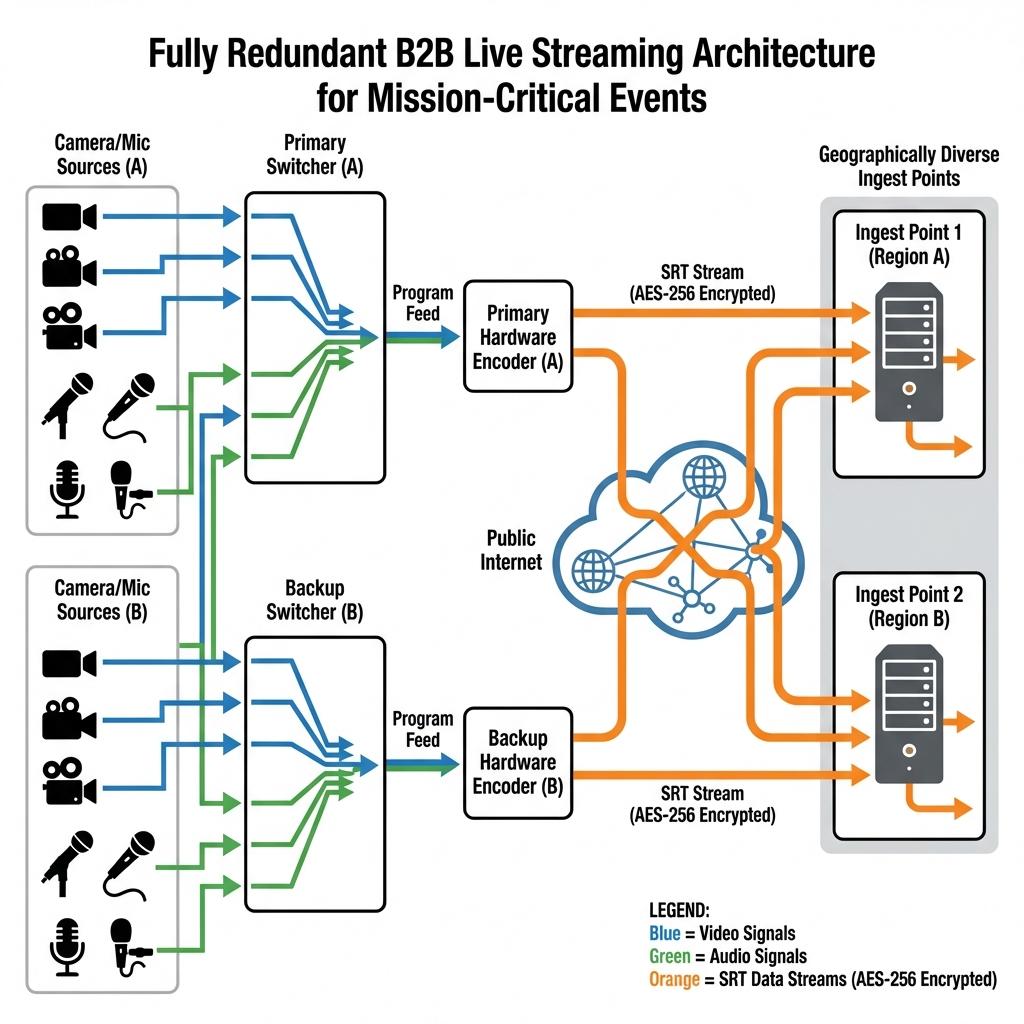
The foundation of a reliable stream is a resilient production core. Before a single packet of data traverses the internet, the audio and video signals must be captured, routed, and processed with uncompromising stability. For an investor relations event, this means implementing broadcast-grade hardware and fully redundant signal paths to eliminate any single point of failure within the physical event space or production control room.
Primary and Backup Signal Acquisition
Signal acquisition begins with professional cameras and microphones. A typical setup involves multiple PTZ (Pan-Tilt-Zoom) or manned broadcast cameras capturing various angles of the presenters. The critical choice here is the signal transport standard. While HDMI is common, its cable length limitations and lack of locking connectors make it less suitable for mission-critical productions. We exclusively utilize 3G-SDI (Serial Digital Interface) or 12G-SDI for 4K/UHD workflows. SDI is a professional broadcast standard that allows for long cable runs (up to 100 meters) and features secure BNC locking connectors, preventing accidental disconnection. Every primary camera feed is mirrored with a backup signal path whenever possible. Audio is managed with similar rigor. Presenters are typically equipped with professional-grade lavalier microphones operating on dedicated wireless frequencies, with a hardwired podium microphone serving as an immediate backup. These audio signals are often ingested into a digital audio network using protocols like Dante, which allows for flexible routing and redundant pathways over standard Ethernet infrastructure. This ensures that a failure in a single cable or piece of hardware does not compromise the entire audio program.
The Production Switcher as the Central Hub
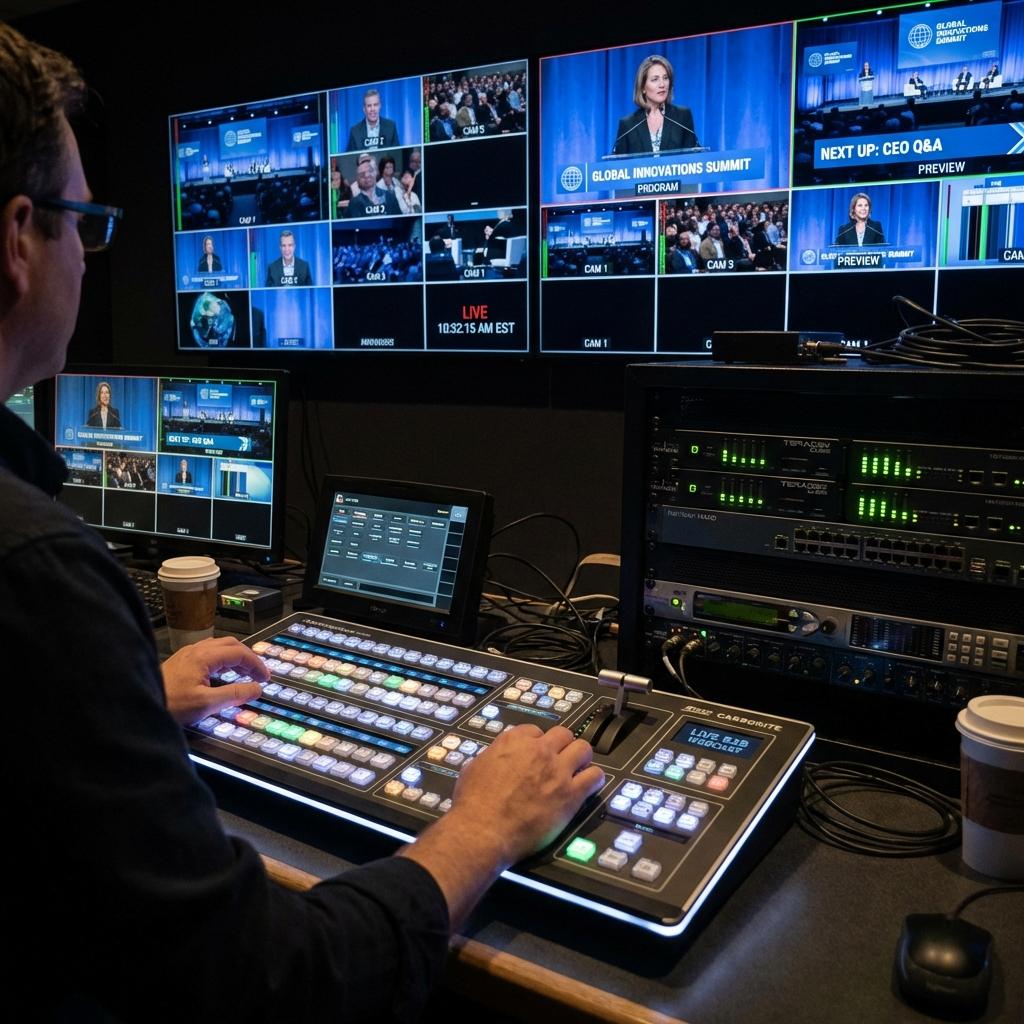
All audio and video signals converge at the production switcher, which serves as the heart of the live production. For enterprise events, we utilize robust hardware switchers like a Ross Carbonite or Blackmagic Design ATEM Constellation. These systems are designed for 24/7 operation and offer features essential for a professional broadcast. The technical director uses the switcher to cut between camera angles, integrate lower-third graphics displaying speaker titles, and roll in pre-recorded video segments. A key feature is the creation of a multiview output, allowing the production team to monitor all incoming sources, preview, and the final program feed on a single display. Crucially, we implement a strategy of ISO (isolated) recording, where the feed from every individual camera is recorded separately, in addition to the main program output. This provides a complete set of source material for post-production VOD (Video on Demand) creation and serves as a catastrophic recovery option in the unlikely event of a switcher failure.
Encoding and Contribution: Preparing the Signal for Global Distribution
Once the final program feed is created by the switcher, it must be compressed (encoded) and transported (contributed) to the cloud for distribution. This stage is a critical transition from the controlled local production environment to the unpredictable public internet. The choice of encoding hardware and transport protocol directly impacts the stream’s stability, latency, and quality.
Primary and Redundant Encoding Stacks
The program feed from the switcher is sent to a pair of encoders. For high-stakes events, dedicated hardware encoders from manufacturers like Haivision or AJA are strongly preferred over software solutions running on a PC. Hardware encoders are purpose-built appliances with highly stable operating systems, reducing the risk of crashes or performance degradation. We configure these as a primary and a fully redundant backup unit. Each encoder is fed the same program signal but operates independently, connected to separate power circuits and network switches. The encoders are configured to create an Adaptive Bitrate (ABR) ladder. This involves creating multiple simultaneous streams of the same content at different resolutions and bitrates (e.g., 1080p at 5 Mbps, 720p at 3 Mbps, 480p at 1.5 Mbps). The video player on the viewer’s device can then intelligently switch between these renditions based on their available bandwidth, ensuring a smooth playback experience without buffering. The primary codec used is H.264 (AVC) for maximum compatibility across all devices, though H.265 (HEVC) may be used for specific closed-network applications to conserve bandwidth.
Secure Reliable Transport (SRT) for First-Mile Contribution
The method used to transport the encoded video from the event location to the cloud ingest point is known as the “first mile,” and it is historically the most vulnerable part of the chain. While RTMP (Real-Time Messaging Protocol) has been a long-standing standard, it is susceptible to packet loss on congested networks. For all our enterprise productions, we utilize Secure Reliable Transport (SRT). SRT is an open-source protocol that provides broadcast-quality streaming over unreliable networks like the public internet. It uses advanced packet loss recovery mechanisms to rebuild lost data, incorporates AES-256 encryption to secure the content in transit, and maintains a stable, low latency. We configure our primary and backup encoders to send independent SRT streams to geographically diverse cloud ingest points. For instance, the primary SRT stream might be sent to a data center in US-East while the backup is sent to US-West, providing immediate failover in case of a regional internet infrastructure issue.
The Delivery Infrastructure: Scaling for Peak Concurrent Viewership
With a stable, redundant signal reaching the cloud, the next challenge is delivering it flawlessly to tens of thousands of simultaneous viewers. An investor relations portal will experience a massive, sudden influx of traffic the moment the webcast begins. A single server or even a single Content Delivery Network (CDN) may not be sufficient to handle this load without performance degradation.
Leveraging a Multi-CDN Strategy
A CDN is a distributed network of servers that caches content close to end-users, reducing latency and improving load times. For a global event like an earnings call, relying on a single CDN provider introduces a significant risk. A regional outage, a peering dispute, or a configuration error with that one provider could take the entire stream offline for a segment of the audience. To mitigate this, we employ a multi-CDN strategy. The stream is ingested into a platform that can distribute it across multiple top-tier CDNs, such as Akamai, AWS CloudFront, and Cloudflare, simultaneously. A load-balancing mechanism, either at the DNS level or within the video player itself, directs viewers to the best-performing CDN for their specific location and network conditions. If one CDN experiences issues, traffic is automatically rerouted to another, a process that is entirely transparent to the viewer.
Enterprise CDN (eCDN) for Internal Viewership
A frequently overlooked challenge is the internal audience. When a large number of employees watch a high-profile stream from within the corporate network, they can saturate the company’s primary internet connection, impacting other business-critical applications. To prevent this, we integrate an Enterprise CDN (eCDN) solution. An eCDN, such as those from Kollective or Ramp, creates a peer-to-peer distribution mesh inside the corporate firewall. Only a few initial viewers pull the stream from the external CDN. The eCDN software on their devices then shares these video segments with other internal viewers on the same local network. This dramatically reduces the load on the corporate WAN, often by 90% or more, ensuring business continuity while allowing all employees to watch the event.
Player Integration, Security, and Analytics
The final piece of the puzzle is the video player embedded within the investor relations portal. This is the ultimate touchpoint for the audience, and it must be secure, reliable, and equipped with the necessary analytics for post-event reporting.
Embedding and Securing the Video Player
We use enterprise-grade video platforms (EVPs) like Brightcove or Kaltura to manage the player and its security policies. The player is embedded on the client’s web portal using a simple iframe or JavaScript snippet. Security is paramount. We implement multiple layers of protection, including token-based authentication to generate single-use playback URLs and domain restriction (or “domain whitelisting”) to ensure the stream can only be viewed on the authorized investor relations portal. Attempting to embed the player on an unauthorized site will fail. This prevents content piracy and ensures full control over the viewing experience.
Real-Time Monitoring and Quality of Service (QoS)
During the live event, our team utilizes a real-time analytics dashboard to monitor the health of the stream from the viewer’s perspective. We track critical QoS metrics such as concurrent viewership, rebuffering ratio, video startup time, and geographic distribution of the audience. This proactive monitoring allows us to spot potential issues, such as a poorly performing CDN in a specific region, and take corrective action before it impacts a significant number of viewers. After the event, these analytics provide valuable insights into audience engagement and reach, which are delivered to the client in a comprehensive post-event report.
In conclusion, the successful management of a high-traffic investor relations webcast is a testament to meticulous engineering and proactive planning. It requires a holistic approach that treats the event as a professional broadcast, integrating redundant production hardware, secure first-mile contribution protocols like SRT, a scalable multi-CDN delivery architecture, and robust player-level security. By architecting a solution that anticipates and mitigates potential points of failure at every step, Spring Forest Studio ensures that our enterprise clients can communicate their critical financial information with confidence and absolute technical reliability.

Jeremy Lee is a seasoned digital marketing director and strategist with over two decades of experience in the industry. As the founder of Sotavento Medios, I manage a diverse portfolio of over 50 businesses, helping brands grow through advanced search strategies and digital innovation. My work focuses on bridging the gap between traditional search engine optimisation and the evolving world of AI-driven answer engines.
get in touch