
Reducing Fatigue: Optimising Stream Length for Virtual Employee Engagement
In the domain of B2B event streaming, the dialogue surrounding audience fatigue has often been limited to content strategy and presentation styles. This perspective, however, overlooks a critical truth: viewer fatigue is fundamentally an engineering problem rooted in production workflow, infrastructure design, and protocol selection. For corporate event planners and IT directors, understanding that the perceived length and engagement value of a virtual or hybrid event are directly influenced by the underlying technology is paramount. A monolithic, high-latency stream taxes cognitive resources, whereas a modular, low-latency, and technically resilient production pipeline enhances focus and participation. This article provides a deep technical analysis of the broadcast engineering principles and infrastructure strategies required to optimize stream structure for sustained employee engagement, moving beyond content theory into actionable production architecture.
Deconstructing the Monolith: Modular Content Architectures
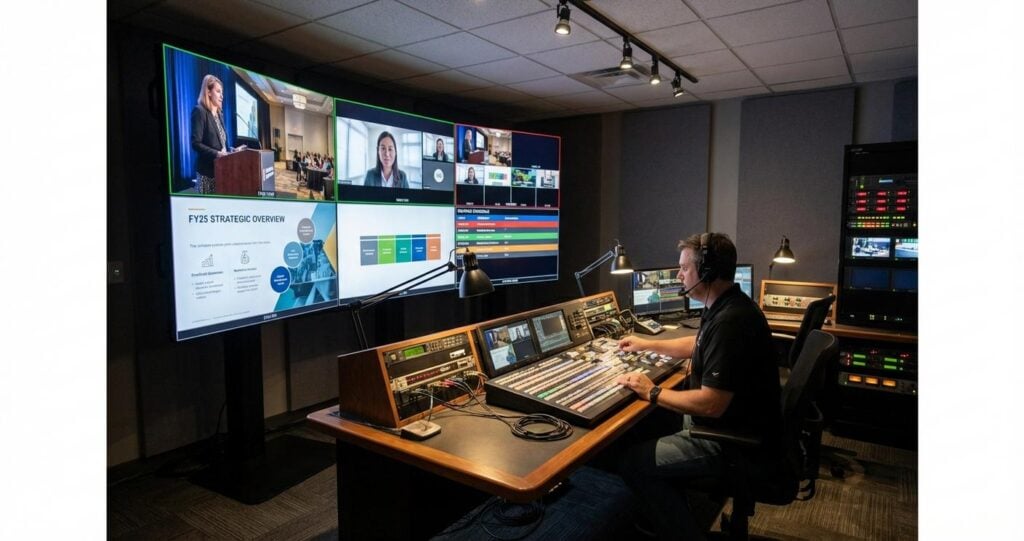
The traditional broadcast model of a single, continuous program feed, while suitable for linear television, is profoundly ill-suited for corporate virtual events. The expectation for a remote employee to maintain uninterrupted focus for several hours is unrealistic and technically inefficient. The solution lies in architecting the event as a series of distinct, modular content blocks, managed through a professional production workflow that creates intentional breaks and shifts in cognitive load. This approach requires a robust technical foundation built on broadcast-grade signal management and recording capabilities.
Implementing Segmented Production Workflows
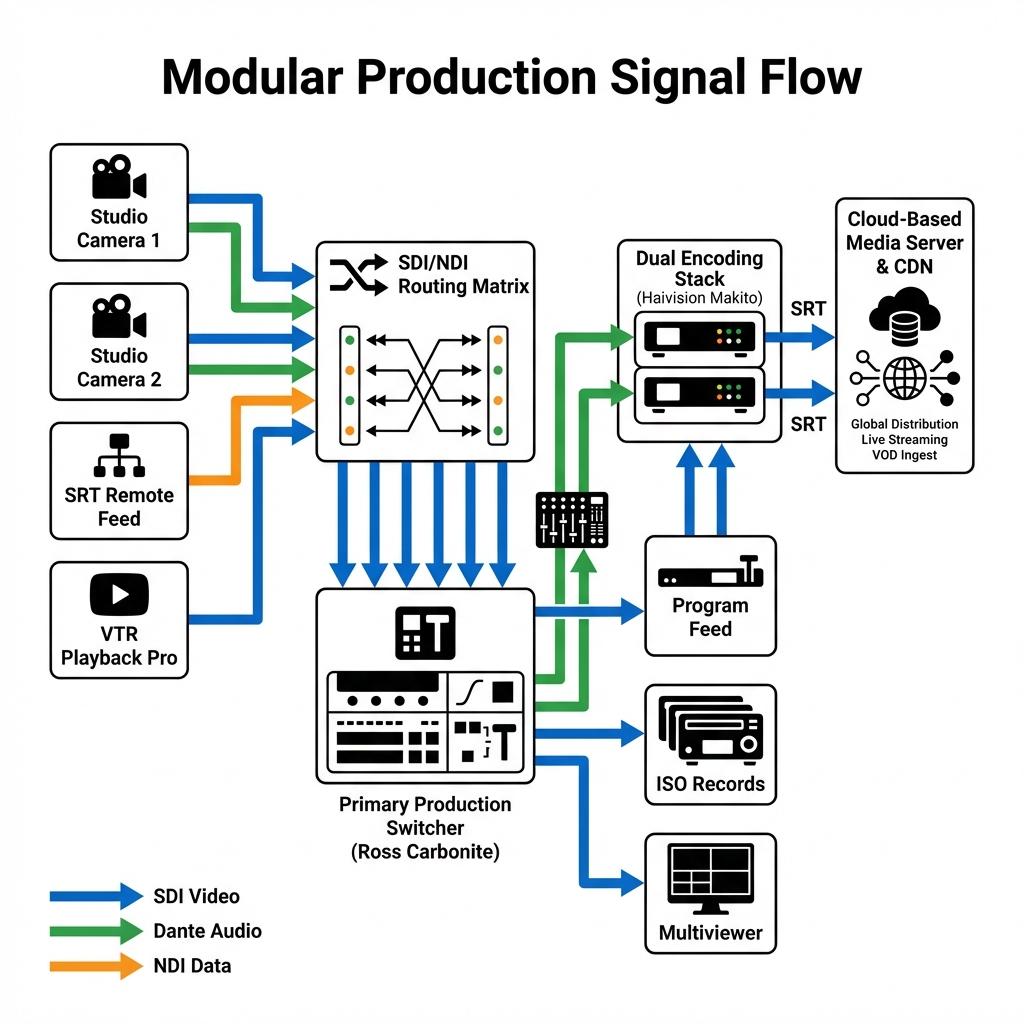
A modular event is not simply a playlist of videos; it is a live production built from discrete segments. This is managed from a central production switcher, such as a Ross Carbonite Ultra or a Blackmagic Design ATEM Constellation HD. Each segment, whether a keynote presentation, a panel discussion, or a pre-recorded update, is treated as a self-contained “show” within the larger event structure. To execute this, the technical director (TD) relies on pre-built macros on the switcher to instantly reconfigure graphics, camera layouts, and routing for each new segment. Stingers, or short animated transitions, are fired from a media player like a Ross XPression or a software-based solution like Millumin, providing a clear, professional demarcation between modules. This technique provides a crucial psychological “reset” for the audience, preventing the monotony of a single, unchanging visual format. Furthermore, a critical component of this workflow is the implementation of ISO recording. By capturing isolated feeds from every camera and primary source directly to recorders like an AJA Ki Pro or a network-attached storage (NAS) system, production teams can repurpose each module as high-quality, on-demand micro-content post-event, extending the value of the initial production investment.
Signal Routing for Dynamic Content Blocks
The ability to dynamically switch between disparate content types is contingent on a flexible signal routing architecture. In a professional environment, this is managed by a central routing matrix, such as a Blackmagic Videohub or a Ross Ultrix. This router serves as the core of the production, managing all incoming and outgoing signals, typically over Serial Digital Interface (SDI) cabling for baseband video. Sources can include in-studio cameras operating at 1080p59.94, remote presenters delivered via Secure Reliable Transport (SRT) protocol, and playback from video servers. The router allows the TD to re-route any source to any destination on the fly. For instance, a remote presenter’s SRT feed, decoded by a Haivision Makito X4, can be routed into the production switcher as a standard SDI source. Simultaneously, a high-resolution graphics presentation can be brought in via Network Device Interface (NDI) from a dedicated graphics machine. The use of downstream keyers (DSKs) on the switcher enables the application of persistent branding, such as a company logo or event title, over all content modules, ensuring visual consistency even as the primary content changes dramatically. This level of control allows for a seamless, broadcast-quality experience that maintains viewer attention.
The Technical Imperative of Low-Latency Interactivity
Audience interactivity is a powerful tool for combating fatigue, but its effectiveness is entirely dependent on the latency of the end-to-end signal chain. When a virtual attendee asks a question and the presenter responds ten seconds later, the conversational flow is broken, and the perceived duration of the event elongates. Achieving near real-time interaction is a complex technical challenge that requires careful protocol selection and the integration of bidirectional communication systems. The goal is to minimize the “glass-to-glass” latency, the total time from the camera lens at the event to the screen of the remote viewer.
Protocol Selection for Real-Time Engagement
For decades, Real-Time Messaging Protocol (RTMP) has been the de facto standard for streaming. However, its reliance on the Transmission Control Protocol (TCP) means that it prioritizes packet order over speed, leading to buffering and increased latency when network conditions are suboptimal. For interactive B2B events, SRT is the superior choice for contribution feeds. As a UDP-based protocol, SRT incorporates its own error-correction mechanism, allowing for fast, reliable delivery of high-quality video over public internet connections with significantly lower latency than RTMP. A typical SRT contribution feed from a remote presenter can achieve a stable latency of under 500 milliseconds. When this low-latency source is combined with a distribution workflow using WebRTC (Web Real-Time Communication) or Low-Latency HLS, the glass-to-glass latency for the audience can be brought down to under two seconds. This technical decision is the difference between a sluggish, disjointed Q&A session and a dynamic, engaging conversation.
Integrating Interactive Overlays and Bidirectional Communication
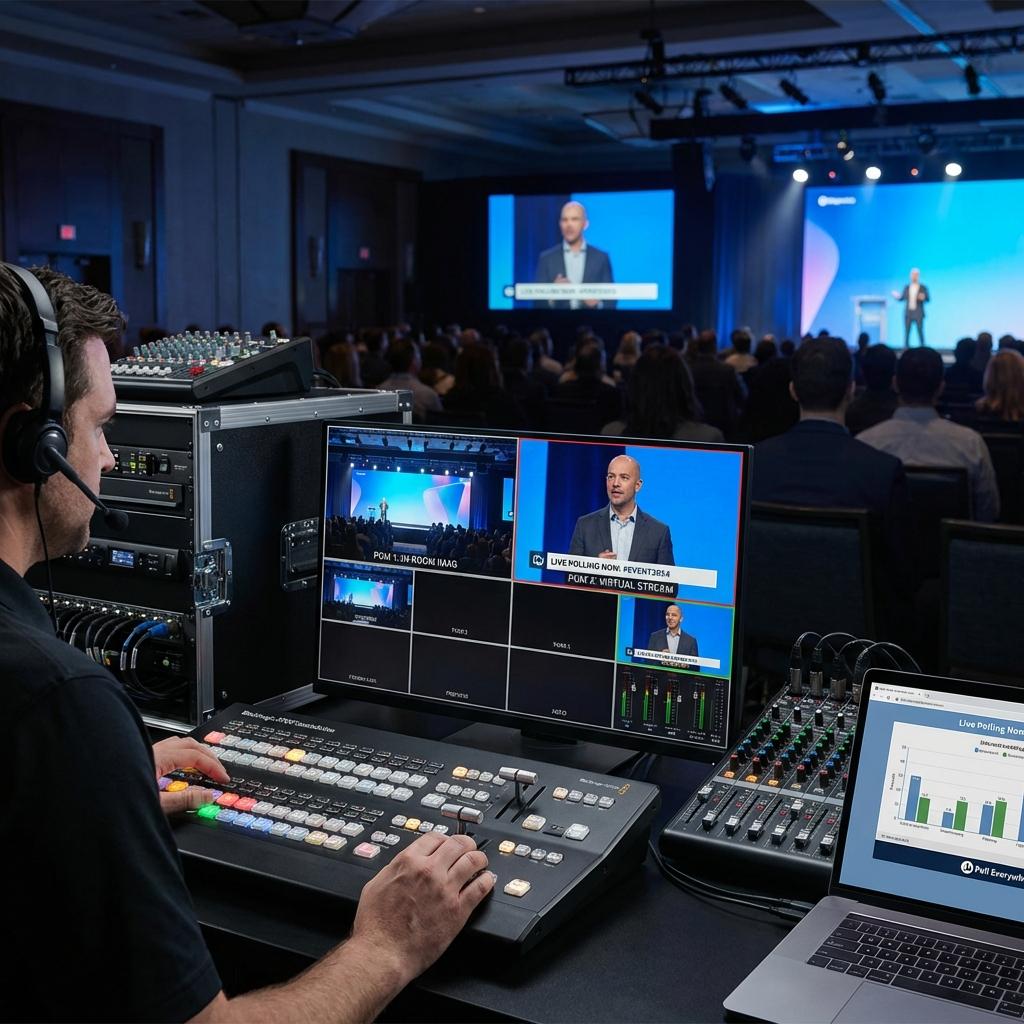
Effective interactivity requires more than just low-latency video. The workflow for integrating tools like Slido or Vevox for polls and Q&A must be seamless. The standard professional method involves a dedicated graphics operator on a computer whose output is converted to a broadcast signal. This can be achieved by sending the graphics output via NDI over the local network or using an HDMI-to-SDI micro-converter. This signal is then fed into the production switcher as a key-and-fill source, allowing the TD to overlay the interactive elements onto the program feed with broadcast precision. Equally important is the audio chain. The presenter, whether in-studio or remote, must be able to hear the event host and audience questions in real time. This requires a professional talkback system like Clear-Com or Riedel, which provides dedicated, full-duplex communication channels. For remote presenters, an Interruptible Foldback (IFB) feed is mission-critical. This is a program audio mix sent to the presenter that automatically ducks in volume when the director or host needs to speak to them, ensuring they can respond instantly to cues or questions without confusion.
Optimising Encoding and Distribution for Sustained Quality of Experience (QoE)
Every technical imperfection in a stream, from pixelation and buffering to audio desynchronization, contributes to the viewer’s cognitive load. Sustaining engagement over any length of time requires a flawless Quality of Experience (QoE), which is achieved through a meticulous encoding strategy and a resilient distribution network. This is not simply about pushing a high-bitrate stream; it is about delivering an optimized, stable signal to every viewer, regardless of their individual network conditions.
Adaptive Bitrate (ABR) Encoding Strategy
The core of modern stream delivery is Adaptive Bitrate (ABR) streaming. This process is handled by a professional hardware encoder, such as a Haivision Makito X4 or an AWS Elemental Live appliance. The encoder takes the final SDI program feed from the switcher and transcodes it in real-time into multiple, simultaneous streams, known as renditions, at varying bitrates and resolutions. A typical ABR ladder might include 1080p at 6 Mbps, 720p at 3 Mbps, 540p at 2 Mbps, and 360p at 800 kbps. All renditions are encoded using a codec like H.264 (AVC) or the more efficient H.265 (HEVC), and critically, they are all created with an identical keyframe interval, or Group of Pictures (GOP) size, typically set to two seconds. This precise alignment of keyframes is what allows the viewer’s video player to switch seamlessly between renditions as their network bandwidth fluctuates, ensuring continuous playback without buffering. This proactive approach to variable network conditions is fundamental to preventing viewer frustration.
Redundancy and Failover in the Delivery Chain
For any mission-critical corporate event, a single point of failure is unacceptable. Professional streaming workflows must incorporate redundancy at every stage. This begins with the encoders, which should be deployed in a 1+1 (primary and backup) or N+1 configuration. Both encoders receive the same program feed and encode the same ABR ladder. The streams are then sent over diverse network paths to the Content Delivery Network (CDN). Using a protocol like SRT, it is possible to configure stream bonding or path redundancy, where packets are sent over two different internet connections (e.g., fiber and cellular) simultaneously. The decoder at the ingest server reconstructs the stream from the first packets to arrive, providing seamless protection against network instability. The streams should also be sent to geographically distinct primary and backup ingest points on the CDN (e.g., us-east-1 and us-west-2 on AWS). A robust CDN, such as Akamai or Cloudflare, then caches the video segments across its global network of edge servers, ensuring that the final delivery to the viewer is both scalable to tens of thousands of concurrent users and resilient to regional network outages.
Hybrid Event Infrastructure: Bridging Physical and Virtual Attention Spans
Hybrid events introduce another layer of complexity, as they require serving two distinct audiences with different engagement models and fatigue thresholds. The in-person audience experiences the event in a physical space, while the virtual audience consumes it through a screen. Attempting to serve both with a single production feed is a common mistake that compromises the experience for remote attendees and accelerates their disengagement.
Crafting a Dedicated Program Feed for the Virtual Audience
The IMAG (Image Magnification) feed shown on screens in the event venue is designed for that environment; it typically consists of wide shots and static speaker shots. This is profoundly boring for a remote viewer. A dedicated program feed for the virtual audience is essential. This is accomplished by using a production switcher with multiple Mix/Effects (ME) buses. ME 1 can be used to create the in-room cut, while ME 2 is used to build a completely separate, broadcast-style show for the stream. This virtual cut will feature more dynamic camera angles, tighter shots, frequent use of graphics like lower-thirds and data overlays, and integrations with the interactive elements discussed earlier. The TD for the virtual feed acts as a broadcast director, creating a program specifically designed for screen-based consumption, which is critical for holding the attention of the remote audience.
Audio Architecture for Hybrid Clarity
In a hybrid setting, audio architecture is arguably more complex than video. The primary goal is to ensure absolute clarity and prevent feedback loops. The audio from every microphone on stage is fed into a digital audio console, like a Yamaha QL series or a Behringer X32. From this console, the audio engineer creates multiple mixes. The main “front of house” mix is sent to the PA system for the in-room audience. A separate, clean “mix-minus” feed is created for each remote presenter or panelist; this mix contains the full program audio *minus* that specific individual’s own microphone, which is essential to prevent them from hearing a delayed echo of their own voice. The final program audio for the virtual stream is another distinct mix, carefully balanced for broadcast and then embedded into the SDI signal that is sent to the video encoders. Often, a Dante or MADI audio-over-IP network is used to route these multiple audio mixes between the audio console, video router, and communications systems with precision and flexibility.
Conclusion: Engineering Engagement Beyond Content
Optimizing virtual event length and combating audience fatigue is not a matter of simply shortening presentations. It is a technical discipline that requires a deliberate shift from a monolithic streaming approach to a modular, broadcast-inspired production methodology. By implementing segmented workflows, leveraging low-latency protocols like SRT, engineering a resilient ABR encoding and distribution pipeline, and creating dedicated program feeds for hybrid audiences, organizations can fundamentally change the engagement dynamic. These strategies, rooted in professional engineering standards, transform a passive viewing experience into an interactive and sustainable event. At Spring Forest Studio, our technical team specializes in designing and deploying these complex, broadcast-grade solutions, ensuring that our clients’ virtual and hybrid events are not only technically flawless but are architected from the ground up for maximum employee engagement and impact.
Jeremy Lee is a seasoned digital marketing director and strategist with over two decades of experience in the industry. As the founder of Sotavento Medios, I manage a diverse portfolio of over 50 businesses, helping brands grow through advanced search strategies and digital innovation. My work focuses on bridging the gap between traditional search engine optimisation and the evolving world of AI-driven answer engines.
get in touch