
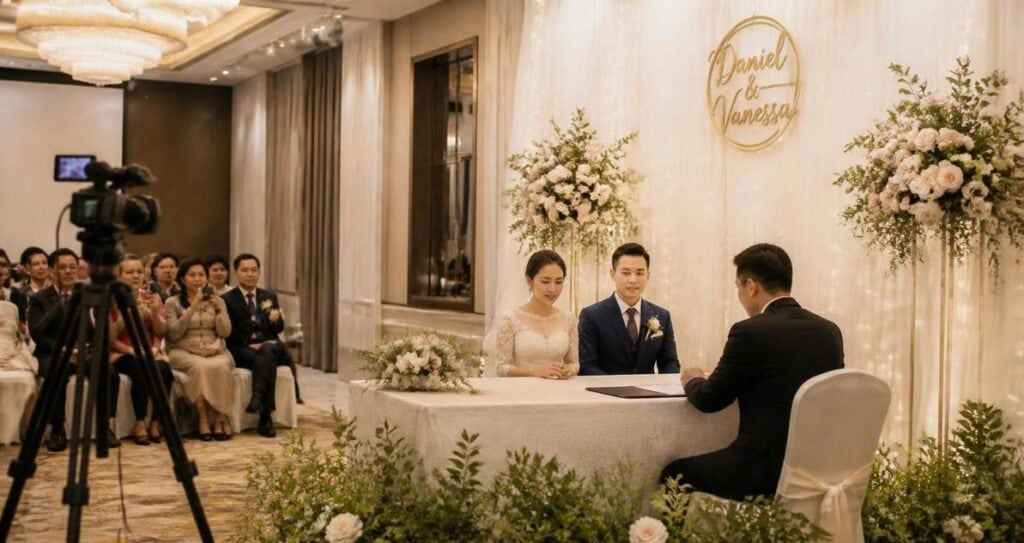
Wedding streaming has become an important option for couples in Singapore who want to include loved ones who cannot be physically present. Some guests live overseas, some are elderly, some may have mobility concerns, and some may simply face scheduling or travel constraints. In a city where family ties often stretch across borders and busy work lives can make attendance difficult, a professionally managed stream can help preserve the meaning of the occasion without drawing attention away from the couple and the ceremony. The key is discretion, which means using technology in a way that feels seamless, respectful, and unobtrusive.
Professional wedding streaming is not only about sending a video feed to a screen or a link. It involves planning the camera positions, managing sound, protecting privacy, coordinating with the venue, and ensuring that online guests can follow the ceremony clearly. For Singapore couples, this often means working within the realities of hotel ballrooms, church sanctuaries, solemnisation venues, restaurants, private homes, or outdoor locations where space and timing may be limited. A discreet approach respects the atmosphere of the event and the preferences of the family, while still making the celebration accessible to guests who cannot attend in person.
Why discretion matters in wedding streaming
Discretion is the difference between a stream that quietly supports the ceremony and one that becomes the centre of attention. A wedding is a personal milestone, and many couples want the technology to feel invisible, not intrusive. In practice, this means the production should blend into the setting, with minimal disruption to the couple, officiant, and guests. The best live streams are often the ones people hardly notice during the event itself, because the experience remains focused on the ceremony, the vows, and the people gathered in the room.
In Singapore, discretion also reflects the multicultural and family-centred nature of weddings. Some couples may be hosting guests from different backgrounds and age groups, with varying comfort levels around cameras, microphones, and online sharing. A careful production team takes these sensitivities seriously. That includes knowing when to use a wide shot instead of a close-up, when to mute a feed during private moments, and how to position equipment so it does not interfere with processions, table arrangements, or photography.
Respecting privacy without compromising access
Privacy is often the first concern for families considering a wedding stream. A secure and limited-access setup can help manage this concern. Couples may choose private viewing links, password protection, or invitation-only access for selected guests. This is particularly useful when the ceremony includes intimate moments, religious rites, or family interactions that are not meant for public distribution. A discreet streaming plan gives the couple more control over who sees the event and how it is shared.
It also helps to decide in advance what parts of the wedding should be streamed. Some couples choose to broadcast only the solemnisation or the exchange of vows, while keeping pre-ceremony greetings, tea ceremony details, or reception activities offline. Others want the entire event recorded and streamed live for relatives abroad. The right choice depends on the couple’s comfort level, the venue, and the expectations of the family.
What professional wedding streaming involves
A reliable wedding stream depends on much more than a laptop and a phone. Professional production brings together audiovisual setup, signal stability, and event coordination. In Singapore, where venues can vary from compact restaurant spaces to large hotel ballrooms, this planning is important because each location presents different lighting, acoustics, and internet conditions. A professional team assesses these conditions before the event, then designs a setup that fits the venue rather than forcing the venue to fit the setup.
Sound is especially important. Guests watching online can often tolerate slight visual softness, but they quickly notice poor audio. If the officiant, bride, groom, or emcee cannot be heard clearly, the stream loses much of its value. Good wedding streaming usually includes dedicated microphones, careful audio mixing, and backup planning for unexpected volume changes. If there are live readings, vows, blessings, or musical performances, each element should be tested in advance so that online guests receive a balanced and intelligible feed.
Camera placement and visual etiquette
Camera placement should support the flow of the ceremony without distracting those present. A discreet setup often uses one or more fixed cameras positioned at the sides or rear of the venue, with framing chosen to capture the important moments while staying out of sight lines. In some cases, a single well-placed camera is enough. In others, a multi-camera arrangement may be needed to follow the procession, the solemnisation table, or the stage without requiring frequent movement.
Visual etiquette matters as much as technical quality. Production teams should avoid blocking guests, interrupting photographers, or crowding the aisle. They should also consider the couple’s preference for how much of the audience appears on camera. Some families are comfortable with wider views that show the room and atmosphere, while others prefer a tighter frame focused on the couple and officiant. A professional team will discuss these preferences before the wedding and adjust the production accordingly.
Internet stability and backup planning
Stable connectivity is essential for live streaming. Even a beautifully produced wedding can suffer if the internet connection fails or becomes unstable. In Singapore, venues may offer wired internet, wireless internet, or limited mobile reception depending on the space. A responsible production workflow includes testing the connection beforehand and preparing backup options where possible. This may involve using bonded connections, mobile data failover, or local recording as a safety measure if the live feed is interrupted.
Local recording is particularly useful because it preserves the ceremony even if the stream encounters a problem. If the live signal drops, the recording can still be shared with guests later. This does not replace a stable stream, but it adds a layer of reassurance. For couples who care deeply about preserving the moment for relatives overseas, that backup matters.
How to plan a discreet streaming experience in Singapore
Planning starts with the venue. Different venues in Singapore have different house rules about equipment, power access, camera stands, and internet use. Hotels and function spaces may require advance notice for setup and load-in timing. Religious venues may have additional expectations regarding placement, movement, and noise. Private homes and condominiums may require extra care with neighbour considerations, common areas, and electrical access. A good plan begins with a clear conversation about what is allowed and what the couple wants the stream to achieve.
It is also important to align the stream with the wedding schedule. Singapore weddings often run on tight timelines, especially when multiple traditions or venue transitions are involved. If the solemnisation is followed by tea ceremony, banquet, or photo session, the production team should know which segments are to be streamed and which are to remain private. Clear timing reduces confusion and prevents rushed technical adjustments during the event.
Choosing the right level of production
Not every wedding needs the same level of production. Some couples only need a clean, single-camera stream with clear audio and a private viewing link. Others want a more polished experience with multiple camera angles, a branded viewing page, and a recording for family archives. The right level depends on the size of the event, the location, the number of remote viewers, and the couple’s priorities.
For smaller solemnisation ceremonies, a subtle setup may be the most appropriate. For larger weddings with relatives joining from different time zones, a more robust setup may be worth the added planning. The goal is not to make the production look expensive. The goal is to make it feel effortless and respectful.
Working with venue teams and family members
Strong coordination prevents disruption. Venue staff need to know where equipment will be placed, who will manage power and cables, and when the setup will happen. Family members should also be informed so they know what to expect. This is especially important if older relatives are unfamiliar with streaming or if the ceremony includes culturally significant moments that should not be interrupted.
One practical approach is to appoint one point of contact from the couple’s side. That person can communicate with the production team, the venue, and key family members, which reduces confusion on the day. In fast-moving event environments, a single coordinator makes a noticeable difference.
Protecting dignity, consent, and cultural sensitivity
Professional wedding streaming must respect consent. Everyone who appears prominently on camera should be aware of the stream, especially if the event includes guests who may not want their image shared online. Consent practices vary by setting, but the principle remains the same, people should know when they are being recorded or broadcast. This is especially relevant in intimate family ceremonies where guests may assume the event is private unless told otherwise.
In Singapore, cultural sensitivity is equally important. Weddings may involve Malay, Chinese, Indian, Eurasian, or mixed traditions, and each can include customs with different expectations around ceremony flow, music, prayer, or family participation. A discreet production team takes the time to understand these details. That may include avoiding unnecessary movement during solemn moments, respecting prayer or blessing periods, and ensuring the camera framing does not intrude on sacred or ceremonial spaces.
Professional discretion also means understanding data privacy. If the stream is recorded or shared online, couples should know where the recording is stored, how long it will be kept, and who can access it. This is part of responsible event management, not an afterthought. Clear communication about storage and access helps build trust with the couple and their families.
What couples should ask before choosing a wedding streaming service
Asking the right questions helps couples choose a service that matches their expectations. A professional provider should be able to explain the technical setup, the privacy options, the backup plan, and the expected workflow at the venue. Couples do not need to become audiovisual experts, but they should feel confident that the production team understands their event and can handle the details smoothly.
- How will the stream be accessed, and can access be restricted to invited guests only?
- What is the backup plan if internet connectivity becomes unstable?
- How many cameras or audio sources will be used, and where will they be placed?
- Will the venue require special coordination for setup, power, or internet access?
- Can the team adapt the stream to match religious or cultural requirements?
- Will the event be recorded locally as well as streamed live?
- How will the recording be stored, shared, and protected after the event?
These questions are practical, not technical for the sake of it. They help couples avoid surprises and choose a setup that reflects their values. A thoughtful provider will welcome these questions and answer them clearly.
Making the experience feel intimate, even for remote guests
A wedding stream should not feel like a generic broadcast. It should feel like a thoughtful extension of the celebration. That starts with framing, sound, and timing, but it also includes how the remote audience is welcomed. Couples may choose to include a brief greeting for online guests, a simple title card before the ceremony begins, or a short message thanking family members overseas for joining virtually. These touches are subtle, but they help remote viewers feel included rather than secondary.
At the same time, the stream should preserve the intimacy of the room. Not every moment needs to be amplified. Some parts of the wedding belong to the people physically present, and discretion means respecting that boundary. A skilled production team knows how to maintain warmth without overexposing the event.
For Singapore couples balancing family expectations, venue rules, and the practical demands of a busy city, professional wedding streaming offers a useful middle ground. It keeps the ceremony accessible without turning it into a spectacle. It helps loved ones near and far share the day, while preserving the calm, dignity, and emotional focus that make a wedding meaningful in the first place. If you are considering a streamed ceremony, start with your privacy preferences, venue requirements, and family needs, then build the production around those priorities. The most successful stream is not the most visible one, but the one that supports the day with care, clarity, and discretion.

Jeremy Lee is a seasoned digital marketing director and strategist with over two decades of experience in the industry. As the founder of Sotavento Medios, I manage a diverse portfolio of over 50 businesses, helping brands grow through advanced search strategies and digital innovation. My work focuses on bridging the gap between traditional search engine optimisation and the evolving world of AI-driven answer engines.
get in touch