
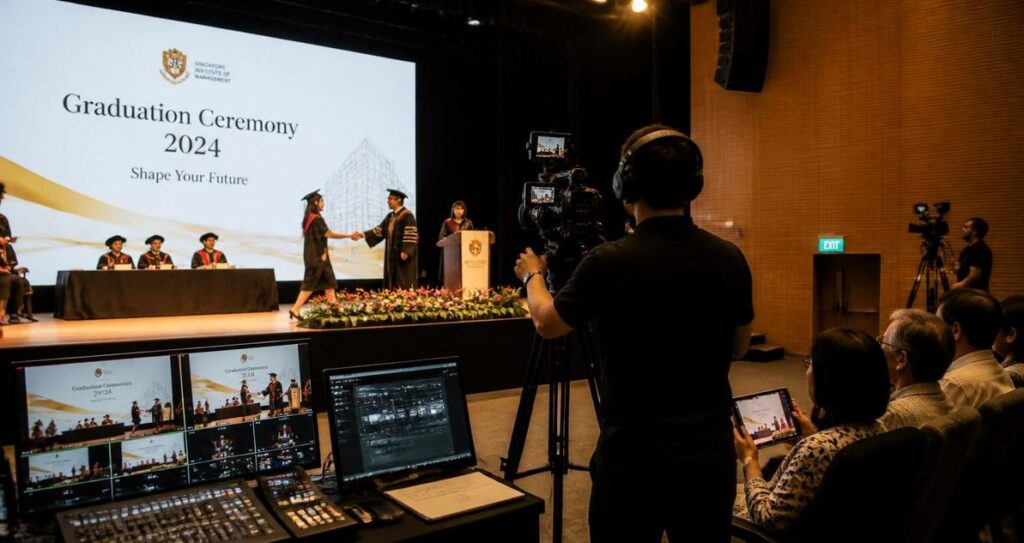
Graduation is one of those milestones that families want to share in real time, even when relatives are separated by borders, work commitments, or travel restrictions. For many Singaporean families, and for international families connected to Singapore, high-definition graduation streaming has become a practical way to bring grandparents, siblings, and friends into the celebration without compromising on clarity or reliability. A blurry video call may capture the moment in a basic sense, but a professionally produced stream preserves the expressions, speeches, stage movement, and atmosphere that make a graduation meaningful.
In Singapore, where international mobility is common and many households have family members living overseas, graduation livestreams serve a clear purpose beyond convenience. They support inclusivity, reduce travel pressure, and allow families to participate safely and comfortably from different time zones. When the stream is planned with proper camera placement, stable connectivity, and clear audio, the result is not just a video feed. It becomes a shared experience that reflects the dignity of the ceremony and the importance of the achievement.
For schools, universities, and event organisers, the priority is to deliver a stream that is technically robust and respectful of the event. That means thinking carefully about venue layout, internet resilience, audio capture, privacy, and viewer access. It also means understanding the expectations of international guests who may be tuning in from different countries using different devices and bandwidth conditions. A successful graduation stream is built on preparation, not improvisation.
Why high-definition matters for graduation events
High-definition, often abbreviated as HD, refers to video with a higher resolution than standard definition. In practical terms, it produces a sharper image, more readable text on screens, and better visibility of important details such as certificates, stage cues, and facial expressions. For a graduation ceremony, these details matter. Families want to see the graduate walk across the stage, hear the names clearly, and watch emotional reactions in real time. A low-quality stream can flatten those moments and make the event feel distant.
HD quality is especially important when the audience includes older relatives or viewers using larger screens such as laptops and televisions. In Singapore, many families are digitally connected and comfortable with streaming platforms, but quality expectations are still high. Viewers are less likely to tolerate buffering, distortion, or muffled audio when the event is emotionally significant and fixed to a specific schedule. A professional stream helps reduce frustration and allows overseas relatives to stay engaged throughout the ceremony.
What viewers actually notice during a live stream
Most viewers are not evaluating technical specifications in isolation. They notice whether the image is stable, whether the audio is intelligible, and whether the stream follows the action smoothly. During a graduation, viewers want to see the stage clearly when names are announced and hear applause without overwhelming distortion. They also want the stream to remain consistent when camera operators change angles or when the ceremony moves from speeches to award presentations. These practical expectations make HD streaming valuable, because it supports both visual clarity and emotional connection.
Common problems with low-quality streaming
Poor streams often suffer from delayed audio, dropped frames, shaky camera work, and low light performance. In a ceremony setting, this can make it difficult to identify the graduate or follow the sequence of events. If the stream compresses heavily to cope with unstable internet, faces may become pixelated and text on presentation slides may become unreadable. These issues are not just technical inconveniences. They directly affect how included international family members feel during the celebration.
Planning a graduation stream for international families
Good streaming starts long before the first guest takes their seat. The organiser should assess the venue, identify the likely audience, and plan for the realities of international viewing. This includes understanding time zones, device preferences, and whether the audience will access the stream through a private link, an event platform, or a secure video service. In Singapore, many ceremonies involve guests across Asia, Europe, and North America, so the timing and access plan should be practical and clearly communicated.
International families also benefit from simple instructions. Some viewers may be using older devices, while others may be joining from regions with different internet conditions. A clear pre-event message should explain how to join, when to test the link, whether captions or subtitles are available, and whom to contact if access fails. This reduces confusion on the day itself and allows the event team to focus on execution.
Choosing the right streaming format
Not every ceremony needs the same production setup. A small school ceremony may only require a single fixed camera, a dedicated audio feed, and a stable live platform. A larger university convocation may benefit from multiple cameras, a switching console, and a technical team that can coordinate stage coverage and speaker close-ups. The right format depends on the size of the venue, the number of graduates, and the expectations of the audience. The key is to match the production level to the importance of the event and the practical needs of the viewers.
Managing time zones and access
When families are overseas, timing becomes an essential part of the planning process. A ceremony scheduled in Singapore time may fall late at night or early in the morning for relatives abroad. Organisers should avoid assuming that international viewers will simply adapt. Instead, they can provide the local time alongside a few major international time zones so families can plan ahead. If the stream is recorded for on-demand viewing after the live event, that should be communicated clearly, especially for relatives who cannot attend in real time.
Privacy and consent considerations
Graduation events often include many attendees, and not every person in the venue may wish to appear on camera. Organisers should consider privacy notices, consent processes, and camera placement carefully. In Singapore, data protection and privacy expectations are taken seriously, so it is good practice to limit unnecessary filming of audience members and to make access private where appropriate. A controlled viewing link is often more suitable than a public broadcast, particularly for school or university ceremonies where access should be restricted to invited guests.
Technical essentials that support a reliable HD stream
The quality of a graduation stream depends on several components working together. Camera quality is important, but it is only one part of the system. Audio, lighting, network stability, and encoding settings all affect the final result. A well-produced stream should look composed and sound clear, even if the audience is watching on a phone or a small laptop screen. For international families, this reliability is especially important because they may not be able to rewatch the live moment in person.
Production teams should conduct a venue walkthrough before the event. This allows them to identify the best camera positions, test audio pickup from the stage, and check for wireless interference or weak network coverage. Where possible, a dedicated wired internet connection is preferable to shared public Wi-Fi. A backup connection should also be available, because even short outages can interrupt a ceremony and cause viewers abroad to miss key moments.
Audio is as important as video
Many viewers forgive modest video quality more readily than poor audio. If the name of the graduate is unclear, or if the speaker’s remarks are difficult to hear, the stream loses much of its value. A direct feed from the venue sound system usually provides cleaner results than relying only on ambient room microphones. If microphones are used for audience reactions or announcements, they should be balanced carefully so that applause does not overwhelm speech. Clear audio helps international families follow the ceremony even if they cannot understand every visual cue in real time.
Lighting and camera positioning
Graduation venues vary widely, from lecture halls to ballrooms to auditorium stages. Lighting should be checked in advance because stage lights can create harsh shadows or uneven exposure. Cameras should be placed so the graduate is visible during the walk across the stage, the handshake or certificate handover, and the brief pause for photos. If the event includes captions, slide presentations, or multilingual elements, camera framing should allow text to remain readable. Good positioning reduces the need for abrupt zooms or unstable movements that can distract viewers.
Backup planning and monitoring
Professional live streaming includes contingency planning. A second camera, a spare microphone, backup power options, and a monitored stream output can help prevent failure when something unexpected happens. Technical staff should actively monitor the stream rather than assuming it will run correctly on its own. If a problem emerges, such as audio drift or network instability, quick intervention can preserve continuity. For a milestone event such as graduation, this level of preparedness is not an extra luxury, it is part of responsible event delivery.
Creating a viewing experience that feels inclusive for families abroad
International families often experience graduation through a screen because travel is not always possible. The emotional value of the stream therefore matters as much as the technical quality. The best streams are designed to help viewers feel present, not merely informed. This can be supported by clear introductions, readable lower-third titles when appropriate, smooth transitions, and camera work that follows the ceremony at a measured pace. The aim is to make remote guests feel that they are attending, not watching a detached broadcast.
Singapore families also tend to value efficiency and reliability, so communication should be concise and useful. If there are multiple parts to the ceremony, such as speeches, conferral, and reception moments, viewers should know what to expect. If a stream has a chat function, moderators should maintain a respectful environment and keep the focus on the ceremony. Too much distraction can dilute the experience. The best online viewing experience is calm, organised, and easy to follow.
Accessibility supports more viewers
Accessibility is an important part of inclusive streaming. Captions can help viewers who are hard of hearing or who are watching in noisy environments. Clear on-screen text, if used, should be large enough to read on mobile devices. Simple navigation also matters, especially for older relatives who may not be comfortable with complex login steps. When an event is designed with accessibility in mind, more family members can participate meaningfully, including those watching from overseas or with different device limitations.
Using recordings after the live ceremony
A recorded copy of the ceremony can be valuable for families who miss the live session because of time differences. It also allows relatives to revisit the graduate’s moment later with better sound and fewer interruptions. If the recording will be shared, the organiser should explain how long it will remain available and who can access it. This is particularly important in Singapore settings where privacy and data handling need to be managed responsibly. A clear post-event plan adds value without creating confusion.
Working with a professional streaming team in Singapore
Professional support can make a significant difference, especially for larger venues or ceremonies with international viewers. An experienced event streaming team understands how to coordinate with venue management, stage crews, and presenters so the production runs smoothly. In Singapore, where event standards are generally high and timelines are tight, professional coordination helps prevent avoidable issues. It also gives organisers confidence that the ceremony can be delivered with polish and consistency.
When assessing a streaming provider, organisers should ask about venue experience, equipment redundancy, audio capture methods, platform security, and live support procedures. They should also confirm whether the team can handle hybrid needs, such as in-person attendees plus online guests, and whether they can support branded overlays, multilingual elements, or private access links if required. The goal is not to overcomplicate the event. It is to ensure the stream serves the ceremony without introducing technical stress.
For families, the result is tangible. Grandparents in another country can watch the graduate cross the stage. Siblings overseas can celebrate at the same time. Relatives who cannot travel because of work, health, or visa constraints can still share in the occasion. That is the real value of a high-definition graduation stream, it brings distance down to a manageable size and allows the achievement to be witnessed properly.
For organisers in Singapore, the practical approach is straightforward. Plan early, prioritise clear audio and stable connectivity, protect privacy, and test every critical part of the setup before the ceremony begins. When those elements are handled well, the stream becomes a dependable extension of the event rather than a technical afterthought. For international families, that reliability is what makes the graduation feel complete.
Anyone responsible for a graduation ceremony should treat streaming as part of the event design, not just a digital add-on. With the right preparation, families abroad can experience the moment with clarity, dignity, and emotional presence, which is exactly what a graduation deserves.
Jeremy Lee is a seasoned digital marketing director and strategist with over two decades of experience in the industry. As the founder of Sotavento Medios, I manage a diverse portfolio of over 50 businesses, helping brands grow through advanced search strategies and digital innovation. My work focuses on bridging the gap between traditional search engine optimisation and the evolving world of AI-driven answer engines.
get in touch