
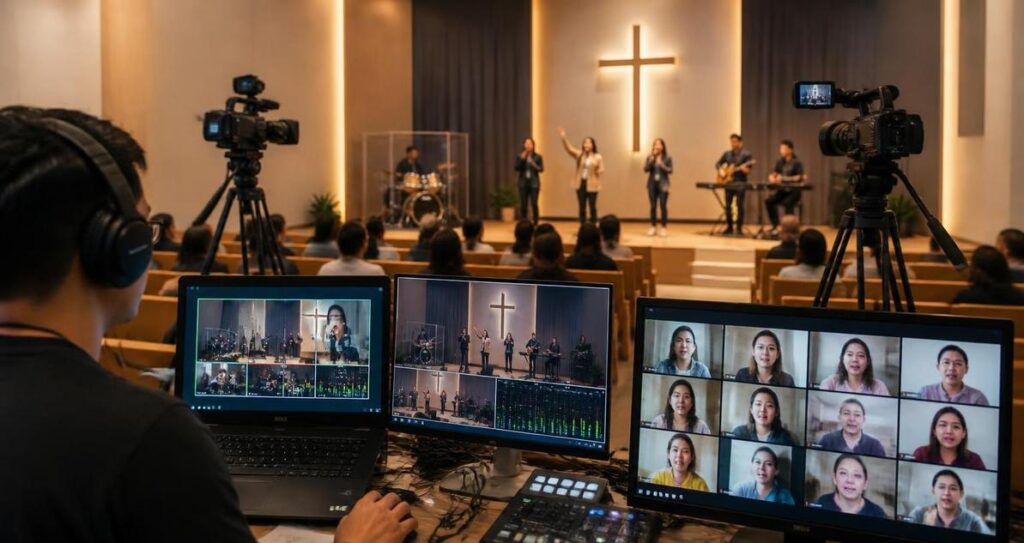
For many churches in Singapore, video is no longer just a way to record a service. It has become a practical bridge to people living across borders, time zones, and life situations. Singapore is a highly connected society, and many churches here serve congregations that include foreign workers, expatriates, students, business travellers, and Singaporeans who are overseas for work or study. Video allows worship, teaching, prayer, and pastoral care to continue even when people cannot be physically present in a sanctuary. For churches with an outward-facing mission, it also opens doors to audiences in the region and beyond, helping local ministries extend their reach in a way that is clear, accessible, and consistent.
This shift matters because video communication has become part of normal daily life in Singapore. People already use online meetings, livestreams, and mobile-first content for work, family, and community life. Churches that use video well can connect with viewers in a familiar format while preserving the sense of reverence and community that religious gatherings require. The question is not only how to go live, but how to do so in a way that is reliable, respectful, and meaningful for a global audience. That involves more than a camera and an internet connection. It requires planning, production discipline, language sensitivity, technical resilience, and an understanding of the needs of viewers who may be joining from very different locations and cultural backgrounds.
Why video has become essential for churches with global reach
Video offers churches a way to communicate across distance without losing the human element that is central to faith communities. A live sermon can reach a migrant worker in Singapore who cannot attend in person because of shift work, a family member in Johor or Jakarta who wants to stay connected, or a young adult studying abroad who still wants to take part in familiar worship. Unlike text alone, video captures voice, expression, music, and liturgical rhythm, which helps preserve the emotional and spiritual texture of the service. That makes it especially valuable for churches seeking to nurture belonging across geographic boundaries.
For Singapore churches, the global dimension is especially relevant because the city-state is deeply linked to the region and the wider world. English-language content can be accessed by viewers in many countries, while multilingual subtitles, translated captions, or bilingual hosting can expand accessibility further. Churches serving Mandarin, Tamil, Malay, and English speaking communities may use video to support congregants who prefer one language while still allowing others to participate. This is not just a communications choice, it is a pastoral one, because language access affects whether people can understand worship, teaching, and announcements clearly.
Video also supports continuity. When members travel frequently for work, or when family members live apart across countries, livestreams and recordings allow shared participation in baptisms, weddings, memorial services, and weekly worship. For churches with overseas mission ties, video can also support partner ministries with training, devotionals, and special events. In practical terms, this means the church can maintain a steady presence even when attendance patterns change. That continuity strengthens trust, which is important for any long-term community relationship.
How Singapore churches design video content for a cross-border audience
Reaching a global audience requires more than simply broadcasting a service camera feed. Churches need to think about content structure, audio clarity, visual composition, and audience experience. A viewer watching from another country has no access to the atmosphere of the room, so the video must communicate enough context to make the service understandable and welcoming. This is where careful production design becomes important.
Creating clear and accessible worship experiences
Clarity begins with sound. In worship settings, speech intelligibility is often more important than visual polish. If the sermon, prayers, or scripture readings are difficult to hear, viewers will disconnect quickly. Good church video production uses properly placed microphones, balanced audio mixing, and monitoring throughout the service. Music should support worship without overpowering spoken content. For online viewers, particularly those using mobile devices or watching in noisy environments, clean audio is often the difference between engagement and disengagement.
Visual framing also matters. A stable camera angle, well-lit stage, and readable slides help remote viewers follow the service. When churches display scripture references, song lyrics, or announcements on screen, font size and contrast should be designed for mobile viewing, since many people in Singapore and abroad watch on phones rather than large monitors. If a service includes multiple speakers or languages, production teams should plan transitions carefully so that viewers are not confused by abrupt changes in camera feed or on-screen text.
Using subtitles and multilingual support wisely
Subtitles are one of the most effective ways to extend a church’s reach. They help non-native speakers, older viewers, people watching in silent environments, and those with hearing difficulties. In the Singapore context, subtitles can support English as well as community languages, depending on the church’s audience. Where possible, churches can prepare translated captions for recorded sermons or key ministry messages. Live captions can also be considered, although they require strong workflow planning and quality control to avoid errors.
It is important to distinguish between subtitles and translation. Subtitles reproduce the spoken message in another written form, while translation adapts meaning into another language. In church settings, theological terms, scripture references, and culturally specific expressions should be reviewed carefully so that the message is faithful to the intended meaning. A rushed or automated subtitle workflow may create misunderstandings. Many churches handle this by having a reviewer familiar with the language and the ministry context check major recordings before publication.
Planning content for different time zones
Global audiences do not all live in the same time zone. A live service that works well for Singapore attendees may be inconvenient for viewers in Europe or North America. Churches can respond by combining livestreaming with on-demand archives, highlight clips, and shorter devotional videos that are easier to consume at different times. This flexible approach respects viewers’ schedules while keeping the church present in their lives.
Some churches also schedule special online events at times that suit overseas partners, such as prayer meetings, leadership training, or mission updates. For these events, advance communication is essential. Posting the time in several major time zones, using calendar invitations, and repeating the information across email, social media, and church websites reduces confusion. When planning outreach to international viewers, a church should think about the full user journey, from discovering the video to joining live, watching later, or contacting the ministry afterwards.
Production standards that help churches communicate trust and professionalism
Trust is critical in any faith-based communication. Viewers notice whether a service feels organised, respectful, and technically stable. In Singapore, where audiences are accustomed to reliable digital services, poor video quality can make a church appear unprepared even if the message itself is strong. Good production is not about entertainment value alone. It is about helping the audience focus on worship and teaching without distraction.
Audio, lighting, and camera discipline
Professional audio capture should be a priority because spoken ministry carries the core message. Churches commonly use lapel microphones, handheld microphones, podium microphones, and ambient microphones for music. Each has its own role, and an experienced operator knows how to combine them appropriately. Lighting should be even and flattering, but not theatrical in a way that distracts from the service. Cameras should be placed to support the flow of worship, with smooth cuts and minimal unnecessary movement.
Reliable internet connectivity is another key requirement. A livestream can fail if the network is unstable, which interrupts worship for local and international viewers alike. Churches in Singapore often benefit from the country’s strong digital infrastructure, but production teams still need backup plans, including redundant connections, backup recording, and contingency procedures if streaming platforms experience problems. A recorded backup of the service is useful not only for later publishing but also for archiving important sermons and events.
Respecting liturgy, theology, and privacy
Church video must reflect the values of the community it represents. This includes respecting liturgical order, theological emphasis, and the privacy of participants. For example, some services include prayer requests, testimonies, or pastoral moments that should not be shared publicly without permission. Children, vulnerable adults, and people receiving pastoral care require additional sensitivity. Churches should have a clear policy on filming consent, restricted camera angles, and what content may be published online.
When churches reach a broader audience, they also need to consider how excerpts may be viewed outside the original context. A short clip of a sermon may be shared widely on social media, where viewers may not have the background needed to understand it fully. For that reason, ministries should review what they publish and provide enough context in captions, titles, and descriptions. Clear framing protects both the church and the audience.
How Singapore’s church context shapes global video ministry
Singapore’s churches operate in a distinct environment. The country is multilingual, highly urbanised, and digitally connected. Many congregations are made up of mixed age groups and mixed nationalities. That makes video an especially practical tool because it can serve different audiences without requiring all of them to be physically present at the same time. It also allows churches to support members who travel frequently for work, which is common in sectors such as finance, technology, shipping, and professional services.
At the same time, Singapore audiences value quality and reliability. They are accustomed to smooth digital experiences in many parts of daily life, so churches benefit from planning their online ministry with the same level of care. That includes choosing suitable platforms, checking stream quality before going live, and designing a user experience that works on mobile devices. Churches that stream only occasionally may still need professional support if they want to maintain consistency for international viewers.
Singapore’s location also gives churches a natural role as a regional connector. A church here may have members or partners in Malaysia, Indonesia, the Philippines, India, Australia, the United Kingdom, or the United States. Video allows a central ministry team in Singapore to communicate with these audiences without needing a separate physical venue in each place. For special events, hybrid production can bring in remote speakers, testimonies, or worship leaders while preserving the integrity of the service.
Practical steps churches can take to strengthen their global video outreach
Churches that want to improve their video ministry can start with a few practical steps. First, they should define the audience clearly. A service aimed mainly at local members may need different production choices from a devotional series intended for international viewers. Second, they should decide which content needs to be live and which content can be recorded and edited. Not every message needs to be streamed in real time. Some teachings are better presented as well-edited videos that allow for captions, chapter markers, and cleaner sound.
Third, churches should establish a workflow for planning, filming, reviewing, publishing, and archiving. This avoids last-minute mistakes and makes the ministry sustainable. A simple checklist can cover camera settings, audio checks, titles, thumbnails, captions, platform scheduling, and backup recording. Fourth, they should assign responsibility clearly. A successful live stream depends on coordination among the speaker, worship team, technician, moderator, and communications person. When everyone knows their role, the service runs more smoothly.
Finally, churches should treat viewer feedback as valuable. Questions about audio balance, subtitle accuracy, or stream timing often reveal where improvements are needed. For global audiences, feedback from different time zones and language groups can help the ministry become more inclusive. Over time, this leads to a stronger online presence that feels both local and international.
For churches in Singapore, video is not a replacement for in-person fellowship. It is a tool that extends fellowship across borders and makes ministry more accessible to people who cannot always be in the same room. When production quality, pastoral care, and content planning work together, video can help a church speak clearly to audiences near and far. The most effective approach is thoughtful rather than flashy, consistent rather than occasional, and respectful of both the message and the people receiving it. Churches that invest in these fundamentals can build a digital presence that serves their members well and supports meaningful connection with global communities.
General information only: This article is for awareness and educational purposes. Churches planning livestreams, online ministry content, or multilingual broadcasts should seek appropriate technical, legal, and pastoral guidance for their specific context.
Jeremy Lee is a seasoned digital marketing director and strategist with over two decades of experience in the industry. As the founder of Sotavento Medios, I manage a diverse portfolio of over 50 businesses, helping brands grow through advanced search strategies and digital innovation. My work focuses on bridging the gap between traditional search engine optimisation and the evolving world of AI-driven answer engines.
get in touch