
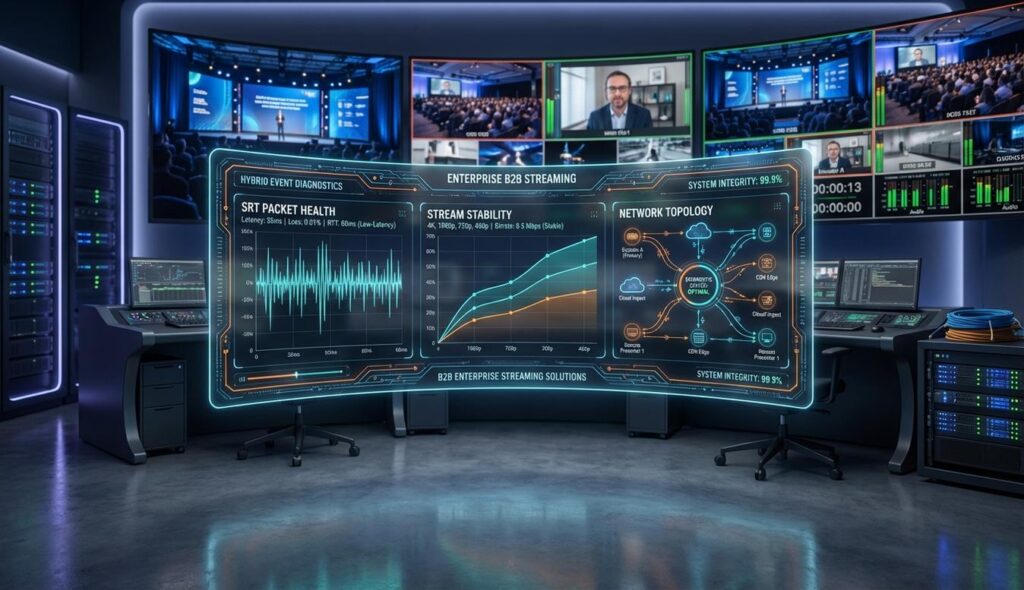
The paradigm for corporate events has fundamentally and permanently shifted. What was once a binary choice between a physical or a virtual event has converged into a complex, hybrid model where success is no longer measured by attendance figures alone. For today’s enterprise, the new vital signs of a successful hybrid event are found within the intricate details of its technical execution. The metrics have evolved from simple stream uptime to a sophisticated matrix of Quality of Service (QoS) analytics, infrastructure resilience, and seamless audience integration. Diagnosing the health of a modern hybrid event requires a broadcast engineer’s perspective, focusing on the underlying architecture that supports a flawless experience for both the audience in the room and the thousands joining remotely. This is not about basic webcasting; it is about deploying a robust, broadcast-grade production ecosystem that treats remote attendees as first-class participants, ensuring their experience is as impactful and reliable as being there in person.
Beyond Buffering: Advanced Stream Health and Quality of Service Metrics
The most visible component of any hybrid event is the video stream, but its stability is merely the surface. True success is dictated by the granular control and optimization of the entire delivery chain, from the camera lens to the viewer’s screen. Relying on outdated protocols or simplistic quality settings is insufficient for high-stakes corporate communication. A modern diagnostic approach focuses on a deeper layer of transmission statistics and encoding efficiency to guarantee a superior and consistent viewing experience, regardless of a remote participant’s location or network conditions.
Protocol Selection and Implementation: SRT vs. RTMP in Enterprise Environments
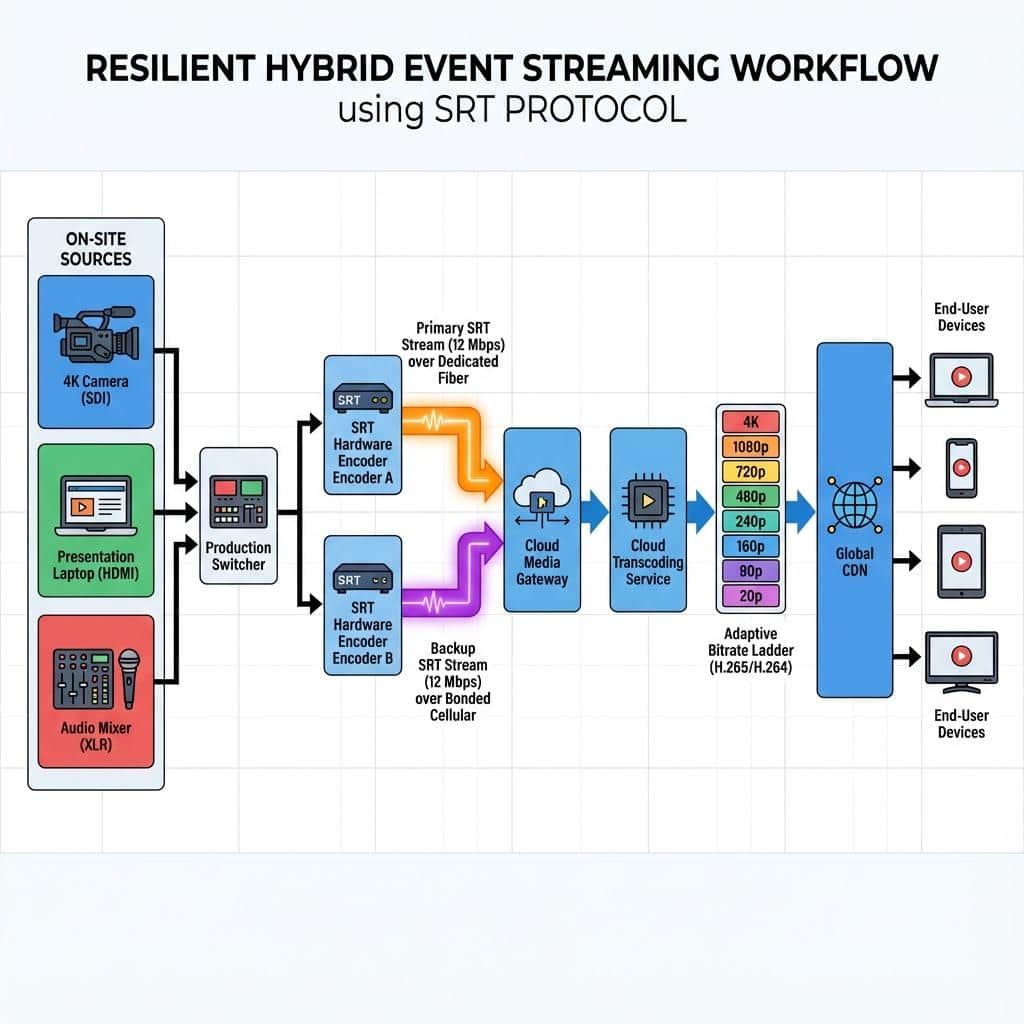
For years, the Real-Time Messaging Protocol (RTMP) served as the de facto standard for streaming. However, its reliance on TCP (Transmission Control Protocol) makes it highly susceptible to packet loss, a common issue on congested or unreliable networks, leading to buffering and stream degradation. For enterprise-level events where reliability is non-negotiable, the industry has migrated towards Secure Reliable Transport (SRT). SRT is a UDP (User Datagram Protocol) based technology that incorporates sophisticated error-correction mechanisms, allowing it to recover from packet loss and maintain stream integrity over unpredictable networks like the public internet. For a global town hall or product launch, deploying an SRT-powered workflow from an on-premise encoder, such as a Haivision Makito X4, to a cloud media gateway provides the low latency (often sub-second) and resilience required for broadcast-quality contribution. While RTMP or RTMPS (RTMP Secure) may still be used for the final delivery leg to some social media platforms, the critical first-mile contribution link must be fortified with a more robust protocol like SRT.
Granular Bitrate and Encoding Analysis
A successful stream is not just about resolution; it is about the efficiency of its data compression. Simply setting an encoder to “1080p” is a primitive approach. Professional productions require a meticulous bitrate management strategy. We must analyze the content type to select between a Constant Bitrate (CBR), which provides predictable bandwidth usage essential for network planning, and a Variable Bitrate (VBR), which can allocate more data to complex, high-motion scenes to improve quality. Furthermore, the choice of codec has significant implications. While H.264 (Advanced Video Coding, or AVC) is universally compatible, H.265 (High Efficiency Video Coding, or HEVC) offers a nearly 50% improvement in compression efficiency. This means a 4K UHD stream can be delivered with the same bandwidth as a high-quality 1080p H.264 stream. Implementing an Adaptive Bitrate (ABR) ladder with multiple H.264 and H.265 renditions is a critical vital sign, ensuring that each remote viewer automatically receives the highest quality stream their device and network can handle, from a 4K feed on a fiber connection to a 480p stream on a mobile device.
Latency Measurement and Mitigation Strategies
Glass-to-glass latency, the total delay from the event camera to the remote viewer’s display, is a critical vital sign for interactive hybrid events. High latency makes real-time Q&A sessions and audience polling feel disjointed and unprofessional. A target latency of under 5 seconds is acceptable for many one-way broadcasts, but for interactive sessions, sub-second latency is the goal. Achieving this requires a holistic approach. It begins with using low-latency protocols like SRT or WebRTC for contribution. It involves optimizing the video processing and transcoding pipeline, as every step adds milliseconds of delay. Finally, it depends on a well-architected Content Delivery Network (CDN) with strategically placed edge servers that minimize the physical distance data must travel to the end-user. Monitoring latency in real-time allows production teams to identify and address bottlenecks within the delivery chain immediately.
Architecting the Hybrid Core: Signal Flow and Production Infrastructure
The heart of any successful hybrid event is the production control room, whether it is a permanent installation or a temporary setup in a venue. The architecture of this core system determines the event’s flexibility, scalability, and, most importantly, its resilience to failure. A modern hybrid event’s vital signs are measured in the robustness of its signal flow, the intelligence of its audio routing, and the layers of redundancy built into every critical component. This infrastructure must be designed to manage two distinct experiences simultaneously without compromising either.
The Convergence of Baseband and IP Video
Traditional event production was built on a foundation of baseband video, primarily using Serial Digital Interface (SDI) cabling. While reliable, SDI is rigid and expensive to scale. Today, a key indicator of a sophisticated production is the integration of IP-based video workflows. Technologies like NDI (Network Device Interface) allow high-quality, low-latency video to be transported over standard Gigabit Ethernet networks. This dramatically simplifies cabling and allows for unprecedented flexibility. A production can ingest feeds from NDI-enabled cameras, presentation laptops running NDI Screen Capture, and even remote presenters on UC platforms, all over a single network cable. For the most demanding applications, standards like SMPTE 2110 provide a non-proprietary, routable solution for uncompressed video over IP, mirroring the capabilities of the largest broadcast facilities. A truly robust system often uses a hybrid approach: SDI for mission-critical camera connections within the control room and NDI for flexible source integration and distribution.
Redundancy by Design: Path and Hardware Failover
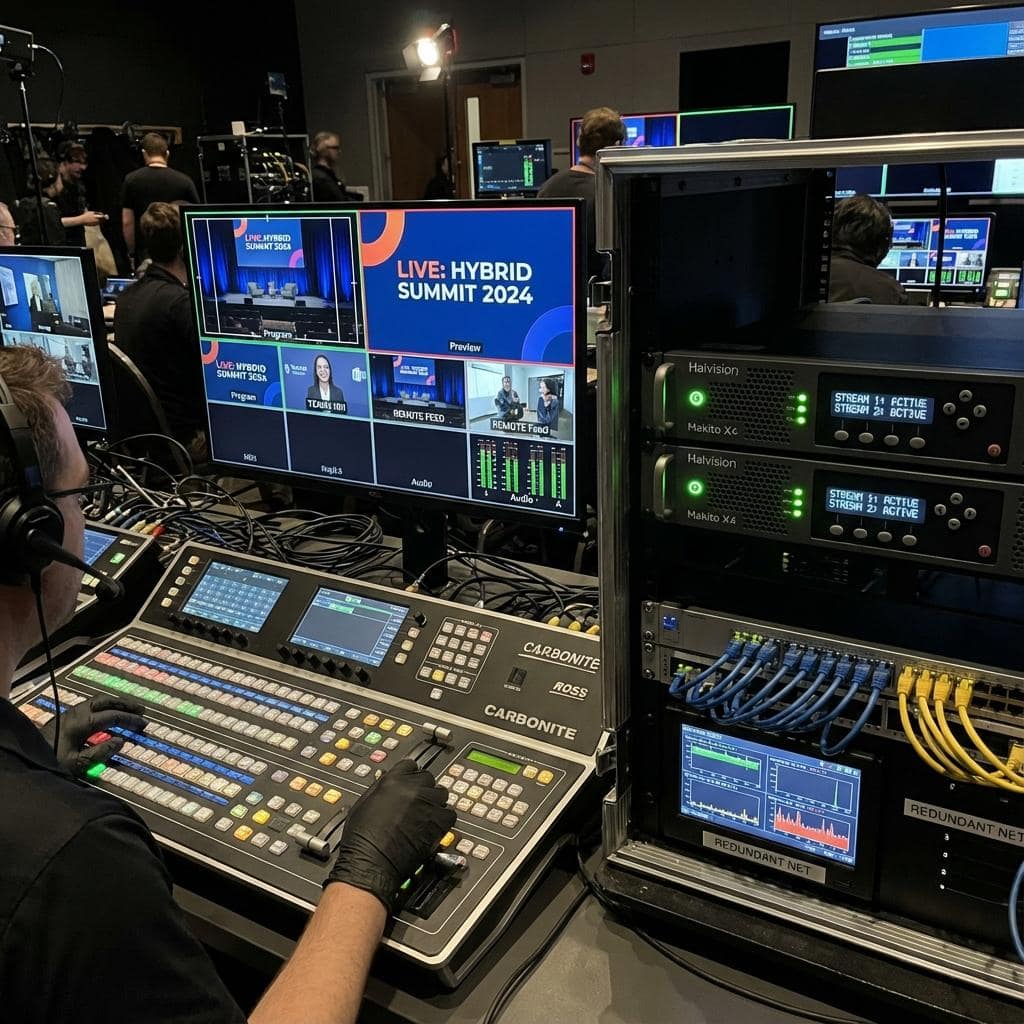
A single point of failure can jeopardize an entire multi-million-dollar event. Therefore, redundancy is not a luxury; it is a fundamental vital sign of professional production. This starts with hardware. Critical components like the video switcher (e.g., a Ross Carbonite or Blackmagic Design ATEM Constellation) and power distribution units must have redundant power supplies. All program feeds should be recorded on-site using systems with RAID-configured storage for data protection. More importantly, transmission paths must be fully redundant. A common best practice is to configure two separate hardware encoders. The primary encoder transmits the main program feed via an SRT stream over a dedicated fiber internet connection. Simultaneously, the secondary encoder sends an identical stream over a completely different network path, such as bonded cellular (combining multiple cellular carriers for increased bandwidth and reliability). This A/B path redundancy ensures that a failure of one encoder or an entire network link will not interrupt the stream to the global audience.
Audio Architecture for a Bifurcated Audience
Audio is arguably more critical than video, and in a hybrid event, its complexity doubles. A healthy audio system delivers pristine, intelligible sound to both the in-person and remote audiences, which have vastly different requirements. The in-room sound requires a mix for the PA system focused on live reinforcement. The broadcast feed requires a completely separate mix, carefully balanced for viewers listening on headphones or desktop speakers. This broadcast mix must incorporate audio from all sources: on-stage microphones, video playback, remote presenters, and graphics packages. A critical technique is the use of a “mix-minus” feed for remote participants. This sends them the full program audio mix *minus* their own microphone audio, preventing the distracting echo and feedback that plagues less professional setups. Implementing an audio-over-IP protocol like Dante allows for incredible routing flexibility and can significantly simplify the complex patching required to create these distinct audio experiences.
The Unseen Backbone: Network Infrastructure and Enterprise Integration
The most sophisticated production hardware is useless without a solid network foundation. For hybrid events, the network is the circulatory system that carries every video, audio, and control signal. Its health and design are paramount vital signs that directly impact every aspect of the production, from source acquisition to global delivery. In an enterprise context, this network must also securely and reliably interface with existing corporate IT platforms, creating a cohesive technological ecosystem.
Network Segmentation and Bandwidth Allocation
Running a professional live stream on a shared or public network is an unacceptable risk. A core principle of reliable event production is network segmentation. All production-critical traffic, including NDI video feeds, Dante audio, SRT streams, and equipment control data, must operate on a physically separate, managed network or a dedicated VLAN (Virtual Local Area Network) with strict QoS policies. This isolation prevents unpredictable traffic from guest Wi-Fi or general venue operations from interfering with the stream. Bandwidth allocation must be calculated and guaranteed. A standard rule is to provision dedicated internet bandwidth that is at least double, and preferably triple, the bitrate of the primary outbound stream. For a 10 Mbps stream, this means a dedicated 20-30 Mbps of upstream capacity is required to accommodate overhead, redundancy, and any remote contribution feeds.
Integrating with Enterprise UC Platforms
Bringing remote executives or panelists into a live production from platforms like Microsoft Teams, Zoom, or Webex is a staple of the modern hybrid event. The technical method of integration is a key vital sign of production quality. Amateur setups often resort to screen-scraping a laptop, which results in poor quality and visible UI elements. The professional approach involves extracting clean, isolated video and audio feeds (ISO feeds) for each remote participant. Many UC platforms now offer NDI output modes, which allow a production switcher to see each participant as a distinct NDI source on the network. Alternatively, dedicated hardware like a Zoom Rooms appliance or a Teams-certified device can output clean HDMI or SDI feeds for direct integration. This allows the technical director to switch to remote presenters just like any other camera source, ensuring they are seamlessly integrated into the program with broadcast-quality results.
On-Premise vs. Cloud-Based Transcoding and Distribution
The final stage of the signal chain involves transcoding the high-quality production feed into the various ABR renditions for public distribution. This can be accomplished with on-premise hardware or cloud-based services. On-premise encoders provide maximum control and security, keeping the entire workflow within the corporate firewall until the final handoff to the CDN. This is often preferred for events with sensitive internal content. Cloud-based transcoding services, such as AWS Elemental MediaLive or Microsoft Azure Media Services, offer unparalleled scalability and global reach. They can ingest a single high-bitrate SRT feed from the venue and transcode it into dozens of formats and bitrates for delivery to a global audience via an integrated CDN. A mature hybrid strategy often involves both: an on-premise encoder for the primary, resilient contribution feed and a cloud service for transcoding and distribution, leveraging the best of both worlds.
Ultimately, the vital signs of a successful hybrid event are not a checklist but a continuous, dynamic process of monitoring, management, and optimization. It requires a deep understanding of broadcast engineering principles applied to the unique convergence of live event production and enterprise IT infrastructure. By focusing on these advanced metrics, organizations can move beyond simply being “live” and begin to deliver truly engaging and technically flawless hybrid experiences that serve both their in-person and global digital audiences without compromise. Partnering with a technical production team that understands this complex ecosystem is the most critical decision in ensuring the health of your next flagship event.

Jeremy Lee is a seasoned digital marketing director and strategist with over two decades of experience in the industry. As the founder of Sotavento Medios, I manage a diverse portfolio of over 50 businesses, helping brands grow through advanced search strategies and digital innovation. My work focuses on bridging the gap between traditional search engine optimisation and the evolving world of AI-driven answer engines.
get in touch