
Foundational Acoustic Principles and Physical Isolation
Before a single microphone is powered on, the integrity of a production’s audio environment is determined by the physical space itself. Mitigating sound leakage begins with a thorough understanding and manipulation of the venue’s acoustic properties. For high-stakes corporate events, where proprietary information is discussed, treating the physical environment is not an optional refinement; it is a fundamental component of information security and broadcast quality. This process involves more than just closing doors; it requires a strategic approach to venue analysis, acoustic treatment, and the management of on-site communication systems.
Strategic Venue Analysis and Zone Planning
The first step in any professional on-site production is a comprehensive site survey focused on acoustics. This analysis must identify all potential sources of sound ingress and egress. Common culprits include HVAC systems, which produce a constant low-frequency rumble, noise from adjacent rooms or hallways, and external environmental sounds like traffic or construction. We measure the ambient noise floor using a decibel meter and analyze the room’s reverberation time, often referred to as RT60, which is the time it takes for a sound to decay by 60 dB. In a corporate setting, a high RT60 value can compromise speech intelligibility and allow sound to carry unpredictably. Based on this analysis, we implement a zoning strategy. The presentation or performance area becomes a “Red Zone”, the most acoustically controlled space. The production control area is a “Yellow Zone”, where crew communication must be contained. The audience and ancillary areas are the “Green Zone”. This allows for a tiered application of acoustic treatments where they are most critical.
Physical Acoustic Treatment Solutions
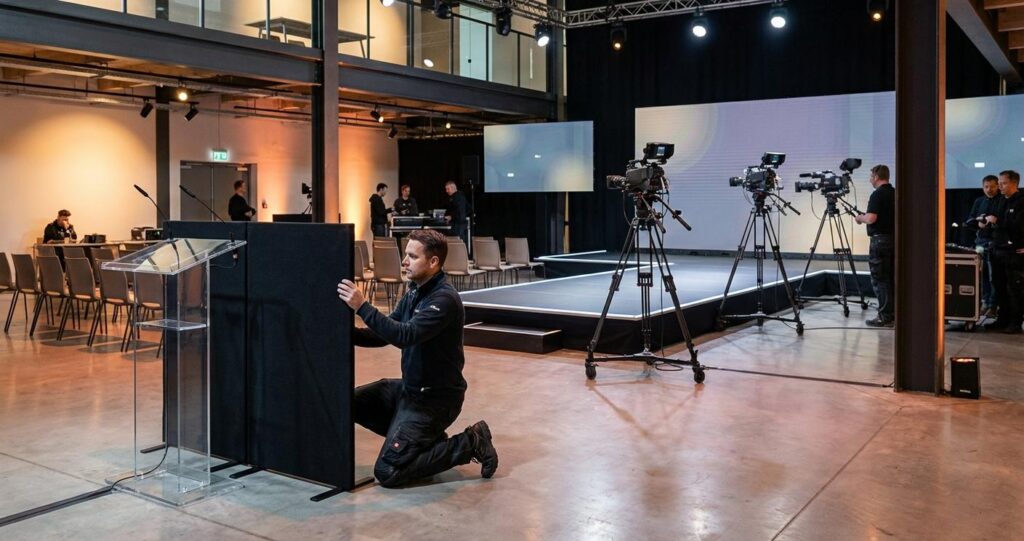
Controlling the acoustics of a temporary event space requires professional-grade, deployable solutions. Standard office environments are not designed for broadcast-quality audio. To create acoustic isolation, we utilize heavy-duty, broadcast-grade sound blankets. These are not simple moving blankets; they are specifically designed with high-mass materials to absorb and block sound transmission. We deploy these on portable frames to create temporary walls or to dampen reflective surfaces like glass windows and bare walls. For more targeted isolation, we use gobos, which are freestanding acoustic panels placed strategically to block sound paths. For instance, a gobo can be positioned to shield a lectern microphone from the noise of a nearby camera operator or production table. In scenarios requiring extreme isolation, such as for a voice-over narrator or a sensitive remote interview, we can construct a small, portable vocal booth on-site using these modular acoustic components. When evaluating temporary walling or partitions, specifying a high Sound Transmission Class (STC) rating is critical to ensuring effective sound blocking.
Managing On-Site RF and IEM Systems
Wireless audio systems, while essential for freedom of movement, can be a significant source of sound leakage if improperly managed. In-Ear Monitor (IEM) systems provide presenters and crew with program audio or cues. However, consumer-grade earbuds or poorly fitted IEMs can bleed a substantial amount of sound, which can then be picked up by a nearby live microphone. This is especially problematic with high-energy content or loud cues. The professional standard is to use high-isolation, custom-molded or universal-fit IEMs, such as those from Shure or Sennheiser, which create a physical seal in the ear canal. Furthermore, the gain structure of the entire Radio Frequency (RF) signal chain, from the transmitter pack to the receiver, must be meticulously managed. Setting the volume on a presenter’s belt pack too high not only risks sound leakage but can also cause hearing fatigue and introduce distortion into the signal.

Advanced Audio Signal Chain Management and Digital Isolation
Once the physical environment is controlled, the focus shifts to the digital audio domain. Modern event production relies on complex audio signal flows, and without rigorous management, digital cross-talk and leakage can be as detrimental as physical sound bleed. The architecture of the audio signal chain, from the microphone capsule to the final encoder, provides numerous opportunities to build in isolation and control. This involves leveraging sophisticated digital routing, advanced processing, and networked audio protocols to ensure that audio is precisely delivered only where it is intended, creating a secure and clean production environment.
Architecting a Discrete Audio Signal Flow
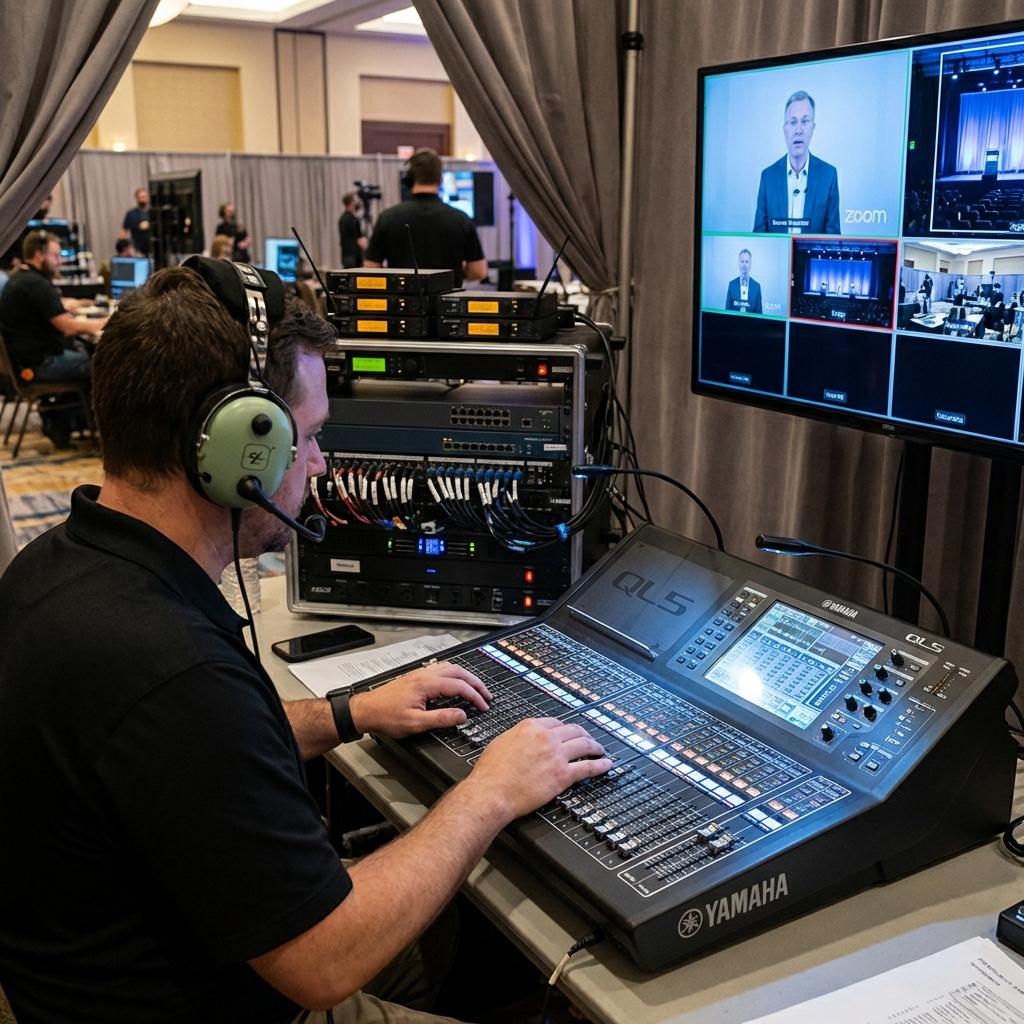
The core of digital audio control is the mixing console. Professional digital consoles, such as the Yamaha QL/CL series or Allen & Heath Avantis, are powerful routing matrixes. They allow for the creation of numerous, independent audio mixes from the same set of inputs. A typical corporate event requires several discrete mixes. The primary one is the Program Mix, which is the final audio sent to the live stream and recording. Another critical mix is the Mix-Minus, which is sent to remote presenters participating via platforms like Zoom or Teams. A mix-minus includes all program audio *except* the remote presenter’s own voice, which prevents the echo and feedback that plagues less professional setups. Additionally, we create separate mixes for the in-room Public Address (PA) system, stage monitors, and often an archive mix that may have different processing. Each of these outputs is isolated within the console’s architecture, preventing the production crew’s intercom chatter from ever reaching the live stream, or the live stream audio from bleeding into a remote presenter’s feedback loop.
Leveraging Dante and Audio-over-IP for Controlled Routing
Audio-over-IP (AoIP) protocols, with Audinate’s Dante being the industry standard, have revolutionized audio transport in live production. Instead of running hundreds of individual analog XLR cables, which are susceptible to physical damage and electromagnetic interference, AoIP allows us to transport hundreds of high-quality, low-latency audio channels over a standard Ethernet network. This offers immense benefits for signal isolation. We can segment the network using Virtual Local Area Networks (VLANs) to create logically separate pathways for different types of audio. For instance, all sensitive microphone inputs can be on one VLAN, production intercom on another, and the main program feed on a third. This makes it impossible for signals to cross-contaminate and provides a layer of security, as access to specific audio channels can be controlled at the network switch level. Dante Controller software provides a clear matrix view of all audio routes, allowing for real-time monitoring and verification that signals are not being sent to unauthorized destinations.
Noise Gating and Advanced DSP Processing
Digital Signal Processing (DSP) is a powerful tool for actively mitigating sound leakage at the channel level. A noise gate, or an expander, is an essential processor for this task. It is an automated volume control that closes a microphone channel when the incoming sound level drops below a certain threshold. For a panel discussion with multiple speakers, we apply a noise gate to each panelist’s microphone. The gate is set to open instantly when they speak but close automatically when they are silent, preventing their microphone from picking up and amplifying ambient room noise, paper shuffling, or private side conversations. For more persistent background noise, such as a loud air conditioning unit that cannot be disabled, we employ real-time noise reduction processors. Tools like Cedar DNS or the Waves NS1 plugin can be integrated directly into the live mixing workflow to identify and suppress non-transient noise without audibly affecting the quality of the speaker’s voice.
Securing Communications and Preventing Talkback Leakage
One of the most common and damaging sources of audio leakage in a live production is the crew’s own communication system. The talkback or intercom system is the nervous system of the production, allowing the director, producers, and technical crew to communicate seamlessly. However, if this system is not properly isolated from the main program audio, cues, private conversations, and troubleshooting chatter can inadvertently leak into the live stream, causing significant embarrassment and compromising the professional quality of the event. Securing these communication lines, especially in a hybrid environment with remote participants, is a critical discipline.
Isolating Production Intercom Systems
Production intercom systems come in two primary architectures: party-line and matrix. A party-line system connects all users on a shared channel, meaning everyone hears everything. While simple, this is a high-risk setup for sound leakage. A professional matrix intercom system, such as those from Riedel or RTS, is a point-to-point communication network. It allows the director to speak privately to a single camera operator, the audio engineer to have a one-on-one conversation with the stage manager, and for separate group channels to exist simultaneously. This granular control is fundamental to preventing leakage. The second critical component is the hardware. All production crew must use high-isolation, circumaural headsets, often from brands like David Clark, which are designed for high-noise environments like airports. These headsets physically block outside sound and prevent the intercom audio from being audible to anyone nearby or, critically, to a live microphone.
Managing Hybrid Contributor Feeds from Zoom, Teams, or Webex
Hybrid events introduce a significant new layer of complexity to communication and audio management. Integrating remote contributors from enterprise platforms like Zoom, Microsoft Teams, or Webex requires a bridge between the professional broadcast world and the consumer-grade audio of these platforms. As mentioned, a dedicated Mix-Minus feed for each remote participant is non-negotiable. It is equally important to manage how the production team communicates with them. We never rely on the platform’s chat function for real-time cues. Instead, we use dedicated hardware interfaces, such as those from Studio Technologies, which can bridge our professional Dante or analog intercom systems directly into the audio channels of the remote caller’s platform. This allows our director to speak to the remote presenter via a dedicated “interruptible foldback” (IFB) channel, which they hear in their earpiece, just as if they were on set. This communication is completely isolated from the main program audio, ensuring a clean and professional interaction.
Integrating Secure Audio into the Streaming and Recording Workflow
The final stage in mitigating sound leakage is ensuring the fully sanitized and controlled program audio is securely embedded, transmitted, and recorded. The entire chain of physical and digital isolation is rendered moot if the audio is compromised at the point of delivery. This involves careful integration with the video system, selecting secure transmission protocols, and implementing a robust recording strategy that provides redundancy and post-production flexibility.
Embedding and Transmitting Secure Audio Streams
After the final program audio is mixed, it must be combined with the final program video from the video switcher, such as a Blackmagic Design ATEM or Ross Video Carbonite. This process is called embedding. The audio is converted into a digital format and embedded into the Serial Digital Interface (SDI) video signal. A standard SDI signal can carry up to 16 channels of audio. It is critical to ensure the correct mix is embedded on the correct channels, typically channels 1 and 2 for the stereo program mix. This embedded SDI signal is then sent to the streaming encoder. This self-contained signal path is secure and insusceptible to the analog noise or interference that can plague separate audio and video runs.
Protocol-Level Security with SRT and RTMPS
The choice of streaming protocol directly impacts the security of the transmitted audio. While the Real-Time Messaging Protocol (RTMP) has been a long-standing workhorse, we exclusively use its secure variant, RTMPS, which wraps the stream in Transport Layer Security (TLS/SSL) encryption. This is the same level of encryption used for secure websites. For productions demanding higher reliability and lower latency, we utilize the Secure Reliable Transport (SRT) protocol. SRT not only provides robust packet recovery to handle unstable networks but also includes built-in AES-128 or AES-256 bit encryption. This ensures that the entire audio and video payload is encrypted from the on-site encoder to the cloud distribution point, making it impossible for unauthorized parties to intercept and listen to the sensitive content of the stream.
Creating Redundant and Isolated Recording Feeds
No live production is complete without a comprehensive recording plan. Relying on a single recording of the final program mix is insufficient. Best practice dictates creating multiple, isolated recordings. Professional video recorders like the AJA Ki Pro or Blackmagic Hyperdeck arrays can record the main program feed while simultaneously capturing “ISO” recordings of each individual camera. Critically, we also record multi-channel audio. This means that in addition to the final stereo program mix, we record each individual microphone on a separate, discrete audio track. This practice, known as ISO recording, is the ultimate safety net. If any unexpected sound leakage, noise, or audio issue occurs during the live event, the post-production team has access to every individual, clean audio source, allowing them to rebuild and perfect the audio for the on-demand version of the event.

Jeremy Lee is a seasoned digital marketing director and strategist with over two decades of experience in the industry. As the founder of Sotavento Medios, I manage a diverse portfolio of over 50 businesses, helping brands grow through advanced search strategies and digital innovation. My work focuses on bridging the gap between traditional search engine optimisation and the evolving world of AI-driven answer engines.
get in touch