
The Imperative of Zero-Trust Architecture in High-Stakes Financial Broadcasting
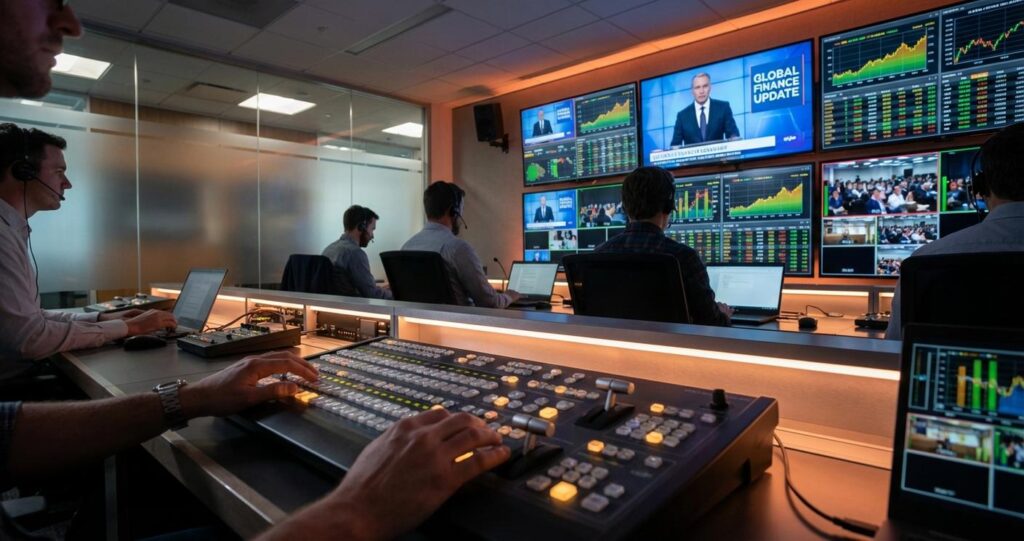
The live broadcast of sensitive financial disclosures, such as quarterly earnings reports, M&A announcements, or investor relations briefings, represents one of the highest-stakes applications of B2B event streaming. For corporate event planners and IT directors, the primary objective is flawless delivery. For the production team, the technical mandate is absolute security and signal integrity from the point of capture to the final authenticated viewer. A single leak, unauthorized access, or signal interruption can have immediate and severe market repercussions. This reality necessitates a shift from traditional production workflows to a zero-trust security model, where every component in the signal chain is hardened, authenticated, and encrypted. This article provides a technical deep dive into the infrastructure, protocols, and production methodologies required to secure these critical corporate communications in a hybrid event context.
Building a Fortress: The Secure Production Environment
The foundation of a secure broadcast is the physical and logical isolation of the production environment. Before a single video frame is captured, the network architecture must be designed to prevent unauthorized intrusion and isolate critical production traffic from general corporate or public network access. This involves a multi-layered approach to network segmentation and hardware management.
Network Segmentation and Logical Isolation
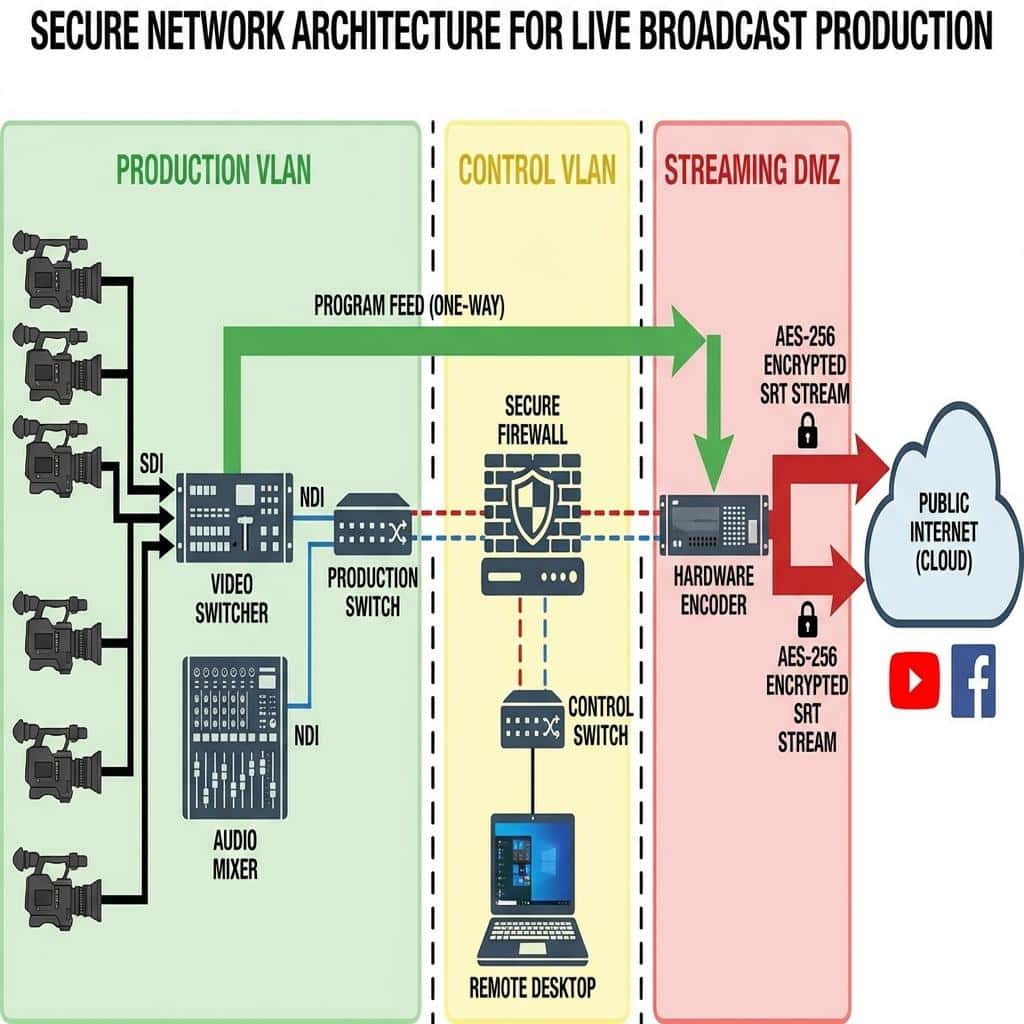
A flat network topology is unacceptable for sensitive broadcasts. The production infrastructure must be segmented into distinct Virtual Local Area Networks (VLANs) to control traffic flow and create security boundaries. A typical secure setup includes at least three core VLANs: a Production VLAN for all internal video and audio signals (SDI, NDI), a Control VLAN for device management and remote control panels, and a Streaming VLAN located in a Demilitarized Zone (DMZ) that provides a strictly controlled path for encoded video to exit the facility. All traffic between these VLANs must be routed through a firewall with explicit “allow” rules for only the necessary protocols and ports. For instance, the firewall would permit an SRT (Secure Reliable Transport) stream on a specific UDP port from the encoder on the Streaming VLAN to the public internet, but it would block all inbound connection attempts.
Physical and Hardware Security
Physical access to the production control room, server racks, and network closets must be strictly controlled. All production hardware, including video switchers, routers, and encoders, should have their administrative interfaces secured with strong, unique passwords, and default credentials must be changed immediately upon deployment. Unused network ports on switches should be disabled. Furthermore, any USB ports or external media access on critical production machines should be programmatically disabled to prevent the introduction of malware or unauthorized data exfiltration. Firmware for all network and production equipment must be kept up to date to patch potential security vulnerabilities. This level of hardware hardening ensures the production core itself cannot be compromised from within.
Hardening the Signal Chain: From Glass to Codec
With a secure network foundation in place, the focus shifts to protecting the integrity of the audio and video signals as they move through the production workflow. Every connection point, from the camera lens to the input of the hardware encoder, presents a potential vulnerability that must be addressed with professional broadcast standards and secure protocols.
Securing Baseband and IP Video Signals
In traditional broadcast workflows, Serial Digital Interface (SDI) cabling provides a physically secure, point-to-point connection that is inherently difficult to intercept without physical access. We typically recommend a 12G-SDI infrastructure for 4K/UHD productions to maintain signal integrity. However, in modern IP-based workflows utilizing Network Device Interface (NDI), signal security requires more attention. While NDI offers incredible production flexibility, the standard NDI protocol transmits video unencrypted over the network. For sensitive applications, it is critical to use NDI only on the completely isolated Production VLAN. Where enhanced security is required, integrating solutions that tunnel NDI traffic through encrypted pathways or utilizing hardware that supports emerging encrypted NDI standards is a necessary step. Audio signals, particularly when using Audio over IP (AoIP) protocols like Dante, must also be secured. Dante systems should be configured to use AES67 compliance mode, which allows for the use of session-level encryption to protect sensitive audio feeds from executive microphones or private talkback channels.
The Production Core: Switchers, Routers, and Recorders
The central production switcher, such as a Ross Carbonite or Blackmagic ATEM Constellation, is the heart of the live program. Its control surface and software interfaces must reside on the secure Control VLAN. All video sources are routed into the switcher, and the primary Program (PGM) feed is sent to multiple destinations: the master encoder, multiview monitors, and ISO (isolated) recorders. For maximum security and post-event auditing, every camera source should be recorded as a separate ISO feed. This practice, using recorders like AJA Ki Pro or Blackmagic HyperDeck arrays, provides a complete, unaltered record of all raw footage. The final PGM feed sent to the encoder must be considered the last point of trust within the internal production environment before it is prepared for external transmission.
End-to-End Encryption for Contribution and Distribution
Once the final program feed leaves the video switcher, its journey to the audience is fraught with peril across public networks. This phase requires robust encryption and a resilient transport protocol to ensure both security and reliability. The choice of streaming protocol is arguably the most critical security decision in the entire workflow.
SRT vs. RTMPS: The Professional Standard
While RTMP (Real-Time Messaging Protocol) was a workhorse for years, its unencrypted nature makes it completely unsuitable for sensitive content. Its secure counterpart, RTMPS, wraps the stream in a TLS/SSL tunnel, providing essential encryption. However, for mission-critical financial broadcasts, SRT (Secure Reliable Transport) is the superior protocol. Developed by Haivision, SRT is an open-source protocol that provides end-to-end AES-128 or AES-256 bit encryption, which is a standard used for top-secret government communications. Crucially, SRT also includes advanced error correction and packet recovery mechanisms, making it far more resilient to network packet loss and jitter than TCP-based protocols like RTMPS. This ensures a stable, high-quality stream even over imperfect internet connections. An SRT stream requires a pre-shared passphrase between the encoder (caller) and the destination server (listener), creating a secure handshake that prevents unauthorized systems from intercepting or injecting data into the stream.
Redundancy and Failover Architecture
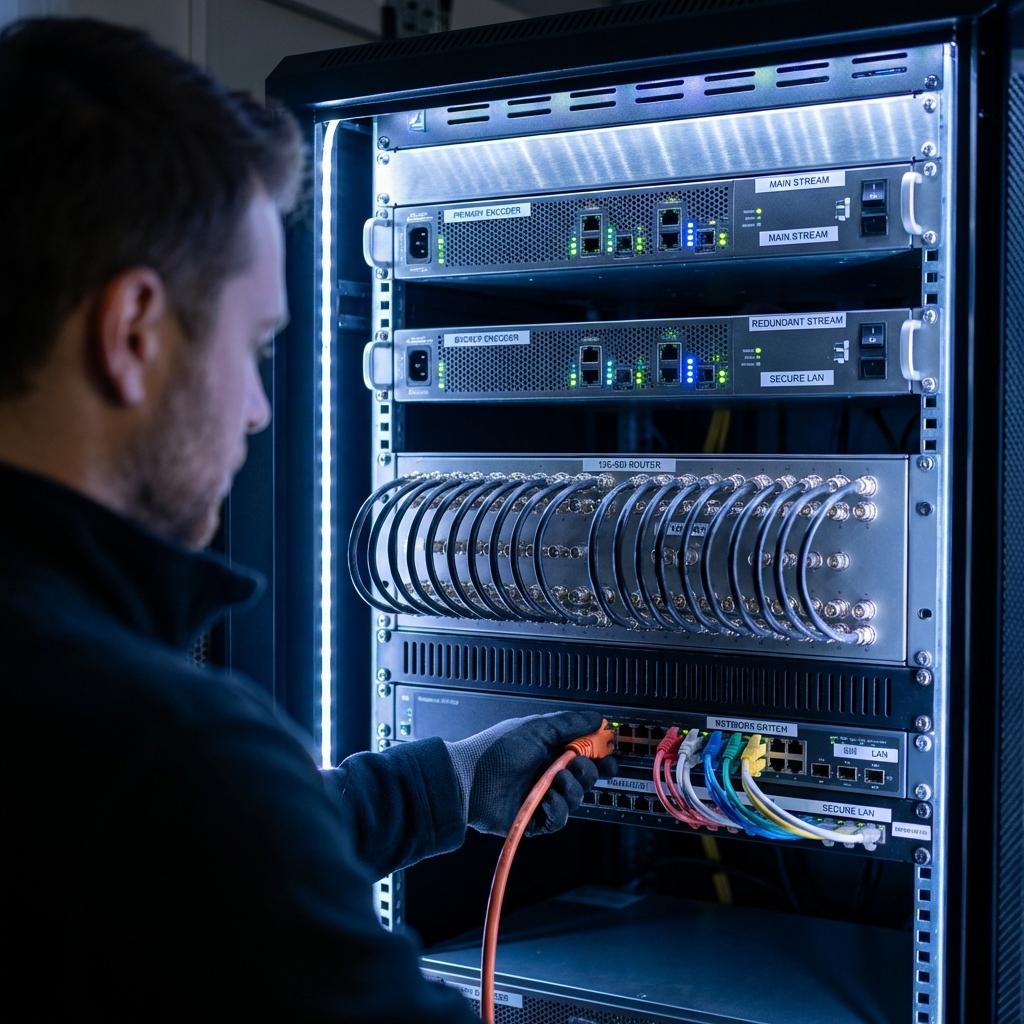
For a zero-failure-tolerance event, a single streaming path is a single point of failure. A professional solution involves a bonded network architecture using hardware from manufacturers like LiveU or TVU Networks, or by configuring redundant SRT streams from the primary encoder. This setup involves sending two identical, encrypted SRT streams over separate internet connections (e.g., one fiber, one cellular) to a cloud-based video platform or media server. If the primary path experiences packet loss or a complete failure, the receiving server can seamlessly switch to the backup stream’s packets, resulting in no disruption to the viewer. This 1+1 or 2022-7 style seamless protection is a broadcast-level standard for ensuring continuity.
Securing Audience Access and Hybrid Participation
The final layer of security involves controlling who is authorized to view the sensitive broadcast. In a hybrid event model, this extends to securing the interactive components for remote presenters and audience members. The goal is to create a secure consumption environment that prevents unauthorized viewing and redistribution.
Enterprise-Grade Access Control
Broadcasting to a public CDN is not an option. Access must be gated through an enterprise-grade video platform that integrates with corporate identity providers. Single Sign-On (SSO) integration with platforms like Okta, Azure AD, or SAML 2.0 is the gold standard. This ensures that only authenticated employees, investors, or journalists with valid credentials can access the stream player. Further security can be layered on top, including token-based authentication where the viewing URL is unique and expires after a short time, IP address whitelisting to restrict access to specific corporate networks, and geofencing to block access from unauthorized regions.
Digital Rights Management and Watermarking
To prevent unauthorized recording and redistribution, Digital Rights Management (DRM) technology should be employed. DRM systems like Google Widevine, Apple FairPlay, and Microsoft PlayReady encrypt the content at the delivery stage, and it can only be decrypted by a compliant player on an authorized device. This prevents simple stream ripping. As an additional deterrent, visible or forensic watermarking can be implemented. A visible watermark overlays the viewer’s username or IP address on the video, discouraging screen recording. Forensic watermarking invisibly embeds a unique identifier in each individual’s stream, allowing a leaked recording to be traced back to the specific user account that was compromised.
Securing Remote Contributors
For C-suite executives or analysts participating remotely, their contribution feed back to the studio must also be secured. Rather than relying on consumer-grade video conferencing software, they should be provided with a secure SRT or WebRTC link from a professional platform. This ensures their audio and video feed is encrypted in transit back to the production switcher, where it can be integrated into the main program feed without compromising the security of the overall production environment.
Ultimately, securing a live financial disclosure briefing is a complex, multi-domain technical challenge. It demands a holistic approach that fuses broadcast engineering principles with enterprise IT security best practices. From physical access control and network segmentation to protocol selection and viewer authentication, every step must be deliberately engineered to protect the integrity and confidentiality of the information. For organizations where financial communications are paramount, partnering with a production team that possesses deep expertise in these secure, enterprise-grade workflows is not a luxury; it is a fundamental requirement for risk management.

Jeremy Lee is a seasoned digital marketing director and strategist with over two decades of experience in the industry. As the founder of Sotavento Medios, I manage a diverse portfolio of over 50 businesses, helping brands grow through advanced search strategies and digital innovation. My work focuses on bridging the gap between traditional search engine optimisation and the evolving world of AI-driven answer engines.
get in touch