

The Unseen Network: How Singaporean Banks Architect Private CDNs for Mission-Critical Internal Communications
In the high-stakes world of finance, particularly within Singapore’s regulatory framework, the secure and instantaneous dissemination of information is not a luxury; it is a fundamental operational requirement. For C-suite strategy sessions, quarterly all-hands meetings, and critical training rollouts, standard B2B event streaming solutions are non-starters. The security risks associated with public Content Delivery Networks (CDNs) and the quality limitations of typical Unified Communications (UC) platforms present unacceptable vulnerabilities. This is where enterprise-grade streaming architecture, specifically the deployment of Private CDNs, becomes a cornerstone of internal communications infrastructure for leading financial institutions. This is not about public-facing webcasts; it is about creating a fortified, internal broadcast network that guarantees security, quality, and reliability for an audience where every viewer is a mission-critical stakeholder.
A Private CDN, often referred to as an Enterprise CDN (eCDN), is a purpose-built network of servers deployed within a corporation’s own network infrastructure. Unlike public CDNs that optimize content delivery over the public internet, a Private CDN optimizes video distribution across a private Wide Area Network (WAN). This architecture addresses the unique challenges of streaming high-quality video to thousands of concurrent viewers within a concentrated corporate environment, preventing network saturation and ensuring a flawless viewing experience, all while operating under a zero-trust security model mandated by financial regulatory bodies like the Monetary Authority of Singapore (MAS).
Deconstructing the Financial-Grade Streaming Stack: Security and Architecture
The decision to implement a Private CDN is driven by technical imperatives that standard solutions cannot meet. For a Singaporean bank, the internal network is a fortress, and any video solution must integrate into this ecosystem without creating new attack vectors. This requires a ground-up approach to designing the entire streaming stack, from signal acquisition to final delivery on an employee’s desktop.
The Core Mandates: Zero-Trust Security, Sub-Second Latency, and Scalable Delivery
The primary technical challenge is multifaceted. Firstly, security must be absolute. This means end-to-end encryption (E2EE) is not optional. Video streams, from the encoder to the player, must be protected using robust encryption standards like AES-256. This extends beyond the stream itself to include access control, which must integrate seamlessly with the bank’s existing identity management systems like Azure Active Directory or Okta via SAML 2.0 for Single Sign-On (SSO). Secondly, latency is critical for interactive sessions. A town hall with a Q&A segment requires latency under one second to feel natural and engaging. Public CDNs, with their multi-layered caching and internet-dependent routing, often introduce delays of 15-30 seconds, which is unsuitable for real-time interaction. Lastly, scalability without network collapse is paramount. A CEO’s address to 10,000 employees simultaneously in one headquarters building would instantly saturate the main internet gateway if all 10,000 employees pulled a high-bitrate stream from an external source. The Private CDN solves this by serving the stream from local caches on the LAN.
Private CDN Topology: On-Premise vs. Hybrid Cloud Deployments
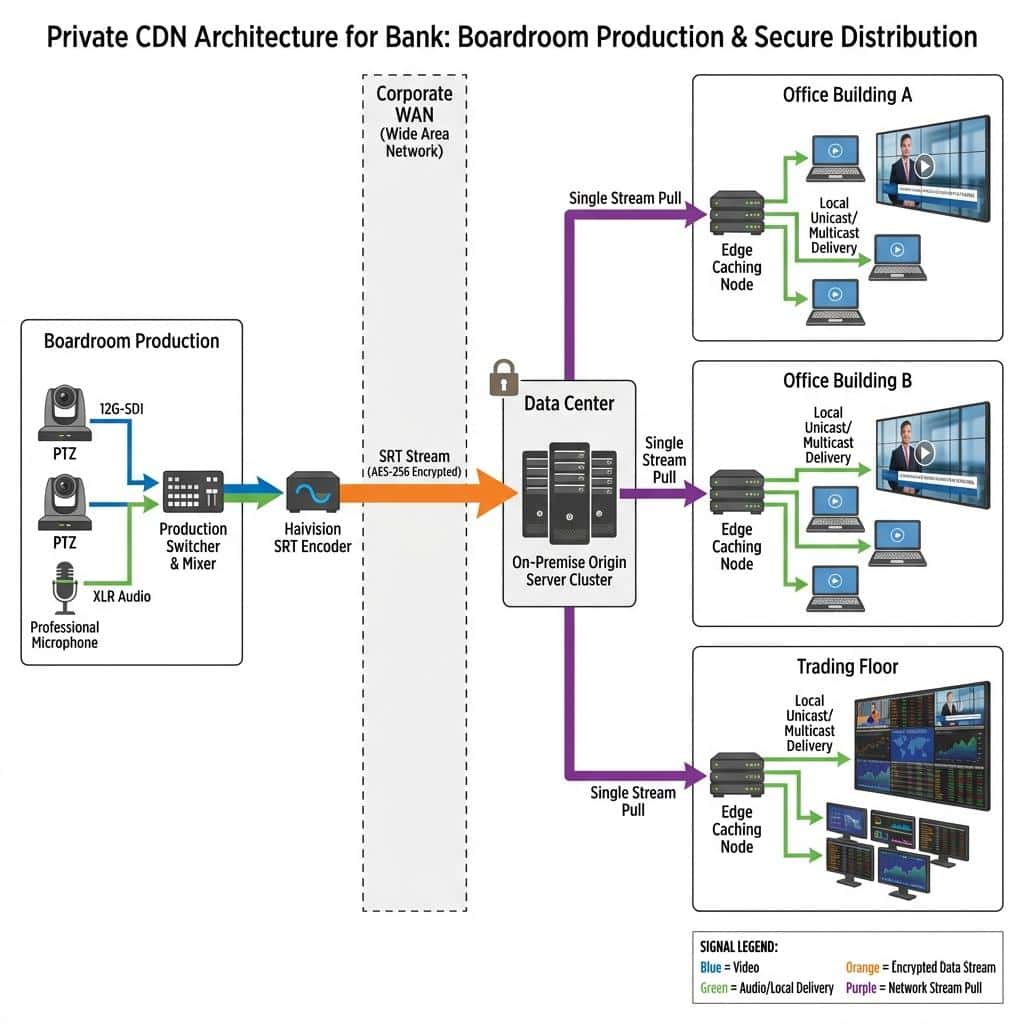
The architecture of a Private CDN typically involves three main components: an origin server, edge caching nodes, and a management layer. The origin server ingests the primary encoded video feed from the production environment. Edge caching nodes are strategically placed throughout the corporate network, often one per major office building or even per floor in a large headquarters. These nodes pull a single instance of the video stream from the origin and then distribute it to viewers on their local network segment. This peer-to-peer or server-to-client distribution model prevents thousands of individual streams from traversing the corporate WAN. For Singaporean banks, two main deployment models are considered. A full on-premise model places all origin and edge servers within the bank’s own data centers and network closets, offering maximum control. A hybrid cloud model might utilize a secure virtual private cloud (VPC) in a local AWS or Azure region as the origin, connected to the bank’s network via a dedicated, high-bandwidth link like AWS Direct Connect. This can offer greater flexibility and scalability while maintaining security within a controlled cloud environment. The management layer provides analytics, monitors network performance, and manages the health of all nodes in the system.
Production Signal Flow and Transmission Integrity for Boardroom Environments
The effectiveness of a Private CDN is contingent on the quality and reliability of the signal it receives. The production workflow for a high-level internal strategy session is as complex and critical as a professional broadcast. It involves capturing pristine audio and video, encoding it robustly, and transporting it to the CDN origin with zero packet loss and verifiable security.
From Glass to Packet: Ingest, Switching, and Encoding Workflows
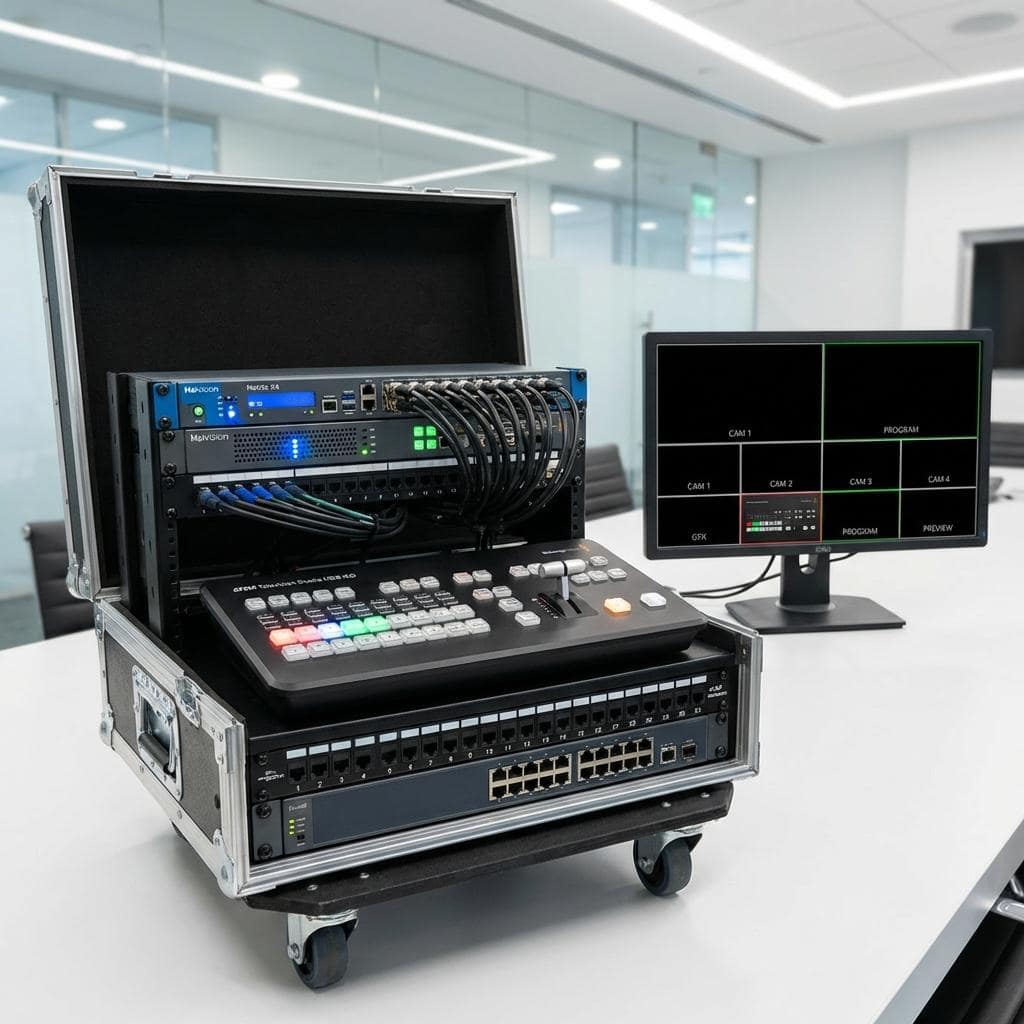
A typical C-suite event utilizes a multi-camera setup to ensure dynamic coverage. This may involve three to four broadcast-quality PTZ (Pan-Tilt-Zoom) cameras, such as the Sony BRC-X1000 or Panasonic AW-UE150, which offer 4K/UHD resolution and professional 12G-SDI or 6G-SDI outputs for uncompressed video. These signals are routed to a production switcher, like a Blackmagic Design ATEM Constellation HD or a Ross Video Carbonite Ultra. The switcher allows a technical director to cut between camera angles, integrate presentation graphics from a laptop feed (often converted to SDI using a Decimator MD-HX), and create a final program feed. This program output, along with a mixed audio feed from a professional console like a Yamaha QL1, is then sent to a dedicated hardware encoder. This is a critical component. Consumer-grade software encoders are insufficient. An enterprise-grade encoder, such as a Haivision Makito X4 or an AJA HELO Plus, is used to compress the video using an efficient codec like H.264 or H.265 (HEVC) and package it for transport.
Protocol Superiority: Why Secure Reliable Transport (SRT) is the Standard
While RTMP (Real-Time Messaging Protocol) was once common, it is now considered legacy for secure, high-quality contribution. The industry standard for transmitting video over managed networks is SRT (Secure Reliable Transport). Developed by Haivision, SRT is an open-source protocol that provides the reliability of TCP with the low latency of UDP. Its key advantages in a banking context are twofold. First, its robust ARQ (Automatic Repeat reQuest) mechanism intelligently retransmits lost packets, ensuring a glitch-free stream even over congested network links between different office buildings. Second, it features mandatory AES-128/256 bit encryption, providing a secure wrapper for the video content from the moment it leaves the encoder. This allows the production team in the main auditorium to send the program feed securely over the corporate WAN to the Private CDN origin server located in a data center, with latency as low as 200 milliseconds.
Architecting for Failure: Redundancy and Bonding Strategies
For mission-critical events, failure is not an option. Redundancy is built into every layer of the production and delivery chain. This starts with dual-path encoding, where two separate hardware encoders process the same program feed and send it over diverse network paths to the CDN origin. This can be as simple as using two different network switches or as complex as using separate ISP links. The CDN origin can be configured in a primary/backup cluster to automatically failover if one server becomes unresponsive. For key remote participants, such as an executive joining from an overseas office, network bonding technology from vendors like Peplink or LiveU can be employed. This technology combines multiple network connections (e.g., fiber, 4G, 5G) into a single, highly reliable data pipe, ensuring their contribution feed reaches the main production studio without interruption.
Integration with Enterprise IT, UC Platforms, and Security Posture
A Private CDN does not operate in a vacuum. Its successful implementation hinges on its ability to integrate with the bank’s existing IT infrastructure, particularly its Unified Communications platforms and stringent security protocols. The goal is a seamless user experience that feels like any other internal application, but with broadcast-level quality and reliability.
Authentication and Access: SAML 2.0, Active Directory, and RBAC
Content protection goes beyond stream encryption. Viewer access must be strictly controlled. Modern Private CDN platforms achieve this through deep integration with enterprise identity providers. When an employee attempts to access a stream, the CDN portal redirects them to the bank’s SSO login page (e.g., Microsoft 365 or Okta). The employee authenticates using their corporate credentials, and the identity provider uses SAML 2.0 to pass a secure authentication token back to the CDN. This confirms the user’s identity. Furthermore, Role-Based Access Control (RBAC) is applied. The CDN can sync with Active Directory groups, allowing IT administrators to create policies such that a stream for the investment banking division is only accessible to employees within that specific AD group. This granular control is essential for ensuring sensitive strategic information is not exposed to the wrong internal audience.
The Hybrid Bridge: Merging Broadcast Production with UC Platforms
Many internal events are now hybrid, requiring the integration of remote participants using platforms like Microsoft Teams or Cisco Webex. Simply screen-capturing a Teams call is unacceptable from a quality standpoint. A professional workflow involves bridging the UC platform into the broadcast production environment. This is achieved using specialized hardware like a NewTek TalkShow or a Kiloview NDI converter that can extract individual participant feeds from a Teams or Webex meeting as clean, isolated video outputs (often over NDI). These NDI sources are then treated like any other camera input on the main production switcher. This allows the remote participant to be composited into layouts, receive proper color grading, and have their audio managed professionally. The final, high-quality program feed, which seamlessly blends the in-room presenters and remote participants, is then encoded and sent to the Private CDN for distribution to the wider viewing audience, who receive a consistent, professionally produced broadcast.
Actionable Implementation Guidelines for Financial Sector AV and IT Teams
Deploying a Private CDN is a significant infrastructure project that requires close collaboration between AV, IT, and network engineering teams. A successful rollout requires a methodical approach focused on analysis, planning, and phased implementation.
The first step is a comprehensive network audit. Analyze the existing WAN and LAN infrastructure to identify potential bottlenecks. Use network monitoring tools to understand traffic patterns during peak hours. Determine if the network supports multicast, which can offer the most efficient method of video distribution on the LAN, or if the solution will need to rely on an intelligent unicast or peer-to-peer delivery method. Secondly, establish a clear set of technical requirements for video quality and latency. Define service level agreements (SLAs) for uptime and performance. This will guide the selection of hardware (encoders, switches, servers) and the Private CDN software vendor. Thirdly, standardize on a secure contribution protocol like SRT for all internal video transport over the WAN. This simplifies network security rules and ensures consistent performance. Finally, run a proof-of-concept (PoC) pilot project. Select a single office building or department to test the full workflow, from production to delivery. Use the PoC to gather performance data, solicit user feedback, and refine the configuration before a full-scale deployment. By following a structured, technically rigorous process, financial institutions can build an internal video platform that is not just a communication tool, but a strategic asset that is secure, reliable, and powerful.

Jeremy Lee is a seasoned digital marketing director and strategist with over two decades of experience in the industry. As the founder of Sotavento Medios, I manage a diverse portfolio of over 50 businesses, helping brands grow through advanced search strategies and digital innovation. My work focuses on bridging the gap between traditional search engine optimisation and the evolving world of AI-driven answer engines.
get in touch