
The Protocol of Production: Engineering Broadcast-Grade Digital Town Halls
In the enterprise ecosystem, the digital town hall is no longer a simple webinar; it is a mission-critical communication event. For corporate event planners, IT directors, and production managers, the underlying technical framework dictates success or failure. The seamless delivery of a CEO’s address to a global workforce, the flawless integration of remote speakers, and the unwavering stability of the broadcast hinge entirely on the protocols and infrastructure deployed. This is not a task for consumer-grade platforms or ad-hoc solutions. It requires a broadcast engineering mindset, focused on signal integrity, transport reliability, and robust production workflows. The challenge lies in architecting a system that marries the high production value of traditional broadcast with the flexibility and scale of IP-based distribution, ensuring every packet of data arrives securely, on time, and with pristine quality. This requires a deep understanding of the entire signal chain, from the camera lens to the corporate end-user’s display.
Foundational Signal Integrity: On-Premise Acquisition and Routing
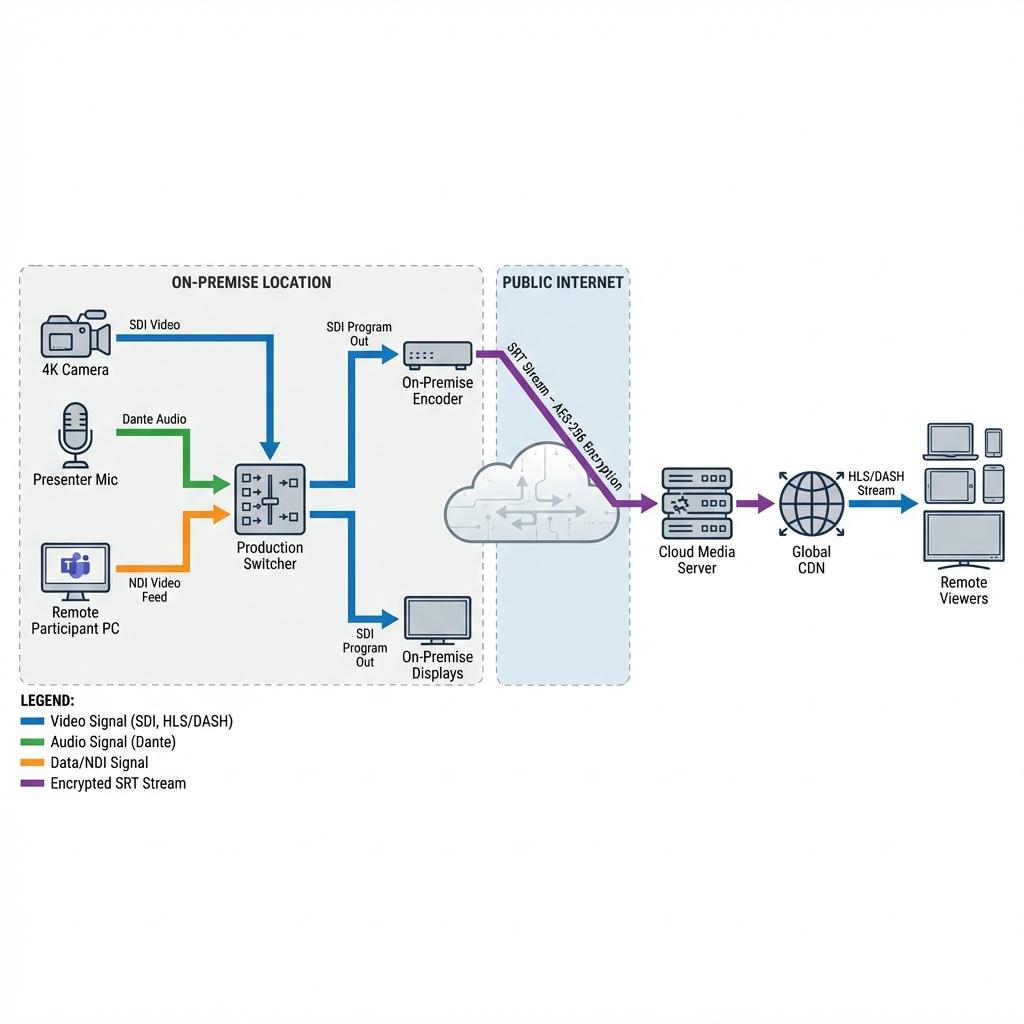
The integrity of any live stream is established at the point of origin. Before a single packet traverses a network, the acquisition and baseband processing of audio and video signals must adhere to professional broadcast standards. The initial choice of physical connectivity between cameras, switchers, and other production hardware sets the quality ceiling for the entire event. For decades, the industry standard for uncompressed video transport has been the Serial Digital Interface (SDI). In modern production environments, particularly for 4K/UHD content, this means utilizing 12G-SDI cabling to carry a 2160p60 signal over a single coaxial cable. This provides a dedicated, point-to-point connection with virtually zero latency and guaranteed bandwidth, crucial for maintaining frame-accurate switching in a multi-camera production. Audio is managed with similar rigor, often using embedded SDI audio or dedicated digital audio transport protocols like Dante or AES67 over a managed local area network (LAN) to ensure pristine, synchronized sound from multiple microphone sources.
Video Signal Flow and Processing
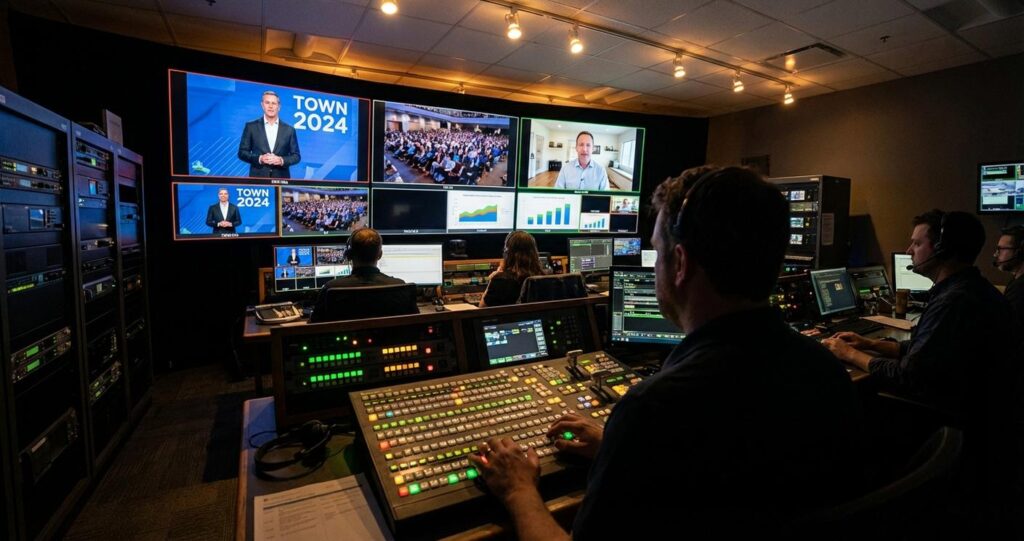
A typical professional setup for a digital town hall involves multiple cameras, each providing an SDI feed into a central production video switcher, such as a Blackmagic Design ATEM Constellation or a Ross Carbonite. This allows a technical director to cut, mix, and dissolve between camera angles, pre-recorded video playback, and graphics. The output from the switcher, known as the Program feed, is then routed to various destinations. A primary Program feed is sent to the streaming encoders. Simultaneously, auxiliary (AUX) outputs from the switcher can feed on-stage confidence monitors for presenters or send specific signals to remote participant integration systems. Monitoring is managed via multiview outputs, displaying all sources, preview, and program feeds on dedicated broadcast monitors for the production crew. This entire on-premise ecosystem is a closed loop, designed for maximum control and minimal latency before the signal is prepared for external transmission.
Encoding and Transport: The Critical Mid-Mile Architecture
Once the Program feed is finalized within the production switcher, it must be compressed (encoded) and transported to a distribution point. This “mid-mile” or “contribution” leg of the journey is where the choice of protocol becomes paramount to reliability and security. While the Real-Time Messaging Protocol (RTMP) was once the de facto standard, its limitations in handling network instability and its lack of modern security features have made it less suitable for high-stakes enterprise events. The industry has largely moved toward more robust solutions.
RTMP vs. SRT: A Technical Comparison
RTMP relies on the Transmission Control Protocol (TCP), which guarantees packet delivery but can introduce significant latency as it retransmits lost packets, leading to buffering and stream freezes over unstable networks. Its secure variant, RTMPS, encrypts the data tunnel but does not solve the underlying performance issues. The modern successor for professional contribution is Secure Reliable Transport (SRT). SRT is a UDP-based protocol that incorporates its own error-correction mechanism, known as Automatic Repeat Request (ARQ). It can retransmit only the specific packets that are lost, without halting the entire stream, resulting in lower latency (typically configurable from 120ms to several seconds) and superior performance over unpredictable networks like the public internet. Furthermore, SRT includes built-in AES-128/256 bit encryption, making it an inherently secure choice for sensitive corporate communications. For a digital town hall originating from a corporate headquarters and streaming to a cloud media server, using SRT provides a broadcast-grade contribution link over standard internet connections.
Encoding Standards: H.264 vs. H.265 (HEVC)
The choice of video codec directly impacts bandwidth requirements and visual quality. The H.264 (AVC) codec remains a widely supported standard, offering a good balance of quality and compatibility. However, for 4K/UHD streaming or in situations with limited network bandwidth, the H.265 (High Efficiency Video Coding, or HEVC) codec is the superior choice. H.265 offers approximately 50% greater compression efficiency than H.264, meaning it can deliver the same video quality at half the bitrate. For example, a high-quality 1080p60 stream that requires 8 Mbps with H.264 could be delivered with comparable quality at 4-5 Mbps using H.265. This efficiency is critical for reducing network load and ensuring a stable stream, especially when multiple high-resolution contribution feeds are involved, such as bringing in a remote executive via a dedicated SRT link.
Hybrid Event Integration and Production Workflow
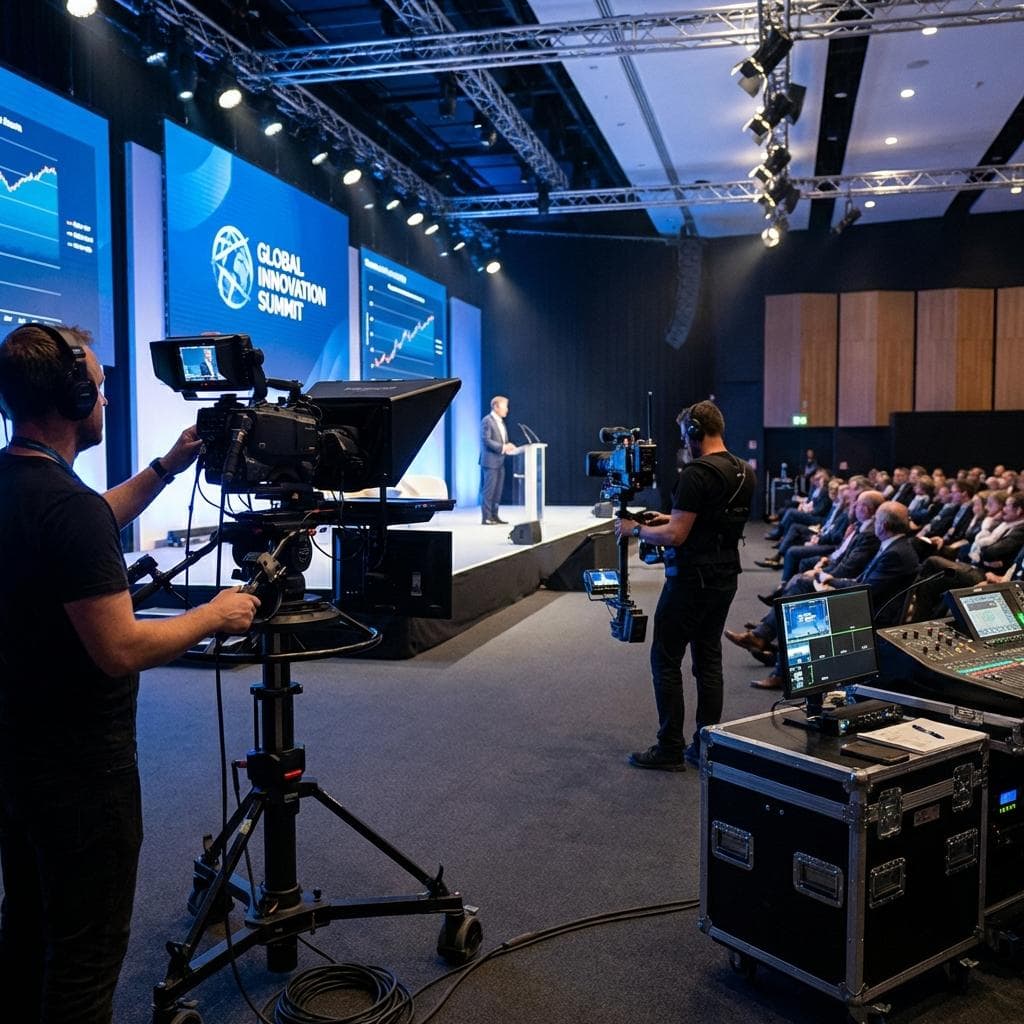
Executing a hybrid town hall, which serves both an in-person and a remote audience, introduces another layer of complexity. The goal is to create a cohesive experience where both audiences feel equally engaged. This requires seamless integration of enterprise collaboration platforms like Microsoft Teams, Zoom, or Webex into the broadcast production workflow.
Integrating Remote Participants into the Broadcast
Simply screen-capturing a standard video conference call is not a professional solution. A broadcast-grade workflow involves isolating individual remote participants as clean video sources. Technologies like Network Device Interface (NDI) are instrumental here. NDI allows high-quality, low-latency video to be transmitted over a standard Gigabit Ethernet network. A dedicated system can run a Teams or Zoom call and use NDI output features to provide each participant’s video as a separate source. These NDI sources can then be ingested directly by the production switcher, just like a physical camera. This allows the technical director to switch to a full-screen view of a remote speaker with perfect clarity, integrate them into multi-box screen layouts, and manage their audio independently through a professional audio mixer. This prevents the jarring experience of seeing the consumer-facing user interface of the conferencing software on the main program feed.
Audio Management and Mix-Minus
Audio is arguably more critical than video in a corporate setting. In a hybrid event, managing audio to prevent feedback and echo for remote participants is essential. This is accomplished using a technique called mix-minus. The main audio mix (the “program” audio) is sent to the stream and the in-room PA system. For each remote participant, the audio engineer creates a custom mix that includes the program audio MINUS that participant’s own microphone. This custom feed is sent back to them, so they can hear everyone else in the meeting without hearing the delayed echo of their own voice, which is a common point of failure in less professional setups.
Redundancy and Last-Mile Delivery
For any mission-critical event, a single point of failure is unacceptable. A robust streaming architecture must incorporate redundancy at every critical stage of the signal chain. This starts with the hardware and extends through network paths and to the final delivery platform.
Implementing Failover Strategies
A standard professional redundancy model involves a primary and a backup encoder. Both encoders receive the same Program feed from the production switcher. They are configured with identical settings but connect to the internet via separate network paths (e.g., primary on the corporate fiber line, backup on a dedicated cellular bonding solution). Both encoders send SRT streams to the primary and secondary ingest points of a cloud media server or Content Delivery Network (CDN). The CDN is configured for source auto-failover, so if the primary stream is interrupted for any reason, it automatically and instantly switches to the backup stream with no interruption for the viewer. This A/B path redundancy mitigates risks from encoder failure, network outages, or issues with the upstream video platform.
The Role of the CDN
The Content Delivery Network is the final piece of the puzzle, responsible for scaling the stream to a large global audience. Once the SRT stream is ingested by the CDN, it is transcoded into multiple adaptive bitrate profiles (e.g., 1080p, 720p, 480p) and distributed across a vast network of edge servers. When an employee clicks play, the video player on their device communicates with the CDN to pull the highest quality stream their individual network connection can reliably support. Enterprise-grade CDNs also provide crucial security features like token authentication, geo-blocking, and IP whitelisting to ensure the town hall is only accessible to authorized viewers. By offloading the distribution to a specialized CDN, the corporate network is protected from the massive traffic load of thousands of simultaneous viewers, ensuring that other business-critical operations are not impacted during the event.
Ultimately, the successful execution of a digital or hybrid town hall is a testament to the unseen protocol and process. It is a discipline of formal standards, technical foresight, and broadcast-level execution. By architecting workflows grounded in professional protocols like SDI, SRT, and NDI, and by implementing systematic redundancy, organizations can transform their key corporate communications from a point of technical risk into a powerful and reliable strategic asset. It is this commitment to technical excellence that ensures the message is not just sent, but received, exactly as intended.

Jeremy Lee is a seasoned digital marketing director and strategist with over two decades of experience in the industry. As the founder of Sotavento Medios, I manage a diverse portfolio of over 50 businesses, helping brands grow through advanced search strategies and digital innovation. My work focuses on bridging the gap between traditional search engine optimisation and the evolving world of AI-driven answer engines.
get in touch