
Broadcasting Leadership Transitions: An Enterprise Streaming Guide
The successful transition of executive leadership is a critical inflection point for any enterprise. Beyond internal memos and press releases, the initial address from a new leader to regional teams sets the tone for future strategy, builds confidence, and ensures organizational alignment. Executing this broadcast flawlessly is not a simple IT task; it is a complex production that demands broadcast-grade engineering, robust network architecture, and a zero-tolerance policy for failure. A dropped stream, unintelligible audio, or security vulnerability can undermine the entire initiative, eroding trust at a moment when it is most essential. This guide provides a technical blueprint for production managers, AV professionals, and IT directors tasked with architecting and delivering these mission-critical events, focusing on the professional streaming infrastructure required to connect a central headquarters with a distributed workforce.
Foundational Strategy: The Hybrid Town Hall Model
The modern enterprise exists as a network of physical and virtual locations. A successful leadership broadcast must accommodate this reality through a hybrid model, treating the event as a unified experience for both in-person attendees at regional hubs and individual remote viewers. This approach requires a carefully planned architecture that prioritizes high-quality contribution from the main stage and reliable distribution to all endpoints.
Defining the Core Venue and Remote Receive Sites
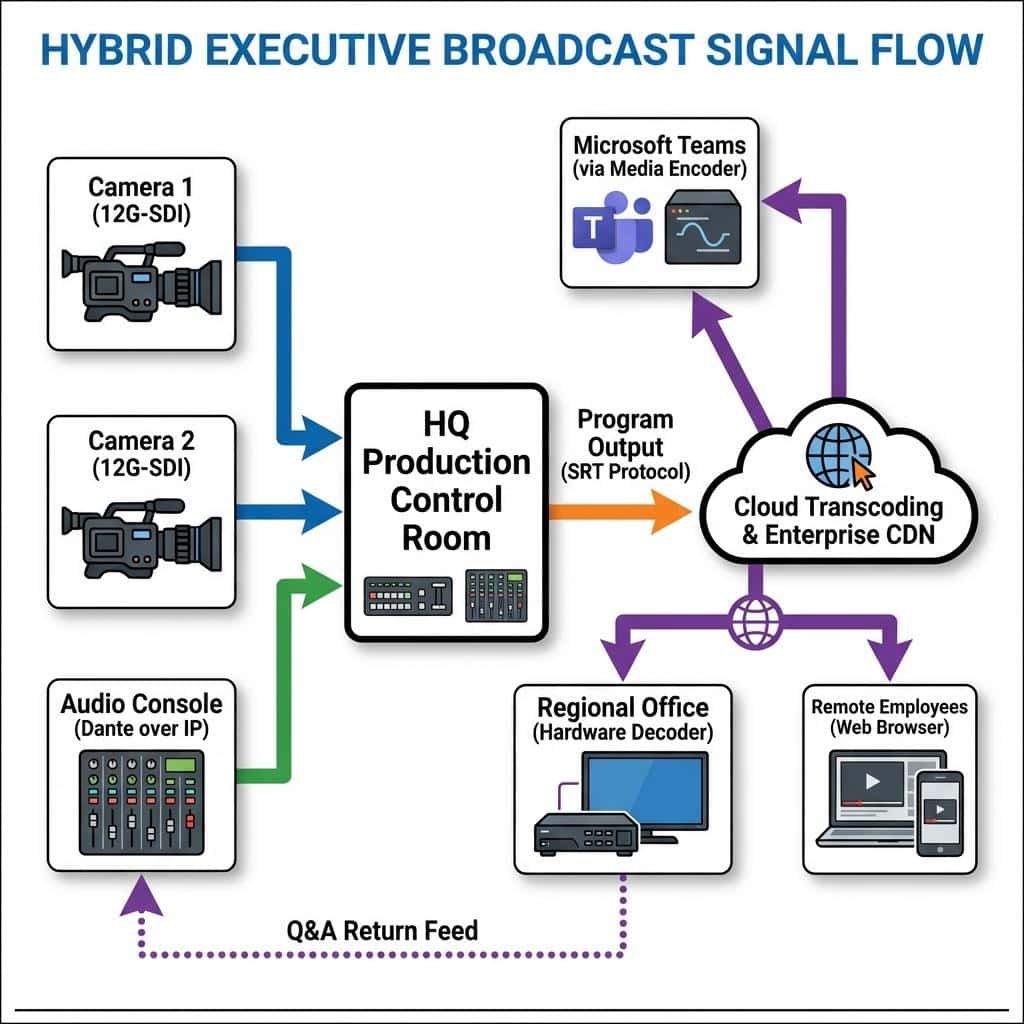
The broadcast originates from a primary location, typically the corporate headquarters, which serves as the production control center. This venue requires a dedicated space with controlled lighting, acoustics, and sufficient power and data connectivity. The receive sites are designated regional offices or event spaces where teams gather. Each receive site must be equipped with professional displays, sound reinforcement, and a dedicated hardware decoder capable of reliably receiving the primary feed. The connection between the headquarters and these sites forms the core of the private broadcast network, demanding a higher level of service than a standard public-facing webcast.
Managing Audience Interactivity and Return Feeds
Interactivity, particularly for Q&A sessions, transforms a passive broadcast into an engaging company-wide meeting. From a technical perspective, this requires a managed return feed architecture. While platforms like Slido can manage text-based questions, enabling live video questions from regional offices demands more. A common implementation involves using a separate video conferencing link (like a dedicated Microsoft Teams or Zoom meeting) as a contribution source. An operator at the main production hub will screen the remote participants and route the chosen individual’s video and audio into the main production switcher as a live source. This requires careful audio routing, including the creation of a mix-minus feed for the remote participant to prevent them from hearing a delayed version of their own voice, which causes echo and disorientation.
Core Production Infrastructure and Signal Flow Architecture
The quality and reliability of the broadcast are directly determined by the professional-grade equipment and signal flow design at the point of origin. Consumer-grade or prosumer equipment introduces unacceptable risks for an event of this magnitude. The entire production chain, from camera lens to encoder, must be specified with redundancy and signal integrity as primary objectives.
Multi-Camera Acquisition and ISO Recording
A professional broadcast utilizes a minimum of two to three cameras to provide dynamic coverage, such as a wide shot of the stage, a medium shot of the speaker, and a tight shot on the lectern. Broadcast cameras, like the Sony FX series or Canon C-line, with Serial Digital Interface (SDI) outputs are standard. SDI is a professional coaxial cable-based standard that offers locking connectors and long-distance signal transmission without the signal degradation or High-bandwidth Digital Content Protection (HDCP) handshake issues common with HDMI. For post-event archival and creation of high-quality video-on-demand (VOD) assets, it is best practice to implement isolated (ISO) recording for each camera feed. This can be achieved using dedicated recorders like the Blackmagic HyperDeck or integrated into advanced switching systems, ensuring a clean, editable version of every angle is captured independently of the live program cut.
Video Switching and Program Feed Generation
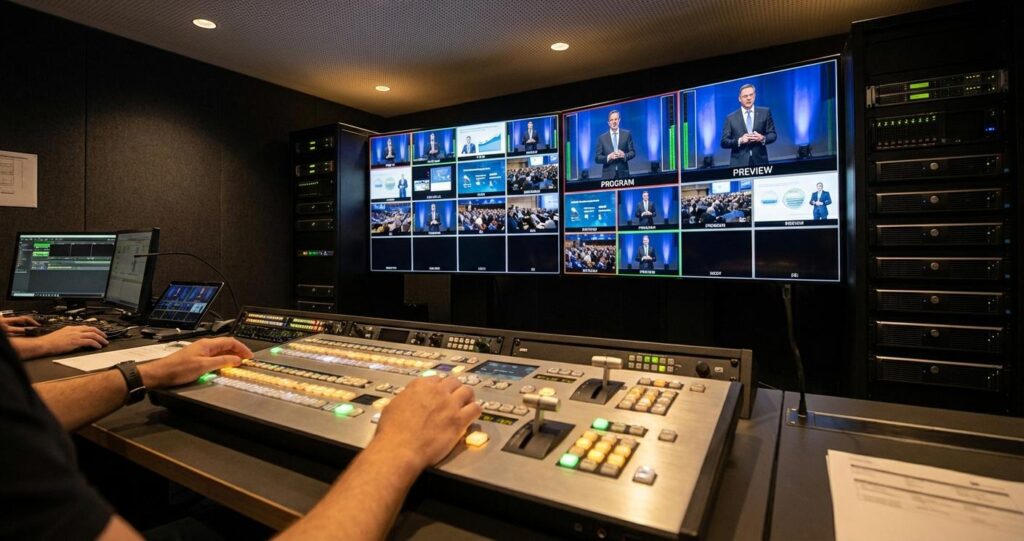
All camera signals, along with any presentation sources like slide decks, are routed to a central production video switcher. Professional switchers like the Ross Video Carbonite or Blackmagic Design ATEM Constellation series serve as the heart of the production. The technical director uses the switcher to cut between sources, create picture-in-picture effects, and key lower-third graphics (speaker titles and affiliations) over the video. The primary output of the switcher is the Program (PGM) feed, which is the final mixed video that will be sent to the encoder. The director monitors all sources simultaneously on a large multiview display, which also shows the PGM feed and a Preview (PVW) feed, allowing them to cue up the next shot before taking it live.
Professional Audio Integration and Signal Management
Audio is arguably more critical than video for message clarity. A redundant microphone strategy is non-negotiable. The primary speaker should be equipped with two professional wireless lavalier microphone packs from manufacturers like Shure or Sennheiser, operating on different, pre-coordinated frequencies. A high-quality lectern microphone should serve as a hardwired backup. All audio sources are fed into a digital audio console, such as a Yamaha QL or CL series mixer. Here, an audio engineer is responsible for proper gain staging, equalization (EQ) to enhance vocal clarity, and dynamics processing to control levels. The final mixed audio is then embedded into the SDI PGM video feed before being sent to the encoder, ensuring perfect audio-video synchronization.
Enterprise-Grade Encoding and Contribution Protocols
Encoding is the process of compressing the high-bandwidth SDI program feed into a format suitable for transmission over standard IP networks. The choice of encoder and transport protocol is one of the most critical technical decisions in the entire workflow, directly impacting stream reliability, latency, and security.
On-Premise Hardware vs. Cloud Encoding Solutions
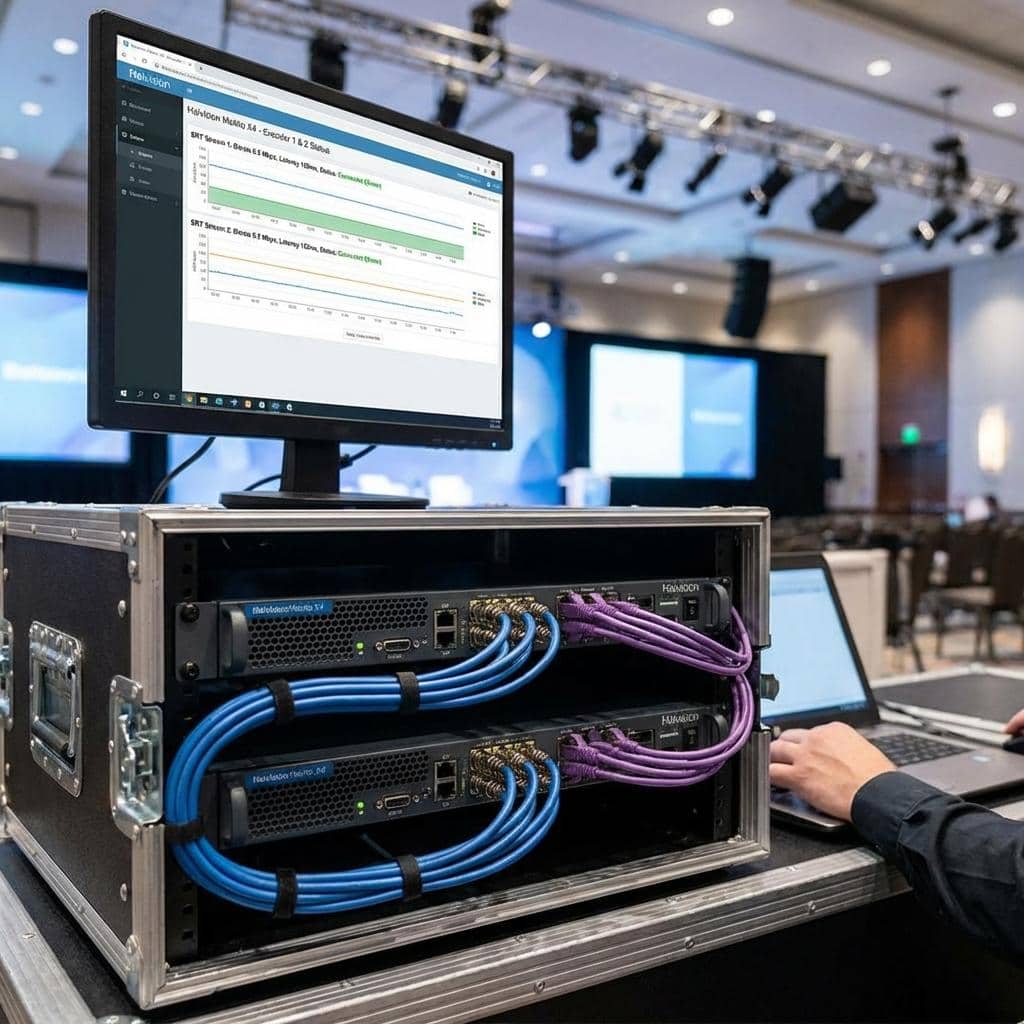
For mission-critical broadcasts, on-premise hardware encoders are the preferred solution. Devices from manufacturers like Haivision, AJA, or Kiloview are purpose-built for continuous, high-quality operation. They offer dedicated processing that is not subject to the performance fluctuations of a software-based encoder running on a general-purpose computer. These units accept SDI inputs directly and provide advanced monitoring and management features. While cloud encoding offers scalability, it introduces another potential point of failure and adds latency. A typical professional setup involves a primary and a backup hardware encoder located on-site for immediate failover capability.
Protocol Deep Dive: SRT as the Enterprise Standard
The protocol used to transport the encoded video from the venue to the distribution point is paramount. While RTMP (Real-Time Messaging Protocol) has been a common standard, it is a legacy TCP-based protocol that performs poorly over networks with packet loss or fluctuating bandwidth. The modern professional standard for contribution is SRT (Secure Reliable Transport). SRT is a UDP-based protocol that provides the reliability of TCP-based transmission but with significantly lower latency. It features advanced error correction to rebuild lost packets, AES 128/256-bit encryption for security, and stable performance over unpredictable networks, making it the superior choice for sending a high-quality feed over the public internet to a cloud platform or directly to regional offices.
Bitrate Management and Codec Selection
The encoder must be configured with an appropriate bitrate and codec. The H.264 (AVC) codec remains a widely compatible choice, while H.265 (HEVC) offers superior compression efficiency, providing higher quality at a lower bitrate. For a primary 1080p60 Full HD feed, a contribution bitrate of 8 to 12 Mbps using H.264 is a robust starting point. This single high-quality contribution stream is then sent to a transcoding service, typically within a Content Delivery Network (CDN). The transcoder creates an adaptive bitrate (ABR) ladder, which is a set of multiple renditions of the stream at different resolutions and bitrates (e.g., 1080p, 720p, 480p). This allows viewers with varying internet speeds to receive the best possible quality their connection can handle without buffering.
Secure Distribution and Hybrid Platform Integration
Once the encoded stream leaves the venue, it must be securely distributed to the intended audience while preventing unauthorized access. This final mile of delivery requires an enterprise-grade video platform and a clear strategy for reaching employees on different devices and in different locations.
Leveraging Enterprise CDNs and Video Platforms
Public platforms are not suitable for internal corporate communications. An Enterprise CDN (eCDN) or a dedicated Online Video Platform (OVP) like Brightcove, Kaltura, or IBM Watson Media is essential. These platforms provide the security and access control features required, including Single Sign-On (SSO) integration with corporate directories (like Azure AD), domain and IP-based restrictions, and detailed per-user analytics to track engagement and verify viewership. They also provide the global server infrastructure needed to deliver the stream reliably to a geographically dispersed audience.
Integrating with Collaboration Tools for the Remote Workforce
For employees working from home, the broadcast must be accessible through the tools they use daily, such as Microsoft Teams, Zoom, or Webex. However, simply screen-sharing the event is not a professional solution. The high-quality PGM feed must be injected cleanly into these platforms. This is achieved by taking an output from the video switcher and feeding it into a device like a Blackmagic Web Presenter or AJA U-TAP, which converts the SDI signal into a standard UVC (USB Video Class) source that appears as a high-quality webcam. This allows the professionally produced feed, complete with graphics and multiple camera angles, to be used as the video source for a Teams Live Event or Zoom Webinar, providing a seamless experience for the remote workforce.
Redundancy and Failover Strategy
A comprehensive redundancy plan is the hallmark of a professional broadcast. This must address every potential point of failure. At the venue, this means having redundant internet connections, such as a primary fiber line backed up by a bonded cellular solution (e.g., LiveU or Teradek). It includes using a primary and a backup hardware encoder, preferably on separate power circuits, sending two identical SRT streams to the cloud platform via diverse network paths. The video platform itself should support primary and backup ingest URLs, enabling instantaneous, automatic failover if the primary stream is interrupted. This multi-layered approach ensures that no single component failure can jeopardize the entire broadcast, safeguarding the message and the reputation of the new leadership.
By investing in a robust technical architecture and partnering with experienced production professionals, enterprises can transform a standard leadership announcement into a powerful, unifying event that resonates across every office and remote location, ensuring a smooth and confident start to a new chapter.

Jeremy Lee is a seasoned digital marketing director and strategist with over two decades of experience in the industry. As the founder of Sotavento Medios, I manage a diverse portfolio of over 50 businesses, helping brands grow through advanced search strategies and digital innovation. My work focuses on bridging the gap between traditional search engine optimisation and the evolving world of AI-driven answer engines.
get in touch