
Secure, AI-Powered Production: The 2026 Enterprise Mandate
The paradigm for enterprise event production has fundamentally shifted. The era of simply pushing a Real-Time Messaging Protocol (RTMP) stream to a public CDN is over; it is an obsolete and insecure model for high-stakes B2B communication. Today’s corporate event planners, IT directors, and production managers face a dual challenge: delivering broadcast-quality, multi-camera hybrid experiences while simultaneously defending against an increasingly sophisticated threat landscape. The solution is not incremental improvement. It is a strategic mandate for 2026: the integration of robust, protocol-level security with intelligent, AI-driven production workflows. This is no longer a forward-thinking concept; it is a baseline requirement for any enterprise that depends on live video for town halls, product launches, investor relations, and critical internal communications. This technical analysis will dissect the components of this mandate, outlining the necessary infrastructure, protocols, and operational strategies required to achieve secure, efficient, and scalable B2B event streaming.
The Evolving Threat Landscape in Enterprise Live Streaming
As live streaming becomes a mission-critical function, the attack surface for corporate events has expanded exponentially. A security breach during a live event can lead to reputational damage, leaks of sensitive information, and significant financial loss. Addressing this requires a multi-layered approach that begins at the protocol level and extends through the entire network architecture.
Beyond RTMPS: Protocol-Level Security with SRT
For years, RTMP Secure (RTMPS) was considered sufficient, primarily offering a TLS/SSL wrapper around the base RTMP data. However, its reliance on TCP (Transmission Control Protocol) makes it susceptible to packet loss and high latency over unreliable networks, a common scenario with remote contributors. More importantly, it lacks the robust security and performance features demanded by enterprise applications. The industry mandate is a clear shift to Secure Reliable Transport (SRT). SRT is an open-source protocol that provides end-to-end AES-256 bit encryption, ensuring the video payload is secure from source to destination. Unlike RTMP, SRT operates over UDP (User Datagram Protocol) and incorporates its own sophisticated packet loss recovery mechanism (ARQ – Automatic Repeat reQuest), making it exceptionally resilient on public internet connections. This allows for stable, low-latency (sub-second) contribution feeds from remote executives or satellite offices without requiring expensive, dedicated fiber links. Implementing SRT means configuring encoders and decoders with specific encryption passphrases and ports, creating a secure, authenticated tunnel for your high-value content before it ever reaches the cloud or your internal media server.
Hardening the Production Network: Zero Trust in AV Infrastructure
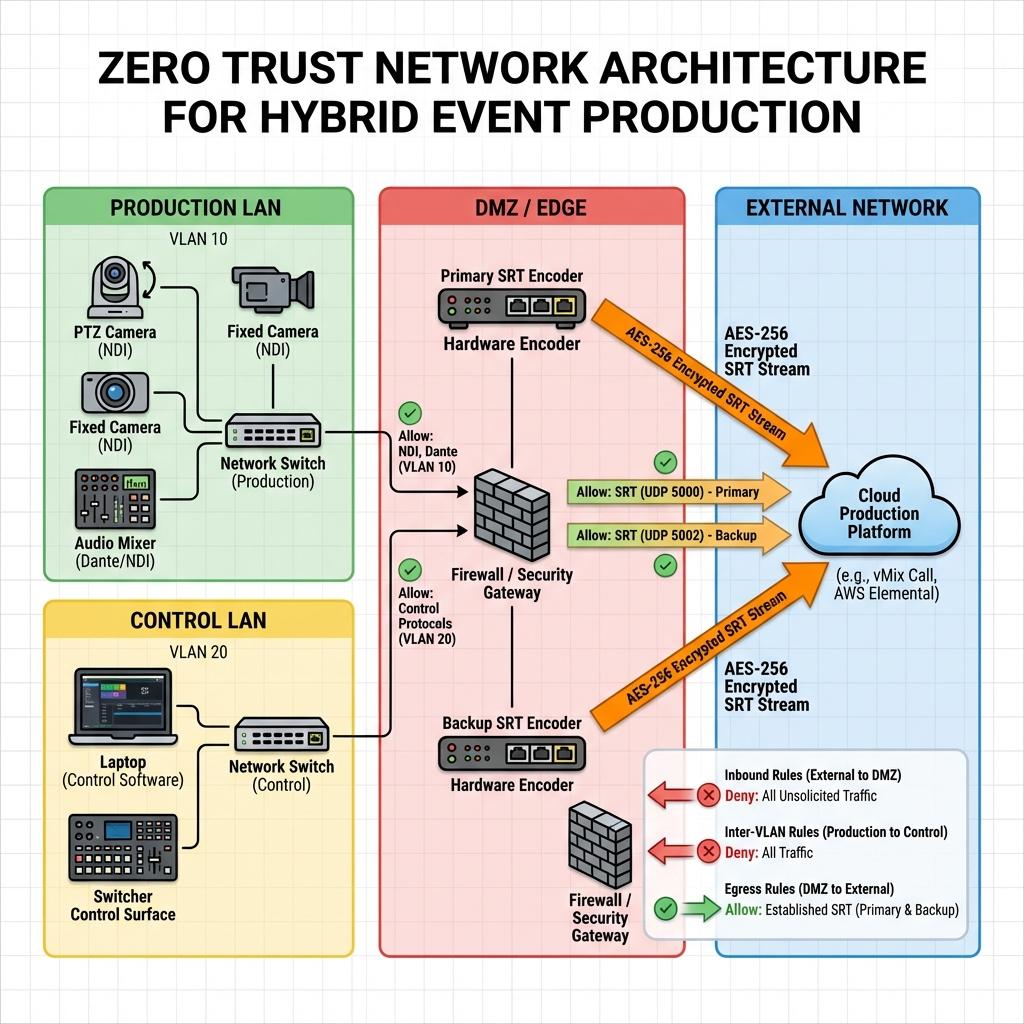
The production environment itself is a critical security domain. The proliferation of IP-based technologies like NDI (Network Device Interface) for video transport and Dante for audio means that your production switcher, cameras, and audio mixers are all network endpoints. A Zero Trust security model, which assumes no device is inherently trustworthy, must be applied. This is a radical departure from the traditionally flat and open networks found in many AV deployments. Implementation involves rigorous network segmentation using VLANs (Virtual Local Area Networks). For instance, NDI video traffic, which is high-bandwidth and latency-sensitive, should be isolated on its own VLAN. A separate VLAN should be used for equipment control data (e.g., PTZ camera commands, switcher control surfaces). A third, highly restricted VLAN should be designated for devices that require internet access, such as encoders streaming to the CDN. Access Control Lists (ACLs) must be configured on network switches to strictly govern which devices can communicate, preventing a compromised device on one segment from accessing the core production systems.
Content Protection: Watermarking, DRM, and Access Control
Securing the transport stream is only part of the solution. The content itself must be protected. For sensitive internal communications, forensic watermarking is a critical deterrent. This technology invisibly embeds a unique identifier into every viewer’s stream. If a recording of the stream is leaked, the watermark can be extracted from the pirated copy to identify the exact source of the leak. While Digital Rights Management (DRM) is common in consumer media, its complexity often makes it impractical for B2B live events. A more effective strategy is robust access control integrated directly with enterprise identity providers. By using standards like SAML (Security Assertion Markup Language) 2.0 or OAuth 2.0, access to the event portal or video player can be tied to the corporation’s Single Sign-On (SSO) system. This ensures that only authenticated employees can view the stream, and their access is automatically revoked upon termination, providing a verifiable and auditable security layer.
AI Integration into the Core Production Workflow
The second pillar of the 2026 mandate is the intelligent application of Artificial Intelligence to enhance production efficiency, quality, and scalability. This is not about replacing skilled production engineers but about empowering them with tools that automate repetitive tasks, reduce the potential for human error, and create more engaging content. The goal is to allow the technical director to focus on the overall narrative and quality of the show, rather than the mechanical execution of every single camera cut.
AI-Driven Vision Mixing and Camera Automation
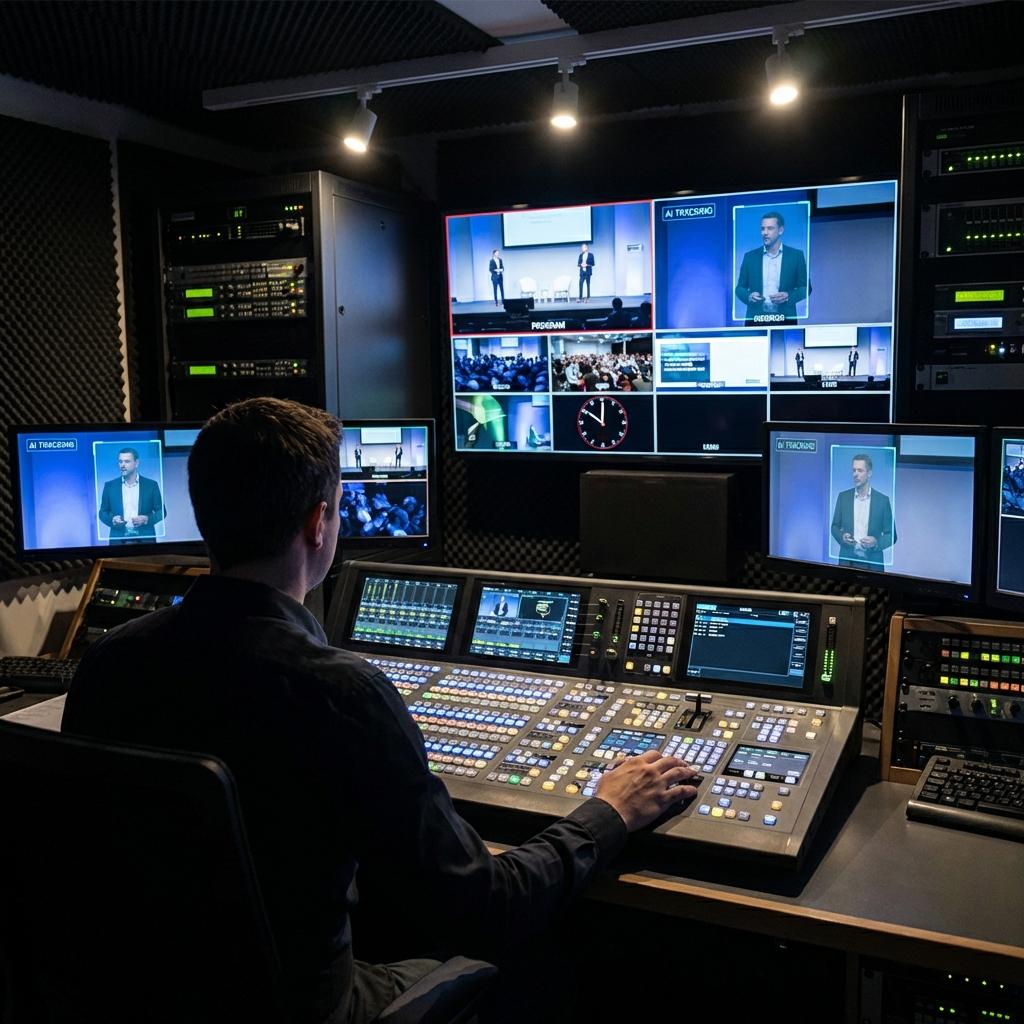
In a multi-camera production, an AI-powered system can act as an invaluable assistant. Modern production systems can analyze audio cues, identifying which participant is speaking and automatically switching to the appropriate camera angle. This is particularly powerful in panel discussions or hybrid meetings with numerous remote participants integrated via platforms like Microsoft Teams or Zoom. The system can be trained to follow specific rules, such as prioritizing a wide shot after a certain duration or avoiding jarring jump cuts. For single-presenter scenarios, AI-driven talent tracking in PTZ (Pan-Tilt-Zoom) cameras ensures the subject remains perfectly framed even as they move across a stage. The system automates the pan, tilt, and zoom functions, producing smooth, organic camera movements that would typically require a dedicated human operator. This reduces crewing costs and delivers a consistently polished look, especially for recurring events like weekly town halls.
Intelligent Audio Processing and Accessibility Compliance
Audio is arguably more critical than video in a corporate setting. AI-powered audio tools are revolutionizing this domain. Sophisticated noise reduction algorithms can identify and remove distracting background noises from a presenter’s microphone in real time, from air conditioning hum to keyboard clicks. For hybrid events with multiple remote contributors, AI can automate the complex task of creating individual mix-minus feeds, ensuring each remote participant hears the full program audio without hearing an echo of their own voice. Furthermore, AI is the engine behind real-time, automated speech-to-text transcription. This not only generates live captions to meet accessibility requirements (such as A-1 compliance) but also creates a searchable transcript of the event almost instantly after it concludes. Integrated loudness monitoring ensures the final audio output adheres to broadcast standards (e.g., -24 LUFS for ATSC A/85), preventing jarring volume shifts for the audience.
Cognitive Services for Post-Event Content Strategy
The value of an enterprise event extends far beyond the live runtime. AI cognitive services can be applied to the ISO (isolated) recordings of each camera feed and the final program edit to generate immense post-event value. These services can automatically analyze the content, creating a chaptered VOD (Video On-Demand) asset based on detected slide changes or topic shifts. They can generate metadata tags, speaker labels, and concise summaries, making the content archive easily searchable. AI can also be used to identify key moments or highlights, such as an executive making a key announcement or a Q&A segment, and automatically clip them for distribution on internal channels or social media. This dramatically accelerates the post-production workflow and maximizes the ROI of the event content.
The 2026 Mandate: Building a Future-Proofed Streaming Infrastructure
Achieving a secure and AI-powered production standard by 2026 requires deliberate architectural planning. The convergence of broadcast engineering and enterprise IT is complete, and infrastructure decisions must reflect this new reality. Enterprises must invest in a flexible, resilient, and scalable ecosystem that can support these advanced workflows.
On-Premise vs. Cloud vs. Hybrid Processing
The choice of where to house the core video processing infrastructure is critical. A fully on-premise solution, built around a broadcast-grade SDI (Serial Digital Interface) or SMPTE 2110 IP router and a hardware video switcher, offers maximum security and the lowest possible latency. This is ideal for a dedicated corporate broadcast studio. A fully cloud-based workflow provides unparalleled scalability and enables a globally distributed production team to collaborate remotely. However, it can introduce latency and relies entirely on internet connectivity. For most enterprises, a hybrid model is the optimal architecture. In this setup, on-site acquisition (cameras, microphones) and initial encoding occur on-premise. The feeds are then securely contributed to a cloud production platform using SRT. In the cloud, graphics are added, remote guests are integrated, and the final program is mixed before being distributed to a global CDN. This approach combines the reliability of on-premise hardware with the flexibility and scale of the cloud.
Redundancy and Failover in an AI-Enhanced Environment
System resilience is non-negotiable. A 1+1 or N+1 redundancy strategy is essential for all critical components. This means having a secondary, fully configured encoder ready to take over instantly if the primary fails. It means using network bonding, where multiple internet connections (e.g., fiber, cable, 5G) are combined to create a single, highly resilient data path for SRT streams. Power redundancy, with Uninterruptible Power Supplies (UPS) and backup generators, is also a baseline requirement. When AI is introduced, the failover plan must account for it. If an AI auto-switching system fails, is there a human operator ready to take manual control via a physical control surface? The system must be designed for graceful failure, allowing a seamless transition from automated to manual operation without interrupting the live program feed. The AI is a tool to enhance the operator, not a single point of failure that can bring down the entire production.
Selecting a Technical Partner: Key Competencies for 2026
Navigating this complex technological landscape requires a partner with a unique blend of expertise. The days of hiring a simple AV company are gone. Enterprises must seek out a production partner that demonstrates deep, verifiable expertise in both broadcast engineering and enterprise IT security. This partner must be fluent in secure protocols like SRT, experienced in designing and implementing Zero Trust network architectures for media, and have a practical, results-driven approach to integrating AI into live workflows. They must be able to architect hybrid on-prem/cloud solutions and design robust failover strategies. This partner acts not as a vendor, but as a strategic consultant, guiding the enterprise toward a production infrastructure that is secure, efficient, and capable of meeting the communication demands of 2026 and beyond.
The mandate is clear. For enterprises that leverage live and hybrid events as a strategic tool, a passive approach to production technology is a liability. Proactively investing in a secure, AI-powered streaming infrastructure is essential for protecting the brand, engaging the audience, and maximizing the value of every corporate event.

Jeremy Lee is a seasoned digital marketing director and strategist with over two decades of experience in the industry. As the founder of Sotavento Medios, I manage a diverse portfolio of over 50 businesses, helping brands grow through advanced search strategies and digital innovation. My work focuses on bridging the gap between traditional search engine optimisation and the evolving world of AI-driven answer engines.
get in touch