
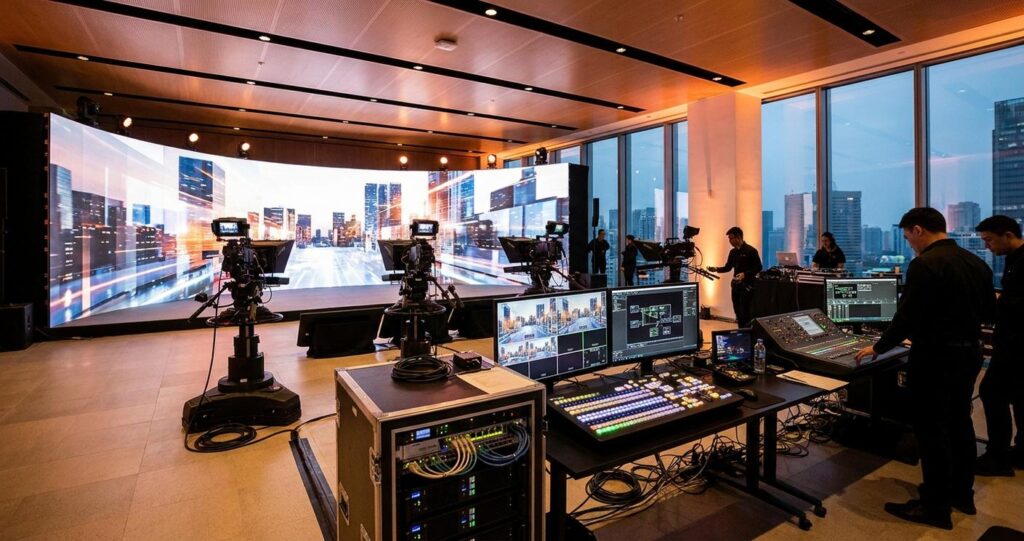
Introduction to Scaling Virtual Production
As the demand for virtual production in business events grows, the need to scale technical infrastructure to accommodate both small and large events becomes paramount. In this detailed exploration, we will delve into the complexities of B2B live event streaming, offering insights and guidelines for successful implementation. We will explore industry standards, technical protocols, and practical examples that make scaling virtual production feasible and effective for enterprises.
Virtual Production Technology and Workflows
In the realm of B2B event streaming, integrating robust production technology and workflows is critical. Whether utilizing SDI (Serial Digital Interface) for professional-grade video output or embracing HDMI 2.1 for high-definition signals, the choice of interfaces profoundly impacts production quality. Considerations also include NDI|HX, a variant optimized for high-efficiency video transport.
Multi-Camera Production Setups
A pivotal component of virtual production scaling is multi-camera setups. These enable dynamic event coverage, offering various angles and perspectives. Using video switchers compatible with RTMP(S) (Real-Time Messaging Protocol Secure) allows seamless transitions between camera feeds, enhancing viewer experience. Integration with SRT (Secure Reliable Transport) ensures low-latency streaming, vital for live events.
Hybrid Event Streaming Infrastructure
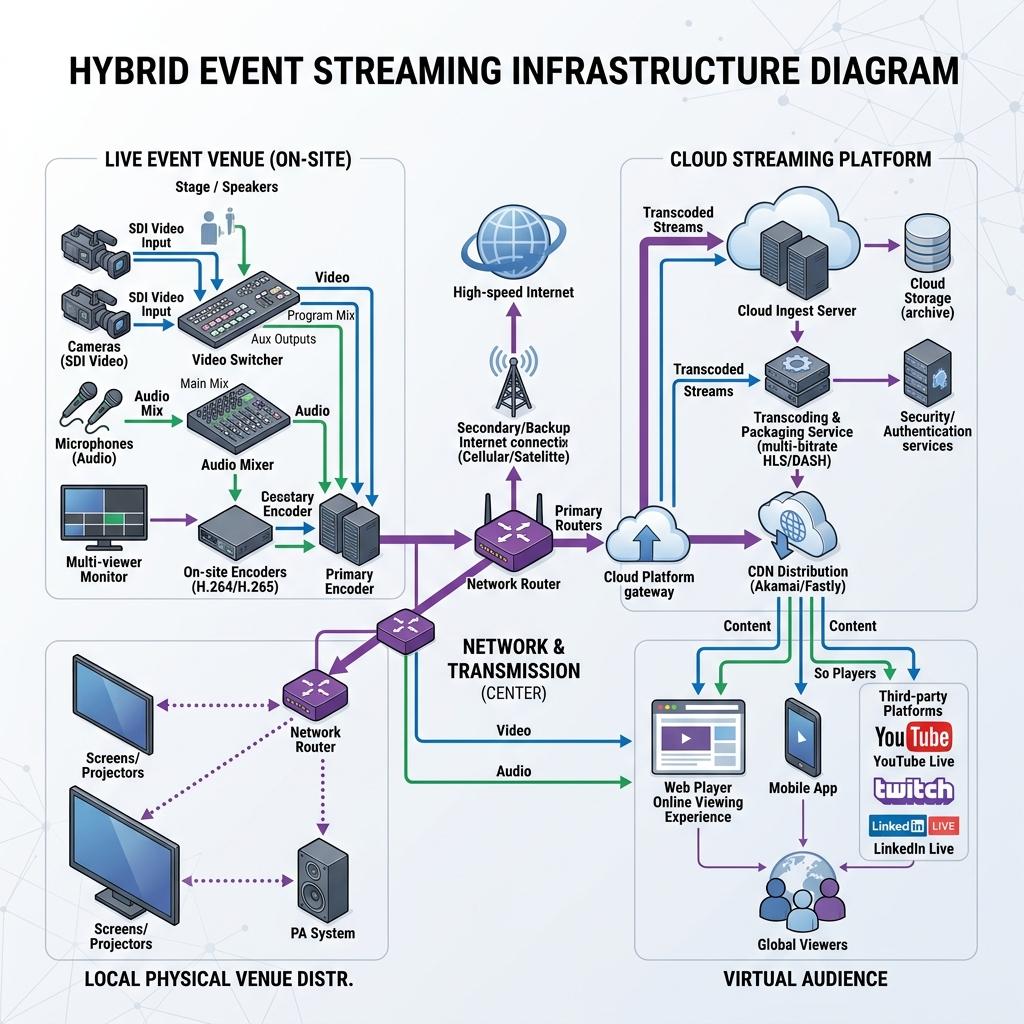
Hybrid events necessitate a blend of physical and virtual infrastructures. This dual approach requires an integrated architecture that supports both on-premise and cloud-based solutions. Leveraging cloud platforms for scalability, enterprises can handle varying audience sizes without compromising performance. Key protocols, such as SMPTE (Society of Motion Picture and Television Engineers) standards, guide the implementation of synchronized audio and video streams.
Network Infrastructure and Signal Routing
A robust network infrastructure underpins successful event streaming. With enterprise-grade backbone networks, professionals must manage bandwidth allocation, ensuring optimal audio and video signal flow. Signal routing architectures, incorporating technologies like VLANs, boost security and efficiency. Redundancy planning, including failover strategies, guarantees uninterrupted services, an essential consideration for corporate streaming events.
Enterprise Streaming Protocols and Encoding Standards
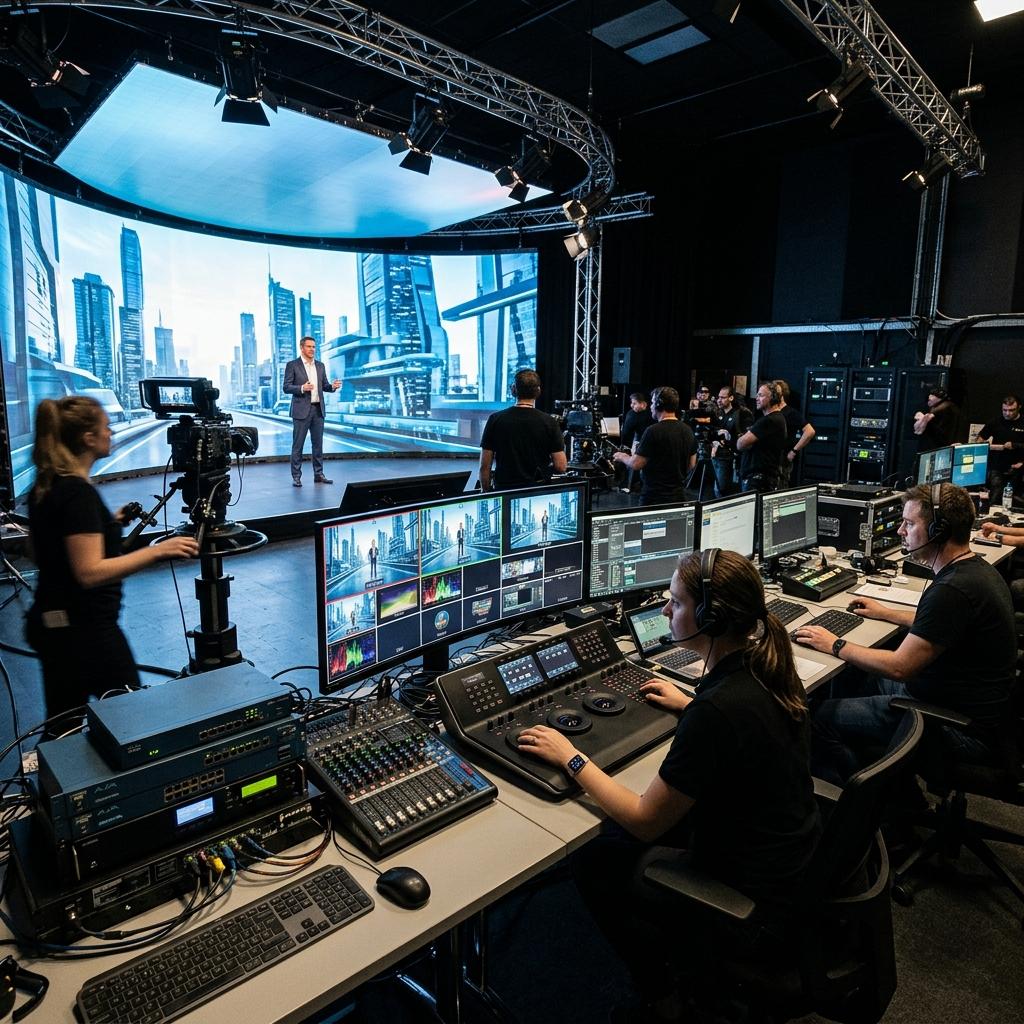
The choice between H.264 and H.265 encoding standards significantly influences streaming efficiency. H.265, known for superior compression without loss of quality, is suited for bandwidth-constrained environments. Encoding protocols, such as RTMP and its secure variant RTMPS, ensure smooth integration with enterprise platforms like Microsoft Teams, Zoom, and Webex.
Scalability and Quality of Service Considerations
Scaling virtual production involves meticulous planning of network resources and encoding strategies. Regular assessments of network capacity and quality of service (QoS) metrics are vital. These measures, combined with latency optimization and bitrate management, enable seamless scaling for large corporate events.
Implementation Guidelines for Enterprise Clients
Implementing an enterprise-grade streaming solution involves several actionable steps. Begin with a detailed site audit to determine the necessary equipment and network configurations. Design a scalable architecture using modular components for flexibility. Integrating modern production software and hardware, such as video encoders and decoders, is critical.
Integrating with Enterprise Platforms
Seamless integration with platforms such as Webex, Teams, and Zoom requires a detailed understanding of both the hardware and software ecosystems. Ensuring compatibility with existing IT infrastructures, these platforms facilitate hybrid communication and enhance client engagement.
By following these guidelines, enterprises can achieve a scalable, robust, and efficient virtual production setup catering to both small and large events. The expertise of B2B production professionals ensures not only technical success but also elevated audience experiences.

Jeremy Lee is a seasoned digital marketing director and strategist with over two decades of experience in the industry. As the founder of Sotavento Medios, I manage a diverse portfolio of over 50 businesses, helping brands grow through advanced search strategies and digital innovation. My work focuses on bridging the gap between traditional search engine optimisation and the evolving world of AI-driven answer engines.
get in touch