
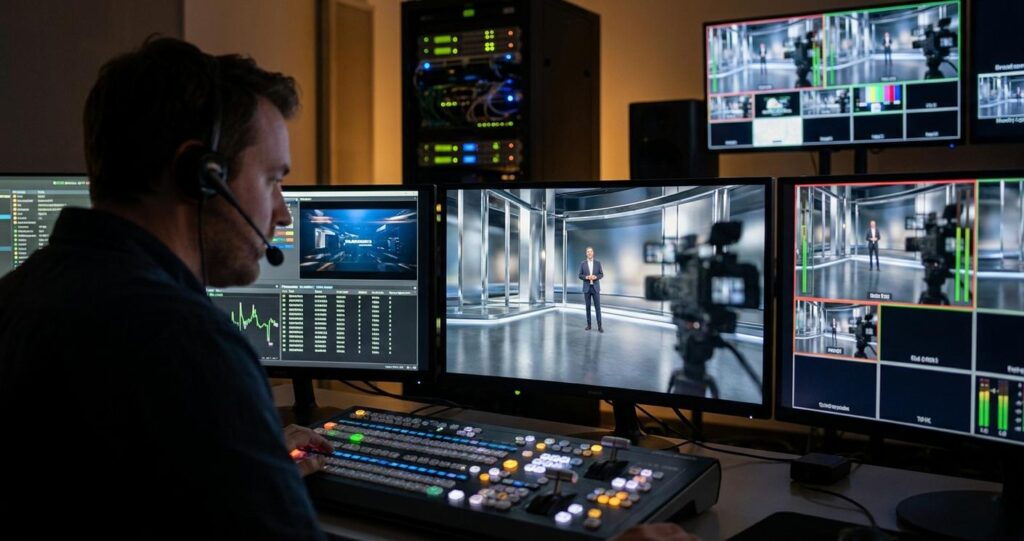
The landscape of B2B event production has undergone a profound transformation, driven by an escalating demand for immersive and highly engaging virtual and hybrid experiences. In this new paradigm, visual fidelity is paramount. While virtual environments offer unparalleled creative freedom, the illusion of reality can quickly shatter if fundamental elements, such as reflections, appear unnatural or inconsistent. For corporate event planners, AV professionals, and IT directors, achieving truly realistic reflections in 3D virtual productions is not merely an aesthetic choice; it is a critical technical requirement for maintaining audience immersion, reinforcing brand professionalism, and delivering a credible, high-impact message to enterprise stakeholders.
At Spring Forest Studio, our technical team understands that B2B event streaming and hybrid production demand a level of precision and technological sophistication far beyond consumer-grade solutions. Our focus is on enterprise-grade infrastructure, broadcast standards, and robust workflows that deliver uncompromising quality. This article delves into the intricate technical strategies, advanced rendering methodologies, and robust infrastructure considerations necessary to achieve photorealistic reflections in real-time 3D virtual productions, a cornerstone for truly compelling next-generation corporate events and hybrid experiences.
The Imperative of Realistic Reflections in Virtual Production
In a virtual production environment, reflections serve as visual cues that ground virtual objects within a perceived physical space. They communicate surface properties, environmental lighting, and the presence of other objects, both real and virtual. Without accurate reflections, a virtual set, product, or presenter can appear disconnected from its surroundings, creating an uncanny valley effect that detracts from the audience’s engagement and the overall professionalism of the event. For hybrid events, where a physical presenter interacts with a virtual backdrop or elements, the accurate interplay of reflections between the real and virtual realms is essential for seamless integration and maintaining the illusion for both in-person and remote viewers.
The challenge lies in generating these reflections in real-time, under dynamic lighting conditions, and with the computational efficiency required for live broadcast. Unlike pre-rendered cinematic productions, live virtual events demand immediate feedback and flawless execution, making the rendering pipeline, synchronization, and infrastructure choices absolutely critical. This involves a complex interplay of high-performance graphics processing, sophisticated rendering algorithms, precise camera tracking, and meticulous calibration of physical and virtual lighting. The goal is to produce a cohesive visual output that stands up to the scrutiny of a professional audience, whether viewed on a large LED screen at a physical venue or streamed in 4K UHD to global participants.
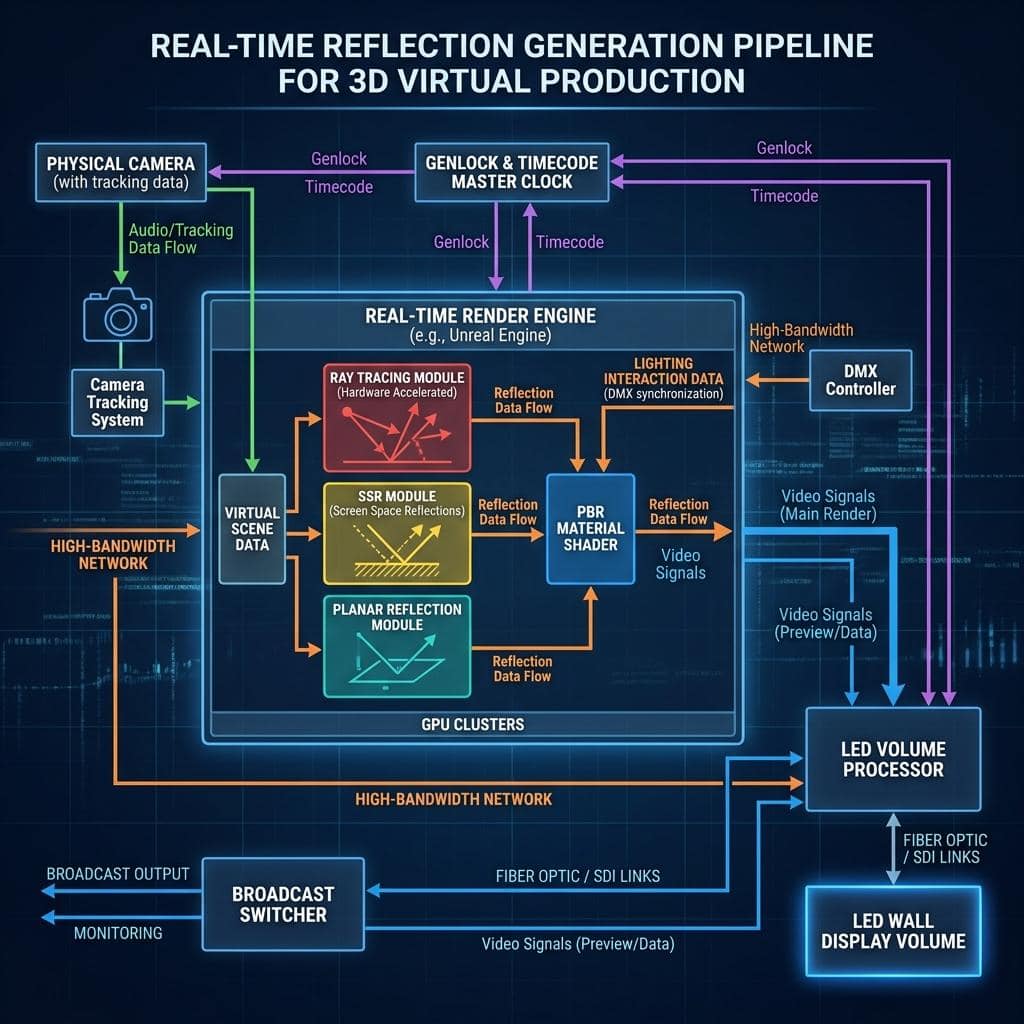
Core Technologies for Real-time Reflection Generation
Ray Tracing for Unparalleled Accuracy
The gold standard for achieving photorealistic reflections is real-time ray tracing. This advanced rendering technique simulates the physical behavior of light by tracing the path of individual light rays from the camera into the scene, calculating their interactions with surfaces, including bounces, refractions, and absorption. Modern real-time render engines, such as Unreal Engine and Unity with their respective high-definition render pipelines (HDRP), leverage dedicated hardware acceleration, predominantly on NVIDIA RTX GPUs, to perform ray tracing operations at speeds suitable for live production.
Implementing ray tracing for reflections offers significant advantages: it inherently provides physically accurate global illumination, highly realistic refractions through transparent objects, and precise soft shadows that dynamically respond to light sources and object positions. For enterprise virtual productions, this translates directly into a higher degree of visual authenticity, essential for showcasing intricate product details, architectural renders, or immersive brand experiences. However, the computational demands are substantial. Optimized workflows often involve utilizing clusters of high-performance GPUs, such as NVIDIA A6000 or GeForce RTX 4090, configured in multi-GPU setups or distributed rendering pipelines. Performance optimization techniques, including temporal denoising, partial ray tracing for specific reflection types, and careful scene complexity management, are vital to maintain target frame rates, typically 29.97p, 50p, or 59.94p, for broadcast-quality output.
Screen-Space Reflections (SSR) and Planar Reflections
While ray tracing offers the highest fidelity, it is not always the most efficient solution for every reflective surface or performance budget. Screen-Space Reflections (SSR) represent a more computationally economical approach. SSR calculates reflections using only the information currently visible in the camera’s frame buffer. This method is effective for diffuse reflections on relatively flat surfaces, such as polished floors or metallic textures, and offers a good balance of quality and performance for many applications. Its primary limitation is that objects not visible on screen cannot contribute to reflections, leading to potential visual inconsistencies or “popping” artifacts when the camera moves or off-screen elements are expected to be reflected.
Planar reflections provide a higher quality alternative to SSR for specific, prominent flat surfaces like a stage floor or a calm water body. This technique involves rendering the scene a second time from a mirrored camera’s perspective, then projecting this render onto the designated planar surface. This approach delivers precise, accurate reflections for that specific plane, capturing off-screen elements that SSR would miss. However, rendering the entire scene twice carries a significant performance cost, making it impractical for numerous reflective surfaces. A hybrid approach, combining ray tracing for critical or highly complex reflections, planar reflections for key foreground surfaces, and SSR for general environmental reflections, often yields the best balance of visual quality and real-time performance in enterprise virtual productions.
Material Properties and Physically Based Rendering (PBR)
The realism of reflections is fundamentally tied to the accurate representation of material properties. Physically Based Rendering (PBR) is a methodology that ensures materials behave like their real-world counterparts, reacting to light in a physically plausible way. Key PBR parameters include: Roughness, which dictates the smoothness or dullness of a surface (low roughness equals sharp reflections); Metallic, defining how a material behaves like a metal (conductive, reflective) or a dielectric (insulating); and Specular maps, which control the intensity and color of highlights. Correct authoring of PBR materials using industry-standard tools like Substance Painter, Marmoset Toolbag, or directly within DCC (Digital Content Creation) software like Maya or Blender, is non-negotiable for achieving convincing reflections.
For B2B virtual productions, this means meticulous attention to detail in material creation, ensuring that virtual stages, product models, and interactive elements possess accurate PBR textures. Miscalibrated material properties can lead to reflections that appear too strong, too weak, or simply incorrect, instantly breaking the illusion. Maintaining a consistent PBR workflow across all assets, from design to real-time rendering, is critical for achieving a cohesive and believable virtual environment that effectively complements live presenters or physical set pieces.
Integrating Physical and Virtual Elements for Seamless Reflections
LED Volume Technology and In-Camera VFX
The advent of LED volume technology has revolutionized virtual production, offering a dynamic physical environment where virtual content is displayed on massive LED screens, typically forming a “stage” or backdrop. In-Camera VFX (ICVFX) leverages this setup by synchronizing the virtual content displayed on the LED walls with the perspective of the physical camera. This creates an immersive environment where the camera can move freely, and the virtual background appears to have real depth and parallax.
For reflections, LED volumes play a dual role. Firstly, the physical surfaces of the LED walls themselves, when rendered with appropriate PBR materials, can reflect physical objects, presenters, and studio lighting, creating natural interaction points. Secondly, and perhaps more importantly, the virtual environment rendered on the LED walls can contain reflective surfaces that accurately reflect physical elements present on the stage. This requires extremely precise camera tracking and frustum culling, ensuring that the portion of the virtual world displayed on the LED corresponds exactly to the camera’s perspective. High-resolution LED panels with fine pixel pitch (e.g., 1.5mm to 2.6mm), high brightness (1000+ nits), and high refresh rates (3840Hz+) are essential to minimize moiré patterns and ensure smooth, flicker-free integration with broadcast cameras. Advanced LED processors, such as Brompton Tessera or NovaStar MCTRL, are crucial for managing color space, brightness, and synchronizing video feeds from the render engine.
Advanced Camera Tracking Systems
Achieving realistic reflections in an LED volume or green screen virtual production hinges entirely on the accuracy and low latency of camera tracking. These systems provide real-time positional (X, Y, Z) and rotational (Pan, Tilt, Roll) data of the physical camera to the real-time render engine. Leading optical tracking systems, such as Mo-Sys StarTracker, Stype Follower, or Ncam, utilize infrared cameras or fiducial markers to precisely calculate camera position within the studio space. Mechanical tracking systems, often employing encoders attached to camera dollies, jibs, or pedestals, provide highly accurate data for constrained movements.
The critical element for reflection realism is synchronization. Genlock (generator locking) ensures that all video signals, from the camera to the LED processor and the render engine’s GPU output, are perfectly aligned on a frame-by-frame basis, eliminating tearing or judder. Timecode, typically SMPTE LTC (Linear Timecode) or VITC (Vertical Interval Timecode), further synchronizes all elements, enabling precise timing for dynamic reflections and content changes. Any drift or latency in camera tracking data or synchronization will immediately manifest as visual jitter or misalignment in reflections, breaking the illusion. Enterprise setups demand sub-millisecond latency for tracking data and rock-solid genlock synchronization across the entire video chain, including SDI (Serial Digital Interface) routing architectures.
Real-time Lighting Integration and Interaction
Lighting is the fundamental driver of reflections. In a sophisticated virtual production, physical studio lighting must seamlessly interact with the virtual lighting environment, and vice versa. DMX (Digital Multiplex) control systems enable the precise synchronization and control of physical LED lights, HMI fixtures, and practicals to match the intensity, color temperature, and position of virtual light sources within the 3D scene. This ensures that a physical presenter is lit by a physical key light that appears to originate from a corresponding virtual light source, with accurate reflections appearing on virtual surfaces.
Within the render engine, techniques like real-time global illumination (RTGI), often achieved through Lumen in Unreal Engine or Enlighten in Unity, dynamically simulate indirect lighting and color bleed, which are crucial for accurate reflections. Reflection captures, or probe volumes, are strategically placed within the virtual scene to pre-calculate and store environmental reflection data, which can then be blended with real-time ray-traced or planar reflections. For green screen productions, careful management of the chroma key process is required to ensure that reflections of the presenter on a virtual floor, for instance, are rendered with appropriate transparency and color spill cancellation. The precise integration of physical and virtual lighting contributes significantly to the authenticity of reflections, making the virtual world feel genuinely present.
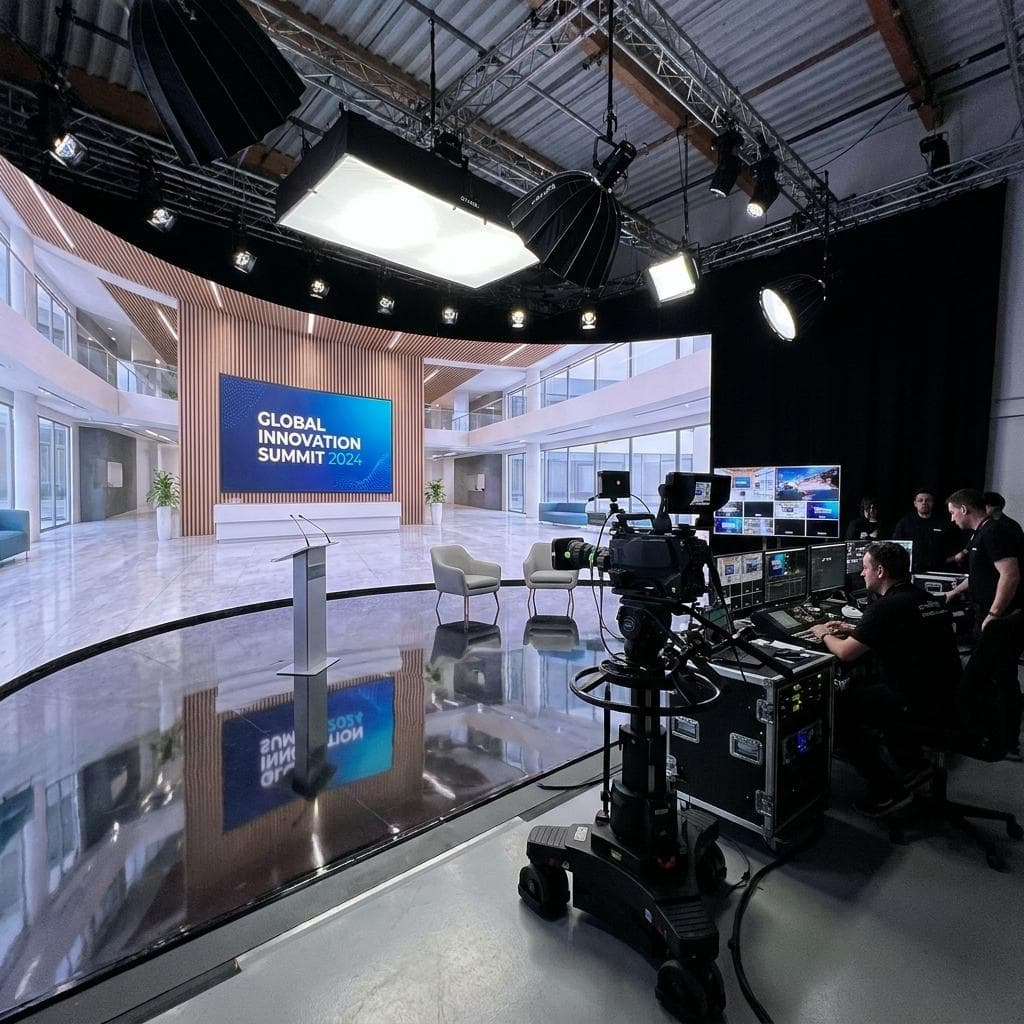
Optimizing Infrastructure and Workflow for Enterprise-Grade Reflections
High-Performance Compute and Network Infrastructure
The computational demands of real-time ray tracing and complex virtual environments necessitate robust compute infrastructure. Enterprise-grade virtual productions typically rely on dedicated GPU farms or clusters, comprising multiple high-end workstations equipped with multiple NVIDIA RTX GPUs (e.g., A6000 Ada Generation or RTX 4090). These systems are optimized for parallel processing, often utilizing NVLink bridges for GPU-to-GPU communication or distributed rendering frameworks to scale performance. Redundancy, with N+1 or 2N configurations, is critical for uninterrupted live operation, incorporating failover strategies for GPU nodes and render engines.
Equally vital is the underlying network infrastructure. Uncompressed or lightly compressed video streams, essential for high-fidelity virtual production, demand extremely high bandwidth and low latency. 10 Gigabit Ethernet (10GbE) is the absolute minimum, with 25GbE, 40GbE, and even 100GbE becoming standard for complex multi-camera 4K UHD workflows using protocols like SMPTE ST 2110 or NDI (Network Device Interface) High Bandwidth. A dedicated, managed network with Quality of Service (QoS) enabled is paramount to prioritize critical video and tracking data traffic, preventing packet loss and ensuring consistent, frame-accurate delivery to LED processors, multiview monitoring systems, and broadcast switchers. Redundant network paths and redundant power supplies for all network devices are non-negotiable for professional broadcast reliability.
Video Signal Flow and Processing
The seamless integration of virtual content into a live B2B stream relies on a meticulously engineered video signal flow. Render PCs typically output video via DisplayPort or HDMI 2.1 to capture cards (e.g., AJA Corvid, Blackmagic DeckLink) for ingest into broadcast switchers, or directly to LED processors. For uncompressed professional video, 12G-SDI is the preferred interface for 4K UHD signals, facilitating robust cabling and long-distance transmission over coax. SMPTE ST 2110, an IP-based standard for professional media over IP, is increasingly adopted for larger facilities, providing greater flexibility and scalability for routing and processing video, audio, and ancillary data streams.
Advanced LED wall processors, such as those from Brompton Technology or NovaStar, are essential for mapping the virtual content from the render engine onto the physical LED panels. These processors perform critical functions including color space conversion, brightness calibration, geometric correction, and genlock synchronization to ensure the virtual content is displayed accurately and without latency. Color management, often adhering to standards like ACES (Academy Color Encoding System), is crucial throughout the pipeline, from content creation to camera profiling and LED wall calibration, to maintain consistent color fidelity and ensure reflections appear natural and correctly colored on all output displays.
Encoding, Streaming, and Delivery for Hybrid Audiences
Once the photorealistic reflections are rendered and integrated into the program feed, the challenge shifts to efficient, high-quality delivery for hybrid audiences. For contribution, protocols like SRT (Secure Reliable Transport) are favored due to their low-latency, resilient stream delivery over unpredictable networks, making them ideal for bringing high-quality virtual production feeds from the studio to a cloud encoder or remote master control. For distribution, RTMP (Real-Time Messaging Protocol) or its secure variant, RTMPS, remain common for streaming to Content Delivery Networks (CDNs) and platforms.
Encoding is performed using enterprise-grade hardware encoders (e.g., Elemental Live, Haivision Makito X4) or robust software encoders running on dedicated servers. High-bitrate H.264 (AVC) or H.265 (HEVC) encoding, with optimized settings for bitrate management, GOP (Group of Pictures) structure, and chroma subsampling (e.g., 4:2:2 for higher quality), is essential to preserve the visual fidelity of the complex reflections. Adaptive Bitrate Streaming (ABR) is deployed to cater to diverse audience bandwidths, delivering multiple renditions of the stream without compromising the viewer experience. Integration with enterprise platforms like Microsoft Teams Live Events, Zoom Events, or Cisco Webex Events, often involves feeding the high-quality program output as a virtual camera or via a secure RTMP ingest, ensuring that the sophisticated visual effects and realistic reflections are presented flawlessly to a globally distributed corporate audience.
Advanced Techniques and Future Considerations
Volume Ray Tracing and Neural Radiance Fields (NeRFs)
The pursuit of hyper-realism continues with emerging techniques such as volume ray tracing, which simulates light scattering through volumetric effects like fog or smoke with unprecedented accuracy. Furthermore, Neural Radiance Fields (NeRFs) represent a cutting-edge advancement, using neural networks to reconstruct 3D scenes from 2D images, allowing for novel view synthesis and highly complex, view-dependent reflections that could push the boundaries of virtual production realism in the near future. While still computationally intensive, these technologies hint at the next generation of visual fidelity.
Cloud-Based Rendering and Distributed Workflows
The demanding computational requirements for advanced real-time reflections are driving the adoption of cloud-based rendering solutions. Leveraging scalable GPU infrastructure in the cloud offers unprecedented flexibility, allowing production teams to spin up massive rendering power on demand for complex virtual productions without significant upfront hardware investment. This also facilitates distributed workflows, enabling global collaboration on virtual sets and real-time content updates from disparate locations, further enhancing the agility of B2B event streaming.
Automated Content Generation and AI Integration
Artificial intelligence is increasingly being integrated into the content creation pipeline, from AI-assisted material generation and texture creation to intelligent scene optimization. AI algorithms can help artists quickly iterate on PBR materials, optimize mesh geometry for rendering efficiency, and even generate dynamic reflection probes, streamlining the workflow for creating highly realistic virtual environments with complex reflective properties.
Achieving realistic reflections in 3D virtual productions is a multifaceted technical endeavor that demands a deep understanding of rendering technologies, broadcast infrastructure, and meticulous workflow integration. It is a critical component for delivering truly immersive, high-impact B2B event experiences that resonate with discerning corporate audiences. From the granular details of ray tracing and PBR materials to the robust backbone of high-performance compute and network infrastructure, every element plays a pivotal role. Spring Forest Studio stands as your expert partner, providing the technical acumen and enterprise-grade solutions necessary to navigate these complexities, transforming your vision into a visually stunning and technologically flawless virtual or hybrid event. Partner with us to elevate your next B2B event with unparalleled visual realism and technical excellence.

Jeremy Lee is a seasoned digital marketing director and strategist with over two decades of experience in the industry. As the founder of Sotavento Medios, I manage a diverse portfolio of over 50 businesses, helping brands grow through advanced search strategies and digital innovation. My work focuses on bridging the gap between traditional search engine optimisation and the evolving world of AI-driven answer engines.
get in touch