
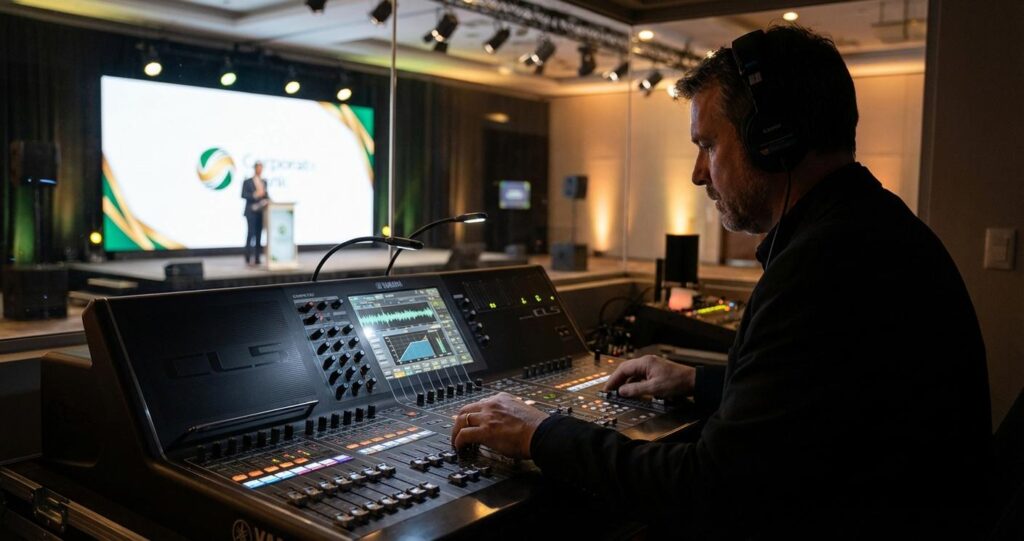
The Critical Role of Audio Compression in Enterprise Event Streaming
In the context of high-stakes B2B event streaming, delivering pristine, intelligible audio to a global audience is not a luxury; it is a fundamental requirement. An executive keynote or a critical product announcement can be rendered ineffective if the audio is plagued by inconsistent levels, making it unintelligible for viewers on different devices and network conditions. The core challenge lies in managing audio’s dynamic range, the difference between the quietest and loudest sounds. A live event naturally has a wide dynamic range, from a presenter’s subtle conversational tone to an unexpected burst of applause. While this is acceptable for an in-person audience, it creates significant problems for a remote viewership. Professional audio compression is the primary tool that broadcast engineers use to solve this problem, ensuring every word is heard with clarity, regardless of how or where it is being consumed. This is not about reducing file size; it is a sophisticated process of dynamic range control that is essential for professional hybrid and virtual event production.
The signal chain in a professional production, from a presenter’s lapel microphone through a digital mixing console, into a streaming encoder, and across global networks, is complex. Each stage presents an opportunity for degradation. Without meticulous dynamic control at the source, the audio signal passed to the encoding stage is unpredictable. Encoders, which use codecs like AAC (Advanced Audio Coding) or Opus, perform most effectively when fed a signal with a consistent level. An uncompressed signal with wild peaks and low valleys forces the encoder to work harder, often resulting in audible artifacts, especially at lower bitrates common in adaptive bitrate streaming scenarios. By applying professional compression techniques before encoding, production teams can create a broadcast-ready audio stream that is robust, clear, and optimized for delivery over protocols like SRT (Secure Reliable Transport) and RTMPS (Real-Time Messaging Protocol Secure), guaranteeing a superior experience for every remote attendee.
Deconstructing Audio Dynamics in a Professional Production Environment
Understanding how to properly apply compression begins with a firm grasp of audio dynamics within the live production ecosystem. The goal is to create a signal that is both clean at the source and resilient enough to withstand the rigors of internet delivery. This involves careful signal management from the moment the sound is captured.
The Problem of Uncontrolled Dynamic Range in B2B Content
In a corporate setting, uncontrolled dynamic range poses a direct threat to message delivery. Consider a hybrid town hall meeting with a panel discussion. One panelist may speak softly, while another is naturally loud and boisterous. An audience member asking a question via a handheld microphone might be too close or too far from the mic. Each of these scenarios creates significant swings in audio levels. For a remote viewer listening on laptop speakers in a busy office, the soft-spoken panelist might become completely inaudible. Conversely, the loud panelist could cause digital clipping or simply be uncomfortable to listen to. This inconsistency forces the remote viewer to constantly adjust their volume, leading to a fatiguing and unprofessional experience. Professional compression rectifies this by automatically reducing the volume of the loud sections and allowing the overall level of the quiet sections to be raised, narrowing the dynamic range to a manageable and intelligible window.
From the Microphone to the Mixer: The Importance of Gain Staging
Before any compression is applied, the initial signal quality must be immaculate. This process starts with proper gain staging. An audio engineer first sets the gain on the microphone preamplifier of a digital mixing console, such as a Yamaha CL5 or a Behringer X32. The objective is to achieve a strong, healthy signal level without clipping, typically targeting around -18 dBFS (Decibels Full Scale) on digital meters, which corresponds to the professional analog standard of 0 VU (Volume Units). This ensures a high signal-to-noise ratio. The signal is then often routed through a digital audio network, most commonly using the Dante (Digital Audio Network Through Ethernet) protocol, which allows for uncompressed, multi-channel, low-latency audio distribution over a standard Ethernet network. Only when this clean, properly-staged signal reaches the main mix bus is it ready for dynamic processing.
The Constraints of the Global Delivery Chain
A pristine audio mix from the production switcher is only the beginning. This signal must travel across the public internet and be played back on a vast array of consumer devices, from high-end corporate AV systems to standard-issue employee laptops and mobile phones. These endpoints have vastly different audio reproduction capabilities. Laptop speakers, for instance, cannot accurately reproduce a wide dynamic range. Furthermore, adaptive bitrate streaming technology will adjust the video and audio quality based on the viewer’s network connection. A viewer on a low-bandwidth connection might receive a lower-bitrate audio stream (e.g., 64 kbps AAC). A well-compressed audio signal is far more resilient to these low-bitrate scenarios, preserving intelligibility where an uncompressed signal would devolve into a garbled, artifact-laden mess. The compression applied in the production control room is a proactive measure to ensure the audio survives this journey intact.
The Mechanics of Professional Audio Compression for Live Streaming
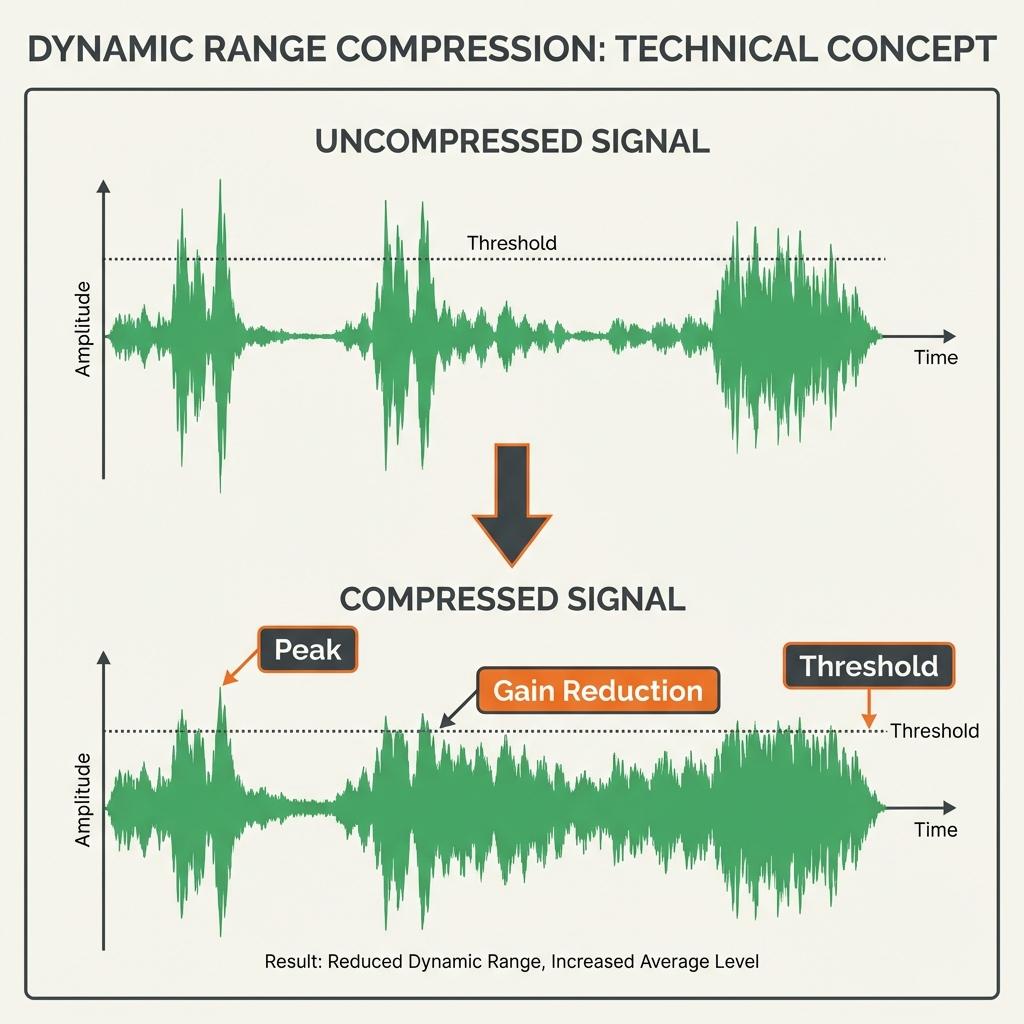
Applying compression effectively requires a technical understanding of its core parameters. Broadcast engineers manipulate these controls with precision to achieve transparent dynamic control that enhances clarity without introducing undesirable audio side effects. For live streaming, the goal is to create a “set and forget” configuration that can handle the unpredictable nature of a live event.
Core Compressor Parameters: Threshold, Ratio, Attack, and Release
A compressor is defined by four primary parameters that dictate its behavior. Understanding their function is critical for any AV professional involved in streaming production.
- Threshold: This is the decibel level at which the compressor begins to act. Any part of the audio signal that is below the threshold remains unaffected. For spoken word content in a corporate stream, a threshold might be set around -20 dBFS to -16 dBFS, targeting the louder parts of the presenter’s voice without affecting quieter breaths or pauses.
- Ratio: This determines the amount of gain reduction applied once the signal crosses the threshold. A ratio of 4:1, for example, means that for every 4 dB the input signal exceeds the threshold, the output signal will only increase by 1 dB. A gentle ratio of 2:1 is often used for overall mix bus compression, while a higher ratio of 4:1 or 6:1 might be used on an individual speaker’s channel to control their dynamics more aggressively.
- Attack: Measured in milliseconds (ms), the attack time determines how quickly the compressor starts reducing the gain after the signal crosses the threshold. A fast attack (e.g., 1-5 ms) is needed to catch sharp, transient sounds like a clap or a dropped microphone. A slower attack (10-20 ms) allows the initial impact of a sound to pass through before compression begins, which can help preserve the natural character of speech.
- Release: Also measured in milliseconds, the release time controls how quickly the compressor stops reducing gain after the signal falls back below the threshold. A short release can cause an audible “pumping” effect, while a release that is too long can mean the compressor is still acting on a quiet passage following a loud one, unnaturally suppressing it. For speech, a release time of 100-300 ms is a common starting point.
Multiband vs. Full-Band Compression
While a standard full-band compressor acts on the entire frequency spectrum of a signal equally, a multiband compressor offers more granular control. It splits the audio into multiple frequency bands (typically 3 to 5 bands, e.g., low, low-mid, high-mid, high) and allows the engineer to apply different compression settings to each band. This is an incredibly powerful tool in a B2B streaming context. For instance, if a presenter’s podium microphone is picking up a low-frequency rumble from the HVAC system, a multiband compressor can be used to compress only the low-frequency band when it gets too loud, leaving the critical mid-range frequencies where vocal clarity resides completely untouched. This surgical approach results in a much more transparent and natural-sounding final product.
Implementing Compression in a Hybrid Event Workflow
The theoretical knowledge of compression must be translated into a practical, reliable implementation within a professional production workflow. The placement of dynamic processing in the signal chain is a critical architectural decision that has significant implications for the final stream quality.
Pre-Encoder Processing: The Optimal Point of Application
The consensus among broadcast engineers is that all significant dynamic processing, including compression, should be applied to the audio signal *before* it reaches the streaming encoder. Hardware encoders like a Haivision Makito X4 or software solutions like vMix receive a baseband audio/video signal, typically via SDI (Serial Digital Interface) or over an IP network using NDI. By applying compression in the audio mixer or via a dedicated downstream processing unit, the encoder is fed a predictable, dynamically controlled audio signal. This allows the audio codec (e.g., AAC-LC) to operate more efficiently, as it doesn’t have to contend with sudden, massive peaks in level. The result is higher-quality audio at any given bitrate and a more robust stream that is less susceptible to network-induced errors. Applying compression after encoding is not a viable professional workflow.
Integrating with Streaming Protocols: SRT, RTMP, and NDI
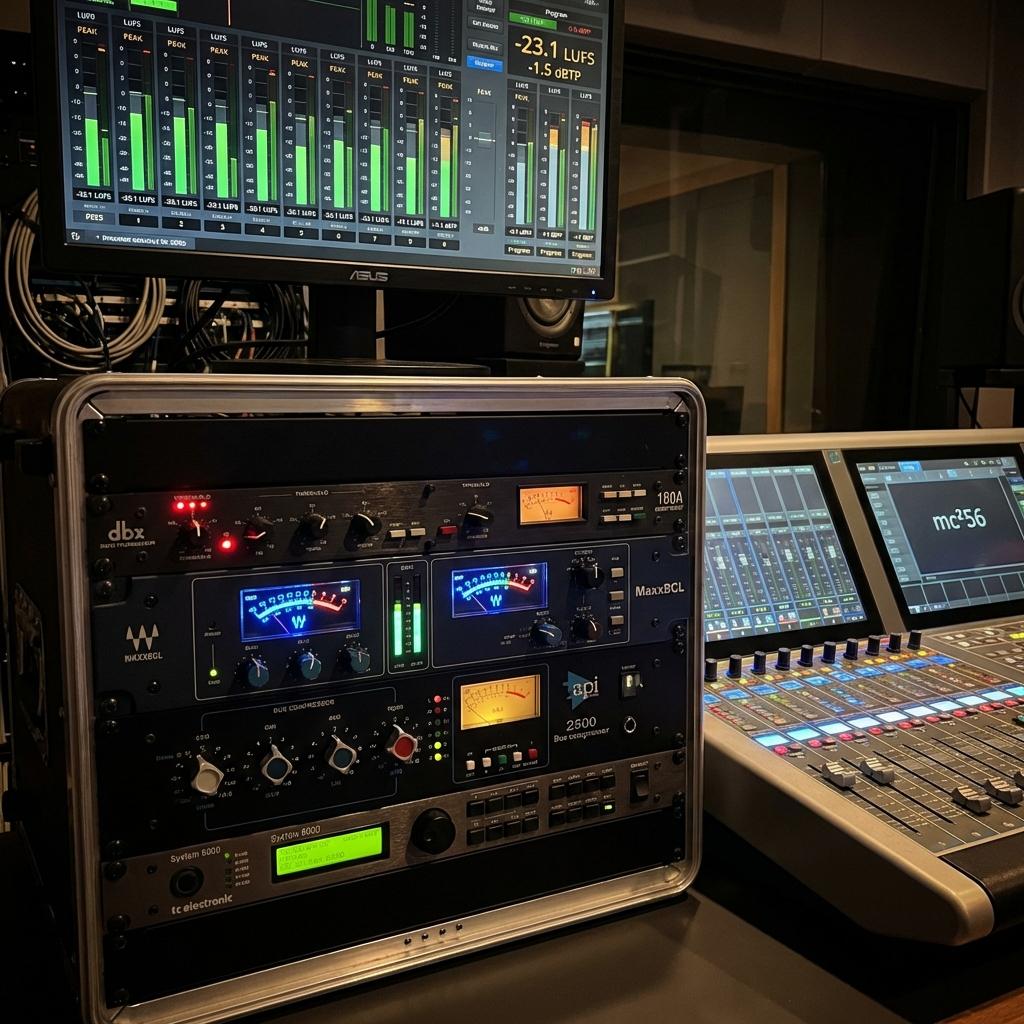
A properly compressed audio signal enhances the performance of modern streaming protocols. Secure Reliable Transport is an open-source protocol that excels at delivering high-quality, low-latency video and audio over unreliable networks. By managing the dynamic range of the audio, the resulting data stream has a more consistent packet size and flow, which can improve the error-correction performance of SRT. Similarly, for RTMP/RTMPS, the most common ingest protocol for social media platforms and many CDNs, a controlled audio stream prevents peaks from causing data rate spikes that could lead to buffer overruns at the ingest server. Within the production facility, NDI allows for the flexible routing of audio. A common workflow is to take the main program audio from a video switcher (like a Ross Carbonite or Blackmagic ATEM) via NDI, route it into a dedicated audio processing computer running VST plugins for multiband compression and loudness metering, and then send the final processed NDI stream to the primary streaming encoder.
Advanced Compression Strategies for Global Intelligibility
For enterprise-level productions, basic compression is just the starting point. Advanced techniques are employed to meet stringent broadcast standards and ensure absolute clarity for every viewer, including those with hearing impairments or those listening in non-ideal environments.
LUFS Targeting and Loudness Normalization
Modern audio production has moved away from focusing solely on peak levels and now prioritizes perceived loudness, measured in LUFS (Loudness Units Full Scale). Standards like EBU R 128 (which targets -23 LUFS) are used in traditional broadcasting to ensure a consistent volume level between different programs and commercials. For streaming, a slightly higher target, typically between -16 LUFS and -14 LUFS integrated loudness, is common. Engineers use real-time loudness meters to monitor the program and apply subtle compression and gain adjustments to hit this target consistently. This practice of loudness normalization is the ultimate tool for ensuring a global audience does not need to touch their volume controls. The CEO’s pre-recorded message will have the same perceived loudness as the live Q&A session, creating a seamless and professional viewing experience.
De-Essing and Frequency-Specific Dynamics
One potential side effect of compressing vocals is the accentuation of sibilance, the harsh high-frequency sounds from “s” and “t” phonetics. A de-esser is a specialized type of frequency-specific compressor designed to solve this. It operates only on a narrow band of high frequencies (typically 5-8 kHz) and applies gain reduction only when sibilant sounds are detected. This tames the harshness without affecting the overall brightness and clarity of the voice. In a professional workflow, a de-esser is almost always placed in the signal chain for presenters and speakers, ensuring the final audio is clear and free from fatiguing sibilance, a detail that significantly enhances the quality for viewers listening on headphones or high-fidelity systems.
Ultimately, professional audio compression is an indispensable discipline in the world of B2B event streaming. It is the invisible force that transforms a chaotic mix of live audio sources into a polished, coherent, and globally intelligible broadcast. By mastering these tools and techniques, production teams at Spring Forest Studio ensure that our clients’ messages are not just transmitted, but are received with maximum impact and clarity, protecting the integrity of their communication and the value of their investment in live event production.

Jeremy Lee is a seasoned digital marketing director and strategist with over two decades of experience in the industry. As the founder of Sotavento Medios, I manage a diverse portfolio of over 50 businesses, helping brands grow through advanced search strategies and digital innovation. My work focuses on bridging the gap between traditional search engine optimisation and the evolving world of AI-driven answer engines.
get in touch