

For enterprise clients and production professionals, the execution of a flawless B2B live broadcast extends far beyond video switching and bitrate management. As hybrid events become standard operating procedure, the infrastructure we design must address a critical, non-negotiable layer of complexity: data protection. The Personal Data Protection Act (PDPA) is not merely a legal framework for IT departments; it is a foundational engineering requirement that directly impacts every component in the broadcast signal chain, from camera sensor to end-user device. Ignoring the technical implications of PDPA is a significant operational risk, potentially compromising client data, attendee privacy, and corporate reputation. This guide provides a technical deep dive into engineering PDPA compliance directly into your live production workflows, ensuring your broadcasts are not only high-quality but also secure and legally sound.
At Spring Forest Studio, we approach data protection as an integral part of the production design. It dictates equipment choices, network architecture, and platform integrations. The challenge lies in the definition of personal data within a live event context. A person’s image, voice, and even their questions submitted via a Q&A module constitute personal data. Therefore, our responsibility as technical professionals is to architect systems that manage the collection, processing, transport, and storage of this data with verifiable security measures. This requires a granular understanding of how data flows through our systems, from the Serial Digital Interface (SDI) output of a broadcast camera to the encrypted delivery via a Content Delivery Network (CDN). We will explore the specific hardware, protocols, and workflows required to navigate this landscape effectively.
Data Collection at the Source: Securing On-Site Production Workflows
PDPA compliance begins at the point of data acquisition. In a live B2B event, this is the physical venue: the stage, the audience seating, and the breakout rooms. Every microphone and camera is a data collection device, and our technical strategy must be built around the principles of consent and data minimization.
Implementing Consent Mechanisms in a Live Environment
Consent is the cornerstone of PDPA. While legal teams handle policy, the technical team must implement the practical tools for managing it. This involves a multi-layered approach. First, clear physical signage at event entry points and within the main broadcast areas is essential, informing attendees of recording and streaming activities. From a technical standpoint, this is supported by strategically placed cameras. For example, using remote pan-tilt-zoom (PTZ) cameras allows operators to define and recall preset shots that frame presenters without including audience members who have not provided explicit consent. We can create digital matte overlays in our production switcher, like a Blackmagic Design ATEM Constellation, to dynamically mask portions of a wide shot. For hybrid events, the digital registration platform must feature a clear, non-pre-checked consent box for attendees to agree to have their image or interactions broadcast if they choose to participate on-camera from a remote location.
Secure Signal Acquisition and On-Site Routing
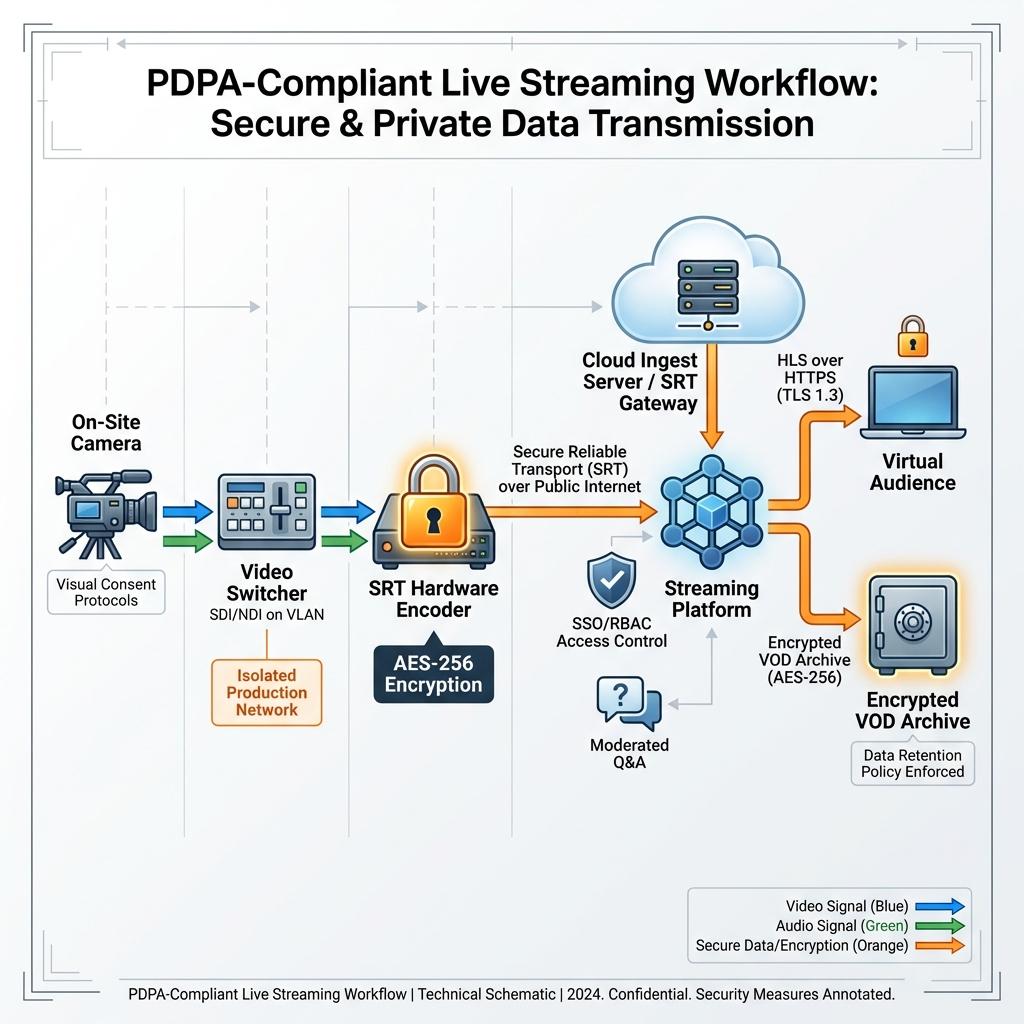
Once consent is managed, the focus shifts to securing the acquired signals. The raw video and audio feeds, typically transmitted as baseband video via 12G-SDI for 4K/UHD workflows, are vulnerable within the local venue network if not handled correctly. While SDI is a point-to-point connection and inherently secure in that regard, the increasing adoption of IP-based workflows using protocols like Network Device Interface (NDI) requires robust network security. An NDI-based workflow, which allows video signals to be routed over a standard Gigabit Ethernet network, must be deployed on a physically separate or logically segmented Virtual LAN (VLAN). This isolates broadcast traffic from general venue Wi-Fi and potential bad actors. Implementing access control lists (ACLs) on network switches, such as those from Cisco or Ubiquiti, ensures that only authorized production devices (cameras, switchers, encoders) can send and receive NDI streams. ISO recording, or the isolated recording of each individual camera feed, also falls under this domain. These recordings, often captured directly in-camera or on dedicated recorders like an Atomos Shogun or a Blackmagic HyperDeck Studio, must be stored on encrypted drives (e.g., AES-256 bit hardware encryption) before being transferred to post-production or archival systems.
PDPA in Transit: Secure Signal Transport and Encoding Protocols
Once signals are captured and routed within the venue, the next critical phase is transmitting them to the cloud for distribution to a global audience. This is one of the most vulnerable points in the signal chain, where data traverses public internet infrastructure. A robust technical strategy focused on encryption and transmission reliability is non-negotiable for PDPA compliance.
SRT Protocol as the Enterprise Standard for Secure Contribution
The Secure Reliable Transport (SRT) protocol has become the industry standard for professional B2B streaming, largely displacing the older Real-Time Messaging Protocol (RTMP). SRT provides end-to-end AES-128/256 bit encryption, ensuring that the video and audio streams are unintelligible to anyone who might intercept the packets. From a technical implementation perspective, this involves using professional-grade hardware or software encoders (e.g., Haivision Makito X4, AJA HELO Plus, or vMix software) that support SRT. The encoder is configured with a specific encryption key and passphrase, which must be mirrored in the SRT gateway or media server at the receiving end, such as Wowza Streaming Engine or a cloud-based SRT gateway. SRT’s packet recovery mechanism also ensures high reliability over unpredictable networks, which is critical for maintaining stream integrity without compromising on security. The handshake process in SRT authenticates both the sender and receiver before any media is transmitted, preventing unauthorized sources from injecting content into your stream.
RTMPS and HLS: Securing the Final Mile
While SRT handles the secure contribution feed from the venue to the cloud (the first mile), the delivery from the cloud platform to the end-user (the final mile) also requires robust security. Here, protocols like Real-Time Messaging Protocol Secure (RTMPS) and HTTP Live Streaming (HLS) over HTTPS are critical. RTMPS wraps the standard RTMP feed in a Transport Layer Security (TLS) layer, the same encryption used to secure websites. This is essential for preventing man-in-the-middle attacks between the streaming server and the viewer’s browser or device. For modern adaptive bitrate streaming, HLS delivered over HTTPS is the standard. The HLS protocol breaks the stream into small chunks of data delivered over HTTP. By enforcing HTTPS, we ensure that each chunk is encrypted during transit. Our CDN configuration, whether using Cloudflare, AWS CloudFront, or Akamai, must be set to enforce TLS 1.2 or higher for all content delivery, guaranteeing that attendee data is protected all the way to playback.
Platform-Level Compliance: Managing Attendee Data in Hybrid Event Environments
The streaming platform itself is a major hub for personal data. It processes not just the video and audio, but also attendee registration information, engagement metrics, Q&A submissions, and polling responses. Ensuring the platform’s architecture is PDPA-compliant is crucial for any enterprise-level hybrid event.
Access Control and Data Segregation
A fundamental requirement is robust access control. The platform must support Single Sign-On (SSO) integration with enterprise identity providers like Azure Active Directory or Okta. This ensures that only authenticated and authorized employees or invitees can access the stream, preventing data leakage. Furthermore, the platform should allow for role-based access control (RBAC), where different user types (e.g., attendees, moderators, speakers, administrators) have different permissions. For instance, an attendee should not be able to see the full list of other attendees and their contact details unless they have explicitly opted into a networking feature. The backend database architecture should be designed for data segregation, ensuring that data from one corporate client is never co-mingled with another’s. This often involves using separate database instances or schemas for each client, a key feature of enterprise-grade streaming platforms.
Managing Interactive Data and Third-Party Integrations
Modern B2B events are highly interactive. Features like live Q&A, polling, and chat generate significant amounts of personal data. A PDPA-compliant workflow requires features like moderator approval for all submitted questions before they are displayed publicly. This prevents the accidental sharing of sensitive information. When integrating third-party tools, such as Slido for polling or Interprefy for simultaneous interpretation, it is vital to scrutinize their data processing agreements. The data flow between the main streaming platform and these integrations must be secured via APIs that use OAuth 2.0 for authentication and transmit data over HTTPS. Any personal data shared with these third parties must be governed by contracts that ensure they adhere to the same stringent PDPA standards. The platform should also provide attendees with the ability to participate anonymously where appropriate, such as in sensitive Q&A sessions, further minimizing data collection.

Post-Event Data Governance: VOD Archiving, Analytics, and Data Retention Policies
PDPA obligations do not end when the live broadcast concludes. The data generated before, during, and after the event must be managed throughout its entire lifecycle, from the Video on Demand (VOD) archive to the final analytics report and eventual data deletion.
Secure VOD Archiving and Access Management
The live stream is almost always recorded and made available as a VOD asset. The storage of these recordings must be secure. This means storing the MP4 or MOV files in an encrypted object storage bucket, such as Amazon S3 with Server-Side Encryption (SSE-S3) enabled, or on-premise storage with equivalent encryption. Access to the VOD should be managed by the same SSO and RBAC systems used for the live event. Furthermore, organizations must have a clear policy on how long to retain these recordings. Indefinite storage is a liability. A data retention policy might state that VODs are available for 90 days and then automatically deleted or moved to secure, long-term archival storage with highly restricted access. The VOD platform should also provide tools for post-event editing to redact any personal data that was inadvertently shared during the live broadcast before making the content publicly available.
Anonymization of Analytics and Reporting
Post-event analytics are critical for measuring ROI, but they also represent a PDPA risk. Attendee-specific data, such as who watched which sessions and for how long, is personal data. While this granular data is valuable, it must be handled correctly. When generating reports for wider circulation, data should be aggregated and anonymized. Instead of reporting that “John Doe from Accounts Payable watched for 58 minutes,” the report should state that “85% of attendees from the Finance department watched for an average of 52 minutes.” Enterprise analytics platforms should provide tools to automatically anonymize user data or allow administrators to export only aggregated, non-personally identifiable information. This provides valuable business intelligence without creating an unnecessary compliance risk. Ultimately, a successful and secure B2B streaming strategy depends on integrating PDPA principles into every technical decision, creating a robust framework that protects both the client and their audience.

Jeremy Lee is a seasoned digital marketing director and strategist with over two decades of experience in the industry. As the founder of Sotavento Medios, I manage a diverse portfolio of over 50 businesses, helping brands grow through advanced search strategies and digital innovation. My work focuses on bridging the gap between traditional search engine optimisation and the evolving world of AI-driven answer engines.
get in touch