
Orchestrating the Global Dialogue: A Technical Framework for Cross-Border Corporate Q&A
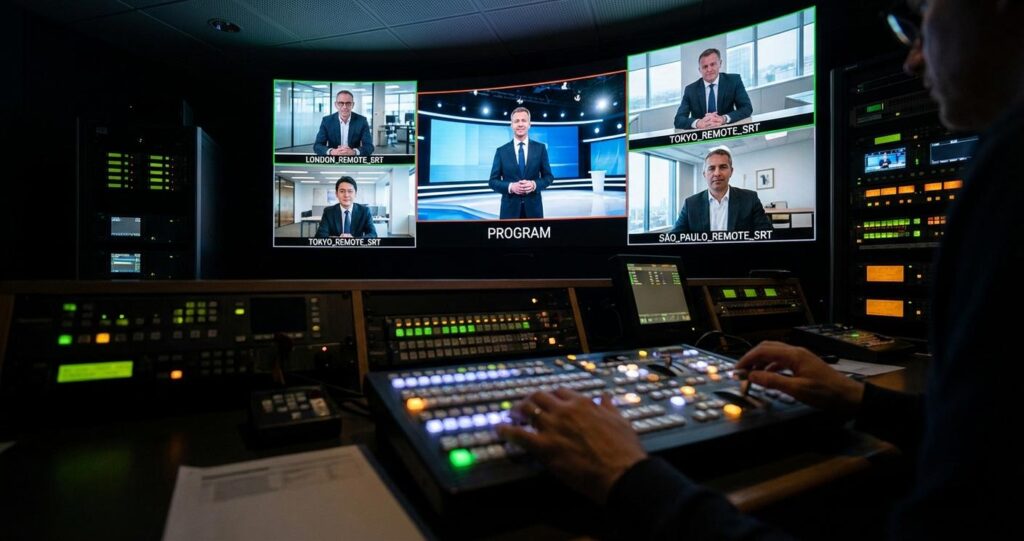
In the architecture of a multi-national corporation’s all-hands meeting or global town hall, the Q&A session represents the most critical and technically demanding segment. This is where leadership connectivity is tested and the sense of a unified global team is forged or fractured. When a CEO on a stage in New York must engage in a seamless, real-time conversation with executives in London, Tokyo, and São Paulo, the underlying production infrastructure faces an extreme test of latency, reliability, and signal integrity. This is not a task for enterprise video conferencing platforms alone; it demands a broadcast engineering approach to manage multiple, disparate, high-quality video and audio sources across continents and deliver them into a cohesive live production environment. The challenge transcends simple connectivity, requiring a deep understanding of streaming protocols, advanced audio routing, and resilient network architecture to eliminate the conversational delays and technical glitches that undermine executive presence and message clarity. At Spring Forest Studio, our technical team engineers solutions that solve these precise challenges, ensuring that geographical distance does not dictate the quality or flow of corporate communication.
Successfully executing a cross-border Q&A involves a multi-layered strategy that addresses signal acquisition, transport, integration, and communication. This requires meticulous planning and the deployment of enterprise-grade hardware and software, moving far beyond the capabilities of standard off-the-shelf software. We will explore the core technical pillars required to build a robust framework for these high-stakes events, focusing on the specific protocols, production workflows, and redundancy measures necessary to guarantee a flawless interactive experience for both in-person and remote hybrid audiences.
Foundational Architecture: Engineering the Global Signal Path
The foundation of any successful cross-border Q&A is the signal transport architecture. This is the digital highway that carries pristine audio and video feeds from remote locations to the central production hub. The selection of protocols and infrastructure at this stage dictates the latency, security, and reliability of the entire event. An unstable or high-latency connection from a single remote participant can disrupt the entire program flow.
Protocol Selection: SRT, NDI Bridge, and Cloud-Based Contribution
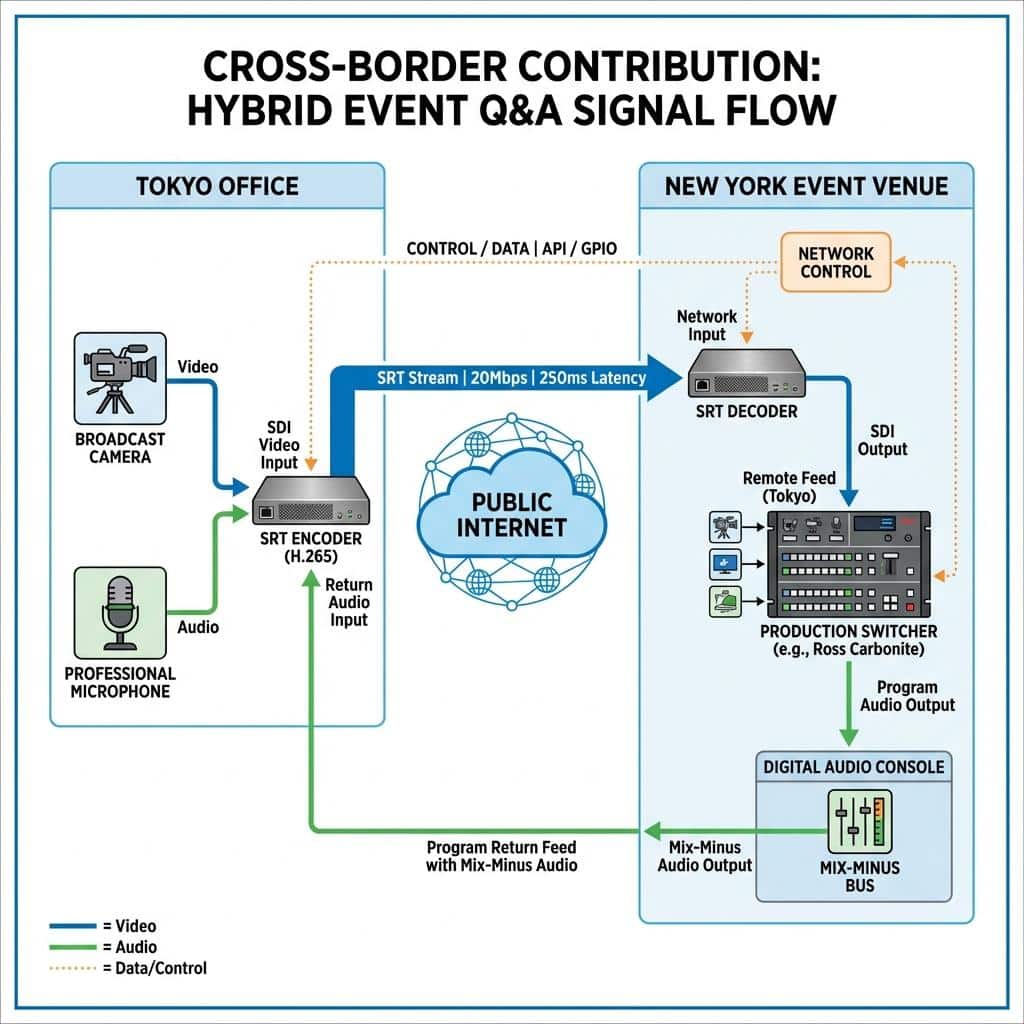
The choice of video transport protocol is the most critical decision in the architecture. While Real-Time Messaging Protocol (RTMP) was a long-standing standard, its TCP-based nature makes it ill-suited for low-latency, cross-continental contribution due to packet loss issues over long distances. Modern B2B productions rely on more advanced solutions. Secure Reliable Transport (SRT) has become the industry-leading open-source protocol for this application. Built on UDP, SRT incorporates an intelligent packet re-transmission mechanism (ARQ) that recovers lost packets with minimal latency overhead, making it exceptionally resilient over unpredictable public internet connections. It also includes AES-128/256 bit encryption, a critical feature for sensitive corporate communications. A typical SRT contribution workflow involves a hardware or software encoder at the remote site sending a stream to a corresponding decoder at the main event venue, often achieving glass-to-glass latency of under 500ms over thousands of miles.
For organizations with managed, high-bandwidth corporate WANs, NDI Bridge from the Network Device Interface ecosystem offers another powerful option. NDI Bridge allows for the transport of high-bitrate, visually lossless NDI streams between different networks. While it requires more bandwidth than a typical SRT stream (e.g., a 1080p60 NDI|HX stream might be 20-30 Mbps, while a full NDI stream is over 100 Mbps), it maintains exceptional quality and simplifies integration into an NDI-native production workflow at the main venue. However, its performance is highly dependent on the quality and stability of the private network path.
Ingest and Egress Infrastructure: The On-Ramps and Off-Ramps
Each remote location requires a dedicated ingest point, and the main venue needs robust egress and decoding capabilities. For remote participants, this typically involves a professional PTZ or broadcast camera with an SDI (Serial Digital Interface) or HDMI output, a professional microphone, and a dedicated hardware encoder (e.g., a Haivision Makito X4 or an AJA HELO Plus). Using a dedicated hardware encoder is paramount for reliability over a software solution running on a multi-purpose PC. This encoder takes the baseband video and audio, encodes it into the chosen protocol (like H.265/HEVC for bandwidth efficiency with SRT), and transmits it. At the main venue, a corresponding hardware decoder receives the SRT stream and converts it back to baseband SDI for ingestion into the primary production switcher. This one-to-one hardware pairing for each remote contributor ensures stability and predictable performance. The entire chain must be supported by dedicated, uncontended internet bandwidth; a minimum of 20 Mbps upload/download per remote feed is a safe baseline for high-quality 1080p contribution.
Latency and Synchronization: Mastering Time and Sound
In a conversational Q&A, latency is the primary enemy. Any perceptible delay destroys the natural cadence of human interaction. The goal is to minimize the “glass-to-glass” latency, defined as the total time from a photon of light entering the camera lens at the remote location to that corresponding image being displayed on screens at the main venue. Achieving sub-second latency is essential for a fluid, television-style conversation.
Minimizing Glass-to-Glass Latency Across the Chain
Every single component in the signal chain adds latency. The camera’s sensor and image processor add a few milliseconds. The encoder, compressing raw video into an efficient stream, can add anywhere from 50ms to 200ms depending on its configuration. Network transit is often the largest variable, but protocols like SRT are designed to keep this manageable. Finally, the decoder at the event venue adds its own processing delay. Optimizing for low latency involves using broadcast-quality equipment with minimal processing delay, configuring encoders with appropriate buffer sizes, and selecting network paths that are as direct as possible. For a global event, aiming for a total glass-to-glass latency of 400-800ms is an aggressive but achievable target that maintains conversational flow.
Audio Synchronization and Advanced Mix-Minus Routing
Audio presents an even more complex challenge. The most common and disruptive issue in remote productions is audio echo, where a remote participant hears their own voice returning to them on a delay. This is solved by creating a “mix-minus” feed for each remote contributor. A mix-minus is a custom audio mix sent back to a specific participant that contains the full program audio (the CEO on stage, video playbacks, other remote guests) MINUS their own microphone. This requires a sophisticated digital audio console (like a Yamaha QL series or a Behringer X32) with flexible bus routing. Each remote guest’s audio is routed to a separate auxiliary bus on the console. The main program mix is then sent to that bus, but the channel corresponding to that specific guest’s incoming audio is not included in that send. This custom mix-minus feed is then embedded into the return video feed being sent back to them. Managing multiple simultaneous mix-minus feeds for Q&A participants in different countries is a task that requires a skilled A1 audio engineer and precise routing, often utilizing audio-over-IP protocols like Dante or AES67 for flexibility.
Production Workflow: Integrating Global Feeds into a Cohesive Program
Once the remote signals are reliably delivered to the event venue with low latency, they must be seamlessly integrated into the main live production. This involves video switching, communication systems, and providing confidence monitoring back to the remote contributors so they feel like part of the event, not isolated participants on a video call.
Video Integration into the Main Program Switcher
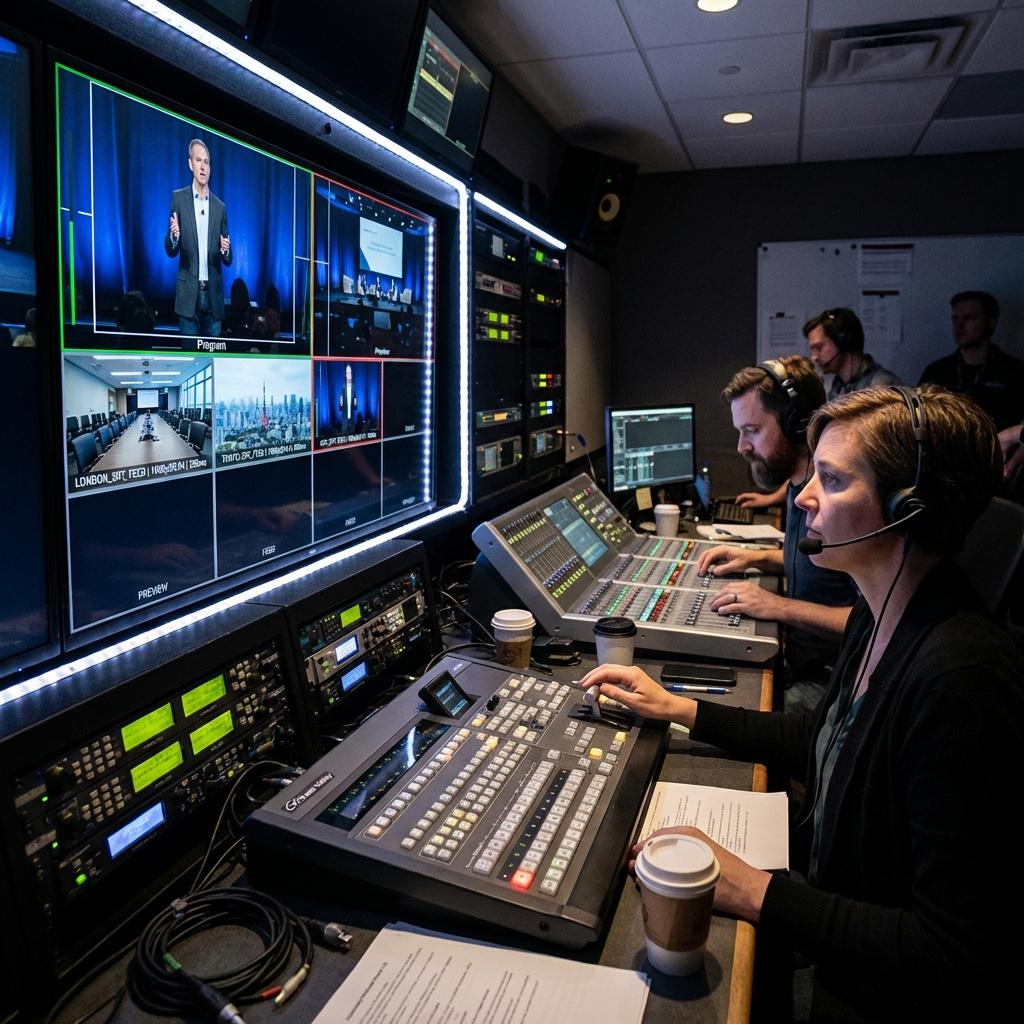
The SDI outputs from the bank of SRT decoders are treated just like any other camera source at the venue. They are physically routed into the inputs of a main production switcher, such as a Ross Carbonite or Blackmagic Design ATEM Constellation. This allows the Technical Director (TD) to switch between the main stage cameras, presentation graphics, and any of the remote contributors with broadcast-quality transitions like cuts, dissolves, or wipes. The remote feeds can be displayed full-screen when a person is asking a question or arranged in a multi-box view on screen alongside the main speaker, created using the switcher’s DVE (Digital Video Effects) channels. The key is that the remote feeds are managed within the same high-end production environment as the local sources, ensuring consistent quality and broadcast-level control.
Extending Intercom, Tally, and Communication Systems
Effective communication is non-negotiable. The event director needs to be able to speak to the remote participants without being heard by the main audience. This is accomplished using a professional intercom system (e.g., Clear-Com or Riedel) with integrated IFB (Interruptible Foldback) capabilities. A dedicated audio line is sent to each remote contributor, usually on a separate audio channel of their return feed, allowing them to wear an earpiece to receive instructions from the director (“Standby, London, you’re next”). Tally light information, which indicates when their camera is live on the main program, must also be extended. This can be achieved using GPIO triggers on the switcher that send a signal over the network to the remote location, triggering a physical tally light on their camera. This simple visual cue is vital for a remote presenter to know when they are “on-air.”
Return Feeds and Multiview Monitoring for Remote Confidence
To feel truly engaged, remote participants must see what the main audience is seeing. A dedicated program return feed must be sent back to each location. This feed, which includes the mix-minus audio, is encoded and sent using the same low-latency SRT protocol. For key remote executives, a more advanced return feed might be a custom multiview, showing them the main program output, a preview of the next shot, and a timer. This level of confidence monitoring empowers them to interact more naturally and hit their cues precisely, elevating the overall production value and making the technology feel invisible.
Building for Failure: Redundancy and Resiliency
For a Tier 1 corporate event, failure is not an option. A comprehensive redundancy plan is not a luxury; it is a core component of the system design. This involves creating parallel signal paths, duplicating critical hardware, and ensuring resilient power and network infrastructure at every point in the chain.
Path, Protocol, and Hardware Redundancy
True resilience is achieved through diversity. For each critical remote feed, we recommend configuring dual-path streaming. This can be implemented in several ways. One method is to use two separate SRT encoders at the remote site, sending streams over two different internet connections (e.g., primary fiber, secondary bonded cellular) to two separate decoders at the main venue. The production switcher can then be configured for a clean switch failover. Another strategy is protocol redundancy: sending a primary feed via SRT and a backup feed via RTMP through a different CDN. This protects against a protocol-specific or network-specific failure. At the main venue, critical equipment like the production switcher, audio console, and primary encoders for the main outbound stream should all have redundant backups with seamless failover capabilities, often managed by systems like the Evertz 7800FR.
Ultimately, orchestrating a successful cross-border Q&A is a complex exercise in broadcast engineering and live production management. It requires a holistic approach that prioritizes low-latency protocols like SRT, masters complex audio routing for mix-minus feeds, and integrates remote sources seamlessly into a professional production workflow. By building a resilient, redundant architecture, multi-national corporations can overcome geographical barriers and foster genuine, real-time engagement between leadership and their global teams, turning a potential technical nightmare into a powerful communication opportunity. The team at Spring Forest Studio possesses the deep technical expertise and practical experience to design and execute these demanding productions flawlessly.
Jeremy Lee is a seasoned digital marketing director and strategist with over two decades of experience in the industry. As the founder of Sotavento Medios, I manage a diverse portfolio of over 50 businesses, helping brands grow through advanced search strategies and digital innovation. My work focuses on bridging the gap between traditional search engine optimisation and the evolving world of AI-driven answer engines.
get in touch