

Optimising Video Bitrates for Enterprise Streaming Across Geographically Diverse Audiences
In the context of professional B2B event streaming, delivering a flawless high-resolution video feed to the executive boardroom is a solved problem. The true challenge for enterprise communication, hybrid events, and global all-hands meetings is maintaining that same quality of experience for thousands of viewers spread across disparate geographic regions, each with unique network infrastructure and last-mile connectivity challenges. The success of a high-stakes corporate broadcast hinges not just on the quality of the signal leaving the production switcher, but on a meticulously engineered delivery workflow that can gracefully adapt to unpredictable viewer conditions. This requires a deep understanding of video encoding, transport protocols, and distribution architecture. For IT directors and production managers, building a robust bitrate optimization strategy is fundamental to guaranteeing message integrity and viewer engagement, regardless of whether the audience is in a fiber-connected corporate campus or a remote office with limited bandwidth.
At Spring Forest Studio, our technical teams design and implement these complex systems weekly. The core principle is moving beyond a single, high-bitrate stream and architecting a multi-layered approach. This involves creating an adaptive bitrate (ABR) ladder, selecting the correct contribution protocol for first-mile transport, and leveraging a distributed delivery infrastructure. This ensures every participant, from the CEO in headquarters to a sales manager in a developing market, receives the most stable, highest-quality stream their connection can sustain without buffering or interruption. This document outlines the technical methodologies and infrastructure considerations required to achieve this level of delivery excellence for mission-critical corporate events.
Foundational Concepts: Encoding, Bitrates, and Perceptual Quality
The foundation of any successful streaming strategy is the video encoding process. This is where the uncompressed video signal from the production switcher, typically transported over Serial Digital Interface (SDI) or Network Device Interface (NDI), is compressed into a format suitable for internet delivery. The choices made at this stage directly impact both video quality and the bandwidth required for delivery.
Codec Selection: H.264 vs. H.265 (HEVC) for Enterprise Delivery
The codec is the algorithm used to compress and decompress video. For years, H.264 (Advanced Video Coding, or AVC) has been the industry standard due to its wide compatibility with virtually every browser and device. It offers a reliable balance of quality and file size. However, for delivering high-resolution content like 4K/UHD or even high-framerate 1080p60 feeds, H.265 (High Efficiency Video Coding, or HEVC) presents a significant advantage. H.265 can deliver comparable video quality to H.264 at approximately half the bitrate. This efficiency is critical when targeting viewers with limited bandwidth. For example, a high-quality 1080p30 stream that might require 6 Mbps in H.264 could be delivered with similar perceptual quality at just 3 Mbps using H.265. The primary trade-off is processing overhead; H.265 requires more powerful hardware for real-time encoding and is not yet as universally supported on older devices without software decoding, which can impact CPU usage on the viewer’s end. For enterprise events where the viewer platform can be controlled or is known (e.g., a specific corporate web player), leveraging H.265 can be a strategic advantage.
Constant Bitrate (CBR) vs. Variable Bitrate (VBR): Production vs. Delivery
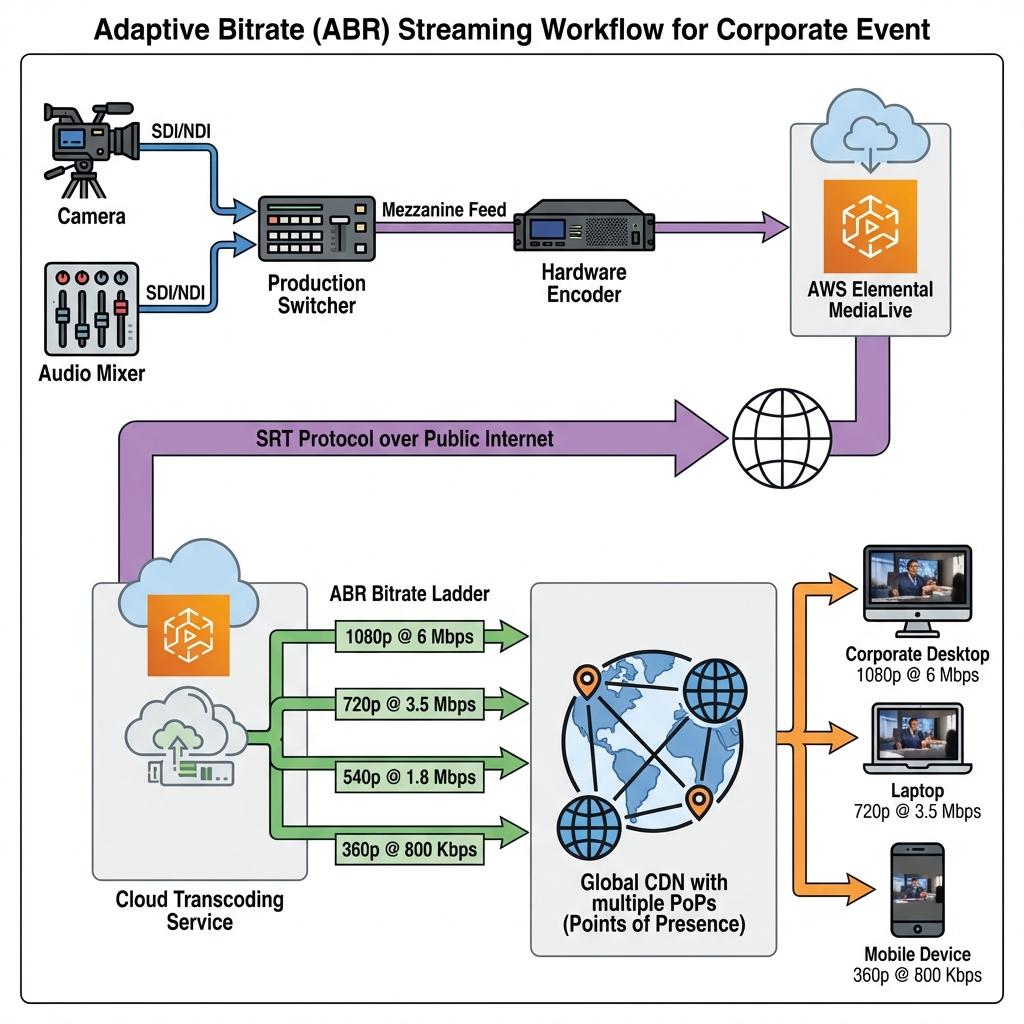
Bitrate, measured in megabits per second (Mbps), dictates the amount of data used to represent one second of video. The method of applying this bitrate is critical. Constant Bitrate (CBR) maintains a steady data rate, regardless of scene complexity. This is highly desirable for the initial contribution feed from the event venue to the cloud ingest point, as it provides a predictable traffic flow over network connections. Variable Bitrate (VBR), conversely, allocates more data to complex scenes with high motion and less to static scenes, like a speaker at a podium. While less predictable for network planning, VBR is far more efficient for the final delivery to viewers, as it optimizes for perceptual quality without wasting data on simple frames. A typical professional workflow involves sending a high-quality, CBR mezzanine feed via a protocol like Secure Reliable Transport (SRT) to a cloud transcoding service, which then generates the final VBR-encoded ABR ladder for public distribution.
The Bitrate Ladder: Engineering for Adaptive Playback
The core solution to varied connectivity is Adaptive Bitrate (ABR) streaming. This technology involves encoding the source video into multiple, simultaneous streams, each at a different resolution and bitrate. This set of streams is called a bitrate ladder. The video player on the viewer’s device intelligently detects their current network conditions and seamlessly switches between these streams to deliver the best possible quality without interruption. Engineering an effective bitrate ladder is a science. It must provide perceptibly distinct quality levels and avoid creating steps that are too large, which can cause jarring shifts in quality. A standard ladder for a 1080p corporate event might look like this:
- 1920×1080, 6000 Kbps (For high-speed fiber connections)
- 1280×720, 3500 Kbps (For standard broadband)
- 960×540, 1800 Kbps (For stable mobile or lower-tier broadband)
- 640×360, 800 Kbps (For poor connectivity and mobile networks)
Each rung of this ladder is packaged into small chunks of video (typically 2-6 seconds in length). The player requests these chunks sequentially, and if it detects that download speeds are falling, it will request the next chunk from a lower-bitrate stream. This adaptability is the key to serving a global audience effectively.
Architecting the Contribution and Distribution Workflow
Delivering a reliable ABR stream requires a robust architecture that covers the entire signal chain, from the camera lens to the viewer’s screen. This workflow is typically segmented into two main parts: first-mile contribution (from venue to cloud) and last-mile distribution (from cloud to viewer).
First-Mile Contribution: SRT vs. RTMP for Reliability
For decades, Real-Time Messaging Protocol (RTMP) was the standard for sending video from an encoder to a media server. However, RTMP is based on TCP (Transmission Control Protocol) and can perform poorly over unstable networks, leading to dropped frames and connection loss. A superior modern alternative is Secure Reliable Transport (SRT), an open-source protocol specifically designed for high-performance video transport over unpredictable networks like the public internet. SRT uses an intelligent packet retransmission mechanism based on ARQ (Automatic Repeat reQuest) to recover lost data before it impacts the video, adding configurable latency to ensure smoothness. It can recover from packet loss of up to 10% or more, making it the definitive choice for sending the primary high-bitrate mezzanine feed from the production site to the cloud transcoder. This ensures the source for the ABR ladder is as clean and stable as possible, regardless of local internet congestion.
On-Premise vs. Cloud Transcoding Architectures
Once the high-quality contribution feed arrives from the venue, it must be transcoded into the ABR ladder. This can be done using on-premise hardware or cloud-based services. On-premise solutions, using dedicated hardware encoders from manufacturers like Haivision or AWS Elemental, offer maximum control and minimal latency within a controlled corporate network. They are ideal for secure facilities or events where the entire workflow is managed internally. Cloud transcoding, using services like AWS Elemental MediaLive or Microsoft Azure Media Services, offers immense scalability and geographic flexibility. A production team in London can send an SRT feed to a cloud transcoder in a US data center to be closer to a North American audience. This reduces the distance the final ABR streams must travel, improving performance. For large-scale global events, a cloud-based architecture is almost always the superior choice due to its ability to scale on demand and its integration with global Content Delivery Networks.
The Role of the Content Delivery Network (CDN)
After transcoding, the ABR streams are not served directly from the transcoder. Instead, they are pushed to a Content Delivery Network (CDN). A CDN is a globally distributed network of proxy servers, or Points of Presence (PoPs), that cache the video chunks closer to the end-users. When a viewer in Singapore requests the video, they receive it from a PoP in Singapore, not from the origin server in North America. This drastically reduces latency and improves throughput. For enterprise streaming, selecting a CDN with a robust global footprint and strong performance in the specific regions of your audience is a critical business decision. The CDN is the final link in the chain and is directly responsible for the viewer’s quality of experience.
Advanced Optimisation and Redundancy Strategies
For mission-critical B2B events, standard ABR streaming is the baseline. True professional-grade delivery requires further optimization and rigorous failover planning to mitigate all potential points of failure and maximize perceptual quality for every viewer.
Dynamic Encoding and Content-Aware Optimisation
A static bitrate ladder is efficient, but it is not optimal. It uses the same bitrate allocation for a talking-head scene as it does for a high-motion product demonstration video. Content-aware or AI-driven encoding analyzes the video source frame-by-frame and intelligently reallocates bits within the ABR ladder. For a static scene, it might reduce the bitrate of the 1080p rendition from 6 Mbps to 4.5 Mbps with no perceivable loss in quality, freeing up capacity. For a complex scene, it ensures the bitrate is sufficient to avoid compression artifacts. This dynamic approach results in a more consistent quality of experience for viewers and can lead to significant bandwidth savings, especially for long-form events.
Latency Considerations: Chunked CMAF and Low-Latency HLS
Standard ABR streaming protocols like HLS (HTTP Live Streaming) can introduce significant latency, often 30 seconds or more from the live action. For interactive hybrid events with Q&A or audience polling, this delay is unacceptable. Newer standards aim to solve this. Using MPEG-DASH or the latest iterations of HLS with the Common Media Application Format (CMAF) allows for much smaller video chunks, sometimes less than one second. This technique, known as chunked transfer encoding, allows the player to begin playback of a segment before it has been fully downloaded, dramatically reducing glass-to-glass latency to just a few seconds. Implementing a low-latency workflow adds complexity to the encoding and distribution pipeline but is essential for events requiring real-time interaction between the presenters and the virtual audience.
Failover and Redundancy Planning
In a professional broadcast environment, there is no single point of failure. This philosophy must extend to the streaming workflow. At a minimum, this includes:
- Encoder Redundancy: A primary and a backup hardware encoder, each receiving the same program feed from the video switcher.
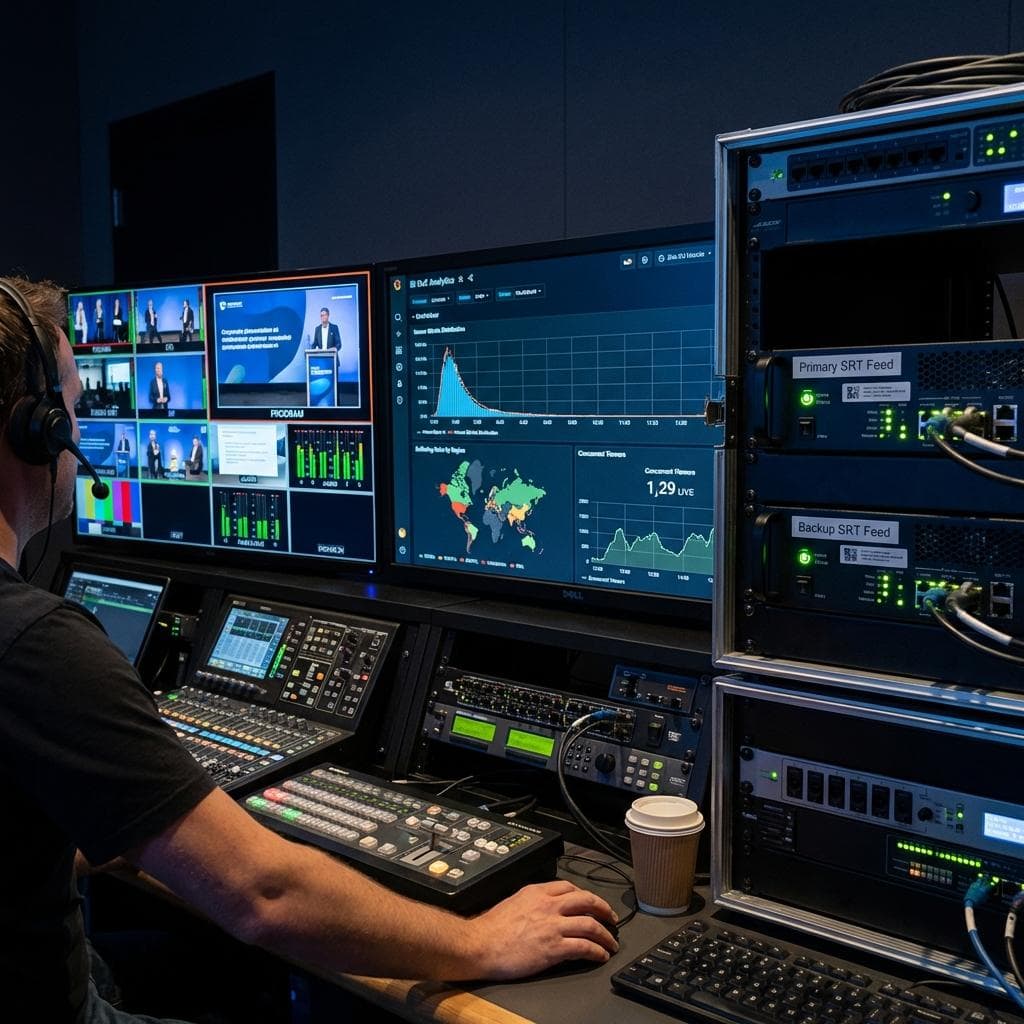
- Network Redundancy: Diverse network paths for the contribution feed. This often means a primary dedicated fiber line and a secondary bonded cellular connection or separate ISP. The two SRT streams are sent simultaneously to the cloud ingest.
- Cloud Ingest Redundancy: The cloud transcoding workflow should be configured to automatically failover to the secondary SRT feed if the primary signal is lost. This failover can be seamless, with the viewer experiencing no interruption.
- Multi-CDN Strategy: For the highest level of availability, some enterprise events may use two or more CDNs. DNS-based load balancing or manual failover can redirect viewers to a secondary CDN if the primary experiences a regional outage.
This multi-layered redundancy ensures that a single component failure, whether it’s a piece of hardware, a network link, or a service provider, does not jeopardize the entire broadcast.
Implementation and Monitoring for Enterprise Teams
Deploying this technology successfully requires collaboration between AV, production, and IT departments. It is not a set-and-forget process; it requires proactive planning and real-time monitoring to ensure performance meets executive expectations.
Pre-Event Network Assessment and Viewer Analytics
Before any major event, it is crucial to understand the audience’s potential connectivity landscape. If a large contingent of viewers is expected from a region known for poor internet infrastructure, the ABR ladder must be engineered with lower-bitrate rungs to accommodate them. During the event, real-time Quality of Experience (QoE) analytics are invaluable. These dashboards provide a live view of key metrics like buffering ratios, startup times, and the distribution of viewers across the different bitrates in the ladder. If analytics show a large number of viewers are stuck on the lowest-quality stream in a certain region, this could indicate a CDN performance issue that needs immediate investigation.
Integrating with Enterprise Platforms
These advanced workflows are not separate from the tools businesses use every day. The highly resilient, adaptive stream can be the source for platforms like Microsoft Teams Live Events, Zoom Events, or it can be embedded directly into a custom-branded corporate web portal. The key is to use the professional streaming workflow to produce a stable, high-quality source that is then ingested by these platforms. Rather than relying on a simple webcam feed sent directly into Teams, the production sends a broadcast-quality SRT feed to a media server, which then provides a reliable input for the enterprise platform, elevating the production value and reliability immensely.
Actionable Recommendations for Production Managers
For those managing corporate event production, a successful global streaming strategy can be summarized in a few key technical directives. First, mandate the use of SRT for all first-mile contribution over the public internet. Second, work with your streaming provider to engineer a custom ABR ladder based on your specific audience and content. Third, ensure your delivery plan leverages a CDN with a strong global presence. Fourth, build redundancy into every critical step of the signal chain, from encoders to network paths. Finally, insist on access to real-time QoE analytics to monitor stream health and prove success post-event. By focusing on these core pillars, you can de-risk the delivery component of your hybrid and virtual events.

Jeremy Lee is a seasoned digital marketing director and strategist with over two decades of experience in the industry. As the founder of Sotavento Medios, I manage a diverse portfolio of over 50 businesses, helping brands grow through advanced search strategies and digital innovation. My work focuses on bridging the gap between traditional search engine optimisation and the evolving world of AI-driven answer engines.
get in touch